How AI Powers Real-Time Patent Alerts
Intellectual Property Management
Sep 5, 2025
Explore how AI transforms patent monitoring into an automated, real-time process, providing instant updates and actionable insights for businesses.

AI has revolutionized patent monitoring, turning it into an automated, real-time process that delivers instant updates on global patent filings, publications, and legal statuses. This eliminates the need for manual searches and ensures businesses stay informed about critical developments in their industry. Here's how:
AI Technologies Used: Machine learning identifies patterns, natural language processing (NLP) extracts key details, and semantic search connects related concepts, even when wording differs.
How Alerts Work: AI scans global databases, scores relevance based on user profiles, and delivers tailored alerts via email, dashboards, or APIs.
Customizable Monitoring: Users can define specific profiles to track technologies, competitors, or inventors, with filters for regions, timeframes, and classifications.
Key Benefits: Saves time and costs, ensures accuracy, and provides actionable insights for better decision-making.
Platforms like Patently combine these technologies with tools for drafting, collaboration, and project management, making patent monitoring more efficient and precise. AI is not just automating tasks - it’s reshaping how intellectual property is managed.
How AI Creates Real-Time Patent Alerts
AI Technologies Behind Patent Alerts
Real-time patent alerts rely on three main AI technologies working together seamlessly. First, machine learning algorithms dive into massive patent databases, learning from technical patterns and continuously improving their ability to spot connections that might escape human reviewers.
Next, natural language processing (NLP) steps in to interpret patent documents. It pulls out key details like technical terms, inventor names, affiliations, and legal statuses. NLP is especially useful for recognizing context - like differentiating between "neural networks" in medical devices and those used in autonomous vehicles.
Finally, semantic search technology takes things a step further. It identifies related concepts even when the terminology differs. For instance, a patent about "wireless communication protocols" could trigger alerts for someone monitoring "radio frequency transmission methods." This is because the AI understands that the two are conceptually linked. Together, these technologies form the backbone of the real-time alert system.
How AI-Powered Alerts Work
Using these advanced tools, AI systems generate precise alerts through a streamlined, four-step process:
Data collection and intelligent filtering: The system scans patent offices worldwide, tracking new filings and publications. Instead of relying solely on keyword matches, it evaluates technical specs, patent claims, and even inventor backgrounds to ensure relevance to user-defined profiles.
Relevance scoring: Each potential match gets a score based on multiple factors. For example, patents from direct competitors or those closely aligned with your technology focus get higher scores. The system also considers patent family connections, citation patterns, and even the involvement of specific law firms.
Alert delivery: Alerts are sent through your preferred channels - whether that's email, dashboard updates, or API integrations. Each alert includes a detailed explanation, showing exactly why the AI flagged it for your attention.
Setting Up Custom Alerts
To make the system work for your specific needs, customization is key. You start by tailoring your profile customization. Instead of broad terms like "artificial intelligence", you can narrow it down to something more specific, like "machine learning algorithms for image recognition in autonomous vehicles." This ensures the system aligns with both your technical focus and business goals.
Competitor tracking is another powerful feature. You can monitor specific companies, research groups, or even individual inventors. The AI learns from their past filing patterns, identifying trends like continuation applications or related publications.
Finally, smart filtering parameters help you cut through the noise. You can set preferences for regions, timeframes, and technical areas of interest. As you interact with the alerts - marking some as relevant or dismissing others - the system adjusts, fine-tuning its algorithms to better match your priorities over time.
Saving Time, Money, & Your Reputation Using PAIR Status Change Alerts
Benefits of AI-Driven Real-Time Patent Monitoring
AI isn't just a technical marvel - it delivers real, practical advantages for patent monitoring.
Time and Cost Savings
Traditional patent monitoring often involves tedious manual reviews, which can quickly rack up costs and require large teams to oversee developments across various technology sectors. It’s a labor-intensive process that leaves little room for efficiency.
AI-powered systems change the game by automating searches and analyses. Instead of sifting through mountains of data, professionals receive pre-sorted, relevant alerts directly in their inbox or dashboard. This automation allows teams to focus on strategic priorities rather than repetitive tasks. For businesses, early identification of critical patents helps avoid costly legal disputes and licensing headaches. Law firms also benefit, as they can redirect billable hours toward high-value strategic analysis instead of routine monitoring.
Improved Accuracy and Faster Detection
Manual reviews can be prone to errors - fatigue and human limitations naturally lead to oversight. AI systems, on the other hand, handle vast amounts of data with consistent precision, never tiring or losing focus.
This reliability is especially crucial in fast-moving tech industries. AI tools can identify potentially conflicting or significant patents far more quickly than traditional methods, giving companies the lead time they need to adapt their strategies. This speed and accuracy help businesses make smarter decisions and stay ahead of potential conflicts.
Smarter Decision-Making
AI-powered patent monitoring doesn’t just alert users to new filings; it transforms raw patent data into meaningful insights. These systems analyze trends, map competitor strategies, and uncover emerging opportunities in the market.
For example, AI can identify gaps in a company’s patent portfolio compared to external filings, offering a clearer picture of where to focus future applications. It also highlights licensing opportunities and strengthens decision-making around IP strategy. In cases involving intellectual property enforcement, AI-generated reports can bolster infringement claims, support licensing negotiations, or prepare for litigation.
Moreover, these insights enhance both defensive and offensive patent strategies. By quickly analyzing the patent landscape, businesses can better assess risks and potential rewards. AI can even pinpoint opportunities to optimize licensing revenue, such as identifying instances where patented technologies are being used without proper agreements. This level of intelligence helps organizations maximize the value of their patents while minimizing risks.
Key Features of AI-Powered Patent Monitoring Tools
AI-powered patent monitoring simplifies everything from research to portfolio management for patent professionals. Here's how Patently makes this process more efficient.
AI-Assisted Patent Drafting and Monitoring
A standout feature is the integration of drafting and monitoring tools, which dramatically boosts efficiency. With Patently Create, drafting time can be reduced by over 90%. This is achieved through AI tools that analyze existing patents, identify relevant prior art, and generate a first draft that aligns with patent office requirements.
The system also connects drafting with real-time monitoring, tracking new filings to identify potential conflicts. For instance, a biotechnology company reported saving 10–15 hours per application, allowing their teams to focus on strategic portfolio management instead of repetitive tasks.
Semantic Search with Vector AI
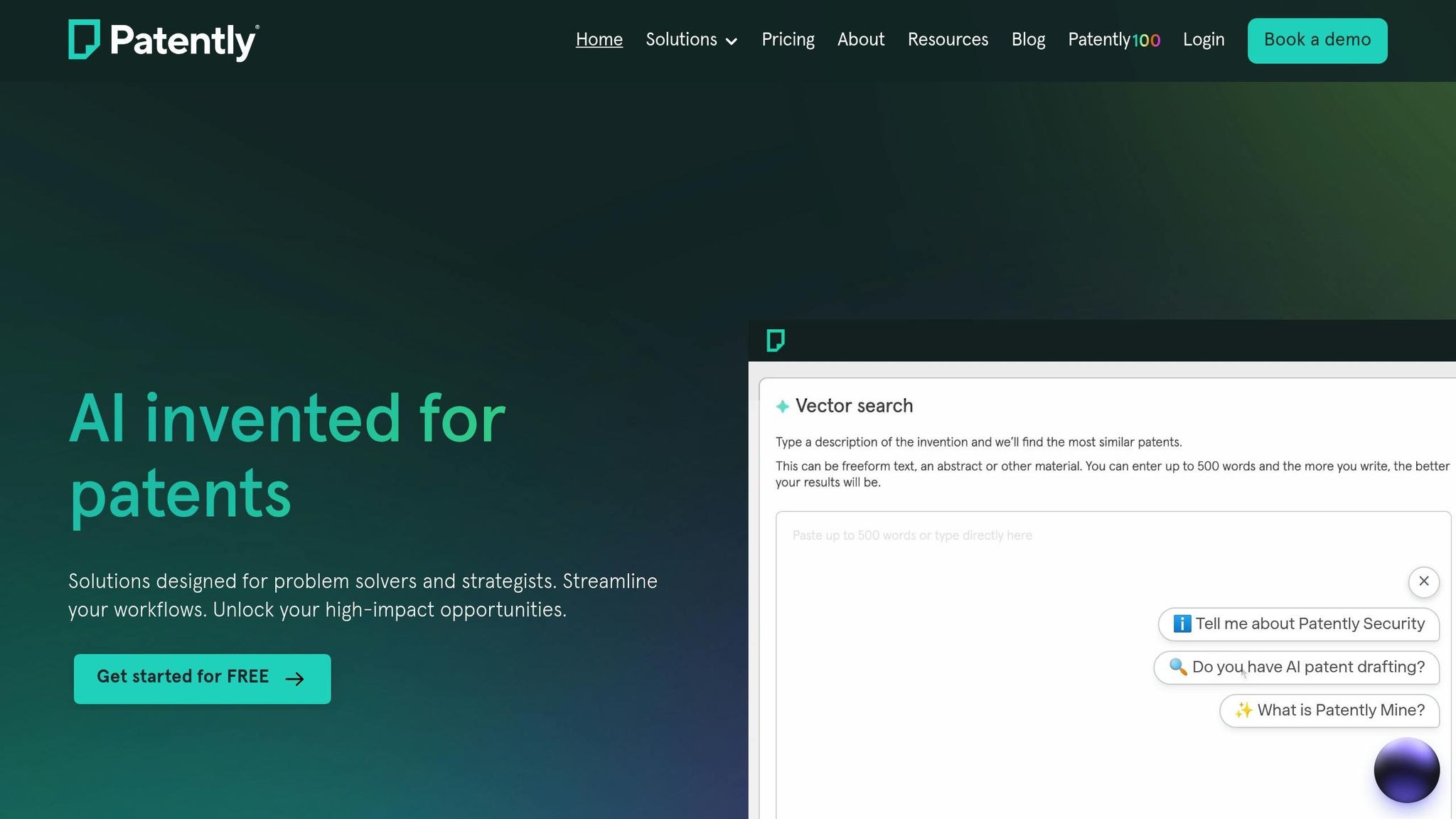
Semantic search, powered by Vector AI, goes beyond keyword matching to understand the conceptual meaning of patent language. This is especially useful when monitoring rapidly evolving technologies with changing terminology. AI-driven searches can process thousands of patents in mere minutes - a task that would take human researchers days or even weeks.
Patently’s global database includes an impressive 176 million assets and 80 million patent families from 166 patent offices. Updated every 30 days, this ensures users have access to the latest information, enabling efficient and up-to-date monitoring.
Team Collaboration and Project Management
Effective patent monitoring often requires collaboration across legal, technical, and business teams. Patently addresses this need with features like Patently Projects and Patently Know, which allow team members to comment, rate, sort, and share insights at both the patent family and individual asset levels.
The platform also supports customizable reviews for various analyses, such as novelty, validity, freedom to operate (FTO), and competitor evaluations. Projects are updated automatically, eliminating the need for manual updates and ensuring that collaborative workspaces always reflect the latest data. Additionally, teams can export company-branded reports in Word format, making it easy to integrate findings into existing workflows and client communications.
These collaborative tools are particularly useful for managing extensive patent portfolios or conducting in-depth competitive analysis. Multiple team members can work simultaneously, staying aligned with the most recent filings and insights while streamlining their processes.
Setting Up Real-Time Patent Alerts with Patently
Getting started with AI-driven patent monitoring is easier than you might think. Patently's platform simplifies the process of creating tailored alerts, keeping you updated on patent activity relevant to your interests.
Getting Started with Patently
First, choose the Patently plan that works best for you. The Free plan offers basic search capabilities and access to full patent details. If you need advanced features, the Starter plan costs $125/month per user and includes tools like semantic search and team collaboration.
Once you’ve picked your plan, you’ll gain access to a global patent database through an easy-to-navigate dashboard. This dashboard is your hub for conducting searches, managing projects, and setting up alerts.
Start by creating your profile and defining your areas of interest. This step ensures the AI delivers alerts that are tailored to your needs. Once your account is ready, you can dive into setting up custom alerts and monitoring profiles.
Setting Up Alerts and Monitoring Profiles
With your account in place, the next step is to configure monitoring profiles to receive updates that align with your focus areas. Patently’s Vector AI adapts to evolving terminology, ensuring you capture relevant filings even as language changes.
The platform’s Patently Know feature is central to this process. It powers continuous monitoring by automatically updating your projects every 30 days, tracking patent families and assets that match your criteria.
To create your first monitoring profile, define specific search parameters based on your interests. You can refine these parameters with filters like technology classifications, filing dates, assignee names, or geographic regions. If you’re unsure of the exact classification codes, the semantic search feature lets you use natural language descriptions of technologies.
For instance, you could set up alerts to track patents related to machine learning in medical diagnostics, diagnostic imaging, or other AI applications.
You can also customize alert settings to fit your workflow. For highly competitive areas, daily alerts might be most useful, while broader technology sectors might only require weekly summaries. This flexibility allows you to monitor multiple areas effectively.
Adding Alerts to Your Daily Workflow
Incorporating alerts into your daily routine ensures you can act on them promptly. Many professionals find it helpful to spend 15–20 minutes each morning reviewing overnight alerts. This practice can help you spot urgent issues, like potential infringement risks or competitor filings in critical areas.
Patently Projects is a great tool for organizing and collaborating on alerts. You can comment on, rate, and categorize findings, ensuring your team stays aligned on important developments. If an alert highlights a key filing, you can immediately add it to a project for further analysis by your colleagues.
The platform’s automatic updates keep collaborative workspaces current, which is especially useful for managing large patent portfolios or conducting competitive analyses. For client-facing tasks, you can export branded reports in Word format, making it easy to share findings.
Weekly team meetings become more efficient when alerts are systematically organized within Patently Projects. Teams can quickly review flagged patents, discuss their implications, and assign follow-up tasks. High-priority findings can trigger immediate notifications, while lower-priority alerts can be reviewed during scheduled meetings. This structured approach ensures that patent monitoring becomes a seamless part of your daily workflow.
The Future of Patent Monitoring with AI
As real-time monitoring continues to advance, the future of patent monitoring looks poised for even greater transformation. With AI technologies evolving rapidly, the way intellectual property is managed is undergoing a major shift. Platforms like Patently are just the beginning of how artificial intelligence can reshape this field.
One of the most exciting developments is the rise of agentic AI, a branch of generative AI that learns from past interactions. This technology is set to take patent monitoring to a new level, making systems smarter and more adaptive over time.
AI-driven monitoring also brings notable cost efficiencies. By offering more affordable options, advanced monitoring tools become accessible to a broader range of patent professionals, leveling the playing field for smaller firms and independent inventors.
Real-time alerts have become a standard feature, offering organizations a critical advantage. These alerts allow for immediate responses to potential infringement cases, licensing opportunities, or changes in the competitive landscape. Being able to act quickly on this information is a game-changer.
Another leap forward is the integration of semantic search powered by Vector AI. Unlike traditional keyword-based searches, semantic search goes deeper, understanding the intent behind queries to deliver more accurate and comprehensive results.
In addition to enhanced search and alert capabilities, collaborative tools are becoming increasingly important. Patent work often involves teams of attorneys, engineers, and business strategists, making seamless coordination essential. Platforms like Patently combine AI monitoring with project management features, turning patent monitoring into a strategic, team-driven process.
Looking ahead, AI is expected to become even more predictive and proactive. As agentic AI matures, tools like Patently may not only monitor patents but also anticipate trends and deliver strategic insights. This evolution could empower professionals to make quicker, more informed decisions in a highly competitive innovation environment. These advancements ensure that platforms like Patently remain at the cutting edge of patent monitoring.
FAQs
How does AI improve the accuracy and relevance of real-time patent alerts?
AI brings a new level of precision and relevance to real-time patent alerts. By using advanced algorithms, it dives deeper into patent data and processes it faster than older, manual methods. Unlike systems that depend only on keywords, AI can grasp the core ideas within patents, which helps cut down on irrelevant results and ensures fewer important patents slip through the cracks.
What’s more, AI keeps a constant eye on global patent filings, delivering updates as they happen. This means patent professionals receive timely notifications about new developments, enabling them to act quickly and make well-informed decisions - without the delays tied to traditional manual reviews.
What are the key benefits of using AI-powered tools like Patently for patent monitoring?
AI-powered tools, such as Patently, bring valuable benefits to businesses when it comes to patent monitoring. By automating patent searches, these tools save time and reduce the need for manual work, boosting both efficiency and precision. They also provide targeted alerts, helping businesses avoid irrelevant notifications and quickly act on critical updates.
Moreover, AI-driven monitoring offers real-time insights into patent landscapes, enabling businesses to make informed decisions and maintain a competitive edge. With streamlined workflows and faster response times, tools like Patently allow companies to focus on driving innovation while staying on top of the ever-changing patent landscape.
How can businesses seamlessly integrate AI-driven patent alerts into their workflows to stay competitive?
To make the most of AI-powered patent alerts, businesses should set up automated systems that provide real-time updates on new patent filings, legal developments, and industry trends. By tailoring these alerts to focus on specific topics or areas of interest, teams can ensure they’re only receiving information that’s relevant to their work.
Integrating these alerts into tools already in use, such as project management software or email platforms, enables legal and R&D teams to respond swiftly to potential opportunities or address risks. It’s also important to have clear processes in place for reviewing and validating the alerts. This step ensures the information is accurate and actionable, allowing businesses to stay ahead in a fast-moving landscape.