5 Steps to Optimize Patent Portfolios with AI
Intellectual Property Management
Mar 20, 2026
Follow five AI-driven steps—audit, set metrics, run FTO, apply analytics, and review—to reduce costs, cut legal risk, and maximize patent portfolio value.

Managing patent portfolios manually is outdated and inefficient. AI-driven tools can save up to 80% of time and costs while uncovering hidden opportunities and mitigating risks. In 2026, leveraging AI isn't optional - it's essential for handling growing patent data and staying competitive. Here's how you can improve your portfolio using five key steps:
Audit Your Portfolio: Use AI to identify valuable patents, reduce maintenance costs, and spot licensing opportunities.
Set Clear Goals: Define measurable objectives like claim scope, market relevance, and monetization strategies.
Conduct FTO analysis: AI can quickly assess infringement risks and refine patent claims to avoid conflicts.
Leverage AI Analytics: Discover high-impact patents, monitor competitors, and track market trends for better decision-making.
Regular Reviews: Use AI to continuously evaluate your portfolio, prioritize assets, and align with business goals.
AI tools like Patently and Clarivate simplify these processes, transforming patent management into a data-driven, efficient practice. By following these steps, you can reduce costs, minimize risks, and maximize the value of your intellectual property.
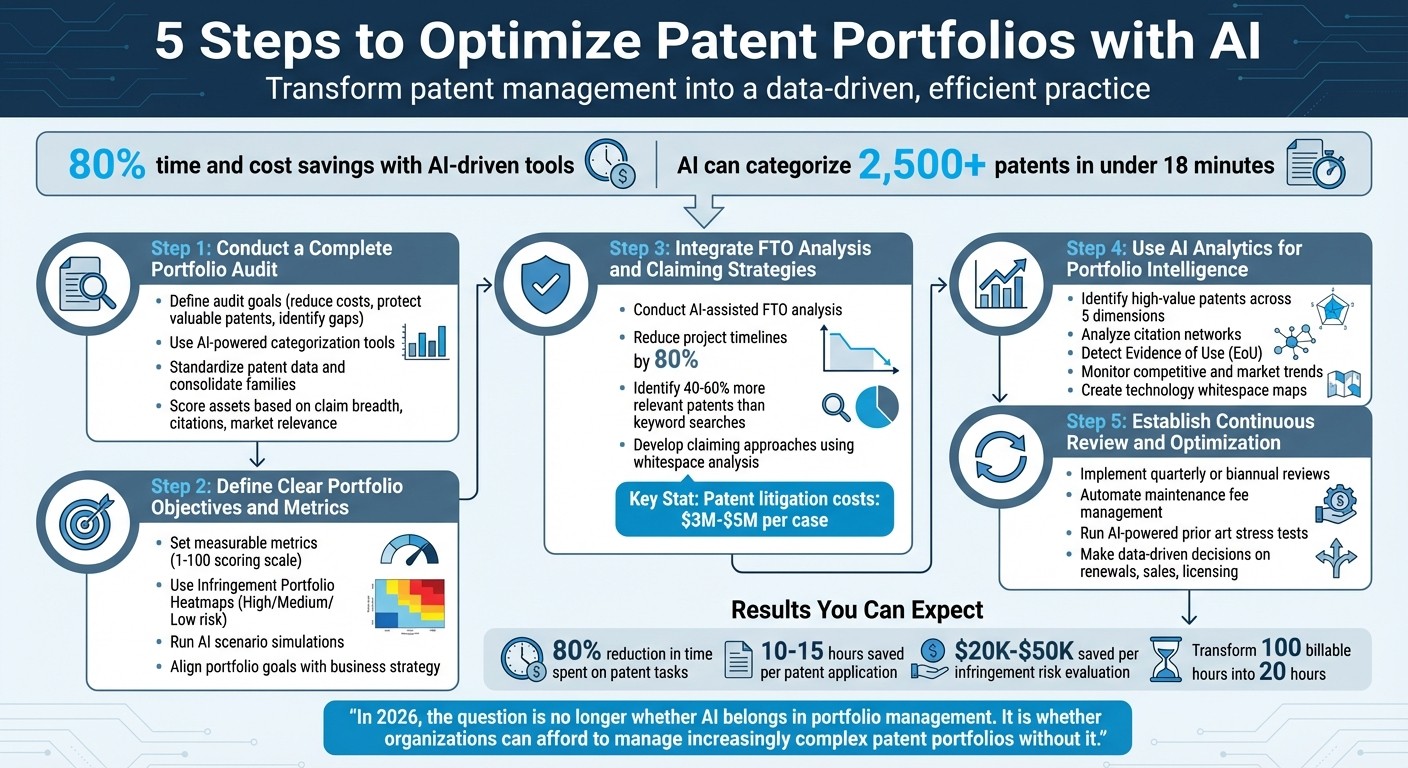
5 Steps to Optimize Patent Portfolios with AI
Using AI to Transform and Unlock Your IP Landscape
Step 1: Conduct a Complete Portfolio Audit
A thorough portfolio audit helps pinpoint which patents add value and which ones are draining resources. The difference between traditional audits and those powered by AI is dramatic: tasks that once took days or weeks can now be completed in just minutes or hours.
Define Audit Goals
Before diving into the details, it's important to clarify your objectives. Are you looking to identify patents that no longer fit your business strategy? Perhaps your priorities have shifted, making some older patents less relevant. Or maybe you're searching for undervalued patents that competitors frequently cite, opening up potential licensing opportunities.
Key areas to focus on include reducing maintenance costs, protecting valuable patents, and identifying technology gaps.
Use AI-Powered Categorization Tools
AI takes the guesswork out of sorting and turns it into actionable insights. Modern platforms rely on semantic categorization, which understands technical concepts rather than just matching keywords. For instance, in October 2025, Clarivate’s Innography AI Classifier managed to categorize over 2,500 patents in under 18 minutes. This tool allowed users to create custom taxonomies using natural language definitions, seamlessly aligning patent groupings with product lines and business units.
AI also ensures consistency in patent data. It standardizes assignee names (like merging "IBM" and "International Business Machines"), consolidates patent families across jurisdictions, and scores assets based on factors like claim breadth, citations, market relevance, and competitive blocking power. The result? A prioritized list that highlights high-value patents and flags candidates for abandonment or sale.
With these AI-driven insights, platforms like Patently enable professionals to transform raw data into strategic intelligence. This streamlined approach to portfolio auditing gives you a clear, detailed view of your assets, helping you align your patent strategy with your broader business goals.
Step 2: Define Clear Portfolio Objectives and Metrics
After completing your portfolio audit, the next step is to define objectives that make the most of AI-driven insights. Without clear, measurable goals, the data from your audit can’t be fully utilized. The idea here is to establish specific metrics that directly align with your business priorities.
Set Measurable Metrics
AI brings a new level of precision to portfolio management. Modern platforms now offer explainable, field-normalized scoring systems that assess patents across various dimensions, such as claim scope, market relevance, commercial impact, enforceability, and citation strength. These scores - often on a 1–100 scale - make it easier to compare assets and allocate resources effectively, particularly when deciding on licensing or monetization strategies.
An Infringement Portfolio Heatmap is another powerful tool. It categorizes patents by their likelihood of infringement - high, medium, or low. This ranking provides a clear framework for setting monetization goals, like focusing on licensing patents with a high risk of infringement. Additionally, AI can pinpoint "sleeping" assets - patents with high external citations but limited internal application - making them ideal candidates for licensing deals or spin-offs.
AI also shines in scenario simulations. It can predict how your portfolio’s value might shift in response to potential market changes, such as a competitor launching a new product or a sudden market expansion. This predictive capability allows you to set forward-thinking objectives rather than simply reacting to current trends.
Align Portfolio Goals with Business Strategy
To ensure your portfolio remains relevant, align its objectives with your core business strategy. Patents should either protect your main revenue streams or support innovations that align with your long-term goals. This requires a dual approach: safeguarding current revenue while paving the way for future growth. For example, if your company is entering new international markets, your portfolio goals might include securing patents in key jurisdictions to support that expansion.
"The intersection of patents and business goals is where intellectual property transforms from legal protection to strategic advantage." - PatentPC
AI simplifies this alignment by organizing patents into thematic clusters based on their functional roles. This lets you quickly see which technology areas are well-covered and where there are gaps. Tools like Patently even allow you to map patent claims directly to product features or competitor offerings, ensuring your intellectual property strategy focuses on what truly matters to your business. As your product roadmap evolves, it’s crucial to reassess your portfolio regularly - identify which patents still align with your goals and decide whether others should be sold, licensed, or abandoned to free up resources.
Step 3: Integrate FTO Analysis and Claiming Strategies
Once your portfolio objectives are clearly outlined, the next move is to address infringement risks by conducting an effective Freedom-to-Operate (FTO) analysis. Traditionally, FTO analysis has been both time-consuming and costly. However, AI is changing the game by identifying potential conflicts early, allowing you to refine your claims proactively.
Conduct AI-Assisted FTO Analysis
AI-powered tools can scan millions of patents across various jurisdictions at incredible speeds. Unlike older methods that rely heavily on keyword matching, these tools use semantic analysis to understand the nuances within patent claims.
Using AI for FTO analysis can cut project timelines by up to 80% while identifying 40–60% more relevant patents compared to traditional keyword-based approaches. This efficiency is crucial when you consider that patent litigation costs often range from $3 million to $5 million per case. Additionally, the number of defendants targeted by Non-Practicing Entities (NPEs) rose by 21.6% in 2024, making early risk detection even more critical.
AI tools also simplify claim mapping by automatically generating detailed, element-by-element charts. These charts connect product features to patent limitations and often include color-coded risk indicators (e.g., High, Medium, Low) to help prioritize which patents require immediate attention.
"FTO is not about patentability, it is about risk management, due diligence, and protecting the business from costly litigation or forced redesigns." – Patlytics
Running FTO analysis early in the product development cycle is key. AI tools allow you to input basic product descriptions in natural language, effectively translating them into patent terms. This means you don’t need to wade through complex legal jargon. Focus your legal team's efforts on reviewing high-risk patents and monitoring aggressive competitors flagged by AI, rather than manually combing through thousands of documents.
These streamlined and detailed analyses directly inform and improve your patent claim strategies.
Develop Claiming Approaches
Using insights from FTO analysis, you can fine-tune your patent claims to offer strong protection while steering clear of potential conflicts. One of the most valuable aspects of these insights is identifying "whitespace" - areas in the intellectual property landscape where no patents currently exist. This opens up new opportunities for innovation.
"Knowing the IP landscape lets you see what competitors are claiming - and what they're not. This helps you find whitespace. The gaps. The areas no one has protected yet." – PowerPatent
Some tools, like Patently, even let you run FTO clearance checks directly from your patent draft. This enables you to quickly iterate and adjust your claim scope before filing. If AI flags an overlap, the element-by-element mapping helps pinpoint the exact risk areas.
It’s also important to document your FTO findings for ongoing risk management. Instead of trying to eliminate every potential risk, focus on clear overlaps with active patents held by competitors who are known for enforcing their intellectual property aggressively.
Step 4: Use AI Analytics for Portfolio Intelligence
Once you've refined your claims and addressed FTO risks, it's time to unlock deeper insights from your portfolio data. AI analytics can turn patent portfolios into dynamic tools that uncover hidden opportunities and enhance competitive positioning.
Identify High-Value Patents
AI analyzes patents across five critical dimensions: Scope & Validity, Market Relevance, Commercial Impact, Enforceability, and Portfolio/Standards Position. This data-driven approach takes the guesswork out of identifying valuable patents.
For example, citation network analysis evaluates forward and backward citations to determine which patents are frequently referenced by competitors or researchers. High-impact patents often have strong citations and broad family coverage across key jurisdictions. Additionally, EoU (Evidence of Use) detection scans web data, product manuals, and technical documents to link competitor products to specific patent claims. This helps identify patents being actively used in the market, making them prime candidates for licensing or enforcement.
"Untapped IP can become a net loss – maintenance fees and administrative overhead mount up, while missed licensing or enforcement opportunities silently deplete potential ROI." – DeepIP
AI can also highlight underutilized patents, often referred to as "sleeping money." These are assets with strong external citations but minimal internal use. Such patents may be excellent candidates for licensing, selling, or spinning off. Given the sheer size of modern portfolios, manually identifying these opportunities is nearly impossible without the top patent tools currently available.
Beyond assessing individual patents, AI tools continuously monitor external trends to refine your overall strategy.
Monitor Competitive and Market Trends
AI keeps tabs on competitor activity and market shifts, tracking patent surges, filing volumes in different jurisdictions, and changes in technology focus. This allows you to detect shifts in competitors' innovation strategies early.
AI tools also analyze product announcements, manuals, and technical documents to uncover potential infringement or licensing opportunities through Evidence-of-Use.
"This shifts the role of the patent portfolio from a static insurance policy to a dynamic strategic weapon, aligned with business objectives and market movements." – DeepIP
Technology whitespace maps created by AI can identify untapped areas for innovation and highlight overcrowded zones where further filings may yield diminishing returns. These maps also compare your portfolio against competitors, giving you a clear view of defensive strengths and gaps.
For industries tied to technical standards, AI tracks standards documentation (like 3GPP or IEEE) to identify Standard-Essential Patents (SEPs) and ensures alignment with regulatory filings. This ensures you capitalize on patents covering critical industry requirements.
The future of portfolio management is heading toward "Agentic Portfolio Intelligence" - AI agents that autonomously monitor market changes and update valuations in real time. This approach ensures your portfolio strategy remains responsive to evolving market conditions.
Step 5: Establish Continuous Review and Optimization Processes
With AI analytics highlighting high-value assets and emerging market trends, maintaining a process of continuous review keeps your portfolio adaptable. Portfolio management isn't a one-time task - it's a recurring cycle. The best patent strategies move away from occasional manual reviews and adopt a system where AI continuously monitors developments, providing insights that transform static management into a dynamic, strategy-driven approach.
Implement Regular Portfolio Reviews
Set up quarterly or biannual reviews to evaluate how well your portfolio aligns with your business goals. Let AI handle the tedious tasks: it can standardize inconsistent data (like "IBM Corp" versus "International Business Machines") and group patents by technology or business unit. This makes it easier to spot clusters that no longer fit your company's strategic plans.
AI also simplifies maintenance fee management by tracking deadlines and prioritizing payments for your most valuable assets. It can even run "stress tests" with AI-powered prior art searches to identify patents at high risk of invalidation, helping you decide which ones to prune.
These regular reviews ensure your portfolio stays aligned with your business strategy by feeding actionable data directly into decision-making processes.
Use AI for Data-Driven Decisions
AI platforms evaluate patents using clear criteria like claim scope, market relevance, citation strength, and validity risk. This helps you decide which patents to renew, sell, license, or let go. AI can also identify underused patents and highlight those that are ideal for licensing or sale.
"The rise of AI patent portfolio management software reflects a broader shift in how intellectual property is governed. Portfolios are no longer static collections of rights - they are dynamic strategic assets that must be continuously evaluated, aligned, and defended." – DeepIP
AI can even group related patents into bundles for licensing, maximizing their revenue potential. By establishing a Decision-First Framework, you can consolidate data, segment by product, assess risks and values, and act on insights backed by evidence. This approach ensures your portfolio remains a powerful and adaptable business asset.
Conclusion
Managing a patent portfolio without AI in 2026 feels a lot like navigating with a paper map instead of GPS - doable, but unnecessarily complicated and full of potential pitfalls. By following the five outlined steps, you can transition from merely reacting to creating meaningful value through proactive management. This approach equips patent professionals to leverage AI at every stage of portfolio strategy.
AI adoption isn't just about convenience - it’s a game-changer for efficiency. It can cut the time spent on intricate patent tasks by as much as 80%. For example, processes that once took 100 billable hours can now be completed in just 20. AI-assisted tools for search and drafting save companies 10–15 hours per patent application, while conducting infringement risk evaluations internally can save between $20,000 and $50,000 per case by reducing reliance on external counsel.
Platforms like Patently consolidate everything - AI-powered search, generative AI patent drafting tools, project management, and SEP analytics - into a single, cohesive system. This eliminates the disjointed workflows of traditional portfolio management, allowing teams to shift from data gathering to actionable strategy in mere minutes instead of weeks.
This streamlined approach not only saves time and money but also bolsters your competitive edge. Faster decision-making, reduced costs, and a sharper strategic focus all contribute to staying ahead in a rapidly evolving market.
"In 2026, the question is no longer whether AI belongs in portfolio management. It is whether organizations can afford to manage increasingly complex patent portfolios without it." – Thomas Chazot, Head of Growth Marketing, DeepIP
By embracing AI, you unlock opportunities for licensing, address gaps in protection, and ensure your IP investments align with shifting market demands. On the other hand, delaying adoption risks leaving your portfolio stuck in outdated, inefficient practices.
Start small: audit your portfolio, define clear metrics, or schedule regular reviews. Once AI becomes part of your workflow, your portfolio evolves from a static collection of records into a dynamic, strategic asset that adapts to the changing landscape.
FAQs
What data do we need to start using AI for a portfolio audit?
To leverage AI for a portfolio audit, gather comprehensive details about your patents. This should include their technological classifications, value, strategic importance, and current status. You’ll also need information on patent performance, licensing agreements, potential risks, and any gaps in your portfolio. With this data, AI can thoroughly analyze your portfolio to pinpoint high-value patents, highlight new opportunities, and help allocate resources more efficiently.
How do we set portfolio metrics that actually match business goals?
To ensure your portfolio metrics truly reflect your company’s objectives, start by defining clear criteria tied directly to your business goals. Focus on metrics that assess patent value, relevance, and their potential impact in areas such as market expansion or innovation leadership.
AI tools can be a game-changer here. They can help analyze the strength and strategic fit of patents, enabling more informed, data-driven decisions.
But it doesn’t stop there - regular reviews are essential. As your goals and market conditions evolve, revisit and adjust these metrics. Use the insights provided by AI to refine your approach, ensuring your strategy stays both relevant and effective.
How early should we run AI-assisted FTO during product development?
AI-assisted Freedom to Operate (FTO) analysis is most effective when initiated early in the product development process - ideally, as soon as your concept starts taking shape. Starting early helps pinpoint potential patent obstacles, enabling informed design decisions and minimizing the chances of expensive redesigns or legal disputes down the line. By aligning your development efforts with the existing patent landscape from the outset, you can make strategic adjustments before committing substantial time and resources.