AI in Patent Value Analysis: Trends for 2026
Intellectual Property Management
Mar 21, 2026
AI transforms patent valuation in 2026 with real-time scoring, NLP claim analysis, litigation-risk models, and AI-driven portfolio optimization.
AI is reshaping patent valuation in 2026, turning slow, manual processes into fast, data-driven systems. Key advancements include:
Real-Time Valuation: AI updates patent values using live data like market trends and competitor activity.
Machine Learning Models: Predict future patent citations, helping value newer patents with limited history.
Natural Language Processing (NLP): Analyzes patent claims, licensing agreements, and legal rulings for better insights.
Litigation Risk Assessment: AI evaluates legal risks using historical court and examiner data.
Portfolio Management: Tools prioritize high-value patents, reduce maintenance costs, and identify licensing opportunities.
With over 12,400 generative AI patents filed globally in 2025, Top AI patent tools are now essential for managing large portfolios efficiently. Companies save time and money while making smarter decisions about their intellectual property.
By 2026, AI isn't just helpful - it's a baseline requirement for patent professionals.
Using AI to Transform and Unlock Your IP Landscape
AI Techniques Changing Patent Valuation
The integration of AI into patent valuation has introduced methods that not only speed up the process but also uncover insights that were previously difficult to detect. These advancements are laying the foundation for broader discussions about AI's role in managing patent portfolios. Specialized platforms now offer AI-enabled patent analysis to streamline these complex workflows.
Forward Citation Analysis with Machine Learning
Machine learning models are now capable of predicting future citations for newly issued patents, solving the problem of valuing patents with limited citation history. Using advanced architectures like CNNs and bidirectional LSTM networks, these models analyze unstructured patent text to estimate both economic value and technological impact. By identifying citation patterns in similar patents, they can apply these trends to newer filings.
For example, a one-unit rise in a patent's "technology impact" score - a metric that adjusts forward citations based on patent age - is linked to a 95% increase in the likelihood of the patent being tied to high damages (over $100 million). Moreover, if a patent family's technology impact score shifts from the average non-litigated level to that of high-damages patents, the odds of securing high damages increase by an astonishing 635%.
Natural Language Processing for Claim Analysis
Natural Language Processing (NLP) has transformed how patent claims are analyzed by interpreting the meaning behind the language used. This semantic understanding makes it possible to identify similar disclosures even when different terminology is used, which is critical for tasks like claim mapping and prior art searches. NLP tools also evaluate claim scope by examining structural features; for instance, patents with "shorter first claims" often indicate broader coverage and higher potential value.
Generative AI patent drafting tools and other AI-powered solutions have drastically cut down the time required for manual reviews, reducing what once took hours to mere minutes. As Bob Hansen, Founding Partner at The Marbury Law Group, explains:
"AI performs best when it understands the full invention disclosure, file history, and drafting materials in one place."
Litigation Risk Assessment from Historical Data
AI models now calculate the likelihood of legal disputes by analyzing historical data from PTAB, PACER court decisions, and examiner behavior. Litigation often serves as a proxy for patent value, as the decision to litigate suggests that the potential economic benefits outweigh the risks and costs of invalidation. These models highlight characteristics that are common among patents that have successfully won high damages, creating "risk-adjusted returns" that provide stronger valuation arguments for investors and stakeholders.
Interestingly, while patents from larger families are more likely to be litigated (17% impact), those that achieve high damages typically come from smaller families. This surprising insight showcases how AI can detect patterns that might be missed by human analysts, offering a fresh perspective on patent valuation.
Current Trends in AI-Driven Portfolio Management
AI is reshaping portfolio management by moving beyond basic record-keeping to enable strategic decision-making at scale. In patent portfolio management, for instance, AI tools can analyze thousands of patents in just minutes, a task that used to take weeks. This shift is timely, as companies are expected to spend nearly $10 billion on patent maintenance fees by 2026. With such high stakes, identifying which patents are worth keeping and which should be discarded has become more important than ever. AI is now paving the way for smarter benchmarking and real-time scoring techniques.
AI-Powered Benchmarking and Classification
AI systems are leveraging natural language processing (NLP) to classify patents based on their meaning and context, making large-scale benchmarking possible. A striking example comes from October 2025, when Clarivate showcased its Innography AI Classifier. This tool categorized over 2,500 patents in under 18 minutes, a job that would have traditionally taken days or even weeks.
One standout feature is custom taxonomy training. This allows companies to group patents into business-relevant categories, such as "sensor fusion for driver monitoring", aligning intellectual property (IP) strategies with their product development plans. Industry leaders are already seeing the benefits. Tom Tassignon, Head of IP at Philips, explained:
"We think these tools are becoming an indispensable part of the patent attorney's toolkit. They allow us to be much more efficient and also deliver higher-quality work - across drafting, novelty analysis, intelligence, and prosecution".
Real-Time Patent Scoring for Cost Management
AI isn’t just helping with classification - it’s also enabling real-time scoring to refine cost management strategies. These scoring systems evaluate patents based on factors like citation frequency and the breadth of geographical protection. This approach helps prioritize valuable assets while identifying underperformers. Between 2020 and 2025, Honda used this strategy to improve its Portfolio Improvement Index by 24.5%, eliminating roughly 60% of its lowest-performing patent families.
Another key benefit is the ability to uncover "sleeping money." These are patents with external licensing or sales potential, even if they have limited internal use. Monetizing such patents can help offset maintenance costs. If companies across industries matched the efficiency of top performers, they could collectively save up to $527 million in 2026. Additionally, AI tools are cutting the time required for patent searches and prior art analysis by 60–80% compared to older Boolean search methods.
AI in Patent Valuation: 2026 and Beyond
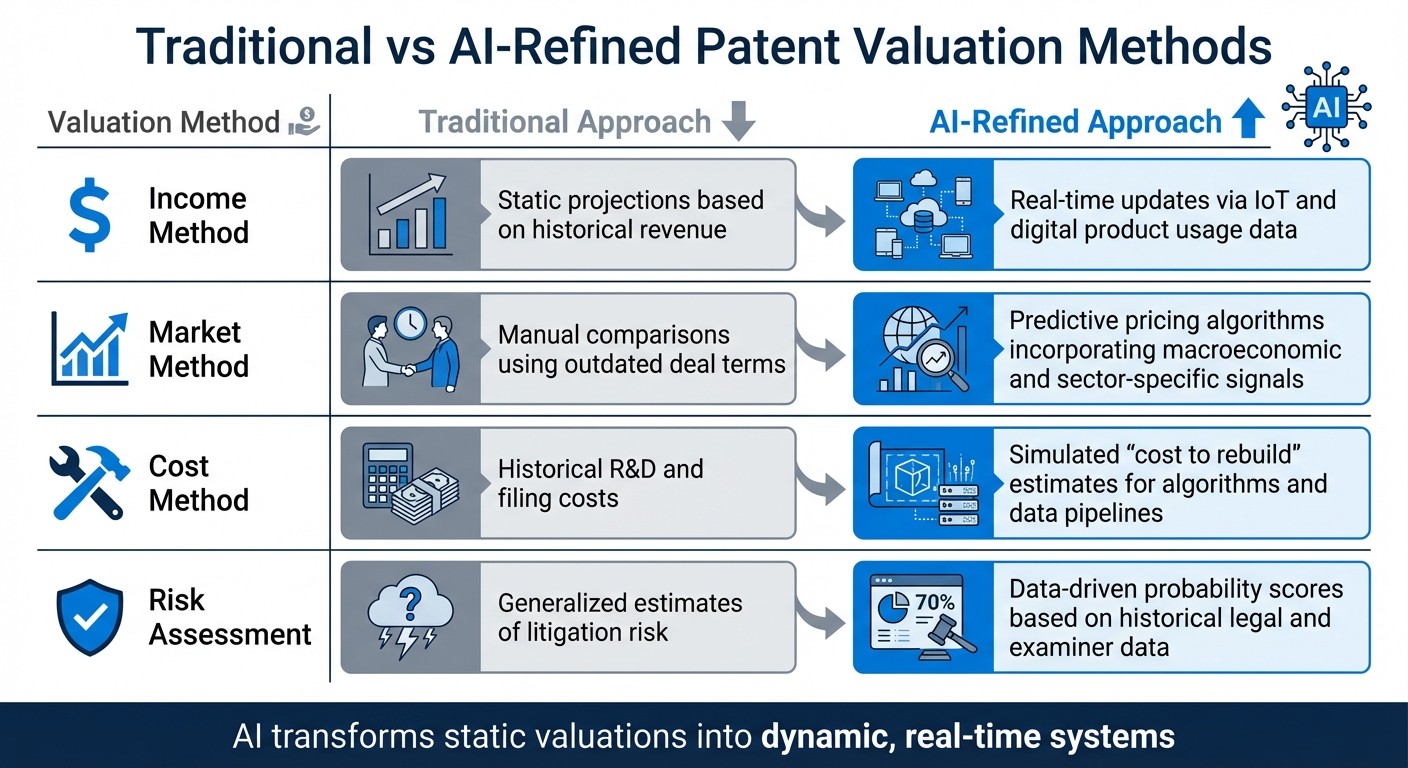
AI-Refined vs Traditional Patent Valuation Methods Comparison 2026
AI is transforming patent valuation from static, one-time assessments into dynamic systems that update automatically. Instead of relying on outdated snapshots, businesses can now monitor the ongoing performance of their intellectual property (IP) assets through real-time data streams. This shift is especially important as intangible assets continue to grow in value. By incorporating AI, traditional valuation methods are becoming more precise and adaptable.
AI Improvements to Valuation Methods
AI is reshaping how traditional valuation methods operate. For income-based models, AI enables continuous tracking by analyzing live IP performance metrics like revenue streams, product downloads, and usage trends. This allows valuations to update automatically as new data becomes available. Similarly, market-based approaches now use predictive pricing algorithms instead of manual benchmarks. These algorithms consider factors like technology adoption rates, macroeconomic trends, and licensing activity across related industries.
The cost-based method is also seeing significant changes, particularly for digital assets. Instead of simply adding up historical R&D expenses, AI estimates the cost to rebuild - a measure of the time, effort, and data required for a competitor to replicate a proprietary algorithm or machine-learning model. Additionally, AI enhances risk assessment by assigning probabilities to legal risks. By analyzing past lawsuits, settlement trends, and examiner behavior across jurisdictions, AI provides companies with precise insights into potential litigation or exclusivity risks.
Valuation Method | Traditional Approach | AI-Refined Approach |
|---|---|---|
Income Method | Static projections based on historical revenue | Real-time updates via IoT and digital product usage data |
Market Method | Manual comparisons using outdated deal terms | Predictive pricing algorithms incorporating macroeconomic and sector-specific signals |
Cost Method | Historical R&D and filing costs | Simulated "cost to rebuild" estimates for algorithms and data pipelines |
Risk Assessment | Generalized estimates of litigation risk | Data-driven probability scores based on historical legal and examiner data |
These AI-driven advancements are further amplified by integrating emerging technologies into patent valuation systems.
Integration with New Technologies
AI valuation tools are increasingly paired with cutting-edge technologies, creating more comprehensive frameworks. Blockchain ensures secure and immutable records of patent transactions and ownership changes, minimizing disputes during licensing or mergers and acquisitions. IoT integration allows real-time performance data from connected devices to flow directly into valuation models, offering insights into how patented hardware performs in real-world conditions.
Quantum computing is poised to take things even further, enabling AI systems to process complex datasets and simulate intricate market dynamics at unprecedented speeds. This capability will allow businesses to model various scenarios and assess their impact on patent valuations. Meanwhile, augmented and virtual reality (AR/VR) are making it easier for stakeholders to understand complex IP assets by creating immersive environments for visualization. Additionally, companies are linking AI valuation tools to internal R&D systems - like Electronic Lab Notebooks and design logs - to capture and evaluate "innovation leakage" before ideas are formally disclosed.
Patently's AI-Powered Patent Value Tools
In 2026, AI is reshaping how patents are valued, and Patently is at the forefront with tools designed specifically for patent professionals. By integrating semantic search, portfolio optimization, and collaborative features into a single workspace, Patently simplifies the complexities of managing intellectual property (IP). These tools improve search accuracy, streamline portfolio management, and refine pricing strategies, making patent management more efficient.
Semantic Search and Vector AI
Patently's semantic search engine tackles the Vocabulary Gap - a common issue where inventors use different terms for the same concept. For instance, one might refer to a "Drone", while another uses "Unmanned Aerial Rotocraft." Traditional keyword searches often miss these connections, but Patently's Vector AI bridges this gap by identifying patents based on their meaning rather than exact wording.
The platform uses Elastic's Search AI Platform to manage a massive dataset of over 82 million patent families and 135 million individual patents, each mapped across 226 fields. Unlike systems that rely on monthly updates, Patently offers real-time data intake, ensuring users always have access to the latest filings. For example, in October 2024, Laurence Brown relied on Patently's Vector AI to quickly filter and pinpoint relevant patents.
"With Elastic, it's like having a patent attorney with decades of experience guiding every search." - Andrew Crothers, Creative Director at Patently
By 2026, professionals typically use a dual approach: Vector AI for broad conceptual searches and Boolean filters for precise legal queries. This combination reduces research time by up to 70% while maintaining 99% prior art coverage. The Vector AI engine also powers specialized tools like "Patently License" for analyzing Standard Essential Patents (SEPs) and "Onardo", an AI drafting assistant that identifies prior art during specification development.
Portfolio Optimization Features
Patently goes beyond improving search capabilities by offering tools to optimize patent portfolios. These features allow teams to refine their strategies continuously, leveraging AI to make smarter decisions. For example, the Auto-Classification Wizard generates taxonomy-based tags and summaries, helping teams spot key technologies and identify gaps in large portfolios.
The FAB (Forward and Backward) citation browser provides insights into citation networks, a crucial factor in evaluating a patent's market relevance and value. Additionally, Patent-to-Product Mappings connect patents to specific products or technologies, shedding light on their commercial applications. The platform's Intelligent Portfolio Clustering groups patents by technology, ensuring that each cluster is analyzed against the most relevant product documentation for infringement risks. These tools transform portfolio management from a static process into a dynamic, data-driven activity aligned with business goals.
Pricing Plans for Different Users
Patently offers flexible pricing options to cater to everyone, from individual users to global enterprises. Here's a quick look at their plans:
Free: Ideal for individuals, this plan includes basic search and family browsing at no cost.
Starter: Designed for small teams, it costs $125 per user per month and adds features like Vector AI, the FAB citation browser, and collaboration tools.
Business+: Tailored for corporations, this custom-priced plan includes advanced features like AI drafting and fee tracking.
Law Firm+: Created for law firms, it offers matter-centric management and client access portals, with custom pricing.
Enterprise: Fully customizable to meet the needs of large organizations, this plan provides bespoke AI solutions.
For those focused on Standard Essential Patents, Patently License (SEP) is available as a separate license. It includes advanced analytics like Questel's essentiality analysis and geographical coverage data, making it a valuable tool for SEP professionals.
Plan | Target User | Key AI Features | Monthly Cost |
|---|---|---|---|
Free | Individuals | Basic search, Family browsing | $0 |
Starter | Small Teams | Vector AI, FAB Browser, Collaboration | $125/user |
Business+ | Corporations | AI Drafting, Fee Analytics | Custom |
Law Firm+ | Law Firms | Matter Management, Client Portals | Custom |
Enterprise | Large Organizations | Bespoke AI Solutions | Custom |
Patently's pricing structure ensures that AI-powered patent tools are accessible to users with varying needs, from solo professionals to enterprise-level teams.
Conclusion
AI is reshaping how patent value is assessed in 2026, turning what was once a static, one-time evaluation into a dynamic, real-time metric. This evolution incorporates factors like revenue, competitor activity, and market trends, enabling IP professionals to shift from reactive portfolio maintenance to proactive, strategic decision-making. By identifying high-value assets and cutting underperforming ones, companies can allocate resources more effectively and stay ahead of the curve.
AI-powered tools have also made patent searches far more efficient compared to older methods. Between 2024 and 2026, the adoption of these tools across the IP field surged from 57% to 85%. In today’s competitive environment, the ability to accurately measure patent value has become a necessity, not just an option.
"By 2026, artificial intelligence will no longer be a 'nice to have' in corporate IP departments. It will be a baseline requirement for managing invention capture and AI drafting, patent quality, portfolio scale, and legal risk." - DeepIP
Patently is at the forefront of this transformation, offering patent professionals tools that simplify and enhance their work. With features like semantic search to bridge terminology gaps and portfolio optimization to uncover licensing opportunities and SEP analytics, the platform turns complex data into actionable insights. Whether you're a solo practitioner using the free plan or part of an enterprise team with tailored needs, Patently’s AI-driven tools help you focus on what truly matters: safeguarding innovation and driving business growth. These capabilities reflect the broader shift toward smarter, data-driven patent management.
As AI continues to redefine valuation, the role of IP professionals is evolving too. They are no longer just creators of valuation models but are becoming strategic editors who interpret AI-generated insights to guide critical decisions. Those who adopt these tools early will gain a clear edge in this increasingly data-centric landscape.
FAQs
How accurate are AI patent value scores?
Advancements in data analysis, pattern recognition, and the ability to combine diverse datasets have significantly improved the accuracy of AI in evaluating patent value. These developments make AI a powerful tool for determining the worth of patents with greater precision and reliability.
What data do AI valuation models need?
AI valuation models thrive on access to extensive and varied datasets. These datasets include resources like patent databases, market reports, legal documents, emerging technological trends, and details about competitors. With this information, the models can uncover patterns and deliver precise insights into the value of patents.
How should teams validate AI valuation results?
To ensure the accuracy and reliability of AI valuation results, it's crucial to take a balanced approach. Combine AI-driven insights with expert judgment to add a layer of human understanding to the data. Cross-checking information from multiple sources helps identify inconsistencies or errors. Additionally, incorporating traditional valuation methods alongside AI analysis provides a well-rounded perspective, ensuring the results are both precise and dependable.