AI Models for Patent Trend Forecasting
Intellectual Property Management
Mar 22, 2026
AI models transform patent forecasting by turning patent data into accurate trend predictions and strategic IP insights.

AI is transforming how patents are analyzed and forecasted. With over 3.5 million patent applications filed globally in 2023 and more than 150 million patent records, traditional methods struggle to keep up. Top AI patent tools now allow organizations to predict trends, track innovation, and reduce research time by up to 80%. Key insights include:
AI's predictive power: Models like ARIMA, N-BEATS, and LSTM forecast patent trends with high accuracy, even in dynamic markets.
Machine learning advancements: Tools like Random Forests and Graph Neural Networks analyze non-linear data and map innovation networks.
Emerging trends: Generative AI patents grew by 800% from 2014 to 2023, with healthcare and climate-related patents also surging.
Regional shifts: China leads in generative AI patents, while India focuses on agriculture and public health.
AI doesn’t replace experts but complements them by handling data-heavy tasks, enabling smarter decisions and faster innovation tracking.
How AI Companies Build Strong Patent Strategies | IP, Innovation & Trade Secrets at Uniphore
AI Methods for Forecasting Patent Trends
When it comes to predicting patent trends, AI offers three main approaches. Each method caters to different needs, helping patent professionals choose tools that align with their strategic goals.
Time Series Models
ARIMA (Autoregressive Integrated Moving Average) is a go-to method for analyzing historical trends. It combines past data patterns (autoregression), smooths fluctuations (integration), and filters outliers (moving averages) to create forecasts. While ARIMA is known for being reliable and easy to interpret, it struggles in volatile markets. The UK Intellectual Property Office highlights this limitation:
"AR models perform poorly under certain market conditions, such as financial crises or periods of rapid technological change, when IP filings fluctuate greatly from past trends".
To overcome these challenges, the European Patent Office (EPO) has adopted N-BEATS, a deep learning model. This model generates five-year forecasts (2023–2027) for patent applications by incorporating external factors like GDP data from member states, which significantly boosts its predictive accuracy. Unlike ARIMA, N-BEATS takes into account broader economic influences, making it a better fit for dynamic environments.
While time series models rely on statistical methods, machine learning techniques offer a fresh approach to handling complex, non-linear data patterns.
Machine Learning Techniques
Machine learning models such as Random Forests (RF), Regression Trees (RT), and Support Vector Machines (SVM) excel at identifying non-linear relationships that traditional models might miss. These methods automatically fine-tune parameters and discard outliers, improving prediction accuracy. Graph Neural Networks (GNN) take this a step further by mapping innovation networks and tracking technological trends to predict company-specific patent activities.
A study on Mexican patent data (1993–2024) by the Mexican Institute of Industrial Property (IMPI) showcased the potential of machine learning. The LSTM (Long Short-Term Memory) model, a type of recurrent neural network, delivered outstanding results. It achieved an R² of 0.97 for applied patents and 0.93 for granted patents, with a Mean Absolute Percentage Error (MAPE) of just 0.63% for applied patents and 2.65% for granted patents. LSTM's ability to capture long-term patterns in sequential data makes it particularly effective for forecasting filing rates and grant outcomes, offering valuable insights for innovation tracking.
While machine learning models thrive on non-linear data, multi-task learning models push the boundaries by tackling multiple predictions simultaneously.
Multi-Task Learning Models
Multi-task learning is at the forefront of patent forecasting. These models predict citation trends across different timeframes, outperforming single-task methods in accuracy. They also measure the Technology Improvement Rate (TIR), a key metric that evaluates technological progress by factoring in cycle time and knowledge flow.
For instance, R&D teams can use these models to pinpoint strategic areas where patent filings grow by at least 20% over two consecutive quarters, signaling emerging innovation hubs. Additionally, by analyzing citation lag - tracking patents cited within 12–24 months - professionals can identify high-impact breakthroughs early on. This multi-dimensional approach transforms patents into dynamic tools for spotting innovation trends, complementing other AI methods with actionable insights.
These techniques pave the way for comparing model performance in the next case studies.
Case Studies: AI in Patent Forecasting
Generative AI and Patent Growth
The surge in generative AI patents provides a fascinating lens for understanding how AI forecasting models track advancements in innovation. From 2014 to 2023, the number of GenAI patent families soared from 733 to over 14,000 - an increase of more than 800%. Even more striking, a quarter of these patents were published in 2023 alone, reflecting the rapid pace of innovation.
Large Language Models (LLMs) have played a significant role in this growth, making up over 40% of AI model-related patent filings in 2022. The release of GPT-3 in 2020 acted as a catalyst, driving a 700% surge in GPT-related patent filings. This marks a shift in how organizations approach AI development. OpenAI, for instance, moved from relying heavily on trade secrets and open-source contributions to building a formal patent portfolio. By early 2024, OpenAI had six U.S. patents published - three granted and three pending.
The healthcare sector has seen similar momentum. Between 2018 and 2023, AI-driven patent applications in drug discovery and healthcare increased by 600%, with a notable 40% jump in 2023. In Australia, the influence of generative AI tools became clear when self-filed provisional applications rose by 193% in 2025, largely due to AI drafting tools. A standout example is Nuwey Pty Ltd, which became the largest filer of Australian provisional applications in December 2025, submitting 158 applications in just a few weeks using AI patent drafting software. This achievement was credited to a single human inventor using generative AI patent drafting tools.
These trends underscore how AI forecasting models effectively capture the rapid evolution of innovation across various sectors.
Cross-Industry Innovation Trends
AI forecasting doesn’t just highlight sector-specific shifts; it also uncovers broader patterns of innovation across industries. For instance, AI patents focused on climate mitigation and adaptation grew from 9,037 in 2019 to 43,118 in 2023 - a 377% increase.
Between 2014 and 2023, Ping An Insurance Group transformed itself from a traditional insurer into a tech powerhouse. The company now ranks among the global leaders in patent families across business solutions, life sciences, banking, and smart city technologies.
Geographic trends also tell a compelling story. China leads the global generative AI race, publishing over 38,000 patent families between 2014 and 2023 - more than the rest of the world combined. Meanwhile, India saw a 12-fold rise in AI patent filings, jumping from 717 in 2019 to 9,404 in 2024, focusing on local challenges like agriculture and public health. The State Grid Corporation of China also expanded its AI patent portfolio significantly, with 33,976 projected patents between 2019 and 2024. Most of these (33,710) were filed domestically, securing its position in the home market before scaling internationally.
These examples highlight how AI forecasting models can track and anticipate innovation trends across industries and regions, providing valuable insights into the shifting technological landscape.
Performance Comparison of AI Models in Patent Forecasting
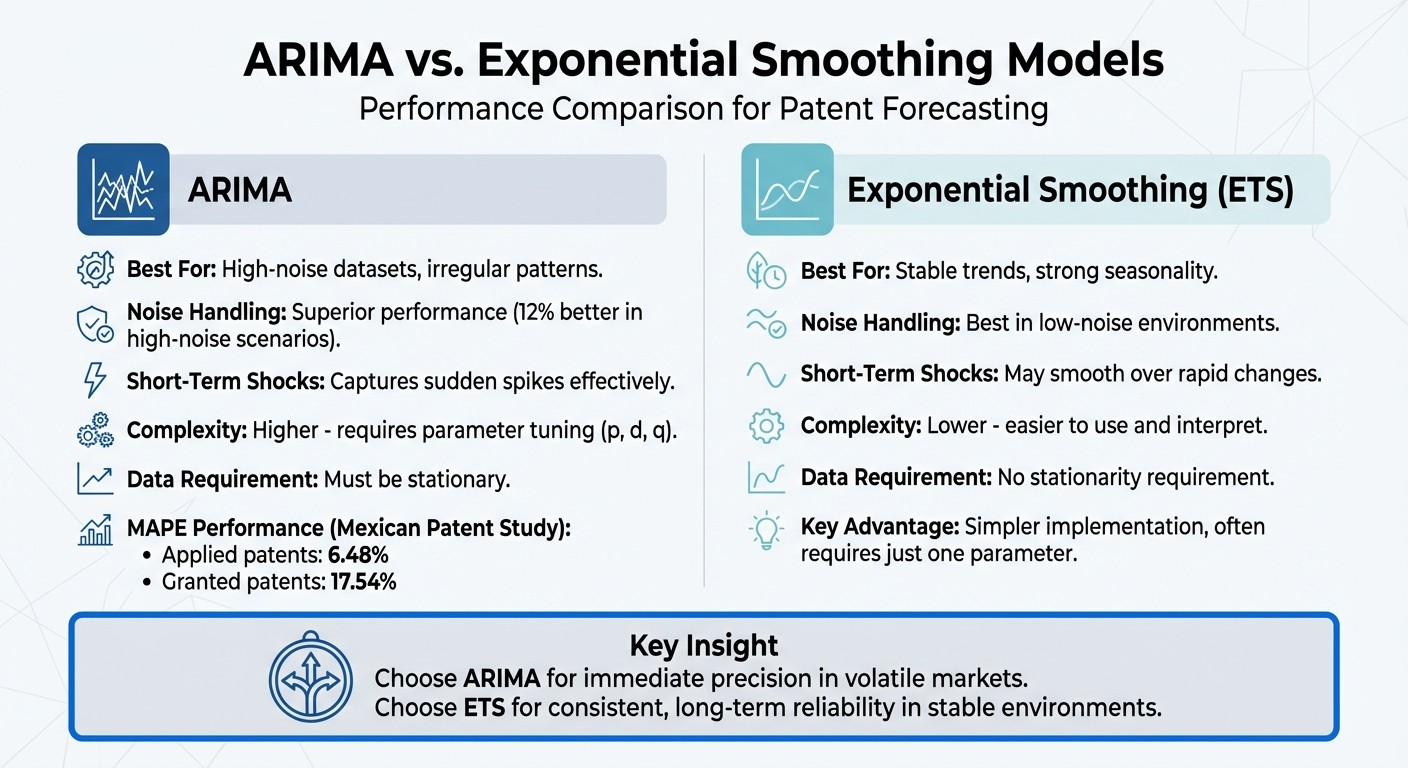
ARIMA vs Exponential Smoothing Models for Patent Forecasting
ARIMA vs. Exponential Smoothing Models
When it comes to forecasting patents, the choice between ARIMA and Exponential Smoothing (ETS) largely depends on how noisy or stable the dataset is, as each model thrives in different scenarios.
ARIMA shines when dealing with datasets that have high levels of noise. Studies indicate it outperforms ETS by around 12% in noisy conditions [[16]](https://flarecompare.com/Machine Learning (ML)/Time-Series Forecasting with ARIMA vs. Exponential Smoothing Which Method is Better). For instance, in an analysis of Mexican patent applications from 1993 to 2024, ARIMA achieved a Mean Absolute Percentage Error (MAPE) of 6.48% for applied patents and 17.54% for granted patents. Its ability to capture short-term fluctuations makes it particularly useful for monitoring emerging technologies, where patent filings can be unpredictable. This makes ARIMA a strong choice for scenarios where short-term precision is critical.
However, no model is without its trade-offs.
"Exponential smoothing emphasizes smoothing over recent observations, it may not respond well to short-term fluctuations... Such short-term impacts are better captured by the autoregressive and moving average components of an ARIMA model." - Sue Liu, Machine Learning Engineer Manager, Kingfisher-Technology
On the other hand, ETS offers simplicity and is better suited for stable trends and seasonal patterns. It is easier to implement, often requiring just one parameter, making it a practical choice for straightforward forecasting tasks. In low-noise environments, ETS performs on par with ARIMA, but its simplicity gives it an edge [[16]](https://flarecompare.com/Machine Learning (ML)/Time-Series Forecasting with ARIMA vs. Exponential Smoothing Which Method is Better). Unlike ARIMA, which requires stationary data (achieved through differencing), ETS directly models levels, trends, and seasonal components, eliminating the need for data transformation.
The key difference boils down to stability versus precision. While deep learning models like LSTM often produce more accurate short-term forecasts, ARIMA consistently delivers stable performance across various scenarios. This makes it particularly appealing for organizations like the USPTO or EPO, where long-term reliability in resource planning is often more critical than short-term accuracy.
Feature | ARIMA | Exponential Smoothing (ETS) |
|---|---|---|
Best For | High-noise datasets, irregular patterns [[16]](https://flarecompare.com/Machine Learning (ML)/Time-Series Forecasting with ARIMA vs. Exponential Smoothing Which Method is Better) | Stable trends, strong seasonality |
Noise Handling | Superior (12% better in high-noise scenarios) [[16]](https://flarecompare.com/Machine Learning (ML)/Time-Series Forecasting with ARIMA vs. Exponential Smoothing Which Method is Better) | Best in low-noise environments [[16]](https://flarecompare.com/Machine Learning (ML)/Time-Series Forecasting with ARIMA vs. Exponential Smoothing Which Method is Better) |
Short-Term Shocks | Captures sudden spikes effectively | May smooth over rapid changes |
Complexity | Higher; requires parameter tuning (p, d, q) [[16]](https://flarecompare.com/Machine Learning (ML)/Time-Series Forecasting with ARIMA vs. Exponential Smoothing Which Method is Better) | Lower; easier to use and interpret [[16]](https://flarecompare.com/Machine Learning (ML)/Time-Series Forecasting with ARIMA vs. Exponential Smoothing Which Method is Better) |
Data Requirement | Must be stationary | No stationarity requirement |
For patent forecasting and strategic decision-making, the choice between these models depends on whether the priority is immediate precision or consistent, long-term reliability.
Conclusion
AI is reshaping how patent trends are forecasted, turning what was once a reactive legal task into a proactive tool for strategic decision-making. The shift from manual keyword searches to semantic analysis - and from basic analytics to predictive insights - empowers professionals to anticipate competitor moves long before products hit the market. This shift also helps streamline R&D processes by identifying innovation opportunities and reducing development timelines.
For example, AI tools can slash prior-art search times by 60–80% and predict patent outcomes with over 80% accuracy. Advanced platforms like Gemini 3 take this a step further, cutting search times from 20 hours to under 2 hours per patent. The rapid growth of the patent analytics market highlights how AI is becoming an essential part of the field. These advancements clearly demonstrate the competitive edge AI provides in patent forecasting.
However, the most effective use of AI comes from combining its capabilities with human expertise. AI excels at processing massive amounts of data, but experienced professionals bring the strategic thinking and legal interpretation needed for nuanced decision-making. This partnership ensures insights are both accurate and actionable.
As shown in various case studies, AI models are delivering both accuracy and predictive power, paving the way for a new era in patent strategy. To keep up, patent professionals should adopt AI-driven monitoring tools for real-time insights, emphasize data quality to ensure comprehensive analysis, and carefully document human input in AI-assisted processes to align with evolving legal requirements. Firms that embrace these practices now will be better equipped to drive innovation in the future.
For those ready to take the leap, platforms like Patently (https://patently.com) offer AI-powered solutions tailored to this new landscape. Features like semantic search using Vector AI, AI-assisted patent drafting, and in-depth analytics help professionals turn raw data into actionable strategies, setting the foundation for smarter, faster innovation.
FAQs
Which AI model should I use for my patent trend forecast?
The right AI model for forecasting patent trends really depends on what you're aiming to achieve and the type of data you're working with. For example, advanced multimodal models like Google's Gemini 3 are exceptional at handling multiple data types - text, diagrams, and claims. This makes them great for reducing manual workload while increasing accuracy.
On the other hand, neural network-based models - especially those using clustering methods - are excellent for spotting emerging trends and working with diverse data formats. Ultimately, your choice should align with whether you need multimodal analysis or the ability to process large datasets efficiently.
What data is needed to forecast patent filings accurately?
Accurate forecasts for patent filings hinge on having access to comprehensive, high-quality data about patent activity. This includes tracking the total number of filings over time, analyzing detailed classifications such as keywords and technology categories, and reviewing patent documents like publications and granted patents. When paired with advanced tools - like AI-powered semantic search - this data becomes even more powerful, improving trend predictions in rapidly evolving fields like AI, biotechnology, and renewable energy.
How can I validate AI patent forecasts and avoid misleading trends?
To ensure the accuracy of AI patent forecasts, it's essential to use thorough methods and cross-check predictions with dependable data sources. Integrate various AI models and datasets, measure outcomes against industry standards, and utilize tools like semantic search to refine precision. Continuously update models with fresh data and compare predictions to real-world filings. This approach minimizes risks and boosts the reliability of your forecasts.