AI vs. Human Translators for Patents
Intellectual Property Management
Mar 23, 2026
Hybrid workflows (AI drafts + expert human review) deliver the accuracy and legal reliability needed for patent translations.
Patent translation is a high-stakes process where precision matters. Even minor errors can jeopardize legal protection, especially in countries like China, where post-issuance corrections are prohibited. Companies increasingly rely on AI tools for speed and cost efficiency, but human translators remain crucial for handling complex legal and technical nuances.
Key takeaways:
AI Strengths: Speed, cost reduction (up to 40%), and consistent terminology.
AI Weaknesses: Struggles with context, new technologies, and legal accuracy.
Human Strengths: Expertise in legal and technical language, accountability, and quality control.
Human Weaknesses: Higher costs and slower turnaround.
For patent translation, a hybrid model combining AI and human review is emerging as the best approach - balancing efficiency, accuracy, and cost.
AI and Patent Translation: Opportunities, Risks and Best Practices
Benefits of AI-Powered Translation for Patents
AI-powered translation brings three standout benefits to international patent filings: speed, cost savings, and terminology consistency. These advantages are invaluable for companies managing extensive patent portfolios across multiple jurisdictions, while also minimizing the risks of translation errors and regulatory setbacks.
Speed and Volume Handling
AI can tackle enormous volumes of patent documents in just hours, making it possible to file in multiple jurisdictions - like the US, EU, and Japan - at the same time, without the delays of sequential processing.
By improving efficiency by 30%–50%, AI-assisted translation becomes a lifesaver for patent professionals working under tight deadlines. This speed can help companies avoid costly rush fees, which often double the expense of translation services. Additionally, AI tools enable attorneys to comb through terabytes of multilingual data for prior art searches, accelerating the validation process across different languages.
Lower Costs
Translation costs often represent a staggering 75%–80% of total filing expenses when converting an English-language application into languages like Chinese, Japanese, Korean, or Russian. AI-driven workflows can slash these costs by roughly 40%.
Globally, companies spend an estimated $1 billion annually on patent translations. By automating repetitive tasks, AI allows translation agencies to offer more competitive rates, while human post-editing ensures quality. According to Clarivate, their AI and machine learning tools boost translation efficiency by up to 35%, directly reducing costs for intellectual property departments.
Uniform Terminology
Consistency in technical terminology is critical for patent filings, and AI excels in this area. It prevents "meaning drift", where human translators might use different terms for the same concept, by adhering strictly to technical language across related patents and large portfolios. Modern Neural Machine Translation systems analyze context, not just individual words, ensuring the most accurate term is chosen when multiple meanings are possible.
Translation Memory systems further enhance consistency by storing previously translated sentences and phrases. When the same terminology appears in future filings or related patent families, the system reuses the exact same translation. This approach is crucial, as even a single mistranslated term can confuse examiners or unintentionally narrow the scope of protection.
While these advantages are game-changing, challenges still exist - particularly when dealing with context-specific language or entirely new technical terms.
Drawbacks of AI in Patent Translation
AI translation offers speed and cost savings, but when it comes to patent documents, it can fall short in critical ways. These shortcomings, including difficulties with context, handling new technologies, and the risk of legal missteps, can undermine the accuracy and reliability needed for patent protection.
Problems with Context and Meaning
AI often struggles to grasp the nuanced context of patent language, especially when dealing with legal terminology. For example, terms like "comprising" and "consisting of" might seem similar, but they carry very different implications for the scope of a patent claim. An AI system might confuse these terms, unintentionally narrowing or broadening the scope of protection in ways the inventor never intended.
Ricardo Vivanco, Partner and QA Director at Vivanco & García, S.L., explains the risk clearly:
The great danger is that NMT can provide patent translations that are apparently correct from a linguistic point of view but are highly questionable when subjected to a rigorous technical analysis in terms of context and terminological accuracy.
The numbers back this up: 81% of IP professionals report encountering errors in patent translations, and 38% of machine-translated legal documents contain mistakes serious enough to impact compliance or enforceability. Even minor errors, like a misplaced comma or the incorrect use of an Oxford comma, can drastically alter the legal meaning of a claim. These challenges become even more pronounced when patents involve cutting-edge technologies.
Difficulty with New Technologies
AI systems also face trouble when translating patents for emerging technical fields. New inventions often require precise, specialized language, but AI may default to imprecise synonyms, which can distort the meaning. For example, in fields like biotech or quantum computing, AI might select terms that sound appropriate but fail to convey the exact technical details of an invention.
Anabel Ruiz, a Content Author at ATLS Global, highlights the core issue:
AI operates on the basis of statistical patterns and linguistic correlations but has no real understanding of the content it processes.
In tests, generic AI translation tools scored about 20 points below the 90% accuracy needed for patent documents to be considered filing-ready. This gap can lead to significant errors when dealing with the evolving lexicon of new technologies.
Legal Risks from Translation Errors
Translation errors don’t just create confusion - they can have serious legal consequences. In some jurisdictions, like China, patent holders cannot correct translation errors once a patent is issued. During prosecution, attempts to fix errors can lead to rejections if the changes are seen as introducing "new matter" not present in the original filing.
The case of IBSA Institut Biochimique S.A. vs. Teva Pharmaceuticals illustrates this risk. A mistranslation of the Italian term for "semiliquid" as "half-liquid" in a U.S. patent filing played a key role in a negative ruling for IBSA. Such errors are not rare - over 25% of IP professionals are aware of cases where translation mistakes significantly harmed a patent applicant’s ability to secure protection.
As Dmitry Yakovlev, a Patent Attorney at Gorodissky & Partners, puts it:
In patent translation, accuracy of translation is of utmost importance, as the scope of patent protection may be badly affected by one improperly place comma.
Advantages of Human Translators for Patents
Even with the advancements in AI, human translators remain critical for patent translations. Their deep expertise, legal accountability, and ability to handle complex patent language make them indispensable for safeguarding intellectual property across borders. These skills directly address the risks and limitations associated with AI-based translations.
Legal and Technical Knowledge
Human translators with backgrounds in specialized fields like biotechnology, chemistry, and engineering are fluent in the precise language of patent drafting. They understand how small linguistic differences - like choosing "comprising" instead of "consisting of" - can dramatically alter the scope of a patent. This level of precision is crucial in ensuring that patents are both accurate and enforceable.
Moreover, experienced translators are well-versed in the specific requirements of various patent offices. For instance, the European Patent Office (EPO), United States Patent and Trademark Office (USPTO), and China National Intellectual Property Administration (CNIPA) each have unique rules for formatting and style. Human experts tailor their translations to meet these jurisdiction-specific standards, reducing the risk of costly revisions or rejections.
Responsibility and Quality Control
One of the key advantages of human translators is their legal accountability. Unlike AI systems, professionals can sign declarations of accuracy required by courts and regulatory bodies, offering a level of responsibility that machines cannot match. Paul Carr, CEO of Welocalize, highlights this distinction:
Algorithms may ensure consistency and volume, yet they cannot assume legal responsibility.
Additionally, professional translation agencies often adhere to ISO 17100:2015 standards. These require a rigorous review process, where a second qualified linguist examines every translation for errors. This multi-layered quality control catches mistakes that could undermine a patent’s legal validity. Human translators also identify issues beyond language - such as logical inconsistencies in the invention’s description, citation errors in prior art, or mismatches between terminology and technical drawings.
Navigating Intricate Patent Terminology
Patents often involve nuanced language that requires careful interpretation. Human translators excel at understanding context, distinguishing subtle differences in obligation, permission, or prohibition - areas where AI models frequently fall short. They cross-reference International Patent Classification (IPC) codes, patent families, and drawings to ensure technical precision.
For groundbreaking inventions, human translators bring professional judgment to describe new concepts accurately. This is a challenge for AI, which struggles with unfamiliar terminology. Andy Benzo, President of the American Translators Association, underscores this limitation:
The nuance of each word is very specific and the (large language models) aren't there yet, by far.
This expertise is especially critical for complex language pairs like Japanese-English or Slavic-English, where AI often misinterprets characters, word order, or passive constructions. Human translators bridge these gaps, ensuring that the translation captures the full intent and meaning of the original text.
AI vs. Human Translators: Direct Comparison
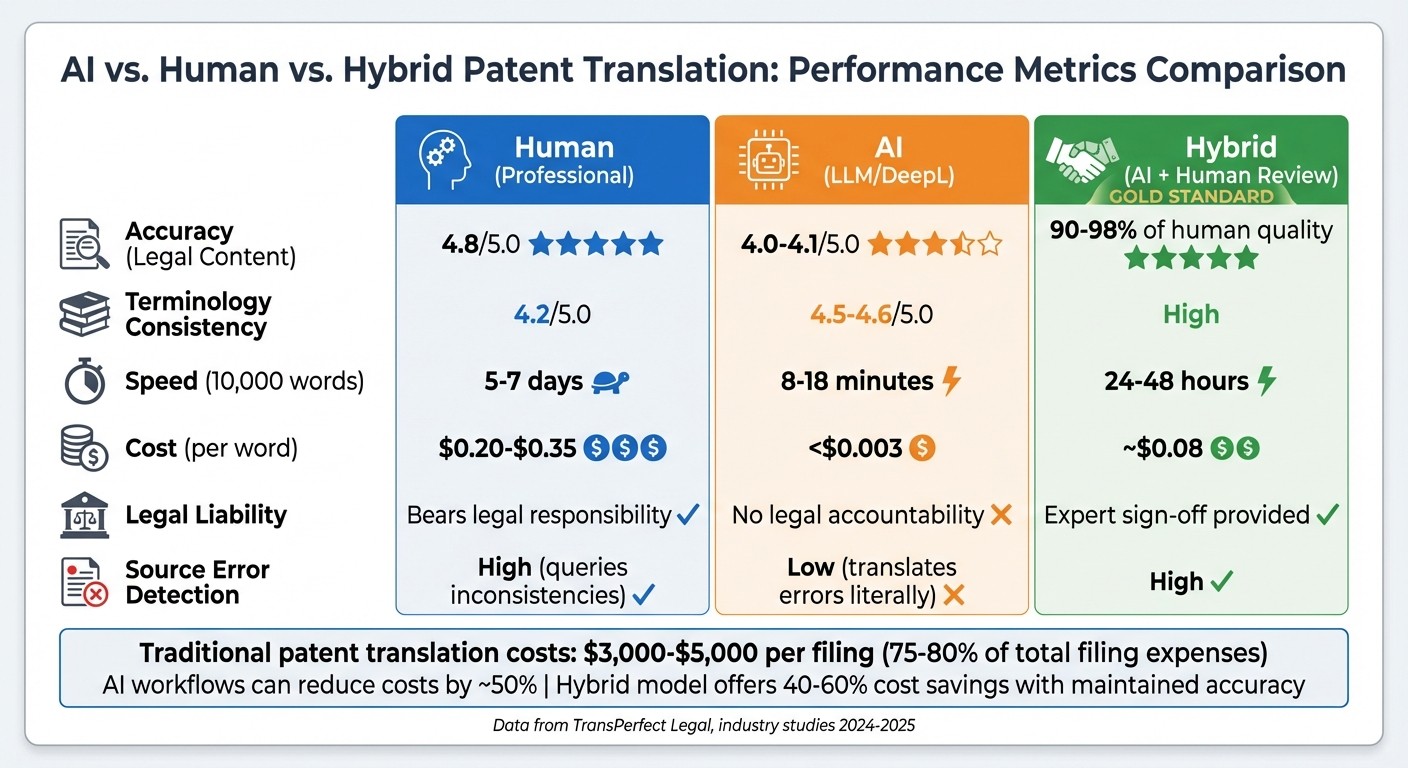
AI vs Human vs Hybrid Patent Translation: Performance Metrics Comparison
Patent translation demands a delicate balance of accuracy, speed, and legal responsibility. It’s not just about cost; each patent filing has unique needs. This comparison lays out the strengths and weaknesses of AI and human translators, helping IP professionals make better decisions.
Key Metrics Comparison
The performance gap between AI and human translators depends on the content type. For general technical documents, AI reaches 93% of human quality. However, with specialized legal content, the gap widens to 15–17%. When rated on a 1-5 accuracy scale for legal content, professional human translators score 4.8, while leading AI models like GPT-4 and DeepL score 4.0 and 4.1, respectively. Here’s a breakdown:
Metric | Human (Professional) | AI (LLM/DeepL) | Hybrid (AI + Human Review) |
|---|---|---|---|
Accuracy (Legal Content) | 4.8 / 5.0 | 4.0 - 4.1 / 5.0 | 90-98% of human quality |
Terminology Consistency | 4.2 / 5.0 | 4.5 - 4.6 / 5.0 | High |
Speed (10,000 words) | 5 - 7 days | 8 - 18 minutes | 24 - 48 hours |
Cost (per word) | $0.20 - $0.35 | < $0.003 | ~$0.08 |
Legal Liability | Bears legal responsibility | No legal accountability | Expert sign-off provided |
Source Error Detection | High (queries inconsistencies) | Low (translates errors literally) | High |
Translating an English patent into languages like Chinese, Japanese, Korean, or Russian traditionally costs $3,000–$5,000, making up 75–80% of filing expenses. AI workflows can slash patent translation costs by nearly 50%, reducing total filing costs by about 40%.
The big trade-off here is between speed and precision. AI excels at speed, converting thousands of pages in hours, while human translators take weeks for intricate technical descriptions. But speed comes at a cost. As patent translator Steve Vitek points out:
Unless and until the text is 'validated' by being processed through the brain of an experienced human translator, it cannot really be called a translation... I call such 'documents' pseudo-translations.
This is where the hybrid approach shines. Combining AI-assisted drafts with professional human review strikes a balance. TransPerfect Legal describes it as:
The combination of translation memory and AI technology augmenting expert human review is now the gold standard of producing quality patent translations.
This method improves productivity by 40% without sacrificing legal accountability, offering a practical solution that blends speed with reliability. The next section takes a closer look at how this hybrid model works.
Combining AI and Human Translation
The hybrid model has become a go-to approach in patent translation, blending AI's efficiency with human expertise to ensure accuracy. By combining the speed of AI with the meticulous precision of human review, this method sets a high standard for quality. As TransPerfect Legal explains:
The combination of translation memory and AI technology augmenting expert human review is now the gold standard of producing quality patent translations.
Here's how it works: AI generates an initial draft using neural engines and translation memory. Then, certified patent linguists step in to refine the translation, focusing on legal terminology and contextual accuracy. Finally, a thorough review ensures the translation meets the standards of local patent offices.
Human Review of AI Translations
In this workflow, human reviewers play a critical role in bridging the gap between AI-generated drafts and the precision required for patent translations. AI handles the bulk of the work, but human translators bring their expertise to fine-tune the output. They address issues that AI often misses, such as logical inconsistencies, citation errors, and unclear legal language.
A key part of this process is Full Post-Editing (FPE). Unlike light editing, which only corrects surface-level mistakes, FPE involves a deeper review, elevating AI translations to a quality level that is nearly indistinguishable from fully human-produced work - achieving 95–99% human equivalence. This is particularly important for patent claims, where even a minor mistranslation can significantly impact the scope of an invention. Human reviewers also consult technical drawings and research the International Patent Classification (IPC) to clarify ambiguities that AI might misinterpret.
This collaborative approach not only eliminates common AI errors but also improves translation quality over time. Modern systems incorporate adaptive learning, allowing AI models to learn from human corrections in real time. For instance, platforms like Lara synchronize edits across the document instantly, streamlining the process for subsequent sections.
Real Applications in Patent Localization
The hybrid model has proven its value in real-world scenarios, particularly in managing high-volume patent filings. By 2025, 67% of the localization industry had adopted Machine Translation Post-Editing (MTPE), largely due to its ability to reduce costs by 30–50% while maintaining the high level of quality required for legal documents.
The productivity benefits are also clear. MTPE workflows allow linguists to process 3,000–5,000 words per day, compared to the 2,000–2,500 words typically handled through manual translation alone. This makes the hybrid approach especially effective for large-scale filings across multiple jurisdictions.
Additionally, the workflow ensures efficient resource allocation. Automated systems now direct technical documents to pure AI translation, while patent claims and legal filings are routed through the hybrid model, combining AI with full post-editing and expert review. This ensures that critical tasks receive the detailed attention they require, balancing speed with the precision demanded in legal contexts.
What's Next for Patent Translation
The growing need for quicker and more budget-friendly patent localization is fueling rapid market growth. But expansion alone doesn’t solve the challenges at hand. The pressing issue is whether AI can adapt to meet the intricate legal and technical demands of patent translation. This highlights the importance of innovations that balance speed with the precision patents require.
AI Training for Specific Domains
General translation tools often fall short when it comes to patents - they simply lack the context to handle the specialized language. The answer lies in domain-specific training. AI models are now being tailored using extensive patent databases in areas like biotechnology, medical devices, and green technology. This focused training allows AI to grasp industry-specific terminology and maintain technical accuracy.
Customizing Neural Machine Translation (NMT) engines with resources like translation memories, glossaries, and preferred terminology can boost quality by as much as 50%. Advanced tools also use Named Entity Recognition (NER) to pinpoint and extract key patent-specific details, such as inventor names, patent numbers, and technical terms. Additionally, Natural Language Processing (NLP) helps analyze the structure, syntax, and meaning of patent documents, ensuring clarity in even the most ambiguous legal language.
However, human oversight remains critical for legal accuracy. Specialized patent AI systems have scored an average of 89.5% in Linguistic Quality Assessments - just shy of the 90% benchmark for filing readiness without human review. As LingArch emphasizes:
The future of patent translation isn't about man versus machine. It's about intelligent collaboration. AI delivers speed and scalability, but human expertise ensures precision, integrity, and legal validity.
These advancements in domain-specific training are paving the way for deeper integration into broader systems.
AI Integration with IP Platforms
Building on domain-specific progress, AI is now being woven directly into Intellectual Property (IP) management systems. This integration embeds translation tools within existing workflows, eliminating the need to switch between systems. Some leading IP platforms already offer real-time global filing capabilities paired with centralized control.
For instance, a recent case study demonstrated a three- to four-fold improvement in patent workflows using an AI-powered Patent Copilot. This not only made fixed-fee work more feasible but also maintained high-quality standards.
Platforms like Patently are leveraging such advancements to streamline patent processes. With tools like Onardo for AI-assisted patent drafting and Vector AI for advanced semantic search, Patently enables professionals to manage translations, drafting, and analytics within a single, unified environment. This reduces administrative workloads and ensures consistency across patent families.
Looking ahead, blockchain technology could be integrated to provide traceability in translations and verify intellectual property. Additionally, there’s a move toward purpose-built NMT engines, which are less prone to errors like hallucinations in technical contexts compared to general-purpose Large Language Models (LLMs).
Conclusion: Choosing the Right Approach
Selecting the best patent translation method hinges on the legal stakes and technical requirements involved. Even a single mistranslation can jeopardize patent protection, so the stakes are high.
As discussed earlier, each translation method comes with its own set of advantages and compromises. The choice ultimately depends on the specific context. By 2026, the three-tiered hybrid model emerged as an industry standard, offering 40–60% cost savings while maintaining the accuracy necessary for patent filings.
Here are some key takeaways to help intellectual property professionals align translation strategies with the specific needs of their patents.
Key Points for IP Professionals
Match the method to the stakes.
For quick and cost-effective internal screening or discovery, pure AI translation works well, with costs ranging from $1–$10 per 1,000 words. For technical documents and patent specifications, a hybrid approach (AI-assisted translation with human post-editing) is ideal, costing $50–$150 per 1,000 words. For high-stakes scenarios like litigation or patent claims requiring near-perfect accuracy, human-first translation is the safest bet.
Use patent-aware AI tools.
Not all AI translation engines are created equal. Generic tools may struggle with the nuances of patent language, particularly claim structures. Instead, opt for domain-specific AI systems trained on patent databases to minimize errors and reduce the need for legal corrections. Also, prioritize platforms with secure API connections to safeguard sensitive patent data.
Weigh risk alongside cost.
Errors in patent translations aren't just small mistakes - they can lead to serious legal consequences. In some jurisdictions, translation costs make up 75–80% of total filing expenses. This underscores the importance of balancing cost efficiency with the precision needed to ensure robust patent protection.
FAQs
When is AI-only translation safe for patent work?
AI-powered translation can be a reliable option for patent work, but only when the system shows strong accuracy, dependability, and consistent performance. It works best for simpler content where exact legal or technical precision isn't as crucial. That said, for intricate legal claims or highly detailed technical descriptions, human review is a must to ensure precision and minimize potential risks. Always double-check translations to uphold quality and protect legal integrity.
What should a human reviewer check in an AI patent translation?
Human reviewers play a key role in ensuring AI translations are precise, especially when it comes to technical terms, legal phrasing, and detailing invention features. They need to confirm that terminology remains consistent and fits the context, particularly in essential parts like claims and descriptions. Their expertise is vital for spotting subtle errors, clarifying ambiguous language, and protecting the patent’s legal integrity and enforceability.
How do I protect confidentiality when using AI for patent translation?
To safeguard sensitive information, it's crucial to select AI translation tools that emphasize data security. Opt for platforms equipped with strong encryption, secure data storage, and adherence to confidentiality regulations. Carefully examine privacy policies and non-disclosure agreement (NDA) terms to maintain control over your data. Internally, enforce strict protocols, restrict access to only authorized individuals, and rely on AI tools specifically designed for secure handling of patent-related work. These measures can help reduce the risk of data breaches or unauthorized disclosures.