How SEP Analytics Reduces Legal Risks
Intellectual Property Management
Mar 24, 2026
SEP analytics helps companies monitor SEP declarations, ensure FRAND compliance, predict litigation, and cut legal costs with real-time risk monitoring.

Managing Standard Essential Patents (SEPs) can be risky, but SEP analytics tools are changing the game. These tools help companies avoid legal trouble by analyzing data, monitoring compliance, and predicting risks tied to SEPs. Here's how they help:
Tackle FRAND Licensing Issues: SEP analytics ensure licensing terms are fair and reasonable by analyzing market data and spotting potential violations early.
Predict Legal Disputes: AI-driven tools forecast litigation risks using historical data, helping companies act before problems escalate.
Monitor Compliance in Real-Time: Automated systems track SEP declarations and licensing updates, reducing the chance of regulatory penalties.
Cut Legal Costs: Early detection of risks saves time and money by preventing costly disputes and legal challenges.
How to Use Standard Essential Patent Data for a FRAND Defense Strategy
How SEP Analytics Ensures FRAND Compliance
Addressing FRAND risks effectively requires a robust approach, and advanced SEP analytics provide the tools to ensure compliance through detailed data analysis. Meeting FRAND obligations involves carefully verifying licensing terms and patent declarations. Tools like Patently's AI-powered SEP analytics analyze market data, comparable licenses, and patent claims to establish royalty rates that align with FRAND principles. These tools also identify pricing anomalies that could indicate potential FRAND violations, allowing legal teams to address issues before they escalate into expensive legal battles. This level of analysis supports two critical tasks: spotting inconsistencies in licensing agreements and ensuring the accuracy of SEP declarations.
Detecting Licensing Agreement Inconsistencies
One of the most important aspects of FRAND compliance is catching deviations in licensing terms early. SEP analytics platforms achieve this by examining licensing programs, pool structures, and rate benchmarks to identify terms that stand out as potential outliers. Additionally, automated claim-to-standard mapping uncovers any gaps or ambiguities in licensing agreements that could lead to disputes over FRAND compliance.
Verifying SEP Declaration Accuracy
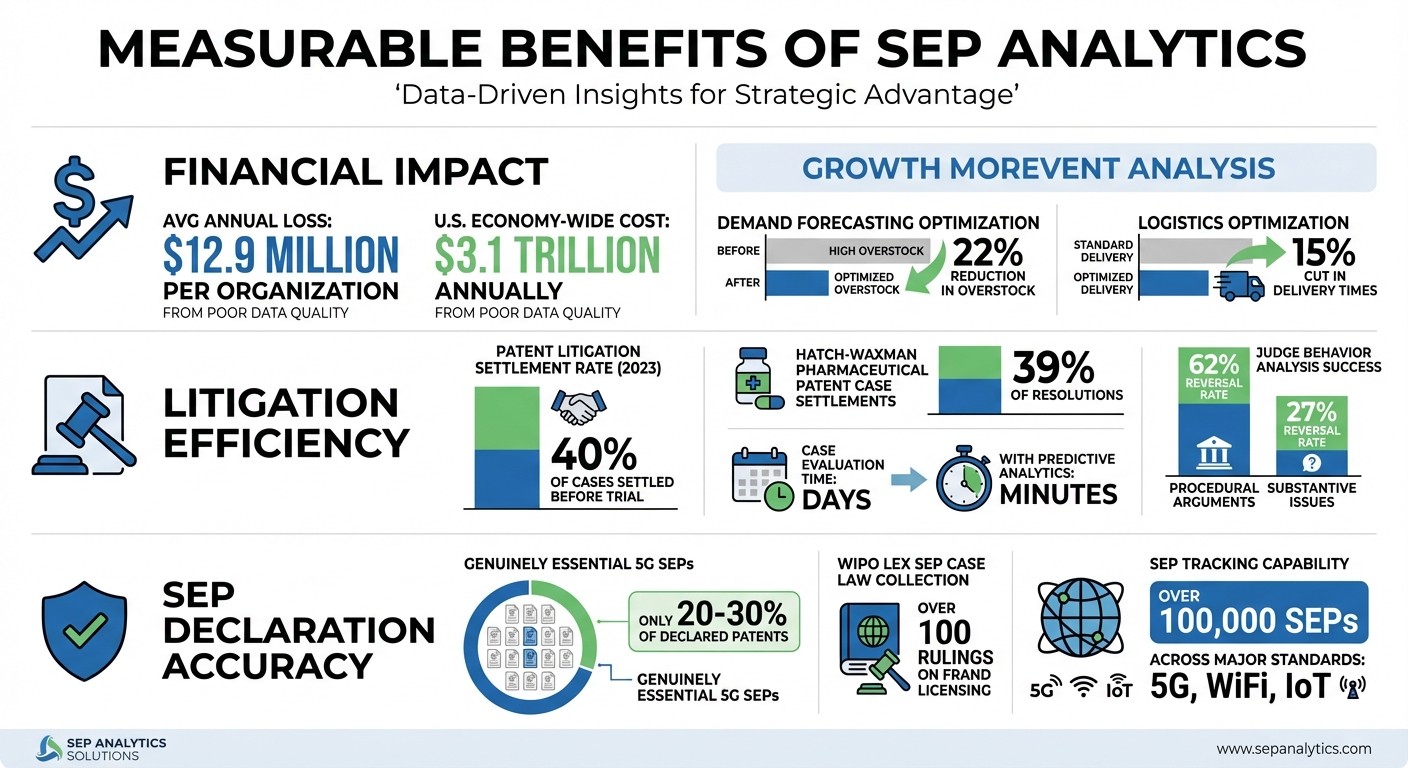
Beyond identifying licensing inconsistencies, AI also plays a critical role in verifying the accuracy of SEP declarations. Over-declaration can jeopardize FRAND compliance, and industry figures suggest that only 20% to 30% of declared 5G SEPs are genuinely essential to the standard. SEP analytics tools help mitigate this risk by offering centralized tracking of SEP declarations across organizations like ETSI and IEEE, ensuring that public commitments remain consistent. These tools also incorporate verification data from patent pool administrators such as Sisvel, cross-referencing internal declarations with independent essentiality assessments. To further enhance credibility, the WIPO Lex SEP Case Law Collection - featuring over 100 rulings on FRAND licensing - provides a valuable resource for benchmarking practices against judicial decisions. Together, these efforts strengthen the reliability of licensing practices.
Predicting Legal Risks in SEP Portfolios
Predictive analytics is taking SEP (Standard-Essential Patent) management to the next level by forecasting potential legal disputes before they even arise. By leveraging historical data and AI-driven modeling, advanced SEP analytics and patent tools help patent professionals anticipate risks and manage their portfolios more effectively. This approach shifts the focus from reactive litigation to proactive risk management.
Modeling Litigation and Settlement Outcomes
Using historical court data, judicial behavior patterns, and patent-specific details, SEP analytics platforms create quantitative frameworks to estimate the likelihood of disputes and their potential outcomes. These models consider factors such as patent family size, the number of claims, and citation data to forecast results based on past trends.
Interim milestones play a critical role in these predictions. Events like motions for summary judgment or Markman hearings can provide insights into case outcomes and serve as turning points for settlement discussions. For instance, in 2023, 40% of patent litigation cases were settled before trial, and settlements accounted for 39% of resolutions in Hatch-Waxman pharmaceutical patent cases.
Additionally, these methods go beyond cash settlements, analyzing terms like royalty structures, side agreements, or quantity restrictions. This helps legal teams assess the true economic value of settlements while identifying potential antitrust concerns. Such outcome models enable a more strategic and informed approach to legal decision-making.
Enabling Data-Driven Legal Strategy
Predictive analytics equips legal teams with the tools to make smarter, data-backed decisions about resource allocation, licensing negotiations, and litigation strategy. By analyzing extensive datasets, these tools can uncover risks and policy violations that might otherwise go unnoticed through manual reviews. This allows for early intervention in cases of mismanagement or compliance issues.
For example, legal teams can focus their efforts on high-priority risks where deviations from standard policies are detected. A notable case occurred in August 2021 when the SEC's Division of Enforcement used risk-based analytics to uncover improper accounting practices at Healthcare Services Group, Inc. The findings showed that the company narrowly avoided missing analysts' earnings estimates by just a penny in several quarters, underscoring the power of data-driven insights.
Implementing Continuous Risk Monitoring
Predictive analytics can help forecast risks, but continuous monitoring takes things a step further by identifying changes as they happen. This approach allows organizations to intervene immediately, rather than waiting until audits or legal challenges arise. By adopting real-time tracking systems, businesses can spot compliance gaps or licensing updates as they occur.
Today's SEP analytics platforms provide a centralized view of data from multiple standards bodies like ETSI and IEEE. These tools can process data on over 100,000 SEPs tied to major standards, including 5G, WiFi, and IoT, offering timely and reliable insights. This proactive approach shifts organizations away from reactive risk management, enabling them to stay ahead of licensing changes and compliance challenges.
Tracking Licensing Agreement Changes in Real Time
Automated systems now make it possible to monitor updates in licensing programs, patent pools, and rate benchmarks continuously. AI tools assess licensing terms and market data in real time. This is especially important as courts increasingly set global FRAND rates for entire patent pools rather than individual portfolios.
For instance, in the InterDigital v Lenovo case, judicial review raised the lump sum payment from $138.7 million to $178.3 million. Additionally, patent pools like Access Advance are now allowed to intervene in disputes to defend their licensing terms. By using a unified monitoring platform, organizations can avoid legal exposure across different standards bodies and ensure consistency in compliance.
Addressing Compliance Issues Early
Catching compliance issues early can save organizations from costly litigation. For example, UK courts require "willing licensees" to actively engage with SEP owners and set aside royalty funds from the outset. As the UK Court of Appeal noted:
"A willing licensee would not sit back and wait for demands from SEP owners, but would pro-actively contact SEP owners... and would put money aside for payment of royalties."
Recent rulings also suggest that limitation periods may not apply to past sales in FRAND assessments, meaning implementers must pay for licenses from the moment they start using a standard. To avoid penalties, organizations should establish royalty reserves early, demonstrating their commitment to compliance and reducing potential interest or cost sanctions.
Regulatory bodies are also stepping in with preventive measures. For example, China's State Administration for Market Regulation (SAMR) now uses "soft" enforcement tools like urgent reminder letters to warn companies of antitrust risks before launching formal investigations. Continuous monitoring helps businesses catch these early warnings, enabling them to address issues before regulatory action is taken. This proactive approach protects FRAND compliance and minimizes the risk of expensive disputes.
Measurable Benefits of SEP Analytics
SEP Analytics Impact: Cost Savings and Compliance Benefits
Lowering Legal Expenses Through Early Detection
SEP analytics can help significantly cut legal costs by spotting potential risks early on. Predictive tools, for example, allow legal teams to evaluate disputes quickly - what used to take days of manual research can now be done in minutes. A Florida-based firm utilized analytics to review defendant histories and jurisdictional trends, enabling them to decline high-risk claims or settle disputes before litigation. Meanwhile, a New York defense team used analytics to secure an early dismissal in a securities fraud case. By studying a judge's past preferences for legal framing, they prioritized procedural arguments, which predictive modeling showed had a 62% reversal rate compared to 27% for substantive issues. NexLaw highlights this shift:
"With predictive analytics, firms no longer spend days digging through case law to determine risk. They can get preliminary estimates on case strength, judge behavior, and optimal filing strategies in minutes".
Access to historical case outcomes also strengthens lawyers' positions during settlement negotiations, moving discussions away from speculation to data-backed arguments. These early detection capabilities don’t just reduce costs - they also improve compliance and operational efficiency, as explored next.
Achieving Better Compliance and Efficiency
SEP analytics doesn’t just lower legal risks - it also boosts compliance and streamlines processes. Companies using these tools have reported tangible improvements, such as a 22% reduction in overstock through better demand forecasting and a 15% cut in delivery times via optimized logistics. Key governance measures like audit trails, data lineage tracking, and row-level security ensure analytics remain aligned with company policies and regulatory requirements.
Prashanth Southekal, Head of DBP-Institute, emphasizes that the real value lies not just in collecting data but in using it effectively. He explains:
"When it comes to analytics, what you do with that insight is equally important. That's part of the business efficiency".
Embedding compliance into the analytics workflow early and creating shared metrics across departments can prevent "metric drift", ensuring consistent standards. This approach supports both immediate legal risk management and long-term operational improvements.
Conclusion
SEP analytics is reshaping how organizations handle patent management, significantly reducing legal risks. Instead of relying on periodic manual reviews, these tools allow for real-time compliance monitoring, a shift that aligns with updated regulatory expectations. In fact, the U.S. Department of Justice now evaluates whether companies use data analytics to measure the effectiveness of their compliance programs, highlighting the need for proactive adoption.
The financial stakes are high. Organizations face an average annual loss of $12.9 million due to poor data quality, while the broader U.S. economy shoulders a staggering $3.1 trillion burden each year from the same issue. Automated alerts provided by SEP analytics catch anomalies early, stopping small errors from snowballing into costly liabilities.
For patent professionals, platforms like Patently provide tools to turn compliance challenges into strategic opportunities. By integrating risk analysis into the early planning stages of business operations, companies can save significant resources compared to addressing compliance issues reactively. As Semarchy aptly puts it:
"strong data governance provides the structure that makes regulatory compliance a natural result, rather than just a box-ticking exercise".
Patently’s SEP analytics tools empower organizations with data-driven decision-making and continuous risk monitoring. This not only builds trust among stakeholders but also strengthens operational resilience.
In 2026, real-time risk management has become the benchmark for organizations committed to protecting their assets and maintaining compliance.
FAQs
What data do SEP analytics tools need to assess FRAND risk?
SEP analytics tools rely on data about standard-essential patents, licensing commitments, and details of patent ownership. This data plays a key role in assessing compliance with Fair, Reasonable, and Non-Discriminatory (FRAND) obligations and evaluating potential legal risks tied to these commitments.
How can SEP analytics tell if a declared SEP is truly essential?
Standard Essential Patent (SEP) analytics focus on examining technical and patent data to assess whether a declared SEP is truly indispensable to a specific standard. By doing this, these analytics help verify genuine essentiality, minimizing over-declaration and supporting adherence to FRAND (Fair, Reasonable, and Non-Discriminatory) obligations.
What should companies monitor in real time to stay FRAND-compliant?
To stay aligned with FRAND obligations, businesses need to monitor their standard-essential patents (SEPs) and licensing commitments continuously. This approach helps ensure they meet regulatory standards while adhering to fair, reasonable, and non-discriminatory practices.