Global IP Compliance Standards for Sustainability
Intellectual Property Management
Mar 25, 2026
Global IP compliance is shifting to drive climate action: regional policies, green patents, and tools reshaping patent strategy.

The global intellectual property (IP) landscape is shifting to address climate challenges. Patents now play a key role in promoting green technologies like renewable energy, advanced batteries, and waste management. Here's what you need to know:
2026 IP Index Highlights: The U.S. leads with a 95.15% score, followed by the UK (93.98%) and France (93.11%). Emerging markets like the UAE saw significant improvements (+4.72%).
Green Patent Initiatives: India’s expedited process cuts approval times from years to months. China prioritizes green patents for large-scale projects, while Europe promotes collaborative licensing.
Regional Trends: The EU enforces IP tied to ecological goals, the U.S. relies on private-sector innovation, and Asia-Pacific nations focus on integrating IP into industrial strategies.
Challenges: Counterfeit goods harm ecosystems, dense patent landscapes hinder new entrants, and smaller businesses face barriers in accessing IP systems.
Solutions: Simplified patent processes, collaborative licensing, and linking IP to measurable outcomes are helping align IP with climate goals.
Businesses must align IP strategies with sustainability priorities to stay competitive. Tools like Patently simplify compliance, drafting, and portfolio management, enabling companies to integrate environmental goals into their IP frameworks effectively.
Intellectual Property and Sustainable Development
Regional Sustainability Standards in IP Compliance
Regions tailor their intellectual property (IP) systems to align with their sustainability goals. The European Union, the United States, and Asia-Pacific countries each have distinct frameworks shaped by their economic priorities, regulatory approaches, and environmental commitments. For companies operating globally, understanding these regional differences is crucial to protecting green innovations across borders.
EU Sustainability Directives and IP Alignment
The European Union has developed a tightly integrated approach that connects IP enforcement with environmental protection. As the European Commission explains:
Counterfeit products can put at risk consumer safety and health, and can harm the environment. The EU supports strong IPR standards to tackle IPR infringements in the EU and abroad.
This policy highlights the ecological risks of counterfeit goods, which often bypass production and disposal regulations, causing additional environmental harm.
To address these issues, the EU enforces high IP standards internationally through bilateral agreements, making it easier to commercialize green technologies globally. The EU also funds technical cooperation initiatives to help developing countries strengthen their IP systems, paving the way for sustainable innovations to scale worldwide. For example, on May 22, 2025, the European Commission released its biennial Report on the Protection and Enforcement of Intellectual Property Rights in Third Countries. Later, on February 12, 2026, it requested a WTO panel to address China's trade practices that impacted royalties in the EU's high-tech sector.
To assist businesses, the EU operates IPR SME Helpdesks in regions like China, Latin America, and Southeast Asia, offering guidance on protecting green innovations. Additionally, the Commission published the third edition of its Counterfeit and Piracy Watch List in 2025, identifying high-risk markets outside the EU. Geographical Indications (GIs) are another tool the EU uses to protect products tied to specific regions, supporting sustainable local economies.
In contrast, the U.S. takes a more market-driven approach to green innovation.
US IP Policies and Green Innovation
The United States has one of the world's most robust IP protection systems, but its approach to green innovation is largely market-driven. Unlike the EU's collaborative strategies - such as patent pools and standard-essential licensing for clean technologies - the U.S. relies on traditional patent rights. American companies typically pursue commercialization independently, leveraging private investments and licensing opportunities rather than structured government support. While this system encourages innovation, it can also create hurdles in ensuring fair access to critical green technologies.
Asia-Pacific Trends in Sustainable IP Compliance
The Asia-Pacific region is quickly becoming a leader in sustainable IP compliance, with policies designed to accelerate green innovation. In December 2025, ASEAN introduced the ASEAN Intellectual Property Rights Action Plan (AIPRAP) 2026–2030, aimed at using IP to promote sustainable and inclusive growth. As HE Vichea Suon of the Royal Government of Cambodia stated:
ASEAN has become a highly integrated and cohesive economic bloc connected with the global economy.
India has streamlined its green patent processes to strengthen its position as a leader in eco-innovation. Meanwhile, China incorporates green patents into its industrial strategy, channeling state funds into scalable technologies and prioritizing domestic renewable products through procurement preferences. Japan’s Green Transformation (GX) Patent Initiative encourages technology sharing via databases and voluntary licensing frameworks, supported by tax incentives to maintain competitiveness.
Elsewhere in the region, countries like Vietnam and Thailand have established specialized IP courts to handle complex enforcement cases. Additionally, efforts to digitize IP offices are improving accessibility and transparency for smaller businesses. On March 18, 2026, Vietnam enacted its first standalone AI Law, signaling a strong commitment to addressing challenges in emerging technologies. The ASEAN Secretariat emphasized:
The new Action Plan [AIPRAP 2026-2030] builds on past achievements while responding to emerging trends such as digitalisation, the growing importance of intangible assets, and the need for more integrated regional cooperation.
These regional developments provide valuable insights into best practices for navigating IP compliance in emerging markets.
Best Practices for Sustainable IP Compliance in Emerging Markets
Emerging markets are increasingly aligning their intellectual property (IP) systems with sustainability goals to support climate initiatives. However, challenges like mismatched patent approvals and high regulatory costs often slow the adoption of green technologies. For instance, in India, faster patent approvals don’t always translate into real-world technology deployment.
The most effective strategies in these markets involve embedding IP into broader industrial policies. Take China, for example - it links green patent approvals to state funding, manufacturing objectives, and procurement priorities. This ensures that patented technologies are not just protected but also actively brought to market. Similarly, India’s Rule 24C expedites patent examinations, significantly reducing wait times. These approaches demonstrate that treating IP as a tool for climate action - rather than an isolated legal framework - can accelerate both innovation and practical applications.
Another critical practice is connecting IP agreements to measurable sustainability outcomes. Instead of viewing patents solely as legal shields, governments and companies are tying licensing terms to metrics like deployment rates and carbon reduction. India’s Patents Act, through Sections 83 and 84, incorporates working requirements that ensure patented green technologies are commercialized at reasonable prices to meet societal needs. This approach strikes a balance between protecting patent holders' rights and advancing public interests in combating climate change.
Dense patent landscapes, especially in sectors like lithium-ion battery technology, pose additional hurdles. Companies like LG Chem and CATL dominate with 803 and over 130 lithium battery patents, respectively, creating significant barriers for new entrants. To address this, some markets are turning to collaborative licensing models, such as patent pools, which simplify access to critical technologies for local innovators.
Simplifying IP processes is also crucial for smaller businesses and rural inventors who often operate outside formal IP frameworks. For example, Ethiopia’s trademarking of its coffee products in the early 2000s led to a 275% boost in export prices. Similarly, Cambodia’s registration of Kampot pepper as a Geographical Indication tripled local incomes. These cases highlight how adapting IP systems to local needs and sustainability objectives can drive both innovation and economic growth.
Global IP Compliance Scores: Regional Comparison
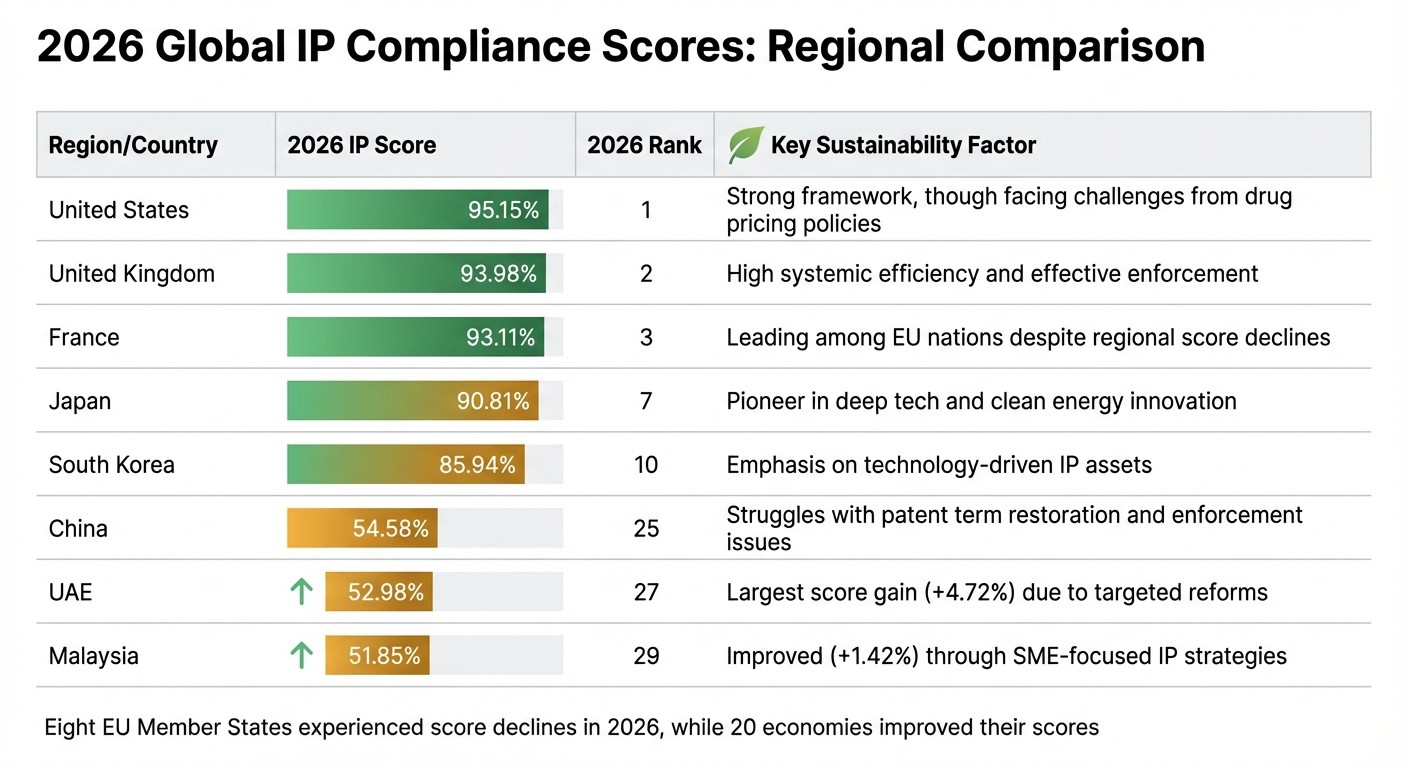
2026 Global IP Compliance Scores by Region and Sustainability Factors
The global landscape of intellectual property (IP) compliance is shifting, with traditional leaders like the US, UK, and France maintaining their strong positions, while emerging markets are making noticeable progress.
Eight EU Member States experienced score declines in 2026, largely due to legislative changes that affected IP standards. On the other hand, 20 economies improved their scores, driven by reforms aimed at sustainability and supporting small and medium-sized enterprises (SMEs). Among emerging markets, the UAE achieved the largest improvement with a 4.72% increase, followed by Ecuador at 2.81% and Malaysia at 1.42%.
This section delves into regional trends, highlighting differences between high-income and emerging economies. While high-income nations continue to lead, the gap in some areas is narrowing. Japan, for instance, ranks seventh globally with a score of 90.81%, excelling in deep tech and clean energy innovation. South Korea, ranked tenth with 85.94%, reflects its strong focus on technology-driven IP policies. Meanwhile, China, ranked 25th with a score of 54.58%, faces challenges such as patent term restoration, which limits the entry of foreign green technologies.
Regional IP Compliance Score Table
Here’s a snapshot of regional scores and the factors driving sustainability efforts:
Region/Country | 2026 IP Score | 2026 Rank | Key Sustainability Factor |
|---|---|---|---|
United States | 95.15% | 1 | Strong framework, though facing challenges from drug pricing policies |
United Kingdom | 93.98% | 2 | High systemic efficiency and effective enforcement |
France | 93.11% | 3 | Leading among EU nations despite regional score declines |
Japan | 90.81% | 7 | Pioneer in deep tech and clean energy innovation |
South Korea | 85.94% | 10 | Emphasis on technology-driven IP assets |
China | 54.58% | 25 | Struggles with patent term restoration and enforcement issues |
UAE | 52.98% | 27 | Largest score gain (+4.72%) due to targeted reforms |
Malaysia | 51.85% | 29 | Improved (+1.42%) through SME-focused IP strategies |
Across Africa, Asia, and the Middle East, seven economies climbed the rankings by implementing initiatives that help SMEs commercialize their IP assets. However, 27 economies showed minimal or no progress, highlighting the ongoing need for reform and innovation.
How Patently Supports Sustainable IP Compliance

As global intellectual property (IP) standards shift to emphasize sustainability, patent professionals need tools that simplify managing green innovation portfolios while staying aligned with changing regulations. Patently's AI-powered platform addresses this challenge by combining compliance tracking, automated drafting, and collaborative workflows into a single, streamlined solution for IP teams. Here’s how Patently enhances these essential processes.
AI Patent Drafting for Green Innovation
Patently's generative AI assistant, Onardo, transforms how patent specifications for sustainable innovations are drafted. By automatically labeling figure features and creating editable diagrams based on provided claims and drawings, Onardo allows professionals to dedicate more time to strategic innovation efforts.
"Patently is the drafting robot with the best UI and best Figure editor."
– Martin Schweiger, AI Patent Drafting Expert
What makes Onardo particularly valuable for sustainability-focused portfolios is its built-in prior art search. Using Vector AI, the system identifies relevant prior art in real time during the drafting process, ensuring that new innovations meet patentability requirements and stand out in the field.
But Patently’s utility doesn’t stop at drafting - it also excels in compliance monitoring.
Semantic Search and Global Compliance Monitoring
Patently employs Vector AI-powered semantic search to help IP teams stay on top of compliance requirements across various jurisdictions. By centralizing patents, trademarks, and licensing agreements, the platform simplifies and speeds up regulatory decision-making. Jerome Spaargaren, Founder and Director of Patently, highlights this feature:
"With the implementation of Elastic Cloud, we've been able to significantly expand our product offerings by introducing Vector AI... It's even used by our AI patent drafting assistant, Onardo, to search for prior art whilst preparing a patent specification."
This advanced search and monitoring capability is further supported by collaborative tools that unify efforts across global teams.
Collaborative Project Management for IP Teams
Managing sustainable IP portfolios across multiple regions demands seamless coordination among diverse stakeholders. Patently’s project management tools provide role-based access and approval workflows, ensuring secure and efficient collaboration. The platform also tracks workflows automatically, sending early reminders for renewal dates and office actions to help teams avoid losing critical IP rights. By centralizing these processes, Patently eliminates fragmented data silos, which often complicate international IP operations.
Conclusion
Bringing intellectual property (IP) compliance in line with sustainability goals is no longer just a legal necessity - it’s a defining factor for brand reputation, investment appeal, and regulatory access. As Patently aptly states:
"IP used to answer the question: 'What do we want to protect?' Now it must also answer: 'What do we stand for?'"
This evolution highlights how IP now serves not only as a legal safeguard but also as a reflection of corporate values.
Global businesses face a challenging mix of regional regulations tied to sustainability. For example, the EU incentivizes clean energy patents through tax benefits, while countries like China and India prioritize domestic filings to bolster technological independence. Meanwhile, in the U.S., IP-backed ventures gain access to targeted grants for both commercial and defense purposes. This diverse regulatory environment requires IP professionals to balance localized strategies with overarching environmental, social, and governance (ESG) goals.
The financial implications of ESG-aligned IP are massive. Back in 2019, UK consumers alone spent $51 billion on ethical goods and services - a figure that has quadrupled over two decades. Investors increasingly devalue IP portfolios without clear sustainability ties, while IP assets linked to measurable environmental outcomes can significantly boost value. On the flip side, patents or trademarks linked to environmental harm can quickly become "toxic", losing licensing opportunities despite retaining legal validity.
To navigate these complexities, businesses need integrated tools and workflows. Platforms like Patently enable IP teams to weave ESG considerations into their processes, offering features like invention review tools, data-driven dashboards for portfolio tracking, and compliance management for global requirements like the 2024 WIPO Treaty on genetic resources. By fostering collaboration between legal, sustainability, and innovation teams, these tools turn compliance into a competitive edge.
Companies that embed sustainability into their IP strategies today position themselves to attract investors, earn consumer trust, and seize opportunities in emerging markets. As Travers Smith puts it:
"If used precisely, transparently and effectively, green IP can be a powerful brand-enhancing tool"
FAQs
How can I align my IP strategy with ESG goals without weakening protection?
To align your intellectual property (IP) strategy with ESG (Environmental, Social, and Governance) goals, focus on a responsible approach that prioritizes sustainability and positive social impact. This means leveraging your IP assets to promote environmentally friendly innovations and drive meaningful social change. By carefully balancing strategic IP management with these goals, you can maintain strong protections while contributing to broader ESG initiatives.
What’s the fastest way to file and enforce green patents across the EU, U.S., and Asia?
The quickest way to handle patents across different regions involves tapping into regional patent systems and utilizing international agreements like the Patent Cooperation Treaty (PCT). This treaty simplifies the filing process, making it easier to manage applications in multiple countries. Partnering with local legal experts ensures you meet specific jurisdictional requirements, helping you address the challenges of filing and enforcement while staying aligned with local regulations.
How can smaller companies navigate crowded green patent landscapes like batteries?
Smaller companies can find their way through the dense landscape of green patents by leveraging patent analytics. These tools allow businesses to map out existing patents, pinpoint gaps in the market, and steer clear of potential infringement issues. By prioritizing quality over quantity and ensuring their intellectual property (IP) strategies align with Environmental, Social, and Governance (ESG) goals, companies can secure patents that stand out and appeal to investors.
Additionally, tools like AI-assisted patent drafting and semantic search can make the process more efficient. These technologies help identify trends and open up opportunities for innovation in less saturated areas, giving smaller players a competitive edge.