Vector AI for Prior Art Search: How It Works
Intellectual Property Management
Mar 26, 2026
Explains how vector AI converts patent text into embeddings to find conceptually similar prior art, speeding searches and improving recall.

Vector AI transforms patent text into mathematical vectors, enabling smarter and faster searches for prior art. Unlike keyword searches, it identifies conceptually similar patents by analyzing meaning and context, even across languages. This approach resolves issues like vocabulary mismatches and translation gaps, saving time and reducing costs.
Key Highlights:
How It Works: Converts patent text into vectors using NLP and transformer-based models, enabling semantic matching through algorithms like KNN and cosine similarity.
Why It’s Needed: Traditional keyword searches miss 20–40% of relevant patents and can cost $7,800+ per search.
Patently’s Role: Searches 82M patent families and 250M publications with natural language queries, delivering results in seconds.
Efficiency Gains: Reduces search time by 40–60% compared to manual methods, supporting faster innovation.
This shift in search methodology simplifies the process, improves accuracy, and lowers costs for patent professionals.
How Vector AI Processes Patent Data
Converting Patent Text to Vectors
Vector AI transforms patent text into mathematical vectors through a structured, multi-step process. It starts by breaking down the text using tokenization and stemming techniques - essentially reducing words to their base forms (e.g., turning "driving" into "driv") to standardize variations. This step ensures the system can focus on the core meaning of terms.
Afterward, transformer-based models, trained specifically on datasets from USPTO and WIPO patents, convert the text into high-dimensional vectors. These vectors capture the intricacies of legal jargon, claim structures, and technical terms. The vectors are then plotted in a multi-dimensional space, where related concepts naturally cluster together. For instance, when you search for something like "autonomous vehicle", the system translates your query into a vector and uses algorithms like K-Nearest Neighbors (KNN) to find the closest matches. This allows it to recognize that "autonomous vehicle" and "self-driving car" are essentially the same concept.
This vectorization process is key to uncovering semantic subtleties in patent claims, forming the foundation for top patent tools like Patently's Vector AI in prior art discovery. Next, let’s explore how Vector AI delves into the meaning behind patent claims and descriptions.
Semantic Representation of Patent Claims and Descriptions
Vector AI is trained to identify specific legal markers in patent claims, such as "comprising", "consisting of", and "substantially", which help define the boundaries of a patent's scope.
Patently: How to guides... Vector search
Measuring Semantic Similarity
After patent text is transformed into vectors, Vector AI uses mathematical proximity to figure out which documents are most relevant to your search. This involves measuring the distance between vectors. Documents with related technical concepts naturally group together, even if they use different wording. Let’s dive into the algorithms that make this possible.
Algorithms for Measuring Similarity
Vector AI uses three main algorithms to determine semantic relevance:
Cosine Similarity: This algorithm calculates the angle between two vectors. A smaller angle means the vectors are conceptually closer. For example, patents describing the same invention will have vectors pointing in nearly the same direction, resulting in a high cosine score.
K-Nearest Neighbors (KNN): KNN identifies a specific number of patent documents whose vectors are closest to your query vector in multi-dimensional space. This helps pinpoint the most relevant matches for AI-enabled patent analysis.
Approximate Nearest Neighbor (ANN): When dealing with massive datasets, ANN algorithms like ANNOY or HNSW come into play. These methods quickly sift through millions of patents, such as those from USPTO or WIPO, to find relevant matches in milliseconds - a must for large-scale searches.
Ranking Results by Conceptual Relevance
Vector AI ranks prior art by assigning similarity scores based on conceptual overlap rather than how often keywords appear. This means a document that aligns with the technical meaning of your query will rank higher than one that just repeats the same words. This approach also addresses a major limitation of traditional search methods: vocabulary mismatch, which can cause keyword-based systems to miss 20% to 40% of relevant documents.
How to Perform a Prior Art Search with Patently
Now that you have an understanding of how Vector AI ranks results by conceptual relevance, let’s dive into the steps for conducting a prior art search on Patently. This process uses Vector AI’s semantic analysis to simplify even the most complex technical queries, from describing your invention to exporting your final results.
Inputting an Invention Description
Begin by entering a natural language description of your invention into Patently’s search field. Forget about rigid Boolean operators or exact keyword matches - just describe your invention as you would explain it to someone else. For instance, you could type something like "In-ear headphones with noise isolating tips." The system will then transform your input into vectors to search through a massive database of 82 million patent families (covering 135 million individual patents) and 250 million non-patent literature publications.
To get the most out of your search, structure your description in layers:
Start with the big-picture functionality: What problem does your invention solve?
Add the specific technical approach: How does it work?
Include any alternative embodiments: Are there other ways it could be implemented?
Clearly distinguishing the problem from the solution gives the AI multiple angles to locate relevant prior art. Replace internal jargon or code names with standard technical terms, and make sure to specify the application context (e.g., "for turbine blade coatings") to guide the search effectively.
Once your description is ready, refine your query further by applying filters and sorting options.
Applying Filters and Sorting Options
After generating initial results, fine-tune them using priority date filters to exclude anything published after your invention’s conception date. This ensures that only documents qualifying as prior art are included. Patently also provides multiple rating systems - like five-star ratings, numeric scores, risk indicators, or a traffic light system - to help you and your team quickly assess the relevance or potential threat level of patents during collaborative reviews.
If the results aren’t quite what you’re looking for, adjust your description or filters and run the search again. Always set your priority date filter early to ensure your focus remains on applicable prior art.
Analyzing and Exporting Results
Once your results are refined, it’s time to analyze and document your findings. Patently uses relevance scoring to rank results against specific claim elements, highlighting evidence at the limitation level. This allows you to pinpoint exactly which parts of a prior art document align with your invention’s claims. Start your review with the claims section - since that’s where legal protection is defined - then move on to drawings and technical descriptions to identify any functional overlap.
Take advantage of Patently’s citation browser to explore forward and backward citations, which can show how a technology has evolved over time. When you’re ready, export your findings to Word or Excel formats for easy documentation. It’s also a good idea to maintain a search journal that logs dates, tools, queries, and notes on relevance. This creates a defensible record of your search process, which can be invaluable for investors or partners.
For ongoing monitoring, set up automated alerts in Patently. These alerts will notify you of new filings that match your invention profile, keeping you up-to-date as the patent landscape changes.
Vector AI vs. Traditional Keyword Search
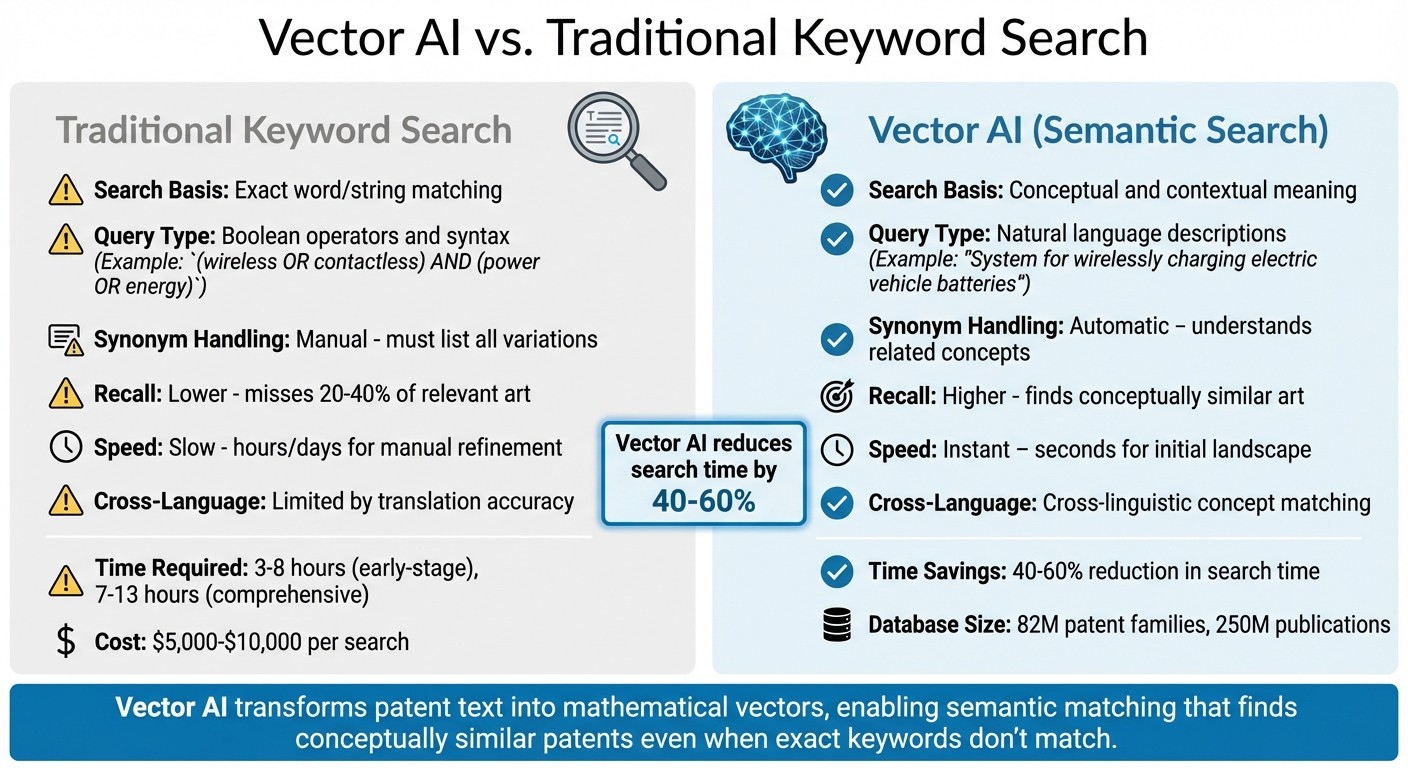
Vector AI vs Traditional Keyword Search for Patent Prior Art
Vector AI takes a completely different approach to searching compared to traditional keyword methods, leveraging the deep semantic processing discussed earlier.
Traditional keyword searches rely on exact text matches or word stems - like matching "bike" to "bikes." However, they falter when different technical terms are used for the same idea. For instance, if one inventor uses "autonomous vehicle" while another uses "self-driving car", a keyword search might not connect the two. Vector AI sidesteps this limitation by transforming patent text into multi-dimensional mathematical vectors that capture the meaning and context of the content. Instead of focusing on matching specific words, it compares the "distance" between vectors to identify conceptual similarities. This allows it to recognize that terms like "artificial intelligence" and "machine learning" often overlap in meaning, even if the phrasing differs. It can even link modern terminology with older language found in patents filed decades ago.
This shift results in significant efficiency improvements. Traditional methods for early-stage prior art searches typically take 3-8 hours of attorney time, while comprehensive searches can stretch to 7-13 hours. Considering that patent attorneys charge between $300 and $600 per hour, these manual searches can cost anywhere from $5,000 to $10,000. Vector AI, in contrast, can reduce total search time by 40-60%. This reduction means you can perform multiple searches as your product evolves, rather than being constrained to a single, exhaustive search.
"The mechanism operates quickly. When working with millions of patents, it's imperative that we obtain findings as rapidly as possible." - Andrew Crothers, Creative Director, Patently
These time and cost savings also open the door to more advanced search capabilities, as outlined below.
Benefits of Vector AI
Vector AI provides higher recall, a critical factor for prior art searches where missing even one document could jeopardize a patent. While traditional keyword searches excel at precision by finding exact matches, they often miss related concepts, leading to low recall. Vector AI, however, casts a broader net, identifying functionally similar inventions even across unrelated industries - such as linking aerospace mechanisms to medical devices.
Another advantage is multilingual matching. Vector AI can identify patents with similar concepts across languages without requiring exact translations. For example, it can recognize that the German "Bremssystem" corresponds to the English "brake system", focusing on the meaning rather than the specific words. This is particularly vital for global patent searches, where the same invention might appear in multiple languages.
Query formulation is also far simpler. Boolean searches demand complex syntax, such as (wireless OR contactless) AND (power OR energy), which requires precision and expertise. Vector AI, on the other hand, allows you to use natural language, like "System for wirelessly charging electric vehicle batteries." Just describe your invention as you would in a conversation, and the AI handles the technical aspects.
Comparison Table: Vector AI vs. Keyword Search
Feature | Traditional Keyword Search | Vector AI (Semantic Search) |
|---|---|---|
Search Basis | Exact word/string matching | Conceptual and contextual meaning |
Query Type | Boolean operators and syntax | Natural language descriptions |
Synonym Handling | Manual (must list all variations) | Automatic (understands related concepts) |
Recall | Lower (misses 20-40% of relevant art) | Higher (finds conceptually similar art) |
Speed | Slow (hours/days for manual refinement) | Instant (seconds for initial landscape) |
Cross-Language | Limited by translation accuracy | Cross-linguistic concept matching |
Conclusion
Vector AI is reshaping how prior art searches are conducted by tackling a common challenge: vocabulary mismatches. Traditional keyword-based searches often miss patents that use different technical terms to describe the same concept. Instead, Vector AI transforms patent text into mathematical vectors, capturing the deeper meaning and context. This allows users to uncover conceptually similar inventions, even when exact keywords don’t align.
Patently demonstrates the power of this technology by processing an immense dataset - over 135 million individual patents across 82 million patent families - in real time. The platform employs Vector AI throughout the entire patent lifecycle, ensuring seamless integration and efficiency.
"With Elastic, it's like having a patent attorney with decades of experience guiding every search." - Andrew Crothers, Creative Director, Patently
Practical examples illustrate how the system delivers results with impressive speed and accuracy. This efficiency enables patent professionals to conduct multiple searches as products evolve, rather than being constrained by the time and cost of a single exhaustive search.
For experts in the field, Vector AI offers a major shift - from manually crafting complex queries to simply using natural language to describe technical concepts. By combining broad semantic discovery with precise refinement, the technology ensures you can find relevant prior art without missing crucial details.
Adopting Vector AI can transform your search process, helping you stay competitive and ahead in the race for innovation.
FAQs
What patent fields should I include in a Vector AI prior art search?
When drafting a patent, certain sections are particularly important for capturing the essence of your invention. The claims, abstract, and detailed description are key areas to focus on. These sections define the legal boundaries, provide a concise summary, and explain the technical specifics of your invention, respectively. Their clarity and detail are essential for accurate semantic analysis.
Additionally, reviewing patents from multiple jurisdictions and incorporating relevant non-patent literature can broaden the scope of your research. This approach helps tools like Vector AI go beyond basic keyword searches, identifying connections to related inventions with greater precision.
How can I tune semantic search to reduce irrelevant results?
When working with semantic search in Vector AI, filtering techniques are your go-to for cutting through the noise. These methods help you weed out irrelevant results while keeping the focus on content that genuinely matters. Unlike traditional keyword searches, these tools emphasize conceptual relevance, making it easier to exclude unrelated documents.
Additional features like citation mapping and interactive visualizations further refine your search. They help you uncover meaningful connections, saving you from wading through unnecessary matches. By applying these strategies, you can achieve more precise and efficient searches, streamlining the entire process.
How do I validate and document Vector AI results for a defensible search?
To ensure that Vector AI results are reliable and well-documented, it's crucial to establish a structured evaluation framework for measuring retrieval quality. This can involve using approaches such as labeled datasets, synthetic data, or even ground-truth-free judges to assess how relevant and accurate the results are.
Key metrics like recall@k and precision should be tracked to quantify performance effectively. Monitoring these metrics consistently over time helps maintain steady performance levels and ensures the results remain defensible.