How to Align IP Portfolios with Sustainability Standards
Intellectual Property Management
Mar 27, 2026
Audit and tag patents, set ESG KPIs, prioritize green tech, embed ESG in governance, and use AI to scale sustainable IP.

In today’s world, intellectual property (IP) portfolios are evolving into tools that reflect a company’s commitment to environmental, social, and governance (ESG) goals. Aligning your IP strategy with these priorities not only supports global challenges but also builds trust with investors, regulators, and consumers.
Here’s how you can align your IP portfolio with sustainability standards:
Audit Your Portfolio: Assess your IP assets to identify those that align with ESG goals, such as renewable technologies or social impact innovations. Retire outdated patents that conflict with these objectives.
Set Measurable Goals: Define clear metrics, like the percentage of “green” patents, and integrate these into your ESG reporting.
Prioritize Green Technologies: Focus on patents that contribute to reducing emissions, improving resource efficiency, or addressing social equity. Use licensing to scale these innovations globally.
Embed ESG in Decision-Making: Update patent filing processes to include ESG criteria and form cross-functional committees to ensure alignment across teams.
Leverage Technology: Use AI-enabled patent analysis to categorize patents, automate sustainability reporting, and improve collaboration between R&D, legal, and ESG teams.
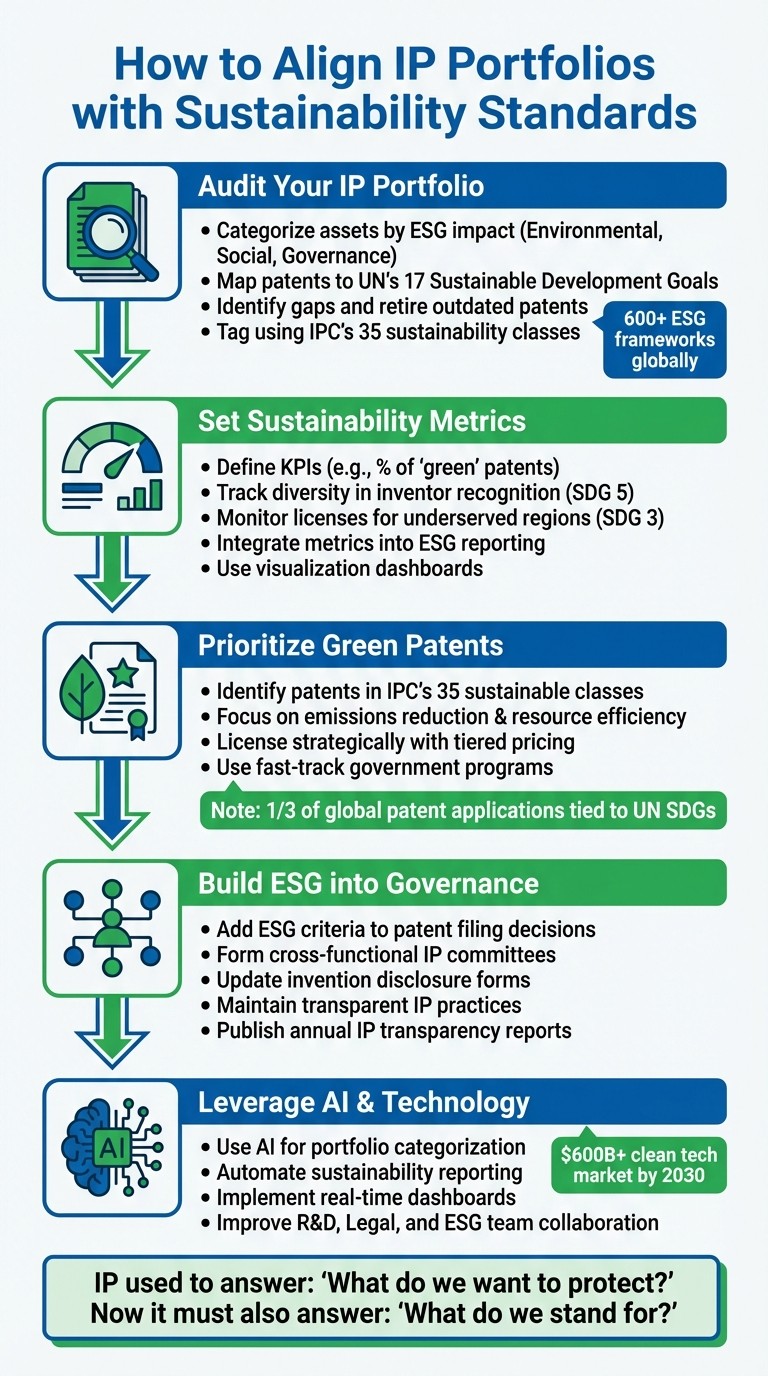
5 Steps to Align IP Portfolios with Sustainability Standards
Intellectual Property and Sustainable Development
Step 1: Audit Your IP Portfolio for Sustainability
The first step in aligning your intellectual property (IP) portfolio with sustainability goals is conducting a thorough audit using top patent tools. This process isn’t just about counting your patents, trademarks, and trade secrets - it’s about understanding how these assets align with your environmental, social, and governance (ESG) objectives. By assessing which assets actively support sustainability and which might conflict with your goals, you create a strong foundation for refining your portfolio.
Categorize IP Assets by Sustainability Impact
Start by grouping your IP assets based on their contributions to ESG goals. For instance:
Environmental: Patents for carbon capture technologies or energy-efficient materials.
Social: Medical devices designed for underserved regions or user-friendly interfaces for accessibility.
Governance: Ethical AI systems or frameworks for data privacy and security.
To further refine this analysis, map your patents to the United Nations’ 17 Sustainable Development Goals (SDGs). Phil Arvanitis, Practice Director at Clarivate, highlights the importance of this approach:
"Innovation is a critical lever for sustainability. Patents can help organizations measure this innovation and provide a trackable KPI to map progress against UN SDGs".
It’s also useful to differentiate between direct technologies (e.g., solar panels) that have an immediate impact and enabling technologies (e.g., battery management systems) that indirectly support sustainable outcomes. Updating your invention disclosure forms to include ESG-related questions - such as whether the invention reduces environmental harm or improves health and safety - can help identify sustainability potential early in the process.
Identify Gaps in Your Portfolio
Once you’ve categorized your assets, it’s time to identify gaps. Compare your portfolio with industry trends and your R&D pipeline to spot areas where sustainable innovation is lacking. For example, if competitors are patenting renewable materials but your portfolio focuses on traditional manufacturing, that’s a gap worth addressing.
Look for unprotected green innovations in your R&D projects and evaluate whether your geographic patent coverage matches your sustainability goals. You might have strong protection in the U.S. but lack coverage in regions with tightening environmental regulations or emerging markets for sustainable products.
Also, assess your renewal cycles to retire outdated assets. As PatentPC advises:
"A bloated patent portfolio that contradicts your ESG values can hurt more than help".
Eliminating patents tied to high-emission or outdated technologies can free up resources for greener initiatives.
Document Audit Findings
Create a centralized inventory to document your audit findings. This master repository should be accessible to Legal, R&D, and ESG teams and include details like:
The sustainability impact of each asset.
Ownership information.
Renewal deadlines.
Usage status (e.g., Active, Licensable, Obsolete, ESG-Aligned).
Tag patents with the International Patent Classification’s (IPC) 35 sustainability classes for easier reporting. Additionally, log the ESG reasoning behind decisions to file or abandon patents. As PatentPC puts it:
"IP used to answer the question: 'What do we want to protect?' Now it must also answer: 'What do we stand for?'".
Step 2: Set Sustainability Metrics for IP Management
Once you've audited your IP portfolio, the next step is to define clear KPIs (Key Performance Indicators) that connect your IP assets to sustainability goals. These metrics make it possible for Legal, R&D, and ESG teams to monitor progress consistently and align IP strategies with global sustainability frameworks.
Key Performance Indicators for Sustainable IP
Start by analyzing your portfolio composition. For example, determine what percentage of your patents qualify as "green" using tools like the Green Patent Indicator (GPI). Establishing this baseline helps identify areas for improvement. Beyond environmental factors, consider how your IP portfolio impacts social objectives. Metrics could include tracking diversity in inventor recognition, which supports SDG 5 (Gender Equality), or counting licenses granted for essential technologies in underserved regions, aligning with SDG 3 (Good Health).
Governance metrics are equally important. Focus on transparency in IP ownership and ethical enforcement policies, which align with SDG 16 (Peace, Justice). As PatentPC aptly puts it:
"What you protect reflects what you value".
Your KPIs should also assess whether your patents contribute to reducing environmental harm or improving health, safety, and equity. These criteria can be integrated into the invention disclosure process to ensure alignment with sustainability goals.
Add Metrics to ESG Reporting
Once you've defined these KPIs, incorporate them into your ESG reporting. Map your patents to specific UN Sustainable Development Goals. For instance, renewable energy patents can be linked to SDG 7 (Affordable and Clean Energy), while carbon capture technologies can align with SDG 13 (Climate Action). Public-facing IP summaries can include details such as the percentage of sustainability-related filings, diversity statistics, and equitable licensing practices.
Throughout the patent lifecycle, track metrics like lapses or inclusive licensing for assets that don't align with your sustainability commitments. To make this work, collaboration is key - ESG officers should participate in invention reviews to ensure that IP strategies reflect actual progress toward corporate sustainability targets.
Use Technology to Monitor Metrics
Leverage technology to streamline the monitoring process. Visualization dashboards and tools like Patently's cloud-based platform can help you tag assets based on sustainability impact, geography, and renewal deadlines. Patently's project management suite, for example, allows you to track trends using graphs, charts, and custom rating systems like traffic light indicators or numeric scores.
Incorporate ESG prompts into your IP management software. Update invention disclosure forms to include questions about a technology's potential environmental or social impact. Use decision trees to help teams decide whether to file, enforce, or license IP based on sustainability criteria. Tiered rating systems, such as star rankings or risk indicators, can also help prioritize assets that best advance your ESG goals.
Step 3: Prioritize Green Patents and Sustainable Innovation
Once you've established clear sustainability metrics, the next step is to focus on patents that deliver measurable environmental benefits. This involves pinpointing the "green" assets in your portfolio, encouraging innovation that aligns with sustainability goals, and leveraging licensing to amplify the impact of these technologies.
Identify Green Patents
The International Patent Classification (IPC) system designates 35 specific patent classes as sustainable. Tools like a Green Patent Indicator (GPI) can help you automatically scan your portfolio and flag patents that fall into these categories. This gives you a solid starting point for evaluating how many of your active patents align with environmental goals. Another approach is to map your patents to the United Nations' 17 Sustainable Development Goals (SDGs). This creates measurable KPIs that tie your IP strategy to global sustainability efforts and reinforce your ESG commitments. For instance, renewable energy technologies can align with SDG 7 (Affordable and Clean Energy), while water purification systems may support SDG 6 (Clean Water and Sanitation). Incorporating ESG-focused questions early in the process helps assess the potential environmental and resource benefits of your assets. Once you've identified the green patents, the next step is to focus on fostering innovations that offer tangible environmental advantages.
Develop Green Innovations
When building a sustainable IP portfolio, it's about quality, not quantity. Filing a large number of patents indiscriminately can conflict with ESG principles. Instead, zero in on innovations with a clear environmental impact, such as technologies that cut carbon emissions, boost resource efficiency, or improve water purification. Update reward systems to incentivize the development of environmentally impactful technologies, and include ESG-focused criteria in your invention disclosure forms. These forms can help measure a technology's potential to reduce harm or address social equity. Filing provisional patent applications early in the development process can secure a filing date while allowing a year for further refinement. Additionally, consider fast-track government programs that provide expedited reviews for environmentally beneficial patents. Once these green innovations are secured, think about how to scale their impact through strategic licensing.
License for Scalability
Licensing offers a way to turn green patents into scalable solutions. If manufacturing a green technology in-house is too costly, licensing it to partners with the resources to scale production becomes a practical alternative. Currently, about one-third of global patent applications are tied to the UN Sustainable Development Goals, highlighting the growing focus on sustainability in innovation. Structure licensing agreements with tiered pricing to ensure clean technologies remain accessible to smaller companies and developing regions. You can also include clauses that revoke rights if sustainability or ethical standards are breached, along with use-based restrictions to ensure the technology serves environmental or social objectives. Embed ESG requirements - like emissions reporting, labor standards, or community access - into licensing contracts to extend your corporate values throughout the supply chain. When marketing green intellectual property, translate technical details into clear benefits that resonate with eco-conscious partners. For example, instead of saying "new battery chemistry", emphasize "20% faster charging times". Lastly, conduct thorough Freedom to Operate (FTO) searches before expanding into new markets, such as Europe, to avoid infringing on existing sustainable patents.
Step 4: Build ESG into IP Governance and Decision-Making
Once you've prioritized green patents, the next step is to weave sustainability into your intellectual property (IP) decision-making. This means updating how you handle patent filings, fostering collaboration across departments to meet ESG (Environmental, Social, and Governance) objectives, and ensuring ethical standards are deeply embedded in your IP operations. By doing this, you align each filing decision with your sustainability goals, building on the foundation of your portfolio audit and sustainability metrics.
Add ESG Criteria to Patent Filing Decisions
Start by revising invention disclosure forms to include ESG-related questions. For example, does the invention help reduce environmental harm? Does it improve safety or promote equity? Could it introduce any social risks? To reinforce these updates, add formal ESG scoring to your decision-making process, alongside the usual technical and commercial considerations.
Additionally, rethink your incentive programs. Instead of rewarding inventors solely for the number of patents filed, recognize them for ideas that align with ESG principles. Decision trees can also help guide consistent IP filing decisions, ensuring they reflect your organization's public ESG commitments.
Align R&D and IP Teams with ESG Goals
Form cross-functional IP committees that bring together representatives from sustainability, ethics, compliance, legal, and R&D teams. These committees should meet regularly to review key IP decisions and ensure they align with sustainability goals.
Educate your R&D teams early on about your ESG priorities, so they can focus on innovative solutions like low-emission materials or designs that address underserved populations. At the same time, train your IP teams to understand how ESG principles influence decisions about filing, licensing, and enforcement. Digital dashboards can help track patents that support specific sustainability goals, fostering collaboration and transparency across departments.
Maintain Transparent and Ethical IP Practices
Transparency is key to building trust with investors and stakeholders. Consider publishing annual IP transparency reports that highlight ESG-linked filings and detail your ethical licensing strategies. Incorporate ESG assessments throughout the patent lifecycle by reviewing renewals and retiring assets that no longer meet sustainability standards.
When it comes to enforcement, adopt a selective approach that considers reputational risks, especially when dealing with entities tackling urgent sustainability challenges. Establish global standards for transparency and ethics that all offices must follow. A great example of this is Tesla's 2018 initiative to share its in-vehicle system program source code on GitHub and make its patents publicly available.
Step 5: Use AI and Technology for ESG-Aligned IP Management
Once ESG principles are embedded into governance, technology becomes a powerful ally in managing intellectual property (IP) in alignment with sustainability goals. AI tools can handle tasks that would otherwise demand significant manual effort, like categorizing patents by environmental impact or producing real-time stakeholder reports. This makes ESG alignment a continuous and automated process. Below, we explore how AI and digital tools can make this transition smoother.
Use AI for IP Portfolio Categorization
AI can scan your entire patent portfolio and classify assets based on ESG-focused criteria, such as reducing emissions, enhancing accessibility, or promoting social equity. Tools like Patently use semantic search and AI-driven features to pinpoint patents that align with sustainability objectives. By incorporating ESG prompts into IP management software, sustainability data can be captured automatically. This enables businesses to quickly determine how much of their portfolio aligns with net-zero goals or other corporate pledges.
Automate Sustainability Reporting
Forget the tedious process of compiling reports manually every quarter. AI can streamline this by providing real-time dashboards that track sustainability-linked patents and generate investor or regulator-ready reports. A great example is how, in 2026, PwC’s sustainability teams used the Manifest Climate AI platform integrated with Microsoft Copilot. This allowed consultants to access curated sustainability data directly within their workflows, benchmarking disclosures without manual intervention. Machine learning can also flag data anomalies across regions, while Natural Language Processing (NLP) translates raw ESG metrics into clear, audience-friendly narratives.
Improve Collaboration Through Digital Platforms
Digital platforms can break down barriers between R&D, IP, and sustainability teams. Real-time dashboards provide visibility into how patents align with ESG objectives, fostering better collaboration. Setting up quarterly IP committees with ESG representatives ensures that innovation and filing strategies consistently support corporate sustainability targets. By using collaborative tools to monitor green innovation efforts, organizations can ensure that everyone, from inventors to executives, understands their role in advancing sustainability goals.
Conclusion
Following the steps in this guide can help align your intellectual property (IP) portfolio with sustainability goals, reshaping how innovation supports broader environmental and social commitments. As PatentPC aptly put it:
"IP used to answer the question: 'What do we want to protect?' Now it must also answer: 'What do we stand for?'"
The process - auditing your portfolio, setting measurable goals, prioritizing eco-friendly patents, embedding ESG principles into governance, and leveraging AI - creates a cohesive strategy that ties your innovations to sustainability objectives. This transforms IP into a tool for responsible and forward-thinking growth.
With over 600 ESG frameworks in play, AI-driven solutions are becoming essential. These tools streamline patent categorization, automate sustainability reporting, and help ensure compliance across different regions. Considering the global clean technology market is expected to surpass $600 billion annually by 2030, patents aligned with sustainability are becoming increasingly valuable in securing funding and navigating mergers or acquisitions.
Cross-functional IP committees that include sustainability and ethics officers play a critical role. They ensure that filing and enforcement decisions reflect public ESG commitments, reducing the reputational risks tied to outdated, high-emission technologies.
The shift towards ethical licensing, selective enforcement, and open innovation is redefining how businesses use their IP. By integrating ESG principles into your IP strategy, your company can meet regulatory demands, attract investment, and earn consumer trust. This comprehensive approach ensures your IP portfolio is ready to support a sustainable and responsible future.
FAQs
How do I decide if a patent is truly “ESG-aligned”?
To figure out if a patent aligns with ESG principles, look at how it supports environmental, social, and governance goals. Ask yourself: Does it encourage sustainable advancements, like renewable energy or clean technology? Does it follow ethical intellectual property practices?
A patent meets ESG criteria when it actively contributes to sustainability efforts, promotes ethical innovation, and fits within broader ESG guidelines.
Which IP metrics matter most for ESG reporting?
Key metrics for ESG reporting related to intellectual property (IP) emphasize the ethical management of patents, trademarks, and other IP assets. These metrics aim to showcase how IP strategies contribute to positive social and environmental outcomes, align with broader sustainability objectives, and facilitate progress toward sustainable development as guided by global frameworks for responsible IP practices.
How can I add ESG requirements to IP licensing without slowing deals?
To integrate ESG requirements into IP licensing effectively, ensure your agreements align with sustainability objectives. Use clear and standardized criteria to avoid confusion. Include clauses that encourage environmental and social responsibility, but keep them straightforward to prevent unnecessary complications. By addressing ESG factors early and adopting adaptable frameworks, you can simplify negotiations and maintain compliance without slowing down the deal-making process.