AI Tools for Sustainable IP Reporting
Intellectual Property Management
Mar 28, 2026
AI streamlines patent classification, generative drafting, and automated ESG reporting to align IP portfolios with sustainability goals.

AI tools are transforming how companies manage intellectual property (IP) portfolios to align with Environmental, Social, and Governance (ESG) goals. With increasing regulatory demands, such as the SEC's climate disclosure requirements, businesses need efficient ways to classify patents and report their contributions to sustainability. Here's how AI is making this possible:
AI-driven patent classification: Tools like semantic search and multi-label classification analyze patents in context, identifying their relevance to sustainability frameworks like WIPO Green and SDG targets.
Automated ESG reporting: AI integrates data from various systems, centralizing information and auto-generating reports that comply with global standards.
Generative AI for documentation: AI automates generative patent drafting and ESG questionnaires, saving time and reducing errors.
Portfolio intelligence: AI identifies licensing opportunities, tracks competitors, and assesses risks, turning IP management into a dynamic process.
These advancements help companies streamline IP management, improve ESG compliance, and showcase their commitment to sustainability through data-driven insights.
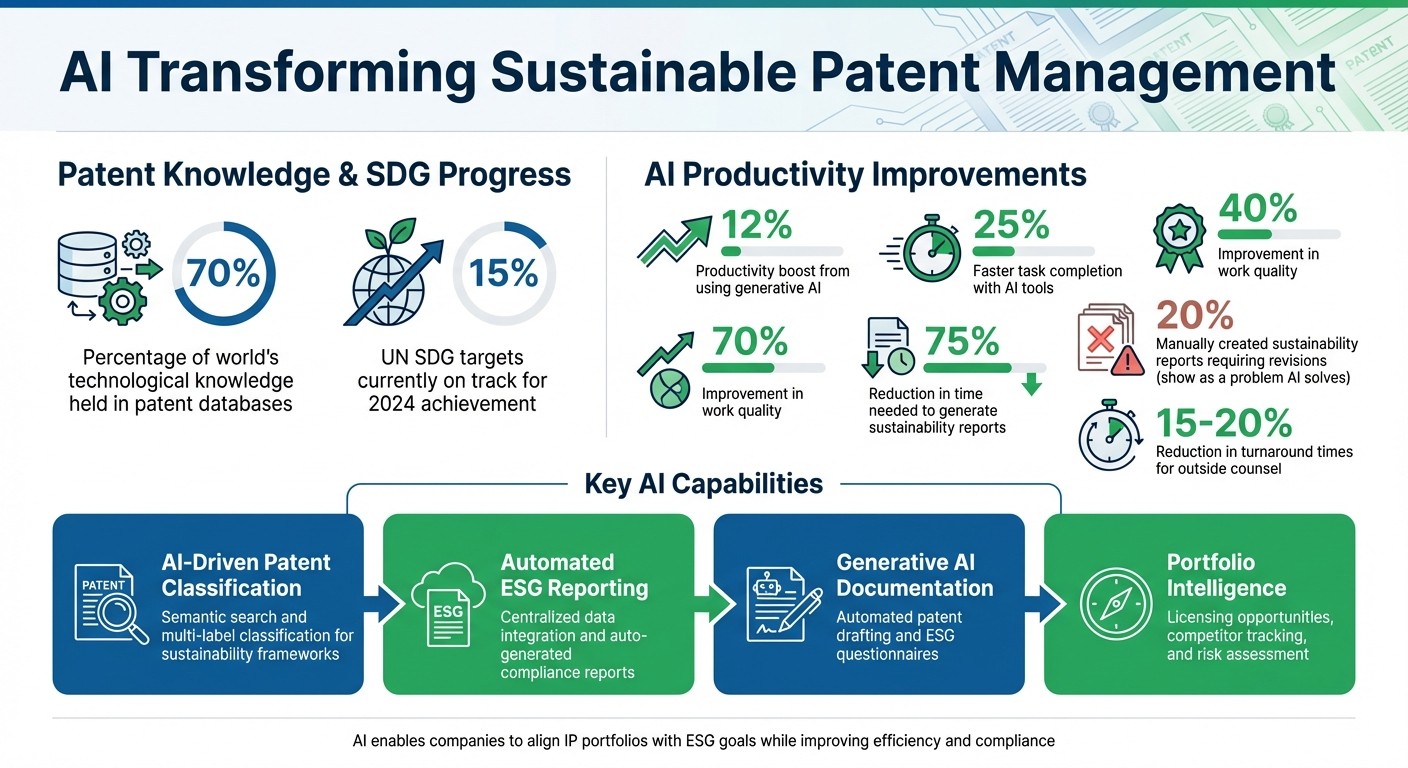
AI Impact on Patent Sustainability Reporting: Key Statistics and Benefits
Navigating the Storm: A Blueprint for AI-Powered Sustainability Reporting
Effective reporting requires AI-enabled patent analysis to synthesize complex data into actionable sustainability insights.
AI's Role in ESG-Focused IP Management
AI is reshaping how companies handle intellectual property (IP) portfolios by making it easier to align them with Environmental, Social, and Governance (ESG) goals. Unlike manual keyword searches that often miss the bigger picture, modern AI systems use semantic understanding to interpret the actual impact of patents in the context of sustainability. This shift enables more precise automation techniques, which are explored below.
Automating ESG Classification for Patents
Traditional approaches to classifying patents rely on keyword matching. However, this method often overlooks synonyms, technical terms, and innovations with multiple uses. AI takes a different approach through weak supervision and semantic analysis. These systems analyze patent citations linked to Sustainable Development Goal (SDG)-tagged scientific publications, using these connections to determine relevance. Large Language Models (LLMs) go further by extracting structured data - like functions, applications, and solutions - from patent text and comparing it to SDG definitions within a shared conceptual framework.
Patent databases hold about 70% of the world’s technological knowledge, yet only 15% of the United Nations' SDG targets are currently on track for achievement by 2024. AI's multi-label classification method addresses this gap by recognizing that a single patent can contribute to multiple ESG objectives. Instead of forcing patents into one category, this approach assigns probabilistic relevance scores to reflect their broader impact.
Tools like WIPO's IPCCAT showcase this capability in action. By analyzing patent abstracts, the tool predicts International Patent Classification (IPC) symbols with confidence levels. It also supports categorization across more than 10 languages, making it versatile for global use. Additionally, Natural Language Processing (NLP) and Optical Character Recognition (OCR) enable the scanning of internal documents - such as PDFs, emails, and supplier reports - to categorize data automatically within ESG frameworks.
AI doesn’t just stop at classification. It also automates data analysis and reporting, offering actionable insights and ensuring compliance.
Data Analysis and Reporting Automation
After automating classification, AI further simplifies data analysis and reporting. It eliminates manual bottlenecks in sustainability reporting by pulling data directly from systems like ERP, HR, and procurement platforms. This centralizes previously siloed information and can even auto-fill ESG questionnaires using patent and supply chain data. The result? Consistent reporting across various regulatory frameworks and a reduced risk of non-compliance.
AI also supports strategic decision-making with agentic portfolio intelligence. Autonomous AI agents consolidate data, track competitors, and uncover insights. This enables companies to streamline portfolio management, identify licensing opportunities through Evidence-of-Use detection, and conduct Freedom-to-Operate analyses by mapping product features to patent claims. For example, businesses can use claim-to-product mapping to quickly assess potential infringement risks before launching new sustainable products.
Advanced AI dashboards now bridge the gap between R&D, legal, and sustainability teams, helping them implement unified ESG strategies. Some organizations have even started incorporating ESG metrics - like carbon reduction, safety, and equity - into their invention disclosure processes, using these criteria to guide decisions on filing patents.
AI Advancements in Patent Sustainability Reporting
AI technology is transforming how companies handle sustainability-focused patents, making discovery and reporting more efficient. Two standout innovations - semantic search and generative AI - are tackling long-standing challenges in intellectual property (IP) management by streamlining both the search and documentation processes.
Semantic Search and Patent Discovery
Traditional keyword-based patent searches often fall short because they can’t capture the nuances of technical language. Semantic search changes the game by using machine learning to grasp the context and relationships within patent text, going beyond simple word matching.
With semantic search, companies can align their patent portfolios with established sustainability frameworks like the WIPO classification for AI, the OECD Env-Tech classification, and the IPC Green Inventory. Vector AI technology takes this a step further by identifying green technologies that span multiple classification systems - connections that keyword searches might miss. For instance, a patent describing a new battery chemistry could contribute to both energy storage and waste reduction, but a traditional search might overlook one of these applications.
Hybrid models that combine Boolean logic with semantic understanding offer even more precise results. These tools are particularly useful for conducting "Freedom to Operate" (FTO) analyses earlier in the R&D process, helping companies identify design-around opportunities for sustainable products before significant investments are made. Semantic mapping also reveals "patent whitespace" - areas where competitors haven’t filed yet - opening doors for new green innovations.
Once patents are discovered, the next hurdle is documentation, and AI is stepping in here too.
Generative AI for IP Documentation
Generative AI is revolutionizing patent documentation and Environmental, Social, and Governance (ESG) reporting by automating time-consuming tasks. These tools can transform unstructured R&D materials - like technical abstracts, Slack conversations, or presentation slides - into structured Invention Disclosure Forms (IDFs) and even draft responses for ESG-related questions, such as calculating Scope 2 emissions or assessing climate risks.
The numbers speak for themselves: organizations using generative AI report a 12% boost in productivity, complete tasks 25% faster, and see a 40% improvement in work quality. Sustainability reporting, in particular, benefits immensely, with AI cutting the time needed to generate reports by up to 75%. This is significant, especially considering that about 20% of manually created sustainability reports require revisions.
One standout feature is Retrieval-Augmented Generation (RAG), which ensures that AI-generated content is based on the company’s actual data rather than generic training models. This reduces the risk of errors or "hallucinations" in ESG claims. AI systems can integrate corporate documents - like greenhouse gas inventories and internal policies - into a centralized knowledge base, ensuring that IP documentation and sustainability reports are aligned with the organization’s ESG objectives. These tools also provide automated citations, queries, and calculations, creating a clear audit trail to meet regulatory requirements.
Patently's AI Capabilities for Sustainable IP Reporting

Patently combines semantic search and generative AI into a single platform tailored for patent professionals managing portfolios with a focus on sustainability. The platform emphasizes three main functionalities: accurate patent discovery, AI-powered drafting, and efficient portfolio management. Updates occur every 30 days to ensure access to the latest sustainability analytics, enabling users to stay aligned with evolving environmental goals.
Vector AI Semantic Search for ESG Alignment
Patently's Vector AI semantic search goes beyond basic keyword searches, capturing technical context across multiple classification systems like WIPO and OECD Env-Tech frameworks. This approach is particularly useful for green patents, which often span multiple categories. For instance, a battery innovation might qualify under both energy storage and waste reduction - connections that traditional keyword searches might overlook.
The platform helps companies map their patent portfolios to global sustainability standards, aligning their R&D efforts with broader goals like climate action and public health. Through the Forward and Backward citation browser, users can uncover trends and technological relationships within the green patent landscape. Additionally, Patently integrates with external environmental databases and industry-specific sustainability metrics, offering a comprehensive view of a portfolio's environmental impact.
AI Patent Drafting for Sustainability-Focused Portfolios
Patently's AI assistant, Onardo, uses a "hybrid intelligence" model, where AI speeds up the drafting process while patent professionals retain full control over the final output. This tool is specifically designed to highlight both technical innovations and environmental benefits in green patent applications, ensuring accuracy in ESG reporting.
Onardo automates the creation of specifications, generating editable diagrams and descriptions figure-by-figure. Its built-in drawing editor allows users to create or import figures directly, keeping claims and visual elements aligned. A "magical" parts list generator extracts features from claims automatically, while the labeling system updates references instantly when figures are reordered - eliminating manual errors.
"Patently is the drafting robot with the best UI and best Figure editor." - Martin Schweiger, AI Patent Drafting Expert & AI Keynote Speaker
Onardo works seamlessly with Vector AI semantic search, enabling users to identify relevant prior art and align their applications with sustainability frameworks right from the drafting stage. Centralized project management tools further simplify tracking ESG metrics across portfolios.
Project Management Tools for IP ESG Metrics
Patently's project management tools allow for hierarchical categorization of portfolios based on sustainability criteria. This makes it easier to organize patents according to specific Sustainable Development Goals (SDGs) and streamline stakeholder reporting. Custom fields enable teams to track ESG metrics, such as carbon reduction potential or circular economy contributions, directly within the platform.
Collaboration is also a key feature. With team access controls and collaboration tools, sustainability considerations can be integrated from the very beginning of the patent filing process. The platform supports exporting reports and syncing data with corporate ESG systems, ensuring compliance with regulatory frameworks like the SEC's climate disclosure rules and the EU's Corporate Sustainability Reporting Directive.
The Future of AI in Sustainable IP Reporting
AI is changing the way patent portfolios are managed, shifting from simple record-keeping to a dynamic process of continuous analysis. Instead of just storing data, autonomous AI systems like Patently Create now actively monitor developments and uncover strategic insights. This shift is especially important for U.S. patent professionals handling sustainability-focused portfolios, as regulatory bodies increase their scrutiny of greenwashing and AI-washing claims.
AI’s current capabilities are just the beginning. For instance, AI-powered platforms can now compare a company’s sustainability disclosures against thousands of competitors in seconds - an analysis that once required weeks or even months of manual work. This speed allows teams to move beyond mere compliance and focus on proactive strategies for environmental, social, and governance (ESG) goals.
But it’s not just about speed. AI is also enabling large-scale strategic prioritization. With tools like AI-driven heatmaps and triage systems, teams can quickly pinpoint high-value green assets, identify licensing opportunities, or flag patents that might be vulnerable to legal challenges. These tools can even rank patents based on their "blocking power" or their ability to serve as a strong defensive asset, turning portfolios into strategic resources rather than static collections. Additionally, AI platforms are helping reduce turnaround times for outside counsel by as much as 15–20%.
One of the key areas for improvement lies in departmental integration. Legal, R&D, and ESG teams often work in isolation, which can slow the alignment of intellectual property strategies with sustainability goals. To address this, companies are embedding ESG criteria directly into invention disclosure forms and scoring systems. This approach encourages inventors to think about environmental impact early in the process. At the same time, robust data security measures - like SOC 2 certification - are essential to protect sensitive patent drafts from unauthorized access.
The future of AI in this space will likely rely on a "human-in-the-loop" model. Here, AI handles large-scale data processing, while patent professionals maintain control over critical decisions and legal validations. This balance reflects a commitment to combining AI’s efficiency with the expertise of human oversight. As AI tools continue to advance, their role in sustainable IP reporting will go beyond improving efficiency, fundamentally transforming how companies demonstrate their dedication to environmental innovation.
FAQs
How does AI decide if a patent supports specific SDGs?
AI leverages semantic analysis and natural language processing (NLP) to evaluate whether a patent aligns with specific Sustainable Development Goals (SDGs). By examining the patent's content, technical details, and classifications, it connects them to the SDG targets defined in the United Nations' 2030 Agenda. This automated approach delivers real-time insights, enabling organizations to monitor their contributions to SDGs, pinpoint areas needing improvement, and align research and development efforts with sustainability objectives.
How can companies audit AI-generated ESG IP claims?
Companies can use AI-driven tools to audit AI-generated ESG (Environmental, Social, and Governance) intellectual property (IP) claims. These tools streamline the process by automating reviews, spotting inconsistencies, and highlighting areas that need improvement. By combining AI with established compliance frameworks, businesses can conduct continuous audits, ensuring their IP claims remain transparent and aligned with evolving ESG objectives, sustainability standards, and Sustainable Development Goals (SDG) targets. This approach also helps reduce risks and adapt to changing regulations effectively.
What data is needed to automate ESG reporting from IP systems?
To streamline ESG reporting from IP systems, it's crucial to work with data that ties patents to the UN SDGs. This can be done using semantic analysis and patent taxonomies. Additionally, monitoring innovations that focus on sustainability and merging ESG metrics with patent data are key steps. These components make it easier to align IP portfolios with broader sustainability objectives.