AI Dashboards for IP Portfolio Insights
Intellectual Property Management
Mar 29, 2026
Use AI dashboards to monitor patents in real time, run semantic searches, assess competitor risk, and optimize IP portfolios.

AI dashboards are reshaping how businesses manage intellectual property (IP) portfolios. These tools use artificial intelligence to simplify complex tasks like patent tracking, risk detection, and competitor analysis. Here's why they matter:
Real-Time Monitoring: Track patent lifecycles, filing trends, and portfolio health instantly.
Semantic Search: Find related patents using meaning-based search, not just keywords.
Competitor Analysis: Spot risks like infringement and identify gaps in innovation.
Cost Savings: Save time and reduce manual effort, with some organizations achieving up to a 10x return on investment.
Portfolio Optimization: Identify underperforming patents for abandonment or licensing while focusing resources on high-value assets.
Top AI patent tools are turning IP management into a streamlined, data-driven process, helping businesses make quicker decisions, cut costs, and align patents with business goals. The future promises even smarter systems with deeper automation and predictive capabilities.
Using Patent Analytics Dashboards for IP Strategy, Competitor Surveillance, and Portfolio Management
Core Features of AI Dashboards for IP Portfolios
AI dashboards are transforming how patent professionals manage their portfolios. These tools go beyond simple record-keeping by delivering active intelligence that updates in real time and uncovers valuable insights automatically.
Real-Time Portfolio Monitoring
With AI dashboards, every patent in your portfolio is tracked throughout its lifecycle - from filing to grant to expiration. These systems offer visual tools to monitor key metrics like Portfolio Health Scores, IP asset valuation, and filing trends. You can also dive deeper into individual patent details with drill-down features.
A standout capability is data normalization. The AI ensures consistency by standardizing names like "IBM Corp" and "International Business Machines" and grouping patents across jurisdictions into unified records. This makes ownership tracking more accurate. Additionally, dashboards analyze attorney and examiner performance, helping you pinpoint delays or inefficiencies in the prosecution process. Dynamic search tools further expand your ability to explore and understand the patent landscape.
Semantic Search and Analytics
Traditional keyword searches often miss related patents that use different wording. AI-powered vector-based search solves this by using Natural Language Processing to find patents based on meaning rather than exact terms. This ensures that semantically related patents are included in your results.
Citation mapping adds another layer of insight, visually showing forward and backward citations to trace technological evolution and highlight highly cited "hub" patents. AI also uses thematic clustering to group patents into categories based on functionality or emerging trends, such as "sensor fusion", even if they don’t share the same classification codes. Predictive valuation tools estimate a patent’s worth by analyzing factors like market relevance and commercial impact, allowing you to focus resources on high-value patents and identify those better suited for abandonment.
Competitor Analysis and SEP Analytics
AI dashboards don’t just focus on your internal data - they also provide a window into the competitive landscape. Using Evidence-of-Use (EoU) detection and SEP assessment, the system scans web content, product manuals, and technical standards to match competitor products with your patent claims. This automated claim-to-product mapping is ongoing, eliminating the need for manual research.
For example, Patently's platform offers SEP analytics tailored to 4G and 5G technologies, helping you determine which patents might be essential to wireless standards. The system also generates technology whitespace maps, comparing your claims to competitors’ at a granular level to identify defensive strengths or gaps in your innovation strategy. Meanwhile, FTO triage tools streamline Freedom-to-Operate analysis, quickly flagging potential infringement risks by matching new product features against global patent databases. This enables you to address risks early and stay ahead of competitors with actionable intelligence.
Research Findings on AI Dashboard Benefits
AI Dashboard ROI and Cost Savings in IP Management
Faster Decision-Making
AI dashboards simplify the decision-making process by centralizing real-time data into a single, streamlined workflow. This eliminates the need for time-consuming manual portfolio reviews. Patent teams can access live asset data directly, skipping the tedious task of combing through spreadsheets. The system automatically scans portfolios for risks like Freedom-to-Operate issues, invalidity weaknesses, and Evidence-of-Use opportunities - tasks that used to take days of manual effort.
Semantic search tools further enhance efficiency by quickly identifying relevant patents. For example, they can connect terms like "Drone" to "Unmanned Aerial Rotorcraft" in just minutes, saving hours of work. Similarly, for Standard-Essential Patent alignment, AI can match claims to standards such as 5G or Wi-Fi in a fraction of the time. Predictive analytics add another layer of value by analyzing USPTO examiner behavior, helping teams predict outcomes like allowance likelihood or RCE success rates. This enables strategic adjustments before filing.
These capabilities not only accelerate decision-making but also lead to measurable cost reductions.
Cost Savings and ROI Measurement
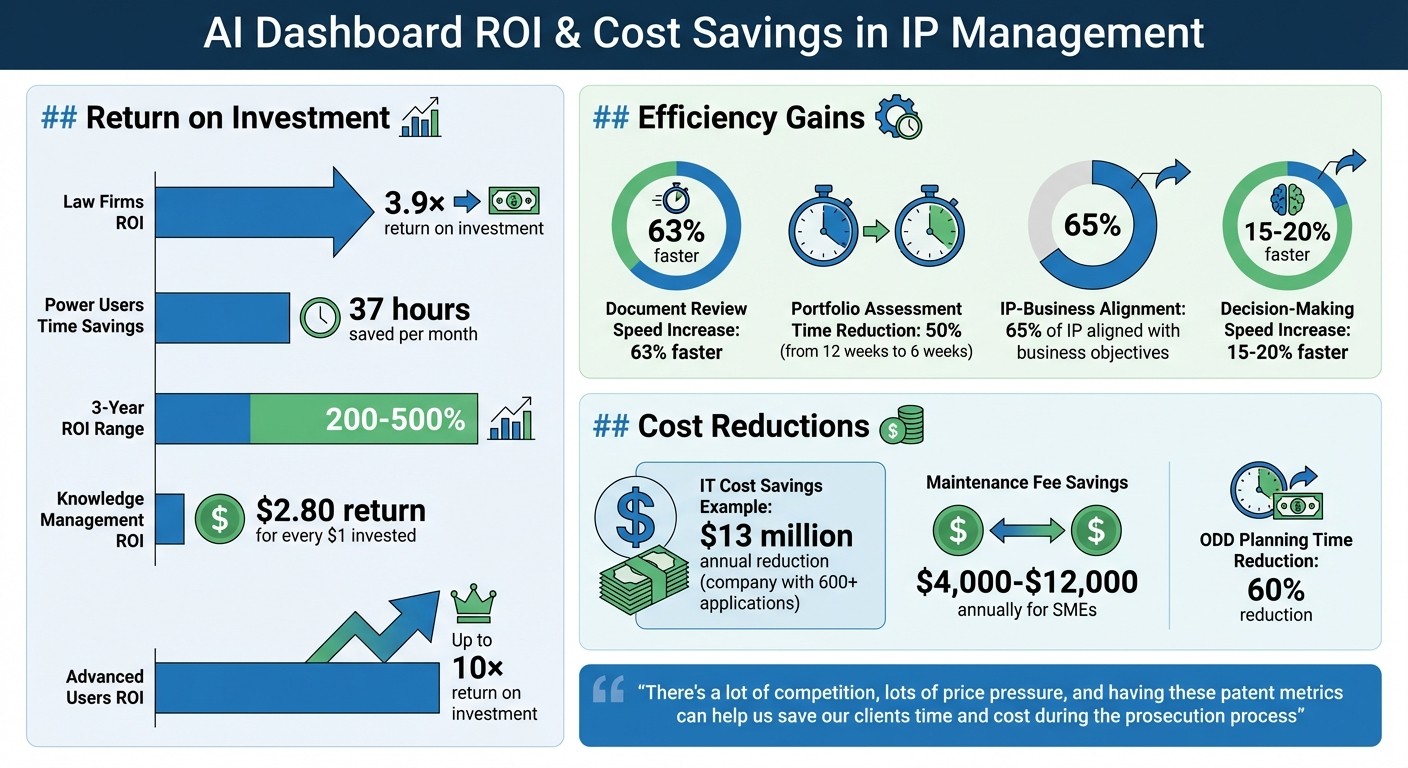
Organizations implementing AI strategies are seeing impressive returns. Law firms report a 3.9× ROI, with power users saving an average of 37 hours per month, translating to a 200–500% ROI over three years. Tools powered by AI also boost document review speeds by 63%.
Financial benefits extend even further. For every $1 invested in AI-powered knowledge management, companies report a $2.80 return, with advanced users experiencing up to 10× ROI. One notable example involves a company with over 600 applications, where AI agents helped identify redundant or underutilized assets, cutting annual IT costs by approximately $13 million. Additionally, maintenance fee dashboards help organizations avoid unnecessary fees, which can range from $4,000 to $12,000 annually for startups and SMEs.
"There's a lot of competition, lots of price pressure, and having these patent metrics can help us save our clients time and cost during the prosecution process".
Beyond monetary gains, these dashboards also refine overall portfolio management strategies.
Portfolio Optimization
AI dashboards shift portfolio management from a reactive to a proactive approach. By identifying low-performing patents through invalidity triage and performance testing, the technology flags assets that are either vulnerable to challenges or misaligned with business goals. Tools like citation analysis and patent clustering spotlight high-impact patents worth further investment while identifying redundant assets for potential abandonment or licensing.
The efficiency gains are substantial. AI reduces portfolio assessment time by 50%, cutting a 12-week process down to just six weeks. It also aligns 65% of IP with business objectives. Real-time analytics allow professionals to evaluate asset value and portfolio efficiency, empowering them to fine-tune their strategies. Additionally, the system uncovers "sleeping" assets - patents with high external citations but limited internal use - which are prime candidates for licensing or spin-off opportunities.
"It's an opportunity to demonstrate to the client the sophistication of the decision-making that went into the strategy".
Case Studies and Adoption Patterns
Enterprise Use of AI Dashboards
In March 2025, boutique intellectual property firm Dilworth IP adopted the DeepIP AI drafting system to handle increasing workloads while adhering to fixed-fee constraints. Founded by Michael P. Dilworth, the firm uses this system to identify broader embodiments and maintain drafting consistency. This approach allows for the creation of detailed and thorough applications without increasing staff. As a result, the firm achieved greater strategic depth within the same drafting time frame.
"At a given constant amount of time, the quality is much higher... I'm able to write longer and more robust, more detailed applications in the same amount of time."
– Ryan Schneer, IP Counsel, Dilworth IP
Later in 2025, a global investment allocator introduced DiligenceVault's AI-powered dashboards to improve its manager review process. By automatically flagging managers overdue for Operational Due Diligence - a task previously hindered by manual tracking - the organization reduced planning time by 60%. The system also eliminated last-minute "fire drills" by forecasting review dates. These examples highlight how AI dashboards can optimize operations across various industries.
Patently Platform Example
Patently offers an AI-driven platform that combines multiple IP management tasks into a seamless workflow. Its Onardo drafting assistant helps patent professionals create detailed, consistent applications across extensive portfolios. The platform also includes Vector AI, a semantic search tool that connects related technical concepts to streamline prior art identification. Additionally, the SEP analytics module links patent claims directly to 4G and 5G technical standards, providing clarity and precision.
On top of these features, Patently’s hierarchical project management system organizes portfolios by business unit, technology area, or strategic goals. Customizable access controls ensure sensitive information stays secure while enabling cross-functional collaboration.
Collaboration and Customization Patterns
Organizations are increasingly using AI dashboards to enhance collaboration between in-house and external legal teams. For instance, in-house teams rely on AI tools for routine drafting and analysis, providing outside counsel with high-quality drafts that reduce the need for multiple revisions. This approach allows legal departments to focus more on strategic decision-making rather than administrative tasks.
"It allows us to be smarter and more efficient every time… Every engagement with our IP management system reveals new ways to simplify our workload."
– General Counsel of IP Ops, Fortune 100 Company
The trend is also moving away from generic solutions toward tailored dashboards. Many companies now use dashboards equipped with automated heatmaps for portfolio management. These tools classify assets for pruning or licensing at scale, eliminating the need for manual patent reviews. By treating AI as an autonomous research agent, organizations can continuously monitor developments and uncover strategic insights. This shift transforms IP management from a passive record-keeping function into a dynamic, analytical process.
Conclusion: AI Dashboards in IP Management
Main Points
AI dashboards are reshaping how intellectual property (IP) is managed, turning it into a process of continuous and proactive analysis. With these tools, organizations gain real-time insights into the health of their IP portfolios. This means they can easily pinpoint high-value assets while identifying underperforming ones that may need attention. These dashboards not only reduce costs but also speed up decision-making by an impressive 15–20%. On top of that, they help mitigate risks through automated Freedom-to-Operate (FTO) triage.
But the benefits go beyond just saving time and money. AI tools are unlocking new monetization paths by spotting potential infringement and uncovering licensing opportunities. They also ensure data consistency across IP portfolios, eliminating the headaches caused by outdated, spreadsheet-based systems.
"AI patent tools are no longer experimental, they are becoming a necessity to keep up with competition." - Patlytics Inc
With these advantages already established, the future of AI in IP management promises even more transformative developments.
Future Developments
The next generation of AI dashboards will integrate more deeply into every stage of the IP lifecycle. Instead of relying on manual queries, Agentic Portfolio Intelligence systems will autonomously scan for risks and opportunities. These tools will move from static analyses to dynamic, scenario-based valuations, enabling teams to explore "what-if" scenarios and instantly understand their impact on portfolio value.
Looking ahead, expect IP tools to become more accessible. Simplified interfaces will allow R&D and marketing teams to handle initial patent checks without needing legal expertise. Blockchain technology will likely play a bigger role, providing immutable ownership records. Additionally, Standard Essential Patent (SEP) automation will expand, making it easier to process massive technical standards for emerging technologies.
Another key focus will be on explainable AI, ensuring that automated recommendations are transparent and trustworthy. This will address concerns about algorithmic bias, particularly in high-stakes legal decisions, and build confidence in AI-driven insights.
FAQs
What data do AI IP dashboards need to work well?
AI IP dashboards thrive on having access to precise and detailed data to deliver actionable insights. The foundation lies in comprehensive IP portfolio details, including patent filings, current statuses, expiration dates, and classifications like IPC codes.
Adding external data sources - such as market trends, competitor movements, and updates in legal frameworks - gives these dashboards the context they need to provide a broader perspective.
To maximize their utility, it's crucial to ensure the secure handling of sensitive information. Integrating data from areas like licensing agreements and R&D activities further strengthens their ability to support strategic decision-making.
How accurate are AI-based patent valuation and risk predictions?
Advances in data analytics, predictive modeling, and complexity analysis have significantly improved the accuracy of AI-based patent valuation and risk predictions. These tools provide a more objective way to assess a patent's worth and identify potential risks, delivering sharper insights for intellectual property professionals.
How can an AI dashboard help my team decide what to renew, license, or abandon?
AI dashboards assist your team in making informed decisions about which patents to renew, license, or let go. By analyzing factors such as patent value, strategic importance, expiration timelines, and market trends, these tools deliver clear, data-driven insights. They help pinpoint underperforming or non-critical patents, cutting down on unnecessary expenses. Additionally, they highlight licensing opportunities and potential risks, simplifying complex data into practical steps that align your intellectual property strategy with your business objectives.