AI in ESG Patent Lifecycle Assessment
Intellectual Property Management
Mar 30, 2026
AI streamlines ESG patent lifecycles through semantic search, automated ESG scoring, monitoring, and portfolio insights.

AI is transforming how companies manage patents tied to sustainability goals. By integrating Environmental, Social, and Governance (ESG) criteria, businesses are now evaluating patents not just for profitability but also for their impact across their lifecycle - from creation to enforcement. Here's how AI is making this process simpler and more efficient:
AI streamlines data collection: Tools like semantic search process millions of patent records, identifying ESG-related assets faster and more accurately.
Automated evaluation: AI applies ESG metrics to categorize patents by their potential to reduce emissions, improve health outcomes, or address social risks.
Lifecycle monitoring: AI tracks patents over time, helping companies decide whether to maintain, license, or retire them based on ESG priorities.
Decision-making insights: Heatmaps and analysis tools identify underperforming patents and highlight areas for innovation.
AI-powered platforms like Patently are already helping organizations align their patent strategies with ESG goals, improving efficiency, accuracy, and decision-making.
AI Agent-Powered Autonomous Patent Management & Monetization Webinar
Steps for ESG Patent Lifecycle Assessment Using AI
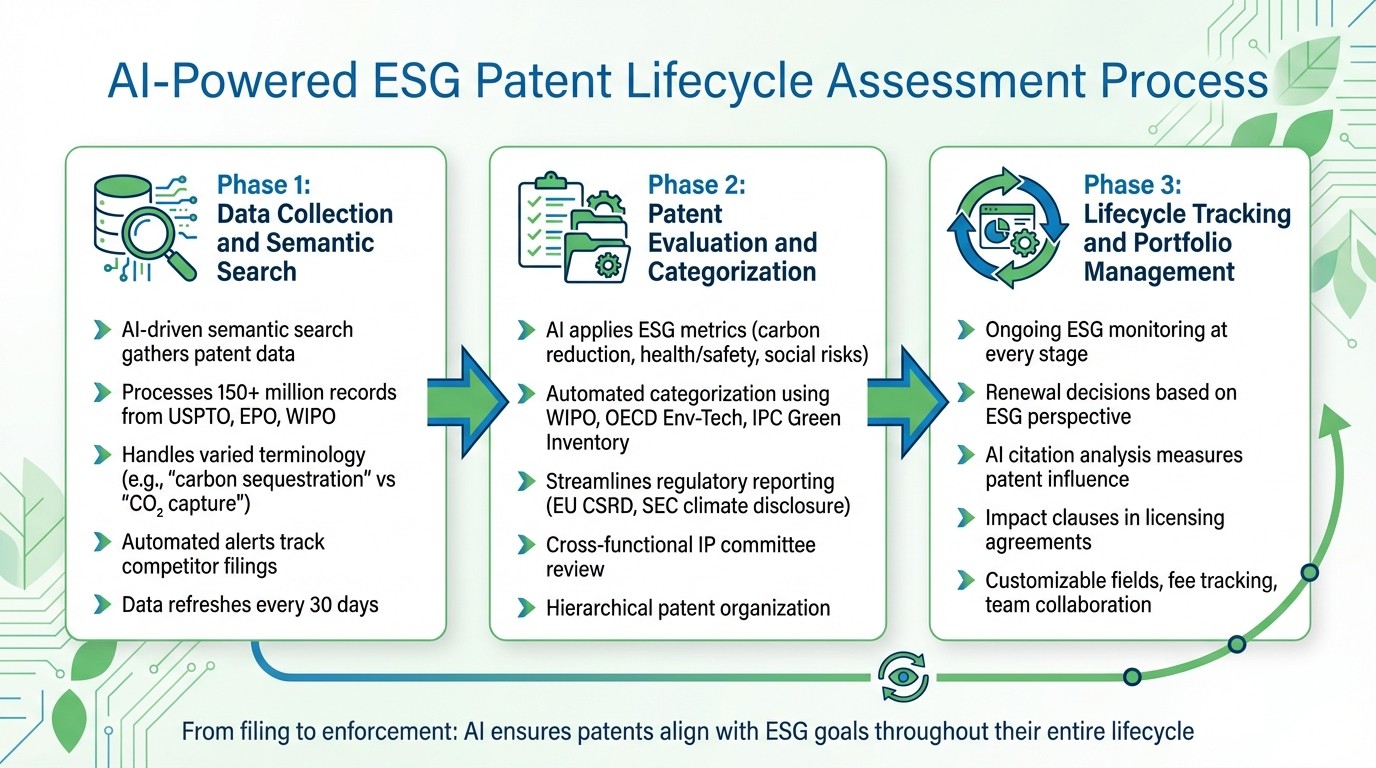
AI-Powered ESG Patent Lifecycle Assessment: 3-Phase Process
This process breaks down into three main phases: gathering patent data, assessing and categorizing patents based on ESG criteria, and continuously monitoring patents throughout their lifecycle to ensure precision, efficiency, and actionable results.
Data Collection and Semantic Search
The first step is to gather patent data from various sources using AI-driven semantic search. While Patently's semantic search capabilities were discussed earlier, this section focuses on the broader data collection process. This is especially important for green technology patents, as terminology often varies across regions - what one country calls "carbon sequestration", another might term "CO₂ capture".
AI simplifies this by consolidating data from major patent offices like the USPTO, EPO, and WIPO, processing over 150 million records without the delays of manual methods. The top patent tools even interpret non-textual data, such as diagrams and chemical structures. Automated alerts within AI platforms can track new filings by competitors in key ESG areas, such as renewable energy or carbon capture. These alerts ensure your data stays up to date, refreshing at least every 30 days.
With this solid data foundation, the next step focuses on applying ESG criteria to evaluate and organize the patents.
Patent Evaluation and Categorization
After collecting the necessary data, AI assists in evaluating and categorizing patents based on their ESG impact. This involves integrating formal ESG metrics into the scoring process, examining aspects like carbon reduction potential, health and safety implications, and social risks. AI-powered classifiers then automatically organize patents into hierarchical structures that align with global standards, such as WIPO's classification, OECD Env-Tech, and the IPC Green Inventory.
This automated categorization streamlines regulatory reporting under frameworks like the EU's CSRD or SEC climate disclosure rules. To ensure alignment with corporate responsibility objectives, sensitive patent decisions can be reviewed by cross-functional IP committees, including representatives from sustainability, ethics, and compliance teams.
Once categorized, the focus shifts to lifecycle tracking to maintain alignment with ESG priorities.
Lifecycle Tracking and Portfolio Management
The final phase involves ongoing lifecycle monitoring of ESG patents. AI tools make it possible to embed ESG reviews at every stage - from initial filing to decisions about maintenance and renewal. For example, during renewal periods, patents can be assessed through an ESG perspective to decide whether to maintain them, let them lapse, or transition them to more inclusive licensing models.
AI-powered citation analysis can also measure the influence of your green patents by tracking how often they are cited by others, offering a way to gauge their technological and societal impact. Licensing agreements can include impact clauses or tiered pricing to ensure critical green technologies remain accessible.
Patently's project management tools further support this process with features like customizable fields, fee tracking, and team collaboration. These capabilities are part of a broader suite designed for AI-enabled patent analysis and landscape projects. These tools help keep all stakeholders aligned on ESG goals throughout the entire patent lifecycle.
Benefits of Using AI for ESG Patent Lifecycle Assessment
AI is transforming how ESG patent portfolios are managed, offering faster processes, better data reliability, and insights that support smarter decisions. Let’s explore how these benefits play out across the patent lifecycle.
Increased Efficiency and Time Savings
AI-powered tools are slashing the time spent on tedious manual tasks. Take Brazil's National Institute of Industrial Property (INPI) as an example: in March 2022, they partnered with CAS to introduce AI workflows. The result? Examination times dropped by 50%, backlog shrank by 80%, and search times for 77% of national applications were significantly reduced.
For ESG-specific portfolios, AI automates processes like normalizing assignee names and grouping patent families. This allows teams to quickly spot valuable green technology assets or identify patents that could be abandoned. Tools like Patently go a step further with features like semantic search and project management, cutting office action analysis times by 15–20%. Tasks that once took weeks, like reviewing renewable energy patents, can now be done early in the R&D phase - when making engineering changes is far less expensive. Plus, this speed doesn’t come at the cost of accuracy.
Better Accuracy and Reliability
AI significantly reduces human error in ESG patent evaluations. Unlike basic keyword searches, semantic search understands the technical meaning behind terms, which is crucial when green technology terminology varies across countries and patent offices. Platforms like Patently integrate data from multiple international databases and update frequently, ensuring teams work with the latest information.
AI also brings consistency to ESG evaluations. Automated triage applies the same ESG criteria across entire portfolios, helping companies comply with frameworks like the EU's CSRD or SEC climate disclosure rules. On top of that, enterprise-grade security measures, such as SOC 2 certification, protect sensitive patent data and ensure customer information isn’t used to train public AI models.
Actionable Insights for Decision-Making
AI doesn’t just speed things up - it uncovers insights that manual analysis might miss. For instance, portfolio heatmaps can highlight patents with strong licensing potential, enabling better capital allocation. Tools like EoU detection analyze public-domain data to flag market activity, offering insights for enforcement or licensing opportunities.
In ESG portfolios, these insights are particularly valuable. Teams can quickly identify renewable energy patents with high commercial potential, decide which green technology assets to cut to save on maintenance costs, and monitor competitors expanding in specific green tech areas. With customizable dashboards and fee tracking, platforms like Patently help ensure all stakeholders stay focused on ESG goals throughout the patent lifecycle.
Practical Applications of AI in ESG Patent Lifecycle Assessment
Case Study: Using Patently for ESG Portfolio Optimization

AI tools like those offered by Patently are proving to be game-changers for ESG-driven portfolio management. By applying the ESG lifecycle framework, these tools help portfolio managers make smarter decisions about which patents to retain, license, or abandon. For example, AI-powered portfolio pruning can pinpoint underperforming patents, enabling companies to cut maintenance expenses and redirect funds toward impactful green technologies.
Another standout feature is AI-driven whitespace analysis, which identifies unprotected areas in renewable energy innovation. This allows companies to focus their R&D efforts on untapped opportunities. For instance, a business might discover that while certain solar technologies are crowded with patents, other areas are wide open, presenting a chance for strategic growth.
Patently's Vector AI goes a step further by analyzing patents across diverse classification systems like WIPO and OECD Env-Tech. This helps teams identify green patent trends that align with their portfolio goals. Additionally, automated maintenance alerts ensure companies stay on top of key deadlines, prioritizing those with both commercial and ESG significance.
Let’s dive deeper into how these tools work in a renewable energy patent scenario.
Example Scenario: AI in Renewable Energy Patents
Imagine a clean energy company evaluating its wind turbine patent portfolio. Using AI-powered FTO (freedom-to-operate) triage, the company can quickly analyze patents for eco-friendly product development. The platform categorizes patents into ESG-specific areas - such as materials for turbine blades, energy storage systems, or grid connectivity - and links them to relevant Sustainable Development Goals for better investor transparency.
AI can also identify patents tied to outdated turbine designs that no longer fit the company’s sustainability goals. By letting go of these less valuable assets, the company not only reduces maintenance costs but also streamlines its portfolio. At the same time, whitespace analysis reveals areas in renewable energy where competitors have limited activity. This insight allows the company to channel its R&D efforts into high-potential areas with clear commercial and ESG advantages.
Conclusion and Future Trends
Key Takeaways
AI is reshaping how companies approach ESG (Environmental, Social, and Governance) patent lifecycle management. Instead of simply meeting compliance requirements, businesses are now using AI to actively integrate ESG principles into their innovation strategies. By embedding ESG criteria into processes like invention scoring and patent renewal reviews, companies can ensure their portfolios align with modern sustainability priorities while also boosting long-term returns on investment (ROI). The move toward real-time, AI-driven portfolio intelligence allows teams to monitor, analyze, and generate insights continuously, eliminating the need for periodic manual reviews.
AI also plays a critical role in risk management. Tools for freedom-to-operate (FTO) analysis and invalidity checks help identify potential infringements and weak patents early in the R&D process. Beyond risk mitigation, AI uncovers underutilized assets with licensing potential and highlights areas ripe for new R&D, directly contributing to increased ROI. Collaboration across Legal, R&D, and ESG teams is also becoming more seamless, thanks to cross-functional committees that align innovation strategies with sustainability goals. These advancements not only improve current processes but also set the stage for the next wave of ESG-focused patent strategies.
Future of AI in ESG Patent Analysis
Looking ahead, AI's role in ESG patent management is expanding toward autonomous systems and predictive capabilities. Machine learning models are increasingly being used to analyze global patent filings and scientific research, helping forecast the next big technological shifts in sustainability. This kind of predictive insight allows companies to anticipate market changes and position themselves strategically in emerging green technology sectors.
Another growing trend is the adoption of responsible licensing models, where companies move from a "control" mindset to one focused on "access." AI is proving instrumental in identifying opportunities for tiered or low-cost licensing of green technologies in underserved markets. Meanwhile, automated tools that convert unstructured data into organized formats are speeding up the patent filing process. AI-powered bots are also becoming standard tools for real-time monitoring, scanning for potential infringements or competitor usage of patented innovations.
As noted by Patlytics Inc.:
AI patent tools are no longer experimental, they are becoming a necessity to keep up with competition
. The integration of ESG metrics into patent scoring, paired with AI-driven portfolio heatmapping, is enabling companies to shift resources away from low-value assets and toward innovations with greater impact. This continuous alignment of patent portfolios with evolving sustainability goals and market demands is redefining how businesses approach ESG-driven innovation.
FAQs
How do you define ESG impact for a patent?
When we talk about the ESG (Environmental, Social, and Governance) impact of a patent, we’re looking at how it supports sustainability goals, minimizes environmental harm, and aligns with ESG benchmarks. AI tools play a key role here - they can evaluate how patents connect to frameworks like the United Nations Sustainable Development Goals (UN SDGs) or other sustainability standards. This provides a clearer picture of how a patent contributes to these critical objectives.
What data sources are needed for AI-based ESG scoring?
AI-driven ESG scoring uses a variety of data points, including patent information tied to sustainability efforts and ESG metrics. It incorporates global standards for environmental impact and employs semantic analysis to match innovations with the United Nations' Sustainable Development Goals (SDGs). Additionally, patent analytics platforms play a key role in monitoring ESG metrics and sustainability objectives, offering insights that can inform strategic decisions.
How are ESG scores used to decide renew, license, or abandon?
ESG scores play a role in deciding whether to renew, license, or abandon patents by assessing how well they align with environmental, social, and governance goals. Patents with high ESG scores often support sustainability efforts and enhance the company’s reputation, making them strong contenders for renewal or licensing. On the other hand, patents with low scores might be abandoned or licensed out to reallocate resources and keep the portfolio in line with the company’s ESG priorities.