How AI Improves IP Workflow Collaboration
Intellectual Property Management
Mar 31, 2026
Centralized AI streamlines patent drafting, semantic prior-art search, version control and prosecution to speed collaboration.

AI is transforming how intellectual property (IP) workflows operate, making collaboration smoother and reducing inefficiencies. By centralizing tasks and automating repetitive processes, AI helps teams - from inventors to attorneys - work together more effectively. Here's how:
Centralized Collaboration: AI integrates drafting, prior art searches, and prosecution into one platform, eliminating the need for manual exports and reducing errors.
Real-Time Updates: Changes to claims or documents sync instantly across all related files, keeping everyone aligned.
Drafting Efficiency: AI converts technical inputs into structured patent drafts and highlights issues like broken claim dependencies or mismatched references.
Enhanced Prior Art Search: AI-driven tools use semantic search to identify relevant references faster and more accurately.
Version Control & Security: Automated version histories and role-based access ensure compliance and data protection.
Integrated AI Workflows for Patent Prosecution IPWatchdog Webinar

AI Tools for Collaborative Patent Drafting
AI has reshaped patent drafting by enabling real-time collaboration, where team members can work on the same document simultaneously, no matter where they are. These tools streamline the process by automatically tracking changes, ensuring everyone has access to the latest version. Here's how AI makes patent drafting - from co-drafting to version control - more efficient.
Real-Time Co-Drafting and Review
Modern AI platforms create shared workspaces for inventors, patent attorneys, and technical reviewers to collaborate seamlessly. Within these environments, changes made to one section of a patent automatically update related components. For example, if an attorney revises a claim term, the update is instantly reflected across all relevant sections, saving time and eliminating the need for manual edits.
This integration can drastically reduce the time spent on drafting. A project that might traditionally take 100 hours can be completed in just 20 hours when drafting, prior art search, and analysis are integrated into a unified AI workflow. Alexander Flake, CEO of Patentext, highlights this efficiency:
AI‐native patent drafting platforms are full environments that mirror how patent applications are written in real practice.
These platforms often include structured interfaces with clickable modules and section outlines, which help teams stay aligned by automatically tracking dependencies between claims, specifications, and figures.
Using AI to Generate Patent Specifications
AI speeds up the initial drafting phase by converting technical inputs into structured patent specifications. However, the most effective use of AI combines its speed with human oversight. AI can generate a first draft, but a patent attorney must refine it to ensure it meets legal standards and aligns with the business's goals.
AI plays a supporting role, not a replacing one. As Clarivate explains:
The key to truly harnessing the power of AI is integrating it into functional software that enhances rather than replaces the practitioner and their workflows.
While attorneys remain responsible for the final submission, AI handles repetitive tasks like generating summaries, creating titles based on claims, and identifying antecedent basis issues. Additionally, AI-powered proofreading tools catch contextual errors - such as mismatched reference numerals or broken claim dependencies - that traditional rule-based systems might overlook. This reduces errors and boosts collaboration quality.
Managing Document Versions and Access Control
AI platforms ensure that document versioning and access control are both secure and efficient. Automated version histories maintain audit trails, recording who made changes and when. This not only preserves document integrity but also ensures compliance with USPTO requirements.
For unpublished inventions, security is crucial. Enterprise-grade platforms employ role-based access control (RBAC) to restrict access to sensitive information, ensuring only authorized personnel can view or edit disclosures. Many leading tools also offer Zero Data Retention agreements, meaning client data is neither stored permanently nor used to train AI models. Andre Marais, Principal at Schwegman, Lundberg & Woessner, emphasizes the importance of this:
In selecting DeepIP as part of our AI toolkit, we conducted extensive due diligence on their security infrastructure. Their deployment on U.S.-based Microsoft Azure servers, coupled with SOC II Type 2 and ISO 27001 certifications, meets our stringent requirements for client data protection.
Platforms like Patently also provide features such as hierarchical project organization, real-time collaboration, and advanced access controls to keep drafts secure. When evaluating AI drafting tools, it's essential to confirm that they meet SOC II Type 2 and ISO 27001 standards and use encryption protocols like TLS 1.3 and AES-256. These measures not only protect sensitive data but also enhance the overall efficiency of collaborative IP workflows.
Improving Prior Art Search with AI Collaboration
AI is reshaping how prior art searches are conducted, turning what used to take weeks into a streamlined, collaborative process. Traditionally, these searches involved painstaking manual research across multiple databases. Now, AI-powered tools simplify this by creating shared workspaces where teams can search, analyze, and refine results together. This approach can cut search times dramatically - from 100 hours to just 20 hours.
Shared Prior Art Search Workspaces
AI platforms bring everything into one place, eliminating the hassle of exporting and reformatting data across different systems. In these centralized workspaces, teams can draft, search, and analyze information collaboratively. Patent attorneys, technical experts, and inventors all have access to the same search results, annotations, and reference materials in real time.
A key feature of these platforms is the use of search journals. These journals track every session, noting dates, tools used, and exact queries. This documentation not only ensures transparency but also creates a knowledge base for new team members to review past decisions. It also demonstrates due diligence to investors and prevents teams from repeating ineffective search strategies. For example, when one team member refines a claim term in a shared module, the update is instantly reflected across related analyses.
These shared workspaces also pave the way for more advanced tools like AI-enabled patent analysis and semantic search.
AI-Driven Semantic Search
Once a unified database is in place, AI takes search capabilities to the next level. Advanced models go beyond keyword matching to understand the technical essence of an invention. For instance, platforms like Patently use Vector AI for semantic search, which can identify conceptually related prior art even if different terminology is used. This allows teams to uncover references that traditional Boolean searches might miss.
To get the most out of semantic search, it’s important to define the invention in detailed layers. Start by outlining its functionality, then specify technical approaches, and finally, list alternative methods. For example, separate the problem (like detecting defects at high speed) from the solution (such as using convolutional neural networks). This layered approach gives AI multiple angles to explore.
Additionally, translating internal jargon or proprietary terms into widely recognized technical language improves search accuracy. Treat the first AI search as a trial run - review the results, refine your terms, and repeat the process a couple of times for better relevance. Running searches across the top AI patent tools is also a smart strategy, as differences in datasets and algorithms can reveal blind spots. Direct the tools to scan diverse sources, such as academic papers, GitHub repositories, and technical manuals, as these often contain informal disclosures that can serve as valuable prior art.
Collaborative Analysis of Search Results
After AI generates a shortlist of potential references, the team’s role shifts to validating and interpreting these results. Start with the claims section, as this defines the scope of legal protection. While AI tools can flag evidence at a granular level, human expertise remains critical for final legal and technical evaluations.
One example of this in action comes from a cybersecurity company's Director of IP & Litigation. In June 2025, the team used an AI platform to internally assess infringement risks, avoiding the need for external counsel and saving between $20,000 and $50,000 per case. The director noted:
"If I can give the executive team an answer in a few minutes, that's priceless. Patently makes me look good to my boss, which is always a sound investment."
Beyond validation, search results can also guide strategic decisions. Teams can use the findings to identify "white space" opportunities for R&D, enabling real-time adjustments to product designs or patent filing strategies. By maintaining shared claim interpretations across all collaborative tools, everyone - from patent prosecutors to business strategists - can work from the same understanding of the competitive landscape.
AI for Patent Prosecution and Strategy Alignment
Patent prosecution often feels disjointed, with teams juggling multiple tools and losing track of critical details as applications move forward. AI platforms are stepping in to change this by creating centralized environments where attorneys, inventors, and business stakeholders can collaborate seamlessly. Instead of constantly shifting between generative AI patent drafting tools, prior art databases, and Freedom to Operate (FTO) analysis platforms, these systems streamline the process, eliminating the "export bottleneck" - that tedious back-and-forth of transferring data between systems.
Collaborative Prosecution Workflows
Modern AI platforms bring real-time capabilities to the table, such as Section 112 checks and FTO reviews. This means teams can refine claims during drafting, avoiding the scramble to address objections later. By enabling in-house teams to assess potential infringement risks early, these tools reduce reliance on external FTO reviews and save valuable time.
Here’s a quick look at how collaborative features are transforming prosecution workflows:
Collaborative Feature | Impact on Prosecution | Stakeholders Involved |
|---|---|---|
AI-Guided Intake | Cuts down on back-and-forth over technical details | Inventors, Patent Attorneys |
Live Dashboards | Replaces status meetings, saving over 10 hours weekly | Legal Teams, Management |
Shared Claim Construction | Ensures consistent terminology throughout the lifecycle | Attorneys, Litigation Experts |
In-Workspace Reviews | Flags §112 or FTO risks during drafting | Attorneys, R&D, Outside Counsel |
AI tools trained on a firm’s previous cases also help preserve institutional knowledge. Junior associates can produce work that aligns with firm standards right from the start, as the AI acts as a virtual mentor, reflecting the expertise of senior attorneys. To ensure security, firms must maintain robust protocols like Zero Data Retention and adhere to relevant certifications.
This streamlined workflow sets the stage for aligning patent prosecution with overarching IP strategies.
Aligning Teams on IP Strategy
AI-powered workflows don’t just make prosecution more efficient - they also provide a holistic view of patent portfolios. This level of visibility allows attorneys and business leaders to identify gaps in coverage, consolidate overlapping claims, and prioritize filings based on competitive insights. For example, AI tools can monitor competitors’ patenting activities in real time, revealing "white spaces" where untapped innovation opportunities lie.
A practical way to integrate IP strategy into daily operations is by embedding IP checkpoints into product development cycles. Instead of waiting for formal disclosure meetings, engineers can tag discoveries in shared tools like Slack or sprint notes. AI can automatically flag these entries for legal review, ensuring timely protection that aligns with product launches. Examiner-specific analytics further enhance this process by tailoring claim language for better approval odds, creating a continuous feedback loop that strengthens the prosecution process.
Measuring the Impact of AI-Powered Collaboration
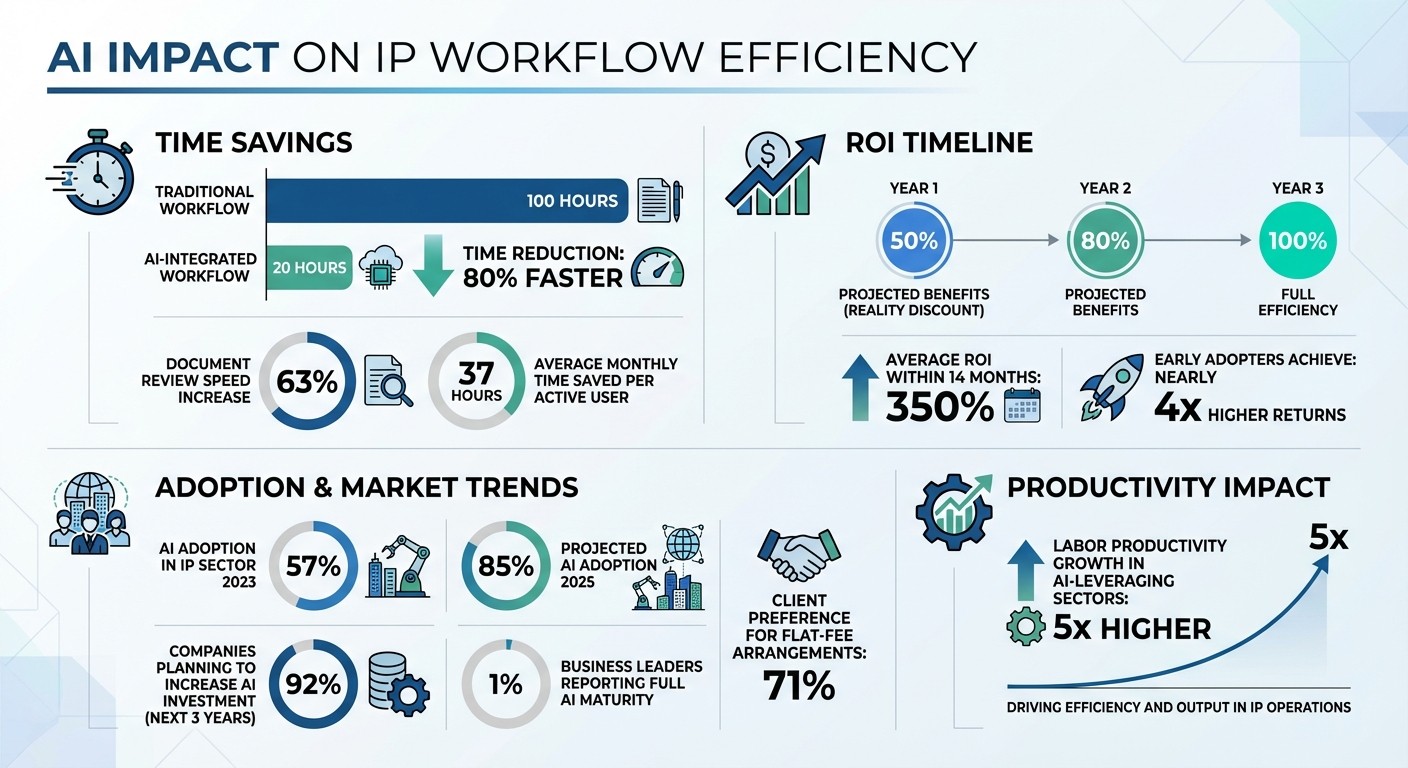
AI Impact on IP Workflow Efficiency: Time Savings and ROI Statistics
Building on the benefits of improved drafting and search, measuring AI's impact is crucial for justifying its role in unified IP workflow management. To prove its value, you need clear metrics that highlight where AI-driven collaboration tools make the biggest difference. For example, well-executed legal AI solutions can deliver an average 350% ROI within the first 14 months. However, achieving such results requires focusing on the right data points.
Tracking Time Savings and Productivity
Start by analyzing the time saved on specific tasks. Measure how long it takes to draft a patent application or conduct a prior art search using AI compared to traditional methods. Instead of focusing solely on individual heavy users, track these metrics across the entire team. AI-driven document reviews, for instance, can speed up processes by 63%, with the most active users saving an average of 37 hours per month. This extra time can then be reallocated to higher-value tasks like claim construction or portfolio planning.
Be aware of an initial adjustment period. Productivity often dips for 3 to 6 months during system adoption. To manage expectations, apply a "Reality Discount" - expecting only 50% of the projected benefits in Year 1, 80% in Year 2, and full efficiency by Year 3.
Beyond saving time, AI also plays a key role in improving team collaboration, making workflows smoother and more integrated.
Measuring Collaboration Improvements
Time savings are just one piece of the puzzle. To understand how AI enhances collaboration, track metrics like the number of shared projects, the frequency of team interactions within the platform, and whether cross-team reviews happen earlier in the process. Another useful metric is Realization Rates, which measure the gap between hours worked and fixed-fee budgets. AI's ability to reduce write-offs is especially important, as 71% of legal clients now prefer flat-fee arrangements, linking efficiency gains directly to profitability.
Don’t overlook qualitative improvements. For example, assess whether junior associates are meeting firm standards faster or if status meetings are less frequent thanks to real-time updates on live dashboards. These indicators show whether AI is genuinely fostering collaboration or simply adding another layer of complexity.
Calculating ROI from AI Implementation
To calculate ROI effectively, consider four key areas:
Financial: Lower outside counsel fees and fewer write-offs.
Operational: Faster turnaround times and increased throughput.
Relational: Higher team satisfaction and reduced burnout.
Strategic: Improved market positioning and lower litigation risks.
Early adopters of AI often see a 350% ROI, with some achieving nearly four times higher returns when fully leveraging the technology.
Additionally, weigh the Risk of Non-Investment (RONI). AI adoption in the IP sector is projected to jump from 57% in 2023 to 85% by 2025. Firms that delay adoption risk falling behind competitors who are already gaining efficiency. As Solve Intelligence aptly put it:
"The question is no longer whether AI delivers ROI, but whether firms can afford the competitive erosion of delayed adoption".
When calculating Total Cost of Ownership, don’t forget to account for hidden expenses like data remediation and integrating legacy systems. These factors are essential to forming a complete picture of AI’s impact.
Conclusion: The Future of AI in IP Collaboration
AI adoption in intellectual property (IP) has skyrocketed, with usage climbing from 57% in 2023 to an expected 85% by 2025. This growth marks a significant transition toward unified, AI-native platforms that break down silos and streamline processes like exporting data. Instead of traditional step-by-step workflows, the industry is moving toward continuous, strategic systems where tasks like drafting, searching, infringement detection, and invalidity analysis happen concurrently within a single environment.
This shift is reshaping roles, enabling professionals to enhance both creativity and efficiency through AI. With 92% of companies planning to boost AI investments in the next three years, AI is rapidly becoming a core operational element rather than a side project. However, full integration remains a challenge - only 1% of business leaders feel their organizations have achieved full AI maturity. As the Clarivate Centre for IP and Innovation Research puts it:
"AI is becoming an operational layer of IP practice; its absence, rather than its presence, increasingly requires justification".
The firms that will excel are those that treat AI as a foundation for collaboration, not just a tool. Emerging technologies like agentic AI - which can autonomously plan and execute complex tasks - and advanced reasoning capabilities are set to further simplify intricate IP workflows.
By improving drafting, searching, and prosecution processes, AI is poised to redefine IP collaboration. The real question isn’t whether AI will change the industry, but how quickly teams will adapt. Sectors leveraging AI are already seeing nearly 5 times higher growth in labor productivity, proving the benefits of early adoption. Success will belong to organizations that reimagine their workflows to harness AI’s strengths while keeping human insight central to strategic decisions.
As these advancements unfold, Patently continues to support patent professionals with AI-powered collaboration tools designed to complement and amplify human expertise.
FAQs
What IP tasks should we automate first with AI?
Start by focusing on automating tasks that are both repetitive and time-consuming, such as patent drafting, conducting searches, and managing portfolios. These processes can save a lot of time and effort - for instance, patent drafting alone can save 10–15 hours per patent with automation. Automating searches allows teams to respond more quickly to shifts in the market, while portfolio management tasks, like auto-classifying patents and pinpointing high-value assets, help refine strategies and cut down on administrative burdens. These areas make excellent starting points for integrating AI into intellectual property workflows.
How do we keep unpublished invention data secure in AI tools?
When using AI in intellectual property (IP) workflows, maintaining data security and confidentiality is a major concern. The articles point out these challenges but stop short of detailing how to protect unpublished invention data when working with AI tools. To address this, it’s crucial to choose AI platforms that adhere to stringent data protection standards. Look for platforms that implement strong encryption protocols to shield sensitive information from unauthorized access. This way, you can better ensure the safety of your confidential data while leveraging AI in your IP processes.
How can we prove ROI from AI in our patent workflow?
AI's impact on patent workflows is clear when you look at the measurable benefits it delivers. It can significantly cut down on time and costs, streamline processes, and provide sharper insights. For instance, AI tools can slash routine drafting time, reducing project hours by as much as 80%. What once took months can now be completed in just days.
These time savings don't just boost efficiency - they allow attorneys to shift their focus to more strategic, high-value work. This not only improves the quality of the workflow but also enhances profitability across the board.