Integrated Patent Analytics for SEP Insights
Intellectual Property Management
Apr 1, 2026
Integrated patent analytics verify SEP essentiality, map claims to standards, and power data-driven FRAND negotiations.
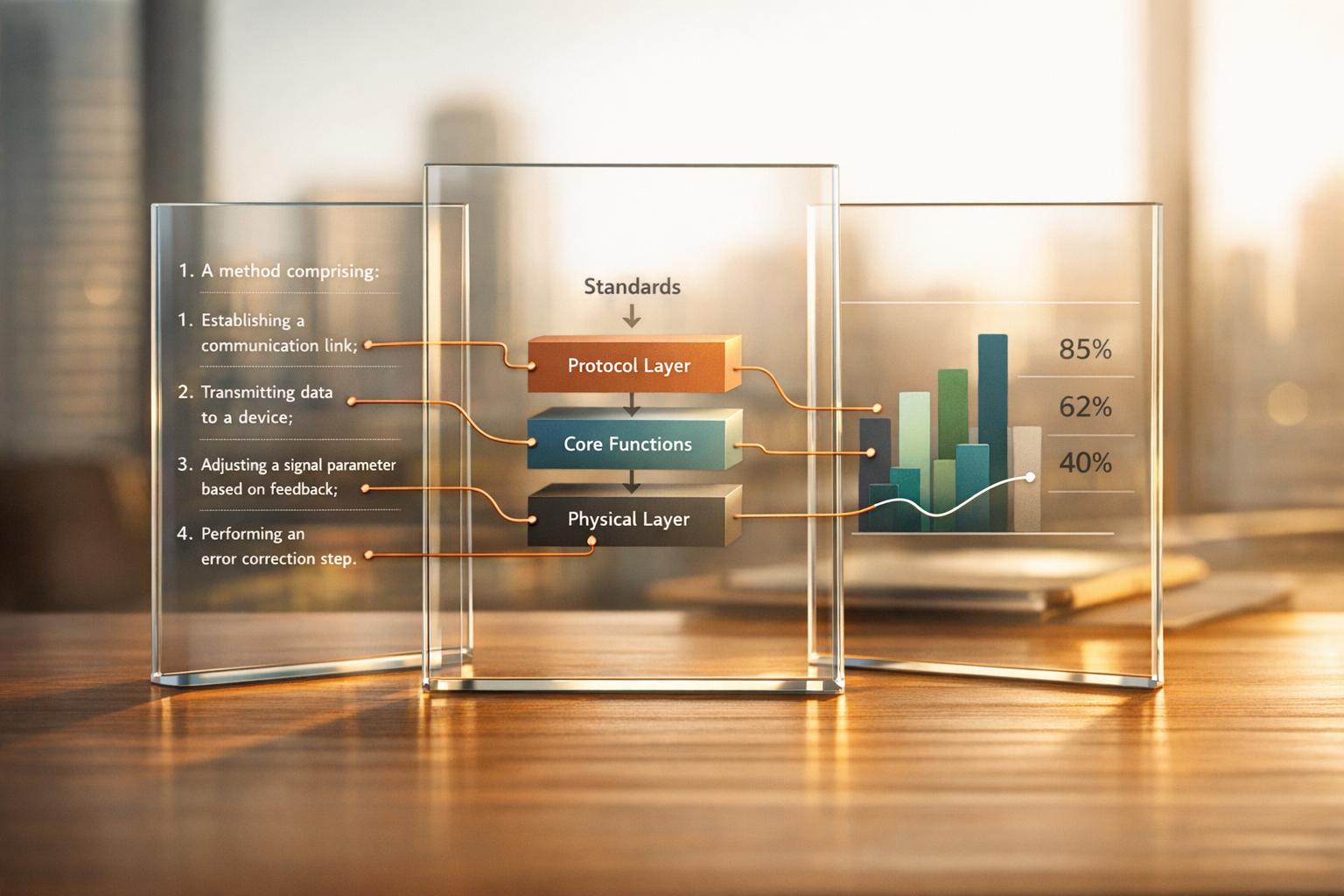
Managing Standard Essential Patents (SEPs) is complex, but integrated analytics tools simplify the process. Here's what you need to know:
SEPs Explained: SEPs are patents critical for implementing standards like 5G or Wi-Fi. They must be licensed under Fair, Reasonable, and Non-Discriminatory (FRAND) terms.
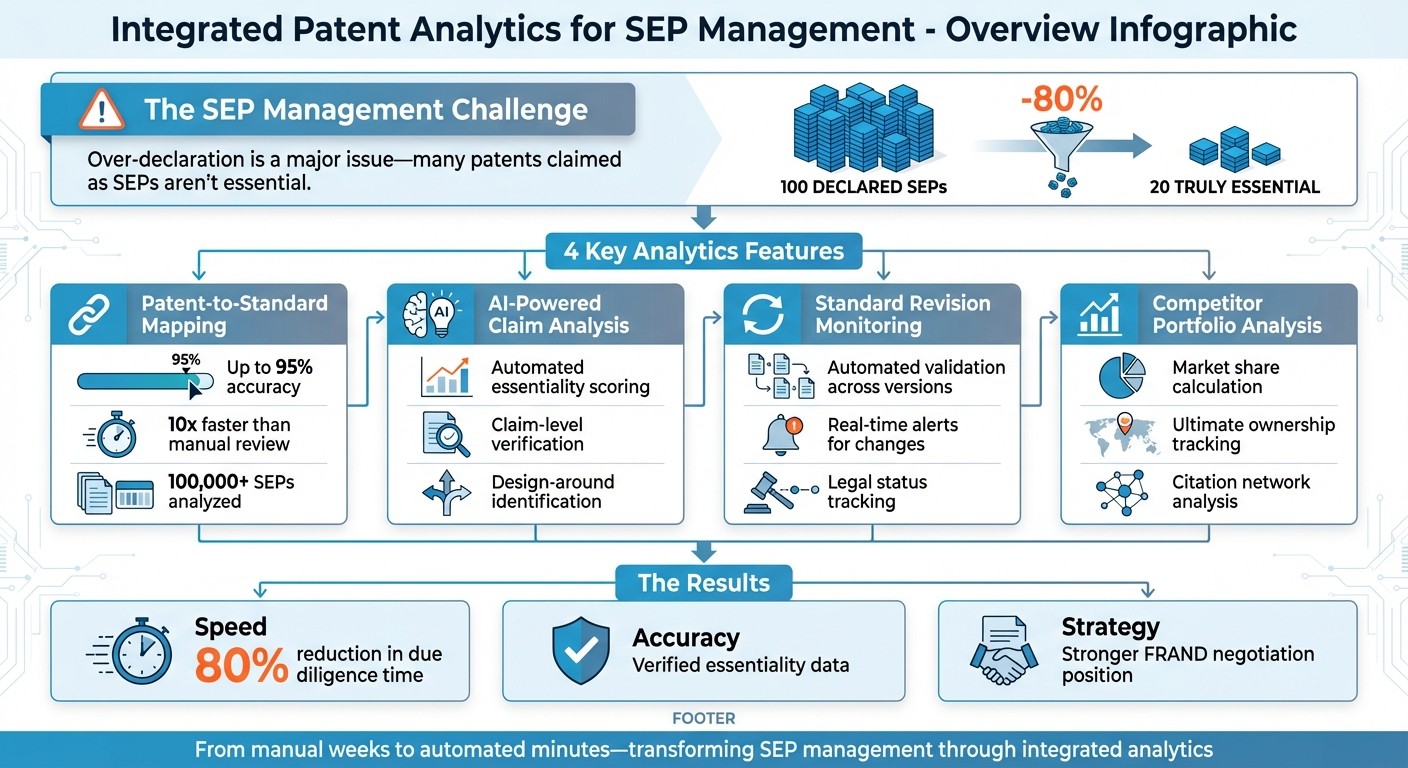
Challenges: Over-declaration is a major issue - many patents claimed as SEPs aren't required for standards. FRAND negotiations often become disputes over fair royalty rates.
Role of Analytics: Advanced platforms use AI-enabled patent analysis to verify which patents are truly applicable, saving time and improving accuracy. These tools also assist in mapping patents to standards, assessing competitors, and managing portfolios.
Key Features:
Patent-to-standard mapping
AI-powered claim analysis
Monitoring standard revisions
Competitor portfolio analysis
Benefits: Faster analysis, better licensing decisions, and stronger negotiation positions.
Bottom line: Integrated analytics platforms like Patently streamline SEP management, helping companies navigate licensing, reduce disputes, and optimize portfolios in a fast-evolving tech landscape.
How Integrated Patent Analytics Streamline SEP Management: Key Features and Benefits
Over-Declaration and Essentiality Verification
Understanding Over-Declaration
Over-declaration happens when patent holders claim their patents are essential to a technology standard, even though they aren't required for implementing that standard. Standard Development Organizations (SDOs) like ETSI, ANSI, and ISO maintain databases of Standard Essential Patents (SEPs), which are based on self-assessments by patent holders. However, these declarations are rarely subjected to independent verification for essentiality.
The root of the problem often lies in SDO policies. For instance, ETSI mandates members to declare patents that "might be essential", compelling patent owners to disclose even when they're unsure. Additionally, patents declared during the application phase may later become non-essential due to changes during the granting process. Some patent holders also deliberately over-declare to inflate the perceived value of their portfolios, giving them an edge in licensing negotiations.
This practice has real consequences. Over-declaration inflates the pool of licensing targets and complicates negotiations. Implementers are forced to conduct their own essentiality checks to ensure they aren't paying for patents that don't actually apply.
"A close examination of SEP databases reveals that a large number of patents that have been declared SEPs are not essential." - Sagacious IP
Given these complications, accurately determining which patents are genuinely essential is crucial. This is where advanced analytics steps in to simplify the process.
Using Analytics to Verify Essentiality
To tackle the challenges of over-declaration, top patent analytics tools have emerged as a powerful way to verify a patent’s true essentiality. These platforms conduct claim-level analyses to determine whether specific patent claims apply to particular entities - like mobile devices versus network infrastructure - and whether they address mandatory or optional features of a standard.
Modern platforms leverage AI to analyze entire patent families, uncovering connections and automating the early stages of essentiality verification. Technical experts then review these AI-driven results to ensure accuracy. By pinpointing the actual SEPs in a portfolio, these tools help companies calculate a patent owner's true contribution to a technology standard, which is key for setting FRAND licensing rates.
For manufacturers, essentiality verification is critical. Before licensing, it's essential to confirm whether a patent has claims relevant to devices or only to network-side components. Similarly, distinguishing between patents tied to mandatory versus optional features ensures that manufacturers only pay for what they truly need.
The importance of this process was highlighted in the UK High Court case Unwired Planet v. Huawei. The court found that only a small percentage of the patents claimed by the licensor were genuinely essential, exposing the gap between declarations and reality. Under FRAND principles, licensees are entitled to licenses for proven SEPs while disputing the rest.
Platforms like Patently (https://patently.com) simplify this process by offering detailed SEP data analysis. These tools combine AI-driven claim analysis with expert reviews, cutting due diligence time by up to 80%. This not only streamlines essentiality verification but also strengthens overall patent management strategies, turning a traditionally manual process into a proactive, data-driven approach. In today’s complex licensing environment, such precision can be a game-changer.
Core Features of Integrated Patent Analytics for SEPs
Patent-to-Standard Mapping
Patent-to-standard mapping connects specific patent claim elements to the technical requirements outlined in standards like 5G, WiFi, or IoT. This process helps companies verify whether a patent is genuinely essential, rather than over-declared, by creating claim charts for purposes like FRAND negotiations, litigation, or sales.
Using AI, this mapping can reach up to 95% accuracy and perform assessments up to 10 times faster than traditional manual reviews. Some platforms have even analyzed more than 100,000 SEPs to provide insights for licensing decisions.
"Manually mapping patent claims to standard specifications is extremely time-consuming and requires deep expertise".
Automated tools streamline the process by initially screening large patent portfolios to identify high-probability SEPs. This allows teams to focus their efforts on valuable assets instead of wasting resources on non-essential declarations. This step is crucial for enabling precise claim assessments later on.
AI-Powered Claim Analysis
AI-driven tools analyze patent claims alongside standard documentation to pinpoint where a patent's coverage aligns with specific technical requirements. This automated approach eliminates the challenges of manual verification, mapping claim elements to standards, generating essentiality scores, and identifying design-around opportunities to refine licensing strategies.
These tools also simplify SEP management by tracking declarations across standards bodies like ETSI and IEEE in one centralized platform. This functionality is particularly helpful when patents apply to multiple standards, reducing the complexity of managing overlapping obligations.
Evaluation Across Standard Revisions
Standards often go through multiple updates, and a patent considered essential for one version may lose relevance as the standard evolves. Integrated analytics tools automate the ongoing validation of patents against these revisions, ensuring portfolios remain aligned with current technical requirements. Features like automated monitoring and alerts notify IP teams about new filings or changes in standard specifications.
These tools also verify legal statuses by checking for events like oppositions, expirations, or other changes that might influence licensing obligations during transitions between standard versions. This constant monitoring ensures that companies can maintain an accurate understanding of which patents remain essential, enabling smarter portfolio management and licensing decisions without the need for manual tracking of every technical update.
Patently's integrated analytics platform combines these capabilities - patent-to-standard mapping, AI-powered claim analysis, and continuous evaluation across standard revisions - to equip patent professionals with efficient, precise, and actionable insights for managing SEPs effectively.
Competitive Intelligence and FRAND Negotiations
Analyzing Competitor SEP Portfolios
Understanding competitor SEP (Standard Essential Patent) portfolios is a key part of managing your own SEP strategy. It’s not as simple as counting patent declarations - you need to figure out who really owns the patents. This means identifying the parent companies that control patents through subsidiaries, joint ventures, or affiliates.
"Ultimate Owner is a game-changing addition... recognizing that parent companies often exert control over patents held by subsidiaries, joint ventures, and affiliates." – LexisNexis IPlytics
Advanced analytics platforms take this further by calculating market share for specific standards, like 5G or Wi-Fi 7. They do this by determining both the numerator (a company's SEPs) and the denominator (the total pool of essential patents), helping you see which competitors dominate in emerging technologies. These tools also track participation in standards development organizations (SDOs), giving you a heads-up on future leaders in the SEP space - even before their patents are officially declared.
Citation network analysis adds another layer, uncovering hidden links between patents. This can reveal potential threats or valuable assets that might otherwise fly under the radar. When combined with litigation tracking, these insights give you a clearer picture of risks and shifts in competitors’ licensing strategies, helping you stay ahead.
All of these insights create a strong foundation for data-driven FRAND negotiations.
Supporting FRAND Negotiations
The competitive intelligence gathered doesn’t just stop at analysis - it plays a big role in FRAND (Fair, Reasonable, and Non-Discriminatory) negotiations. Tools like the Semantic Essentiality Score help assess how likely a patent is to be truly essential to the standard it’s linked to, ensuring fair royalty calculations.
"The IPlytics Semantic Essentiality Score guides you on how likely essential a patent is to the standard it is declared for." – LexisNexis IPlytics
By accurately identifying the number of truly essential patents, companies can avoid paying for licenses that include over-declared or non-essential patents. Benchmarking your portfolio against competitors highlights strengths and high-value patents while exposing weaknesses that could influence royalty rates.
With features like ultimate ownership tracking, semantic essentiality scoring, and precise market share calculations, analytics platforms like Patently provide SEP managers with the tools they need to approach FRAND negotiations confidently and based on solid data.
Integrating Global SEP Data Sources
Accessing Authoritative SEP Data
To get a full picture of the Standard Essential Patent (SEP) landscape, it’s necessary to pull data from multiple trusted sources. Comprehensive analytics platforms achieve this by combining information from standard-setting organizations like ETSI, IEEE, ISO, and ITU-T, along with global patent offices and patent pool administrators. This multi-source strategy is vital because no single database contains all the required details.
In February 2026, WIPO made a significant update to its PATENTSCOPE database by incorporating verified essentiality data from the patent pool administrator Sisvel. This update, launched on February 3, 2026, at WIPO Headquarters in Geneva, allows users to view independent third-party assessments of patent essentiality alongside existing patent records. WIPO explained, "By integrating verified essentiality data into PATENTSCOPE, WIPO is responding to growing demand for greater transparency in the SEP ecosystem at a moment when standards and connected technologies are developing rapidly".
Top-tier SEP analytics platforms bring together SEP declarations from numerous standard-setting organizations, covering thousands of standards. This results in a searchable index containing hundreds of thousands of SEPs. These platforms use semi-automated algorithms to gather and curate data from intellectual property, scientific, and legal domains. By tapping into millions of publications from over 100 patent authorities, they ensure thorough tracking of global legal statuses. This level of integration provides the precision needed for informed decision-making in SEP portfolio management and FRAND (Fair, Reasonable, and Non-Discriminatory) licensing discussions.
Ensuring Data Accuracy and Completeness
While pulling data from diverse sources is essential, ensuring its accuracy is equally important for generating actionable insights. Raw SEP data from standard-setting organizations often comes in inconsistent formats - such as handwritten forms, scanned PDFs, or varying numbering systems - making automated processing prone to errors. To overcome this, advanced analytics solutions combine automated retrieval with manual standardization of application and publication numbers. They also perform patent family deduplication to remove duplicate declarations across jurisdictions.
One major step forward is the integration of verified essentiality data with declared SEPs. Independent expert assessments confirm whether a patent is truly essential to a standard, going beyond mere declarations by intellectual property rights holders. At Patently, technical experts provide these evaluations, enabling users to "see family-based counts of SEPs that experts have determined to be truly essential, not just those which have been declared as standard essential by the IPR holders".
Another critical measure for accuracy is cross-checking the declaring party against the current patent assignee, ensuring ownership information is current when patents change hands. By merging SSO declarations with patent pool records (like those from Sisvel) and verifying legal statuses across over 100 patent authorities, integrated analytics platforms deliver a dataset that is both thorough and reliable. This robust foundation supports confident decision-making for FRAND negotiations and effective SEP portfolio management.
How to Use Standard Essential Patent Data for a FRAND Defense Strategy
Conclusion
Handling Standard Essential Patents (SEPs) involves much more than simple tracking. Modern patent analytics platforms are transforming how SEP portfolios are managed by pulling together data from trusted sources, verifying essentiality through expert reviews, and automating time-intensive analysis tasks that used to take weeks.
The move from traditional keyword-based searches to AI-driven semantic analysis marks a major shift in evaluating patent essentiality and linking claims to technical standards. What used to take days can now be done in minutes, freeing up teams to prioritize strategic decisions over manual data collection. This streamlined process not only saves costs but also speeds up insights critical for FRAND negotiations and competitive strategy, leading to more precise portfolio management.
With verified essentiality data, professionals can clearly distinguish between self-declared SEPs and those that are confirmed. This clarity is crucial for accurately assessing the value of a portfolio.
As technologies progress from 5G to 6G and the Internet of Things (IoT) expands, the demand for precise and thorough SEP analytics will only grow. Tools like patent-to-standard mapping and AI-powered claim analysis from platforms such as Patently empower teams to make confident, data-backed decisions at every stage of the patent lifecycle.
Looking ahead, the future of SEP management will blend automated intelligence with human expertise. This combination will help identify valuable patents, evaluate competitors' portfolios, and strengthen negotiation strategies with dependable, actionable data.
FAQs
How do you confirm a declared SEP is truly essential?
To determine if a declared Standard Essential Patent (SEP) is genuinely essential, it's crucial to use trusted data that has been reviewed by technical experts. Platforms like Patently License™ offer expert-assessed insights, providing dependable information to ensure accurate evaluations of SEPs.
How can analytics improve FRAND royalty negotiations?
Analytics play a key role in improving FRAND (Fair, Reasonable, and Non-Discriminatory) royalty negotiations by offering precise, data-backed insights into patent valuation and essentiality. Tools such as Patently utilize verified Standard Essential Patent (SEP) data and AI-driven analysis to evaluate both essentiality and market value. This approach helps create greater transparency while reducing the likelihood of disputes.
With access to data like essentiality assessments, licensing records, and current market trends, negotiators can work toward fairer agreements. These insights make it easier to identify comparable licenses, establish reasonable terms, and lower the chances of costly litigation. The result? More balanced and effective licensing agreements for all parties involved.
What happens when a standard is revised?
When a standard undergoes revision, it can directly impact Standard Essential Patents (SEPs) by changing their essentiality, scope, or licensing terms. Patent holders may need to revisit and update their essentiality declarations, which could influence negotiations and the overall valuation of these patents. These revisions also call for a fresh evaluation of SEPs, often using tools like Patently, to ensure the insights remain accurate. This process helps stakeholders adjust their licensing strategies to align with the latest version of the standard and verified data.