AI Patent Classification: How It Works
Intellectual Property Management
Apr 2, 2026
How machine learning, NLP, and vector embeddings automate IPC/CPC patent categorization to speed searches, cut costs, and boost accuracy.

AI patent classification uses machine learning, natural language processing (NLP), and vector-based analysis to organize patents more efficiently than manual methods. It analyzes claims, abstracts, and metadata to categorize patents accurately and quickly. This approach addresses the challenges of handling growing patent volumes, reducing errors, and improving processing speed.
Key Points:
Traditional methods, like IPC and CPC systems, rely on manual review and are slow and error-prone.
AI tools automate classification, cutting processing time from months to minutes and reducing costs significantly.
Core technologies include machine learning for pattern recognition, NLP for text processing, and Vector AI for semantic analysis.
Applications include portfolio management, prior art searches, and customized patent categorization. These capabilities are central to AI-enabled patent analysis for novelty and landscape projects.
AI-driven systems are transforming patent management by making it faster, more cost-effective, and precise.
Patent Classification Analysis with AI
How Traditional Patent Classification Works
Patent offices around the world rely on two main classification systems: the International Patent Classification (IPC) and the Cooperative Patent Classification (CPC). The IPC, established in 1971, organizes technology into 8 sections using language-independent symbols and includes about 80,000 subdivisions. Meanwhile, the CPC, introduced in 2013 as a collaboration between the European Patent Office (EPO) and the United States Patent and Trademark Office (USPTO), offers even more detail with over 250,000 categories. This level of detail reflects the hierarchical structure these systems are built upon.
Both systems start broadly and narrow down to specifics. For instance, a section letter (like "A" for Human Necessities) indicates the general field. This is followed by a two-digit class, a single-letter subclass, and then groups and subgroups, such as "33/00", which are separated by an oblique stroke. While this structure makes it easier to organize patents, the sheer volume of entries makes navigating it a daunting task for patent professionals. Many now use top patent tools to navigate these complex hierarchies.
One of the biggest hurdles is the manual review process. Human examiners analyze a patent's abstract, claims, description, and drawings to assign the appropriate classification codes. At the USPTO, this classification determines which "art unit" - a specialized group of examiners - will handle the application. To illustrate the scale of this effort, in 2015, the USPTO awarded a five-year contract worth $95 million to Serco for patent classification services. Even with this level of investment, contracted classifiers often take months or even longer to process their queues.
Accuracy remains a significant issue. Studies show that up to 30% of patents might be miscategorized, especially as cross-domain and interdisciplinary technologies blur traditional boundaries. With over 3.3 million patent applications filed globally every year, each requiring classification symbols, the system struggles to keep up. Adding to the complexity, patent professionals must stay updated on new classes and subclasses as technologies evolve, further complicating their work.
These challenges have paved the way for AI-driven solutions, which aim to simplify and speed up this labor-intensive process.
Core Technologies Behind AI Patent Classification
AI-driven patent classification has transformed the once labor-intensive process of sorting through patent data. By automating tasks that previously required human expertise, these technologies allow for faster and more precise categorization. At its core, this system relies on three key technologies working in harmony: Machine Learning, Natural Language Processing (NLP), and Vector AI.
Machine Learning
Machine learning powers the automation of patent classification by training algorithms on labeled data - patents that human experts have already categorized. Instead of following rigid instructions, these algorithms learn to identify patterns in claims, abstracts, keywords, citations, and existing class codes. Given the International Patent Classification (IPC) system’s thousands of categories, this automation is essential for managing the immense volume of patent data.
The system improves with continuous training. By analyzing positive examples (patents correctly placed in a category) and negative examples (patents that don’t belong), the algorithm sharpens its ability to distinguish between similar technologies. For instance, it might separate consumer electric toothbrushes from professional oral surgery tools. Advanced models are trained on millions of documents, enabling them to interpret complex legal language, claim structures, and evolving technical terms.
In a notable example from September 2021, researcher Cat Fritz used an XG Boost machine learning model to classify patents into WIPO technology fields. By preprocessing data from over 200,000 patents per category and applying Tfidf vectorization, the model achieved 78.9% accuracy for electrical engineering patents and 87.1% accuracy for chemistry patents.
While machine learning identifies patterns, the next step - converting raw text into structured data - is handled by NLP.
Natural Language Processing (NLP)
NLP transforms unstructured patent text into organized, searchable data. This involves breaking text into smaller units (tokenizing), filtering out common words, and simplifying words to their base forms. Advanced techniques like Named Entity Recognition (NER) identify inventors, companies, technologies, and chemical compounds, while Part-of-Speech tagging assigns grammatical roles to words, clarifying relationships in complex claims. NLP often focuses on the Claims section, which follows a strict grammatical structure designed for legal clarity - ideal for pattern detection.
In December 2020, the USPTO introduced an AI-based auto-classification tool using NLP. This system identifies claimed subject matter, recommends CPC codes, and links specific text segments to those codes. By doing so, the USPTO significantly reduced its reliance on external classification contracts.
"While a contracted classifier can take months or even over a year to classify patent applications as they work through their submission queue, an auto-classification AI system will have the capability to classify applications very quickly, if not instantly upon submission." - Christina Sperry, Mintz
To go beyond surface-level understanding, AI employs Vector AI for deeper semantic analysis.
Vector AI
Vector AI brings a new dimension to patent classification by converting entire documents into embeddings - numerical representations that capture the semantic meaning of the text. Unlike traditional keyword searches, which rely on exact matches, Vector AI maps text into a multi-dimensional space, allowing it to connect related concepts. For example, it can link "autonomous vehicle" with "self-driving cars", even if the exact terms don’t overlap.
This system uses algorithms like K-Nearest Neighbors (KNN) to quickly search vast datasets, identifying vectors with similar meanings in milliseconds. This approach fills in the gaps left by keyword searches, uncovering relevant patents that share conceptual similarities but lack identical terms.
"With embeddings, [values] are multi-dimensional vectors that capture deeper meaning." - Patent.dev
Vector AI also offers speed and adaptability. AI classifiers built with this technology can be developed in as little as one hour to one day, depending on the user’s knowledge and the scope of the search. With over 100,000 pending patent applications mentioning "artificial intelligence", the importance of such advanced classification systems continues to grow.
How AI Patent Classification Works: Step-by-Step
AI patent classification relies on a systematic process that combines machine learning, natural language processing (NLP), and vector analysis. This approach transforms raw patent documents into categorized data, making organization and retrieval more efficient.
Text Extraction and Preprocessing
The process starts by extracting text from the patent document, with a focus on the first claim. This claim is critical as it encapsulates the invention's technical and legal essence. This structured data also serves as the foundation for generative AI patent drafting tools that streamline the application process. The AI then normalizes the text - converting it to lowercase, stemming words, and removing stop words. These stop words include generic terms as well as patent-specific "noise" words that add little value to the classification process. Once cleaned, the text is converted into numerical data using Tfidf vectorization. This method measures the importance of specific terms within the dataset, ensuring that key terms receive appropriate weight.
Candidate Narrowing
With the text now represented numerically, the system narrows down potential classification categories. It does this by analyzing patterns and incorporating additional metadata like claims, abstracts, keywords, citations, and existing class codes. Machine learning models - such as XG Boost, Logistic Regression, or Decision Trees - are employed to distinguish between categories. These models are trained using both positive and negative examples, helping refine their decision boundaries. For instance, in the case of electrical engineering patents, terms like "data", "comput", "inform", and "signal" often play a significant role in guiding the classification . After narrowing the options, the system evaluates each candidate's fit before finalizing the classification.
Confidence Scoring and Final Classification
The system then assigns confidence scores to each potential classification. These scores indicate how well a patent's vectorized data aligns with the characteristics of a specific technology field. Confidence scores are particularly useful for identifying cases that may require human review, reducing the risk of errors in the automated process. The system's accuracy can vary by field; for example, in simpler two-class models (e.g., distinguishing Electrical Engineering from Non-Electrical Engineering), the system achieved 83.2% test accuracy. At the USPTO, automated tools assist in identifying technical fields and recommending CPC codes. However, human examiners play a critical role in verifying classifications to ensure they align with the patent's subject matter.
AI vs. Traditional Classification Methods
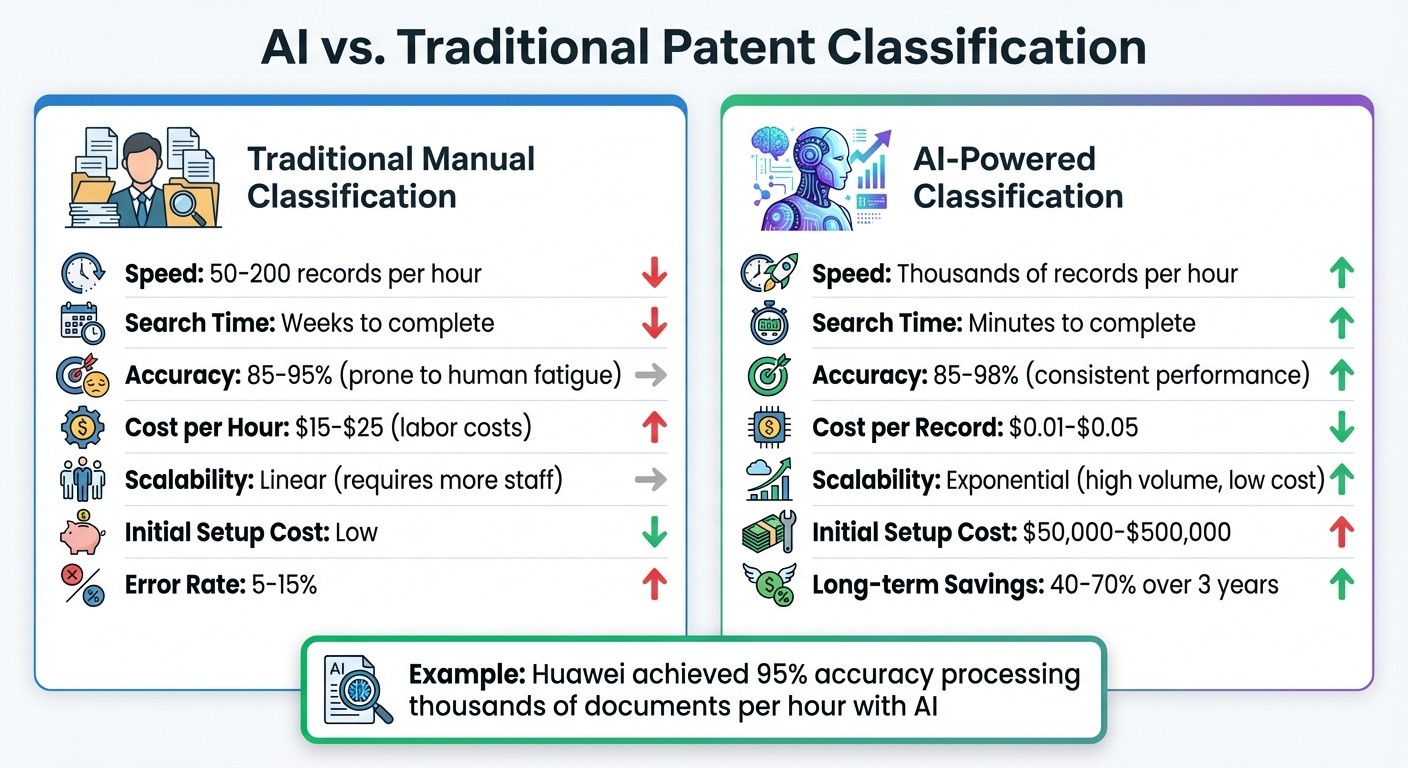
AI vs Traditional Patent Classification: Speed, Cost, and Accuracy Comparison
AI-powered classification is reshaping patent management by automating tasks that manual processes can no longer handle efficiently. While traditional methods process only 50–200 records per hour, AI can handle thousands, reducing search times from weeks to just minutes.
When it comes to speed, AI leaves traditional methods far behind. For example, in February 2026, Huawei Technologies adopted the ModelArts platform for AI-driven classification, achieving up to 95% accuracy while processing thousands of documents per hour. In contrast, manual methods are limited to handling only dozens of documents with inconsistent results. Similarly, the USPTO's auto-classification tool, introduced in December 2020, enables near-instant classification right after submission.
Cost efficiency is another area where AI excels, especially at scale. Manual classification costs between $15 and $25 per hour, while AI systems average just $0.01 to $0.05 per record. Over three years, this translates to savings of 40%–70% for organizations processing high volumes of records - typically over 5,000 to 15,000 per month.
AI also improves accuracy and consistency. Manual classification often suffers from error rates of 5%–15%, largely due to examiner fatigue. In contrast, modern AI models deliver 85%–98% accuracy, maintaining consistent performance even across extensive datasets.
The table below highlights these differences in key metrics:
Comparison Table
Metric | Traditional Manual | AI-Powered Classification |
|---|---|---|
Speed | 50–200 records per hour | Thousands of records per hour |
Time to Complete Search | Weeks | Minutes |
Accuracy | 85–95% (prone to fatigue) | 85–98% (consistent) |
Cost per Hour | $15–$25 (labor) | $0.01–$0.05 per record |
Scalability | Linear (requires more staff) | Exponential (high volume, low cost) |
Initial Setup Cost | Low | $50,000–$500,000 |
Long-term Savings | N/A | 40–70% over three years |
These advancements in speed, cost, and accuracy highlight how AI is transforming patent classification. With its ability to handle large-scale processing quickly and consistently, AI is paving the way for more efficient portfolio management.
Practical Applications in Patent Management
AI is reshaping the patent management landscape, offering tools that streamline operations and provide actionable insights. Platforms like Patently Create exemplify this shift by integrating AI across the full spectrum of patent work. By automating processes like categorization and data normalization, AI helps patent professionals uncover opportunities that traditional methods might miss. For instance, patent examiners dedicate nearly 40% of their time to prior art searches, which often involve sifting through a staggering 1.3 billion technical records across 179 databases.
Portfolio Benchmarking
Managing large patent portfolios can be overwhelming, but AI simplifies this by grouping and analyzing patents based on business priorities. Take IBM, for example - managing over 155,000 patents as of 2025. AI helps by normalizing assignee names (e.g., unifying "IBM" and "International Business Machines") and clustering related patents filed in different countries into family groups. This approach treats one invention as a single record instead of multiple duplicates.
AI doesn’t just organize data; it also highlights innovation gaps, guiding companies on where to focus their R&D efforts to stay competitive. Moving from static spreadsheets to real-time, interactive dashboards has made it easier for teams to align their patent strategies with business goals. These insights also streamline other tasks, like conducting efficient prior art searches.
Prior Art Searches
AI dramatically speeds up prior art searches by leveraging natural language processing (NLP) to understand the technical meaning behind patents, rather than relying solely on keyword matches. A notable example comes from Brazil’s National Institute of Industrial Property (INPI), which partnered with CAS in March 2022. Using 10 customized AI algorithms, this collaboration reduced patent examination times by 50%, cut the application backlog by 80%, and shortened search times for 77% of applications.
"Excessive delays in patent examinations harm a country's innovation and economic development. They discourage companies from seeking legal protection for their inventions, since, when the patent is finally granted, the technology protected in it may be totally outdated and obsolete." – Juliano Ryota Murakami, Partner, Gusmao & Labrunie
Custom Taxonomy Implementation
AI also enables companies to create tailored thematic clusters based on factors like product lines, market trends, or R&D initiatives. By refining patent classification and adapting to internal business needs, AI transforms portfolio analysis into a more strategic process. Using NLP, patents can be categorized in ways that align with specific business objectives, regardless of language barriers.
These tools go further by maintaining dynamic, real-time maps of patent portfolios. AI-driven systems can even automate Evidence-of-Use (EoU) scouting, identifying potential infringement through competitor announcements or technical documentation. For Standard-Essential Patents (SEPs), AI matches patent claims with technical standards from organizations like 3GPP or IEEE, pinpointing patents that could be critical to industry benchmarks.
How Patently Uses AI for Patent Classification
Patently employs machine learning (ML), natural language processing (NLP), and Vector AI to simplify patent drafting, searching, and portfolio management. The platform incorporates AI-driven classification into workflows, using a proprietary system that refines IPC and CPC headings into easy-to-understand functional themes. It also organizes documents by subject matter under a "Genetic family" definition.
AI-Assisted Patent Creation
Patently's drafting tools leverage NLP to speed up the patent creation process, from initial claims to prosecution. A key feature is Onardo, an AI assistant that can draft complete patent descriptions once claims and drawings are provided. According to Patently, these tools reduce drafting and prosecution efforts by anywhere from 50% to 90%.
"With Patently Create and Patently Shape, you're in control. You get state-of-the-art NLP and AI that accelerates the entire patenting process without taking you out of the driver's seat."
Despite the advanced automation, Patently ensures users maintain full control over the outputs, allowing practitioners to make final decisions. These drafting tools integrate seamlessly with Patently's classification system, ensuring consistent and precise categorization.
Advanced Semantic Search
Patently takes search functionality to the next level with its semantic search powered by Vector AI. Unlike traditional keyword-based searches, this feature focuses on conceptual meaning and functional language. Users can input natural-language queries, functional descriptions, or problem-solution frameworks to locate semantically relevant prior art. By identifying conceptually aligned patents, the semantic search enhances classification accuracy and helps uncover related technologies. Additionally, it standardizes applicant names and analyzes contextual language patterns, improving the precision of portfolio filtering and landscape analysis.
Collaborative Project Management
Patently also boosts team productivity with integrated project management tools designed for collaboration. Features like shared comments, asset-level ratings, and automated smart reports keep teams organized. The platform supports hierarchical project categorization, allowing patents to be sorted by department, profit center, or client-specific matters. Confidentiality is maintained through access controls and ethical barriers.
For Standard Essential Patents, Patently offers specialized analytics for 4G and 5G technologies. This includes "true essentiality" analysis developed in collaboration with Questel and an index of all ETSI/3GPP declarations by technical specifications. Additionally, an AI-powered claim charting tool maps patents to technical documentation, enabling users to generate high-quality claim charts in just minutes.
Conclusion
AI patent classification transforms traditional manual processes by leveraging Natural Language Processing and machine learning to grasp technical concepts and relationships. This approach ensures consistent categorization across vast patent portfolios, avoiding the clutter of irrelevant keyword-based results.
Beyond operational efficiency, AI offers strategic advantages. It identifies whitespace - areas where innovation is flourishing but patent protection is sparse - helping R&D teams focus on unexplored opportunities. Additionally, AI tracks competitor filing patterns in real time, enabling businesses to anticipate market trends and make informed decisions about whether to maintain or abandon patents. This kind of analysis helps reduce unnecessary renewal costs by evaluating commercial potential and competitive dynamics.
Platforms like Patently illustrate these advancements by integrating tools such as semantic search, AI-assisted patent drafting (via Onardo), and collaborative project management. These features create a streamlined system where accurate classification enhances every phase of the patent lifecycle.
On a broader scale, this shift is reshaping how patents are managed. The move from static, one-time searches to dynamic, real-time systems marks a major evolution in the field. Automated, precise classification has replaced manual reviews, and as patent filings grow across jurisdictions, AI-driven classification is no longer a luxury - it’s a necessity.
FAQs
How does AI pick the right IPC/CPC code?
AI uses advanced techniques like natural language processing (NLP), text embedding, and machine learning to assign IPC (International Patent Classification) or CPC (Cooperative Patent Classification) codes. These methods analyze the technical details within patent documents to determine the most relevant classification codes.
By training on extensive datasets of previously classified patents, AI systems achieve faster and more accurate results compared to manual methods. This not only reduces the workload for human experts but also ensures consistent reliability. Additionally, AI-generated explanations - powered by language models - help clarify predictions, making the process more transparent.
What data do I need to train an AI classifier?
To build an AI classifier for patent classification, you'll need three key components:
Positive examples: These are patents that are relevant to the classification task.
Negative examples: These represent patents that are irrelevant.
Appropriate tags: Clear and consistent labels to guide the classifier's learning process.
The quality of your samples matters a lot. Using well-chosen, representative examples ensures the AI learns effectively, leading to more accurate and dependable results.
When should humans review AI classifications?
Humans play a critical role in reviewing AI classifications to ensure they are accurate, catch subtle details that AI might miss, and handle strategic decisions that go beyond AI's capabilities. This step is particularly crucial when finalizing patent claims or filings, as it helps prevent mistakes and improves the overall quality of the work.