Patent Whitespace Analysis with AI
Intellectual Property Management
Aug 5, 2025
Explore how AI enhances patent whitespace analysis by identifying innovation opportunities and transforming R&D strategies for competitive advantage.

Patent whitespace analysis helps companies find areas with little or no patent activity, offering opportunities for innovation. With AI, the process becomes faster and more precise by analyzing large datasets, identifying trends, and revealing untapped areas for development. Here's why it's important and how AI is transforming it:
What It Is: Identifying gaps in patent landscapes to focus R&D efforts.
Why It Matters: Guides companies to invest in areas with less competition and high potential.
How AI Helps: AI uses advanced tools like semantic search, patent mapping, and clustering to uncover patterns and predict trends.
AI-driven tools like Patently simplify this process with features such as semantic search, project collaboration, and analytics for better decision-making. This approach not only improves efficiency but also helps businesses stay ahead by spotting opportunities early.
Using AI to Transform and Unlock Your IP Landscape 1
AI Methods for Patent Whitespace Analysis
AI has transformed the way we identify gaps in the patent landscape. These advanced methods go well beyond traditional keyword searches, uncovering hidden opportunities and patterns that might otherwise remain unnoticed. They provide the technical backbone for a systematic approach to whitespace analysis, which will be discussed in more detail later. Let’s delve into three key AI-driven approaches that are reshaping how patent whitespace analysis is conducted.
Semantic and Vector-Based Search
Semantic and vector-based searches move beyond simple keyword matching, allowing AI to detect subtle connections and similar concepts within patents. By converting patent documents into mathematical vectors that capture the meaning of the text, these systems evaluate similarity based on context, word placement, and usage patterns. This is particularly useful when patent language is intentionally vague or complex.
Research highlights the power of combining semantic search with AI-driven categorization, resulting in more comprehensive and far-reaching results. By leveraging these insights, organizations can map patent landscapes in ways that visually represent strategic opportunities.
Patent Landscape Mapping
AI-powered patent landscape mapping creates clear, visual representations of patent activity across various technology domains. This makes it easier to pinpoint areas with little patent activity - prime spots for innovation and growth. By offering a full view of patent activity in specific sectors, organizations can better understand their competition and uncover whitespace opportunities.
The process is swift and insightful, thanks to automation. Natural language processing extracts key details from patent texts, while machine learning algorithms identify patterns and predict emerging trends. These tools transform patent analysis into a forward-looking strategy. Using data mining and visualization, AI uncovers hidden connections and emerging clusters within massive datasets.
The impact on the market is undeniable. The patent landscape analysis industry is projected to reach $4.1 billion by 2033, with a compound annual growth rate of 13.04%. Real-world examples illustrate its potential: TT Consultants identified $8 million in licensing opportunities for a global automotive technology firm, helping the client secure $3 million in deals within just six months[18, 19]. Similarly, PixelBlue Innovations used patent landscape mapping to discover competitors they hadn’t previously identified - ranging from Chinese startups to large corporations expanding into new markets. Traditional market research had missed these insights[17, 18]. Reflecting on this, PixelBlue Innovations CEO Michael Currin remarked:
"Now I see that your real competitors are not always who you think they are."
Siemens also saw remarkable results, achieving a 47.2% boost in the strength of its Internet of Things patent portfolio over four years by adopting a quality-focused patent strategy informed by comprehensive patent landscape analysis.
Clustering and Topic Modeling
Clustering and topic modeling group patents by themes and similarities, making it easier to spot trends and opportunities. These machine learning techniques organize large datasets into meaningful categories, often visualized through heatmaps or topic maps. This allows organizations to identify underexplored areas and emerging trends at a glance.
For example, recent data shows that the number of generative AI patent families skyrocketed from 733 to over 14,000 in just a decade. Meanwhile, quantum computing applications saw a 200% surge between 2021 and 2023[20, 18]. Topic modeling goes a step further by identifying emerging themes and areas of technological convergence, signaling new avenues for innovation. Visual tools make these complex relationships easy for decision-makers to grasp.
When combined, these AI methods create a powerful toolkit. Semantic search provides broad exploratory capabilities, landscape mapping delivers strategic visualization, and clustering uncovers detailed patterns. Together, they offer the clarity and insight needed to develop forward-thinking patent strategies and uncover untapped opportunities in the innovation ecosystem.
Step-by-Step AI Whitespace Analysis Process
AI whitespace analysis turns raw patent data into actionable insights, following a structured approach. This involves three key phases: collecting and preparing high-quality data, categorizing technology domains strategically, and interpreting and validating AI-generated findings with care.
Data Collection and Preprocessing
The foundation of effective whitespace analysis lies in comprehensive, high-quality patent data. Start by sourcing data from trusted platforms like USPTO, EPO, WIPO, Google Patents, and PatentsView. These sources ensure broad coverage, minimizing the risk of overlooking opportunities due to incomplete datasets.
Interestingly, preprocessing typically takes up about 80% of the analysis time. AI tools can simplify this step by automating error detection and standardizing data. A solid preprocessing workflow should include data profiling to uncover patterns, relationships, and anomalies. This step identifies issues like missing values, incorrect formats, and duplicates. AI can also predict missing data based on trends and cross-check patent details against reference sources to flag inconsistencies.
Implement automated cleaning pipelines that scan for errors every time new data is added. Once your data is in good shape, the next step is to define clear technology domains to guide your analysis.
Defining Technology Domains and Categories
This phase organizes raw data into meaningful segments. Effective categorization strikes a balance between technical accuracy and strategic business goals. Your classification system should align with your company’s objectives, product lines, and priorities. Involving subject matter experts ensures both precision and relevance.
To avoid ambiguity, categories must provide full coverage of relevant technology areas while being mutually exclusive. Aim for a manageable number of categories - typically 50 to 100 patents per class - to ensure reliable AI analysis. Consistency is crucial: use clear, concise titles and maintain uniform naming conventions throughout. Enhance organization with custom fields, hierarchical categories, and a thesaurus to consolidate synonyms for complex terms. Finally, design your system to be adaptable, allowing for updates as new technologies emerge.
With well-defined categories in place, you’re ready to interpret and validate the AI-generated results.
Interpreting and Validating Results
Cleaned data and structured categories set the stage for actionable insights. However, human expertise remains vital in translating AI outputs into strategic opportunities. This step involves filtering out false positives and zeroing in on genuine opportunities by considering factors like commercial potential, your organization’s innovation capacity, and the competitive landscape.
Validation is key - compare AI findings with known market conditions, competitor activities, and internal R&D insights to ensure the results are reliable. For instance, the global AI market is expected to grow to $826.7 billion by 2030, with a compound annual growth rate of 28.46% from 2024 to 2030. Leveraging AI effectively can help organizations stay ahead by identifying trends, whitespace opportunities, and competitor movements.
Throughout the validation process, balance AI-driven insights with human judgment. Document your validation criteria to maintain consistency across analyses and to clearly communicate findings to stakeholders. This documentation also serves as a foundation for refining your process as your expertise with AI tools grows.
Using Patently for Patent Whitespace Analysis
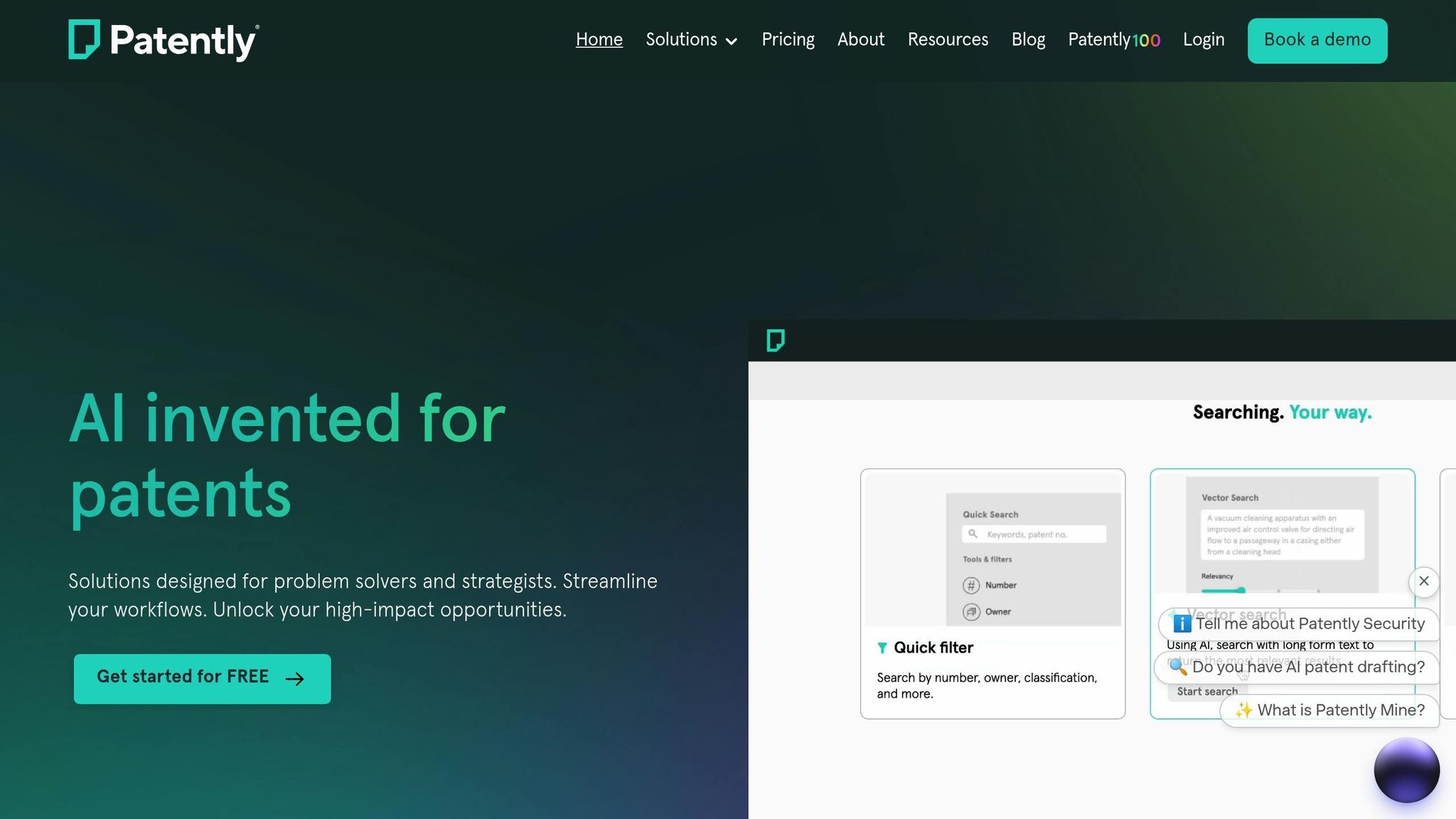
Patently streamlines the process of identifying and validating patent whitespace opportunities by combining AI-powered search tools with collaborative project management features.
AI-Assisted Patent Creation and Semantic Search
Patently's Vector AI takes patent searches to the next level by going beyond exact keyword matches. With this tool, you can search using full sentences that describe the technology you're researching, enabling the discovery of patents with similar ideas - even if the wording doesn’t match your search terms exactly [34,35]. To make the analysis even more thorough, family-based logic groups related patents together, providing a more complete view.
The platform also includes the Forward and Backward (FAB) browser, which allows you to follow citation trails and uncover additional results that might not surface in your initial searches [34,35]. With data refreshed every 30 days, you can trust that you're working with up-to-date information. Plus, Patently lets you combine searches - including results from external sources - into a single list, making it easier to analyze both conceptually similar and technically precise patents using a hybrid search approach.
When you're ready to act on identified whitespace opportunities, Patently Create can slash drafting time by over 90%. This efficiency allows you to quickly transition from identifying opportunities to securing patent protection. All these advanced search features integrate seamlessly with Patently's collaborative tools, making it easier for teams to analyze and act on findings together.
Collaborative Project Management
Patently's collaborative project management features are designed to complement its advanced search tools, ensuring effective teamwork. The Patently Know feature allows team members to comment on, rate, and sort patent families and assets within shared projects. These reviews can be tailored for various purposes, such as novelty assessments, validity checks, freedom-to-operate (FTO) analysis, and competitor evaluations. This ensures that each team member's expertise contributes meaningfully to the analysis.
For larger organizations, hierarchical project categories offer a structured way to organize work by department, profit center, or client. Access controls let you manage user permissions based on confidentiality needs and enable secure collaboration with external experts when required. Additionally, projects are updated every 30 days, ensuring all team members work with the latest data.
To make sharing results easier, findings can be exported as company-branded Word reports, enabling seamless communication with stakeholders who don’t use the platform. Team members can also tag and comment on families or assets of interest, creating a detailed record of the analysis process [34,35].
SEP Analytics and Competitive Insights
Patently's analytics tools go beyond search and collaboration, offering insights that support strategic decision-making in fast-moving tech sectors. Standard-Essential Patents (SEPs) play a key role in whitespace analysis, especially in areas like 5G, WiFi, and HEVC. Patently's SEP analytics help pinpoint which patents are essential to specific standards, exposing gaps in SEP coverage. The platform evaluates filing trends, research activity, litigation, and product documentation to identify companies that could benefit from licensing specific assets.
To gain a competitive edge, you can analyze patent strength across various factors, including technology categories, jurisdictional coverage, portfolio age, filing trends, inventor activity, and litigation history. This detailed analysis helps identify trends, market leaders, and areas with high potential, enabling a focused approach to whitespace opportunities. Considering that 80% of patents never generate revenue, these insights help zero in on areas with real commercial potential.
Patently also includes claim charts, which clearly map how patents align with specific standards. This feature proves especially useful when identifying potential patent infringements at the claim element level.
"When it comes to Standard Essential Patents (SEPs), it's not just about owning patents. It's about how you use them." – GreyB
Best Practices for AI-Driven Whitespace Analysis
To make your whitespace analysis both accurate and actionable, it's crucial to combine advanced AI techniques with structured data processes. Here’s how to ensure your efforts yield meaningful insights.
Ensuring Data Quality and Relevance
The foundation of effective AI-driven whitespace analysis lies in having clean, complete, and reliable data. Without it, strategic decisions can go astray. Start by clearly defining your objective - whether it’s exploring licensing opportunities in 5G technology or identifying gaps in automotive AI innovation.
One critical step is verifying patent ownership. Mergers, acquisitions, and portfolio transfers can quickly make ownership records outdated, leading to errors in identifying whitespace. Additionally, patents often belong to families spanning multiple jurisdictions. Missing international filings can create the illusion of gaps where none exist. By maintaining accurate and up-to-date data, you can avoid these pitfalls and ensure your analysis is sound.
Once your data is in order, expert review is key to converting raw insights into actionable strategies.
Balancing AI with Human Expertise
AI is excellent for processing vast amounts of patent data and spotting patterns that might elude traditional methods. However, it’s not infallible. Human expertise is essential to validate whether the gaps identified by AI represent real opportunities or areas where patent protection might not make economic sense.
By combining AI tools - like semantic search and clustering algorithms - with human technical expertise, you can ensure that the insights generated are both meaningful and practical. This hybrid approach allows you to contextualize findings and make informed decisions that align with your strategic goals.
As strategies take shape, regular oversight is necessary to maintain their relevance.
Regular Monitoring and Updates
Patent landscapes are dynamic. What looks like whitespace today may become crowded with new filings tomorrow. For example, a TT Consultants report from October 2024 highlighted how a global automotive tech firm used patent landscape analysis to uncover $8 million in licensing potential. Within six months, they secured $3 million in deals, demonstrating the value of staying ahead of the curve.
To keep your analysis current, establish a monitoring schedule that fits your industry’s pace. In fast-moving sectors, quarterly updates might be necessary, while more stable industries could manage with annual or semi-annual reviews. Tracking competitor filing patterns and adjusting your monitoring criteria as market conditions shift can help you stay ahead. Staying informed about global intellectual property trends and regulatory changes will further enhance your ability to seize new opportunities before others do.
Conclusion
AI-powered patent whitespace analysis is reshaping how organizations approach innovation. By automating complex data analysis and speeding up discovery, AI transforms R&D from a reactive process into a flexible, forward-thinking system.
But it’s not just about improving efficiency. AI allows companies to anticipate opportunities and potential disruptions rather than merely reacting to market demands. This proactive strategy pays off - companies using AI-driven whitespace analysis have reported a 30% increase in successful innovation projects. As technology advances at breakneck speed, this approach is becoming essential.
For instance, green AI patent filings surged by 35% in 2023, highlighting the rapid pace of technological evolution. This acceleration makes AI integration critical for maintaining a competitive edge. Companies leveraging AI for patent analysis can uncover overlapping technologies, evaluate infringement risks, and pinpoint areas for differentiation. They can also keep an eye on global patent trends to identify emerging innovation clusters.
With tools like Patently's AI-powered platform, patent professionals gain access to cutting-edge features like semantic search powered by Vector AI, collaborative project management tools, and detailed SEP analytics. These tools help organizations implement best practices, such as maintaining high-quality data and blending AI insights with human expertise.
FAQs
How does AI make patent whitespace analysis more accurate and efficient than traditional methods?
AI is changing the game when it comes to patent whitespace analysis, offering results that are both faster and more precise than traditional manual methods. Using advanced algorithms, it can sift through massive amounts of patent data in no time, making it easier to spot gaps in the patent landscape.
This improved efficiency and accuracy allow innovators to identify unpatented areas of technology with ease, giving them the confidence to make strategic decisions. Plus, by minimizing human error, AI ensures a more dependable and thorough analysis overall.
What challenges might companies face when using AI for patent whitespace analysis?
Using AI for patent whitespace analysis comes with its own set of challenges. One major concern is bias in the training data, which can result in incomplete or skewed outcomes. This means the AI might miss critical insights or provide results that aren't entirely reliable.
Another issue is the risk of overreliance on AI tools. While these tools are powerful, they might not catch subtle legal or technical nuances, leaving room for errors or missed opportunities that could have serious consequences.
Then there’s the matter of data quality. Poor or inconsistent data can directly impact the accuracy of AI-generated insights, making it harder to trust the results. On top of that, ethical questions arise, such as the potential for overpatenting or the uncertainties tied to inventions created by AI.
These challenges underscore why it’s essential to pair AI tools with human expertise. By blending technology with the nuanced judgment of skilled professionals, companies can achieve a more well-rounded and dependable analysis.
How can organizations combine AI insights with human expertise to drive innovation effectively?
Successfully blending AI insights with human expertise requires a thoughtful approach. This involves defining distinct roles for both, ensuring AI systems are transparent and easy to understand, and keeping these systems updated to meet evolving demands. Human judgment remains crucial, especially in areas like patent analysis, where legal subtleties and creative thinking are indispensable.
To strike this balance, organizations can take several steps:
Leverage AI for tasks like data analysis and identifying patterns, freeing up humans to concentrate on strategic and creative decision-making.
Encourage collaboration between AI tools and professionals to validate findings and refine approaches.
Invest in ongoing training for employees, equipping them to work effectively with AI systems while maintaining essential oversight.
By merging the analytical power of AI with the nuanced judgment of humans, businesses can develop strategies that are both effective and aligned with their objectives.