Ultimate Guide to AI-Based Prior Art Visualization
Intellectual Property Management
Mar 15, 2026
AI turns patent documents into interactive maps and citation networks to speed prior art searches, improve accuracy, and support legal strategy.
AI-based prior art visualization simplifies patent research by converting dense patent data into visual formats like interactive maps and citation networks. This approach uses machine learning and natural language processing (NLP) to group patents by meaning, revealing patterns and connections traditional keyword searches often miss.
Key Benefits:
Saves Time: Reduces research time by 60–70%.
Improves Accuracy: Identifies 50% more relevant prior art through semantic analysis.
Simplifies Collaboration: Interactive visuals and shared environments make patent data easier to understand for teams.
Features:
Semantic Search: Goes beyond keywords to find conceptually related patents.
Citation Mapping: Highlights critical references and relationships between patents.
Interactive Tools: Heatmaps, 3D landscapes, and dashboards for better analysis.
Use Cases:
Novelty Searches: Quickly identify if an invention is new and find "whitespace" opportunities.
Technology Analysis: Track innovation trends and competitive landscapes.
Legal Strategies: Build stronger invalidity and opposition cases with detailed visualizations.
AI tools transform patent research from a tedious task into an efficient process, helping professionals make faster, more informed decisions.
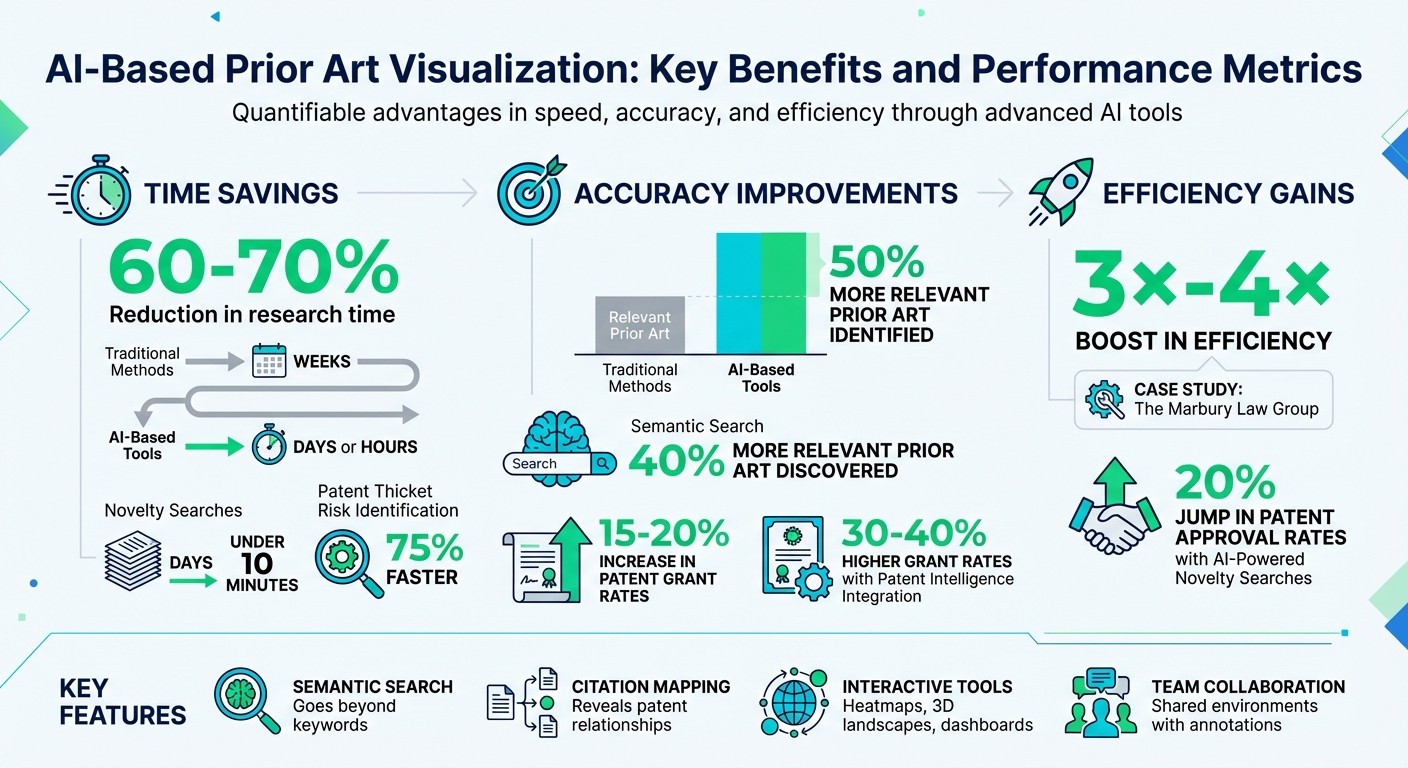
AI-Based Prior Art Visualization: Key Benefits and Performance Metrics
Benefits of AI-Based Prior Art Visualization
Faster Analysis and Time Savings
Top AI-powered patent tools can shave 60%–70% off the time it takes to conduct prior art searches. Instead of slogging through thousands of patent documents with traditional Boolean queries, these tools analyze invention disclosures directly. They create search representations that align with your specific technical goals. Tasks that once required weeks can now be wrapped up in just days - or even hours.
The time savings don’t stop there. Features like automated citation mapping and technology family graphs handle repetitive tasks for you, freeing up time for strategic decision-making. Plus, these tools don’t just save time - they also improve the precision of identifying relevant prior art.
Better Accuracy and Deeper Insights
Beyond speed, these tools enhance discovery, leading to stronger R&D outcomes. AI-based systems improve the identification of relevant prior art by up to 50% compared to traditional keyword-based methods. Using semantic search, they can spot connections between inventions even when different terminology is used. For example, while researching a consumer wearable health tracker, AI might uncover sensor technology applicable to industrial safety equipment.
Technology clustering provides a clearer picture of competitive landscapes, highlighting dense areas of innovation and revealing untapped "white space" opportunities. This approach helps companies strategically plan their R&D efforts, often resulting in 30%–40% higher patent grant rates.
Easier Collaboration and Communication
AI visualization tools turn patent data into interactive charts, making complex intellectual property landscapes easier for everyone to understand. This improved clarity helps bridge the communication gap between engineers and patent attorneys, ensuring R&D efforts align with intellectual property strategies. Many platforms also offer shared environments where IP attorneys, inventors, and R&D teams can collaborate seamlessly. With features like integrated annotations and comments, teams can work together more effectively. One case study even reported a 3×–4× boost in efficiency when using collaborative AI tools.
Generate New Ideas from Patents with Knowledge Graphs and AI
Features of AI Visualization Tools
Advanced features in AI visualization tools are reshaping how patent analysis is conducted, turning it into a more dynamic and actionable process.
Semantic Search and Citation Mapping
Semantic search goes beyond simple keyword matching by understanding the underlying concepts within patents. For example, tools like Patently's Vector AI can identify that terms such as "fastening mechanism" and "clip assembly" might describe the same invention. This approach can uncover up to 40% more relevant prior art compared to traditional search methods.
When paired with citation mapping, these tools provide a detailed view of forward and backward citations, uncovering key patents and hidden connections. Patently's citation browser, for instance, allows users to interactively explore these relationships, which helps trace the evolution of a technology and locate additional prior art. These semantic capabilities naturally integrate with dynamic visualizations, offering a clearer picture of innovation trends.
Interactive Graphs and Knowledge Maps
Interactive visual tools like heatmaps and 3D technology landscapes group patents into clusters, making it easier to identify areas with dense innovation and potential "white spaces" for new opportunities. Citation network graphs transform static lists into dynamic, navigable maps. Instead of sifting through endless documents, you can visually trace patent relationships, quickly pinpointing critical references. This method can cut patent analysis time by up to 70%, thanks to features like automatic clustering and relationship mapping.
Team Analytics and Customization
Modern platforms are designed for real-time collaboration, offering tools like customizable dashboards and integrated annotations. Features such as hierarchical categorization, access control, and annotation tools let teams save, comment on, and revisit searches collectively. For example, Patently's project management tools allow users to tailor views based on specific workflows, whether it's for conducting novelty searches or building invalidity cases. Additionally, these platforms automatically handle data normalization, addressing the 15% variation in assignee name spellings that often complicates competitive analysis.
Use Cases for AI-Based Prior Art Visualization
AI visualization tools have become a game-changer for patent professionals, streamlining workflows and uncovering insights that were previously difficult to access. Let’s explore how these tools are reshaping three key patent-related tasks.
Conducting Novelty Searches
Determining whether an invention is genuinely new can be a daunting task. AI visualization tools simplify this by mapping invention concepts onto existing patent landscapes. For example, Patently's Vector AI uses semantic clustering to group patents based on meaning, making it easier to see how a new invention aligns with prior art. This approach not only speeds up the process but also provides a clearer picture of where the invention fits in the broader patent ecosystem.
Citation graph expansion adds another layer of depth by tracing the evolution of a technology. It identifies "hub" patents and related disclosures that might go unnoticed in traditional searches. With AI, the time required for novelty searches can shrink from days to under 10 minutes. Organizations using these tools have reported a 15–20% increase in patent grant rates, thanks to earlier detection of novelty conflicts.
These tools also highlight "whitespace" - areas in crowded technology fields where new filings are more likely to meet novelty and non-obviousness criteria. Modern platforms integrate semantic search, classification codes, and citation tracking into a unified visual workflow, reducing the chances of overlooking critical references. Additionally, dynamic visualization provides insights into broader technology trends, offering a more comprehensive view.
Analyzing Technology Landscapes
AI has revolutionized technology landscape analysis, turning static reports into dynamic, interactive dashboards. These tools track competitive shifts and innovation trends in real time. By leveraging machine learning and natural language processing, AI clusters patents by similarity, helping pinpoint innovation hotspots and uncover R&D gaps. This makes it easier for companies to identify areas ripe for development.
Citation mapping plays a crucial role here, revealing how foundational patents influence subsequent filings. This helps companies spot high-impact "hub" patents, monitor competitor R&D activities, and even detect signals of market entry. For businesses, these insights are invaluable - AI-powered patent analytics can reduce the time to identify patent thicket risks by up to 75%. Companies that incorporate patent intelligence into their R&D planning have seen a 30–40% boost in patent grant rates.
"A patent landscape is not just a collection of documents. It is a living map of where innovation has already happened, where it is happening right now, and where it is likely to happen next." – PowerPatent
Building Invalidity and Opposition Cases
AI visualization tools are also transforming legal strategies by simplifying the process of building invalidity and opposition cases. These platforms generate detailed claim charts, breaking down limitations with citation-backed disclosures. This allows legal teams to evaluate multiple prior art references simultaneously, saving time and effort.
Interactive citation graphs are particularly valuable, as they reveal relationships between patents, making it easier to find those elusive "needle in the haystack" references across global databases. Beyond text-based evidence, these tools can analyze non-textual materials, such as demo videos and product images, to create annotated, courtroom-ready exhibits.
AI engines also assess whether a reference qualifies as prior art under specific statutory frameworks, such as AIA or Pre-AIA, and identify priority conflicts. For obviousness cases, AI suggests primary and secondary references, drafting arguments based on KSR principles to strengthen the case. These capabilities equip legal teams with a robust set of tools to challenge patents effectively and efficiently.
Conclusion
AI-based visualization tools have changed the game for patent professionals, making prior art research faster and more efficient than ever. What once took days or weeks can now be completed in mere minutes or hours, with time savings of 60–70% becoming the norm. These tools don’t just speed things up - they also bring a smarter approach, using semantic analysis to catch references that traditional keyword searches might miss and uncovering strategic opportunities through interactive visuals.
The impact is clear in the numbers. Organizations using AI-powered novelty searches have seen patent approval rates jump by about 20%. Meanwhile, companies incorporating patent intelligence into their R&D planning report 30–40% higher grant rates. For example, The Marbury Law Group experienced a 3× to 4× boost in efficiency for patent drafting and research after adopting AI tools in June 2025. These gains highlight a major shift in how patent work is approached.
But the benefits go beyond speed. These tools provide essential strategic insights by turning complex data into easy-to-understand visual maps. This bridges the gap between technical and legal expertise, enabling professionals to act decisively. Platforms like Patently allow users to identify innovation "white spaces", monitor competitor R&D trends, and build stronger legal cases. Features like semantic search, citation mapping, and interactive visualization elevate prior art research from a tedious task to a critical strategic advantage.
"AI can find the information, but humans turn it into insight. When the two work together, your prior art search stops being a burden and becomes one of the most valuable decision-making tools in your business." – PowerPatent
To get the most out of AI, treat it as a collaborative partner. Use these tools to filter and analyze vast amounts of data, then apply your expertise to refine and interpret the results. With global patent filings steadily increasing, incorporating AI visualization tools into your workflow isn’t just helpful - it’s essential for staying ahead in today’s competitive patent landscape.
FAQs
How does semantic search find prior art beyond keywords?
Semantic search takes things a step further than basic keyword matching. By leveraging AI techniques like natural language processing (NLP) and machine learning, it dives into the meaning and context behind the text. This means it can interpret technical concepts and their relationships, even when different words or phrases are used to describe them. For patent professionals, this is a game-changer - it helps uncover relevant prior art that traditional keyword searches might overlook, ensuring a more accurate and thorough search process.
What visuals work best for novelty and invalidity work?
For invalidity analysis, detailed claim charts and thorough diagrams are the go-to tools. They provide the depth needed to evaluate claims against prior art. On the other hand, when conducting novelty searches, simplified, broad visual summaries work best. These summaries help present key findings clearly and concisely, aligning with the task's exploratory nature. Each method ensures the information is tailored and effective for its purpose.
How should teams validate AI prior art results?
Teams need to verify AI-generated prior art results by combining a detailed review with an assessment of relevance. This means closely analyzing the results, paying attention to similarity scores and conducting in-depth comparisons to confirm they align with the claims and inventive concepts being evaluated.
Manual checks are also critical. Cross-referencing with known disclosures and evaluating novelty can help prevent false positives. To make the process more efficient and accurate, take advantage of filtering and comparison features available in AI tools. These can help refine the results and bolster the overall validation process.