Secure Patent Collaboration: Common Questions Answered
Intellectual Property Management
Jun 9, 2026
Essential security for unpublished patent work: RBAC, MFA, AES-256, audit trails, semantic search, and data residency controls.

Secure patent collaboration is about protecting sensitive intellectual property (IP) while enabling efficient teamwork. Handling unpublished patent applications and prosecution strategies requires robust security to prevent breaches that could lead to financial losses or forfeited patent rights. Here's what you need to know:
Why it matters: Patent leaks can expose trade secrets and jeopardize legal protections under laws like 35 U.S.C. § 102.
Key risks: Cross-project data leakage, manual errors, and inadequate security measures.
Solutions: Use secure platforms with features like role-based access control (RBAC), multi-factor authentication (MFA), and AES-256 encryption.
Secure tools like Patently integrate AI-assisted drafting, semantic search, and project management while prioritizing data security. They help teams minimize risks, streamline workflows, and maintain compliance with standards like SOC 2 Type II and ISO 27001.
To protect your IP and improve collaboration, focus on platforms offering advanced access control, document-level security, and audit trails. These measures ensure confidentiality, integrity, and efficiency.
Core Security Features for Patent Collaboration
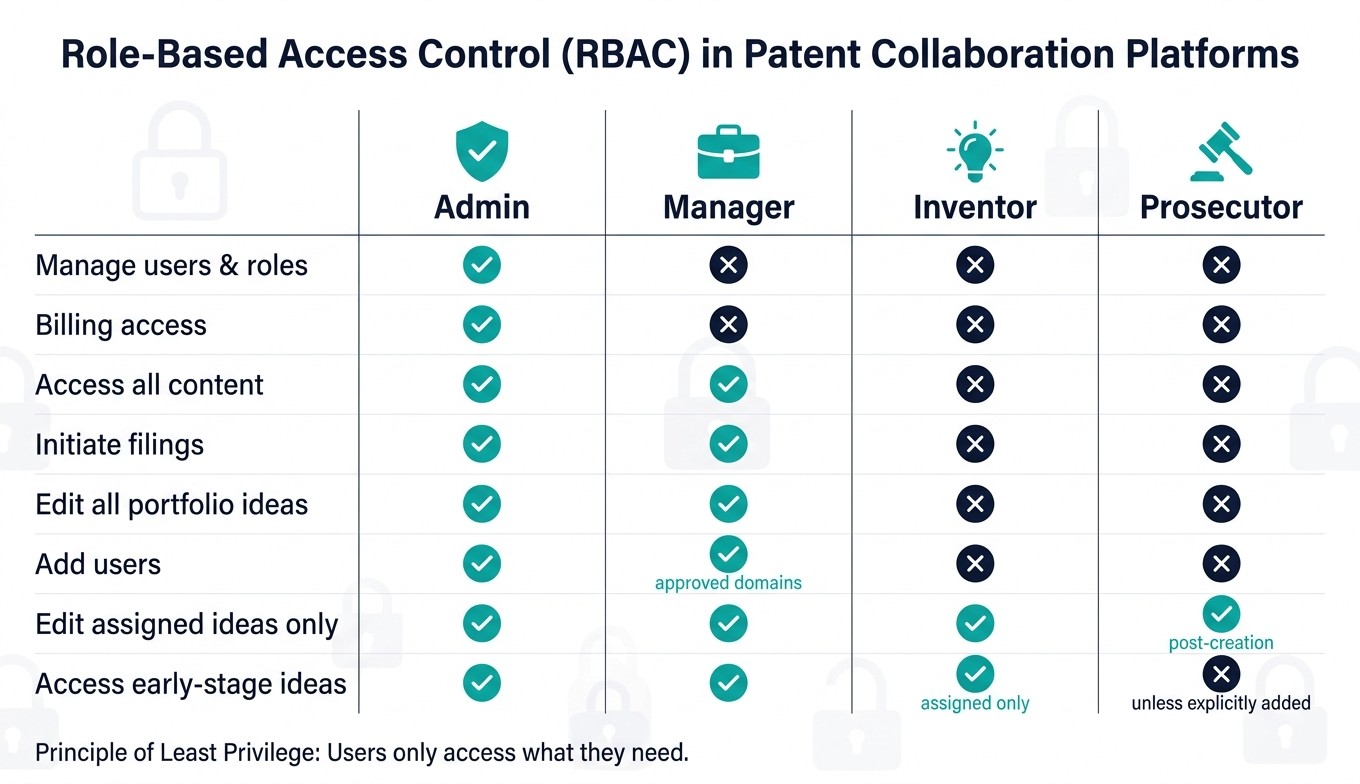
Patent Collaboration Platform: Role-Based Access Control Permissions
Creating a secure environment for patent collaboration means building multiple layers of defense. These layers - access control, authentication, and document-level protections - work together to minimize vulnerabilities and protect sensitive intellectual property.
Access Control and Permissions
Effective access control is the backbone of any secure patent platform. A well-designed system uses role-based access control (RBAC) to ensure that users only have access to what they need. Instead of granting broad permissions, RBAC enforces the principle of least privilege by assigning roles with specific capabilities. Common roles in a patent platform might include:
Role | Typical Permissions |
|---|---|
Admin | Full control: manage users, roles, billing, and access to all content. |
Manager | Edit all ideas in a portfolio, initiate filings, and add users within approved domains. |
Inventor | View and edit only the ideas they are assigned to; cannot add users. |
Prosecutor | Access and edit filings after creation; restricted from early-stage ideas unless explicitly added. |
Permissions should be flexible enough to apply at different levels - from entire workspaces to specific projects or individual documents. These role-based controls are further strengthened by robust authentication measures.
Authentication and Encryption
Strong access control becomes meaningless if credentials are compromised. That’s why multi-factor authentication (MFA) is a must for patent collaboration platforms. MFA adds an extra layer of security by requiring a second verification step, such as a one-time code sent to a mobile device, making it much harder for unauthorized users to gain access.
For larger organizations, Single Sign-On (SSO) using SAML simplifies and secures user management. By integrating with corporate identity systems, SSO eliminates shared accounts, centralizes access control, and ensures that user access can be revoked immediately when someone leaves the team.
To protect data, platforms should employ AES-256 encryption for stored information and TLS 1.3 encryption for data in transit. This ensures that both drafts and live data transfers remain secure.
"A simple decision rule: the more sensitive the data content, the more you should bias toward isolation, strict retention controls, and auditable access." - Szymon Pancewicz, Solve Intelligence
While authentication safeguards entry points, document-level protections ensure the integrity of the content itself.
Document-Level Security
Access controls determine who can enter a workspace, but document-level security dictates what they can do once inside. Version control is a critical feature, maintaining a detailed history of every change. Teams can track edits, identify who made them, and revert to earlier drafts when necessary. Paired with role-specific editing restrictions, this prevents unauthorized modifications from going unnoticed.
Another essential feature is Data Loss Prevention (DLP), which blocks unauthorized downloads and file transfers. For platforms utilizing AI, a zero-training policy is crucial. This ensures that patent documents uploaded to the platform are never used to train or refine AI models for other customers. This measure directly addresses concerns about cross-project data leakage, a major barrier for patent professionals considering AI tools.
Optimizing Collaboration Workflows
Strong security measures are essential for protecting intellectual property, but they shouldn't slow down your team's progress. Instead, they should work hand-in-hand with streamlined workflows to help patent teams operate more effectively. The top patent tools provide a secure platform that isn't just about locking down access; it's about creating a space where inventors, attorneys, and outside counsel can collaborate efficiently, cutting down on delays and miscommunications.
Structured Review Processes
Patent teams often lose valuable time sifting through endless email threads, managing exported drafts, or trying to consolidate scattered feedback. Secure platforms solve this by centralizing the entire review process. These tools allow teams to co-draft documents in real time, complete with inline commenting, while maintaining the robust access controls and audit protections that patent work demands.
Senior attorneys can "pin" critical legal phrases and inventor-specific descriptions, ensuring these sections stay intact during AI-assisted revisions. This helps preserve the original intent and meaning. When you add features like automated deadline tracking across 180+ jurisdictions and task routing, the review cycle becomes much smoother and more efficient.
This kind of structured review process sets the foundation for AI tools to amplify productivity even further.
AI-Assisted Collaboration
AI tools can make a huge difference when they're built directly into a secure workspace rather than tacked on later. For example, drafting assistants and semantic search tools integrated into a secure platform can ensure consistency across the entire patent lifecycle. Shared claim construction offers a clear benefit: universal interpretations of key terms automatically flow into infringement heatmaps, invalidity charts, and drafting prompts. This alignment reduces errors and keeps everything on track.
"AI systems that marginally slow a drafter but improve claim clarity, reduce rework, or strengthen patent protection may deliver far greater long-term ROI than tools that simply produce output more quickly."
Platforms like Patently embed AI drafting and semantic search directly into collaborative project environments. This integration allows teams to move seamlessly from prior art searches to claim drafting without switching tools or risking data exposure.
Audit Trails and Accountability
Traceability is non-negotiable. Audit trails provide a clear record of who made each change, when it happened, and under which role. This transparency supports internal accountability and ensures compliance with external standards like SOC 2, particularly under the "Processing Integrity" and "Confidentiality" criteria.
Some platforms take this a step further by including visual history tools that let users review every edit through a video-style playback of the document's version history. For AI-generated outputs, detailed logs are especially critical:
"Record which system was used, for what task, what data tier was involved, and what human review was applied. This supports auditability and defensibility."
These features ensure that every step of the process is documented, making it easier to maintain compliance and defend decisions when needed.
Advanced Search and Secure Sharing
Secure Semantic Search
Traditional patent searches often depend on exact keyword matches. This approach can lead to gaps - like searching for "autonomous vehicle" but missing patents that use "self-driving car." Semantic search takes a smarter route by converting patent text into mathematical vectors, allowing it to identify conceptually similar documents even when the wording differs. It also bridges language barriers, ensuring that patents written in other languages don’t slip through the cracks.
A great example of this is from October 2024, when Laurence Brown used Patently's Vector AI to pinpoint 300 relevant patents in a fraction of the time it would usually take.
"This powerful addition [Vector AI] has positioned Patently as one of the most innovative platforms for semantic patent search and is core to our technology stack." - Jerome Spaargaren, Founder and Director, Patently
To get the most out of semantic search, it helps to structure your invention description in layers. Start with a broad functional overview, then move into specific technical details, and finally, include alternative approaches. This method gives the AI multiple perspectives to work with, increasing the chances of uncovering relevant results you might otherwise miss.
Once you’ve identified the patents you need, the next step is to share those findings securely.
Controlled Sharing and Export
After gathering search results, securely sharing them is just as important as finding them. Whether you're collaborating with co-counsel, inventors, or clients, it's essential to protect sensitive information. Tools like project-level permissions and role-based access controls (RBAC) ensure that only authorized individuals can view search results, draft applications, or analysis reports. Features like ethical walls add another layer of security by preventing overlap between different client matters, even within the same organization. Additionally, all sharing actions are logged for a complete audit trail.
When exporting findings, platforms like Patently make it easy to share data in Word or Excel formats. These exports highlight relevance scores at the limitation level, keeping the information organized and easy to follow.
For external sharing, robust encryption protocols are a must. These protocols, as mentioned earlier, are essential for safeguarding unpublished intellectual property and ensuring data remains protected throughout the process.
Data Governance and Compliance
Retention Policies and Access Logging
Handling retention policies for unpublished patent applications is just as critical as controlling access. A data breach in this area can have irreversible consequences.
"Exposure of unpublished applications can permanently compromise patent rights." - Patlytics
To address this, secure platforms often include features like retention settings that automatically delete data after 30 days of inactivity or upon sign-out. These tools help manage the varied data footprints created during AI workflows, including prompts, outputs, metadata, and analytics.
Every action taken by a user should be timestamped and linked to their identity. This creates a reliable audit trail that not only promotes accountability but also simplifies compliance with standards such as SOC 2 Type II and ISO 27001. Additionally, it’s crucial to verify where logs and backups are stored to ensure compliance with internal and external requirements.
The next step is to assess how external integrations influence your platform’s security posture.
External Integrations and Security
Integrating a patent platform with external systems - like docketing software, document management tools, or third-party AI models - can introduce new vulnerabilities. It’s essential to understand how data flows when these third-party subprocessors are involved.
A good practice is to require advance written notice for any changes to subprocessors, such as replacing an AI model, and to maintain the right to object. Platforms should also adhere to Zero Data Retention (ZDR) agreements with their AI providers, ensuring that your inputs, files, and prompts are neither stored nor used for training purposes. Beyond these safeguards, alignment with compliance standards such as GDPR, CCPA, SOC 2 Type II, and ISO 42001 is vital.
"If you cannot clearly explain to a client what happens to their data (where it goes, who can access it, and how it's controlled) you're not ready to use that tool for their matter." - Solve Intelligence
For firms with international clients, data residency is another key factor. Some platforms offer the option to store and process data exclusively within the US, which can help meet domestic confidentiality rules and client expectations. Involving your IT and security teams early in the vendor evaluation process ensures a thorough review of hosting models and contractual terms before handling sensitive data.
Key Takeaways for Secure Patent Collaboration
Protecting unpublished intellectual property (IP) starts with a strong security foundation. Core safeguards like Role-Based Access Control (RBAC), Zero Data Retention policies, and certifications such as SOC 2 Type II and ISO 27001 are critical for managing sensitive patent work effectively.
But security alone isn't enough - efficiency matters too. Streamlining workflows by integrating tasks like drafting, prior art searches, and project management can eliminate time-consuming manual steps. For example, generative AI patent drafting tools can reduce the time it takes to create a first draft to just 30 minutes. Similarly, semantic search - which understands technical intent rather than relying on basic keywords - can significantly speed up prior art research.
Equally important is data governance. Implementing data tiering ensures that materials are classified appropriately - from publicly accessible information to highly sensitive, unpublished disclosures. This approach defines how and when materials can interact with AI tools. For added protection, using US-only data residency where necessary helps maintain client confidentiality and regulatory compliance.
To get started, consider running a 30-day pilot program focused on a specific, measurable task, such as drafting or prior art searches. This allows you to establish security protocols and evaluate the return on investment (ROI) before scaling up.
In short, secure patent collaboration requires a mix of robust security measures and an integrated, efficient workflow. Platforms like Patently are designed with these principles in mind, offering tools like AI-powered drafting, Vector AI semantic search, and collaborative project management - all backed by enterprise-grade security. The result? Faster, more secure, and compliant work for your clients and your team.
FAQs
What security features are most important for unpublished patent work?
Protecting sensitive trade secrets and avoiding early disclosure is essential. Some of the standout measures include tenant isolation, which ensures customer data remains completely separate, and zero-data retention agreements that stop third-party AI tools from storing any inputs. Additionally, robust encryption methods like AES-256 for data at rest and TLS 1.3 for data in transit provide a strong layer of security.
Other critical safeguards include role-based access controls to manage permissions, multi-factor authentication to verify identities, and audit trails to track interactions. These features not only ensure compliance but also promote accountability. Patently puts these standards at the forefront to enable secure and seamless collaboration.
How do AI tools stay secure without training on my patent data?
AI tools prioritize security by functioning in inference mode, ensuring that your inputs don’t alter the model’s parameters. Trusted platforms implement strict measures like enterprise-level agreements that prohibit using your data for training, enforce zero-data retention (ZDR) policies, isolate data in secure sandboxes, and encrypt all information both at rest and during transit. Patently adheres to these stringent protocols to safeguard your patent data and uphold your privacy.
What should we check before integrating a patent platform with other systems?
Before moving forward with integration, it’s crucial to prioritize security and compliance. Make sure the platform encrypts data both at rest and in transit. Double-check that data residency complies with the regulations in your jurisdiction and review the subprocessors involved in handling your data.
Look for key security features like role-based permissions, multi-factor authentication (MFA), and support for SSO/SAML protocols. Additionally, confirm there’s a contractual agreement ensuring your data won’t be used to train AI models.
Finally, verify the platform meets your operational needs. This includes secure API integration, detailed audit trails, and workflows tailored to jurisdiction-specific requirements.