Top Features of Cloud-Based IP Sync Platforms
Intellectual Property Management
Jun 8, 2026
Real-time cloud IP sync for patents: multi-device updates, offline access, AES-256 security, AI drafting, and scalable workflows.

Cloud-based IP sync platforms simplify intellectual property (IP) management by centralizing patents, trademarks, and designs into a single, real-time dashboard. These systems eliminate manual data entry, streamline collaboration, and reduce errors with top patent tools. Key benefits include:
Real-time updates: Changes sync instantly across devices, ensuring everyone works with the latest data.
Offline access: Work uninterrupted even without internet, with automatic re-sync when back online.
Advanced security: AES-256 encryption, TLS 1.3, and role-based access controls protect sensitive IP data.
AI tools: AI patent drafting tools, semantic search, and automation reduce workloads and improve accuracy.
Collaboration features: Real-time co-editing, version control, and task tracking enhance teamwork.
Compliance and audit trails: Detailed logs and data residency options meet regulatory needs.
Scalability and reliability: Designed to handle large portfolios with minimal downtime.
These platforms save time, improve efficiency, and ensure secure, organized IP management for legal teams, R&D departments, and external counsel.
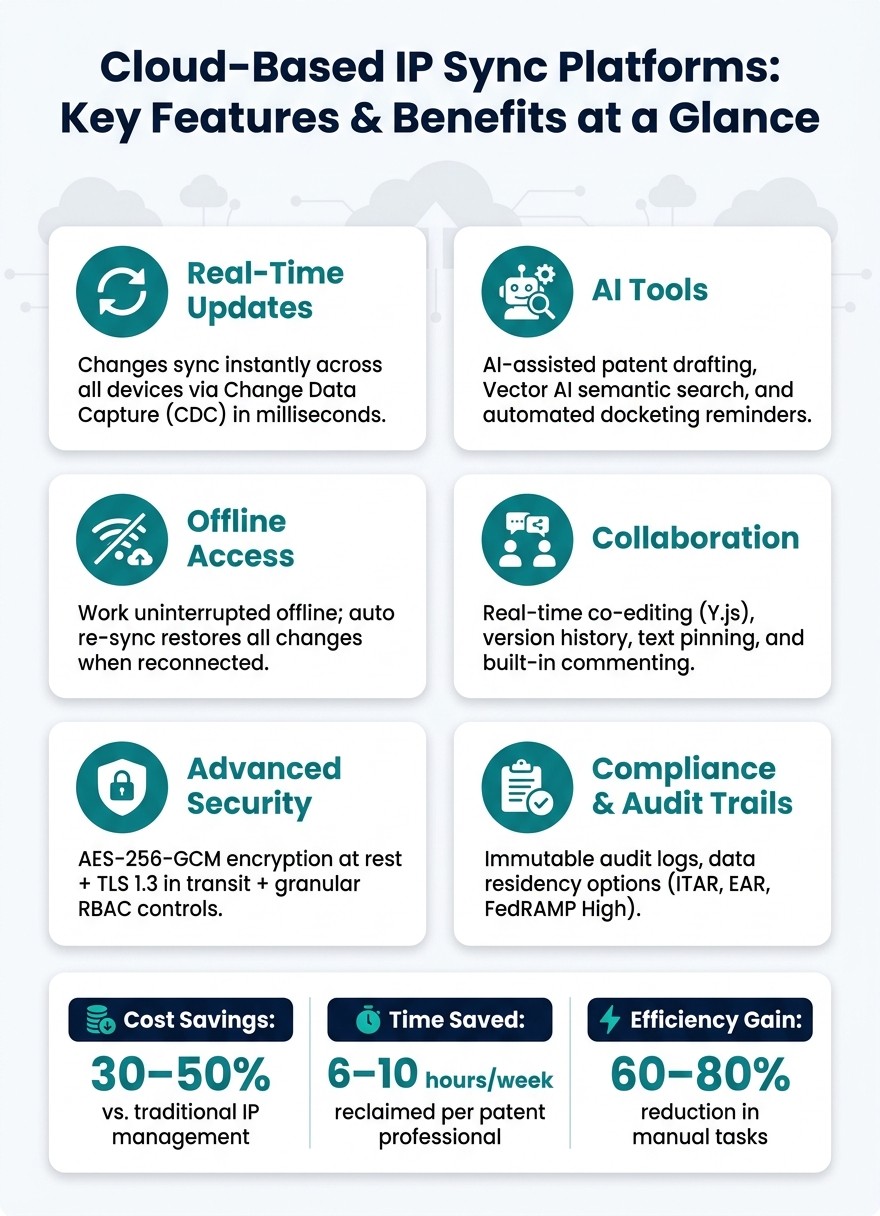
Cloud-Based IP Sync Platforms: Key Features & Benefits at a Glance
Core Synchronization Features
Multi-Device Sync for Patent Professionals
For intellectual property (IP) teams working across different U.S. time zones, having access to the latest patent data is essential. Cloud-based IP synchronization platforms make it possible for everyone - whether they're using a laptop, tablet, or smartphone - to view the same up-to-date information at the same time. So whether a patent attorney in Chicago or an R&D lead in Houston is reviewing patent documents, the entire team is always on the same page.
These platforms offer instant updates across devices. For example, when a change is made in the patent management system, it instantly reflects in the connected Document Management System. This eliminates the need for repetitive manual updates and ensures data remains consistent across the board. Such smooth multi-device syncing also helps teams tackle potential conflicts without delay.
Real-Time Updates and Conflict Management
Using Change Data Capture (CDC), these platforms can push updates in milliseconds, making edits visible almost immediately to all connected users. This is especially useful when multiple team members are working on the same patent document at once. With technologies like Y.js, these systems enable collaborative editing similar to what you’d find in Google Docs, automatically merging changes and resolving conflicts. This level of co-editing supports a more efficient and collaborative workflow. Additionally, idempotent operations ensure that updates are never duplicated, even if there are temporary connectivity hiccups.
Offline Access and Auto Re-Sync
When internet connectivity becomes unreliable, offline functionality ensures work can continue uninterrupted. Many cloud-based IP sync platforms allow users to access and work on critical files even when offline. Once the connection is restored, features like Echo Content Synchronization automatically sync local changes with the central system. This process requires no manual action, ensuring that all IP data stays consistent and up to date across the entire team.
Security, Compliance, and Access Control
Encryption and Permissions
Patent data often contains confidential inventions and critical R&D insights, making robust protection a must. Cloud-based IP sync platforms tackle this challenge with AES-256-GCM encryption for data at rest and TLS 1.3 for data in transit, which is a step up from the older TLS 1.2. But encryption is just the beginning. Top-tier platforms implement granular role-based access control (RBAC) to ensure that users only access what they need. For instance, an inventor might only see and edit their own disclosures, while a prosecutor only gains access to filings after they're officially created. This "principle of least privilege" minimizes the risk of accidental or intentional exposure of sensitive information.
"Cross-firm data access is blocked at the database query level - not just at the UI level." - eety.ai
Some platforms go even further with zero-knowledge architecture, where encryption and decryption occur locally on the user's device. This setup ensures that even the service provider can't access plaintext patent drafts, which can be critical for organizations worried about third-party subpoenas. Together, these measures create a foundation for secure audit trails and compliance, as discussed in the next section.
Activity Logs and Data Residency
Strong access controls are only part of the equation - detailed tracking and regional data policies are also key to protecting intellectual property. Every interaction with a patent document - whether it's an edit, comment, view, or AI-generated suggestion - should leave a traceable record as you change the way you work. Immutable audit logs provide a clear history of who did what, when, and why. As PatentSolve explains:
"Any administrator access to a customer account... is recorded in an immutable audit log with admin identity, action, target, timestamp, and reason."
For U.S.-based IP teams managing government contracts or defense-related patents, data residency is another critical factor. Platforms offering regional isolation - like AWS US-West or specialized GovCloud instances - help organizations comply with strict regulations such as ITAR (International Traffic in Arms Regulations), EAR (Export Administration Regulations), and FedRAMP High standards. If your organization operates under these frameworks, make sure the platform ensures data is physically or logically isolated within the required jurisdiction before making a commitment.
Single Sign-On and Multi-Factor Authentication
Encryption and tracking safeguard data, but strong user authentication ensures only the right people can access it. For law firms and corporate legal teams, juggling multiple user credentials can be a security headache. Single Sign-On (SSO), using SAML integration with identity providers like Okta, Azure AD, or Google Workspace, simplifies credential management. By centralizing authentication, SSO eliminates the need for separate platform passwords, reducing security risks.
When combined with multi-factor authentication (MFA), SSO adds an extra layer of protection. Even if a primary password is compromised, MFA ensures that access remains secure. This setup is especially useful for firms that allow external attorneys or clients to access inventor portals, where sensitive early-stage disclosures are submitted directly into the system. This data can then be leveraged for AI-enabled patent analysis to shorten cycle times during novelty and landscape reviews. Modern platforms also incorporate JWT with PKCE flows for secure authentication across web and mobile applications, preventing session token interception or misuse.
Collaboration and Version Control
Real-Time Co-Editing and Commenting
Patent drafting is rarely a solo effort. Attorneys, inventors, and technical reviewers often need to collaborate simultaneously. Cloud-based IP sync platforms, powered by technologies like Y.js, make this possible by enabling real-time co-editing. These tools allow multiple contributors to work on patent specifications, claims, and office action responses at the same time without stepping on each other's toes. The precision of these platforms ensures the unique demands of patent documents are met.
Adding to this collaborative environment are built-in commenting and rating tools. Instead of managing feedback through email or separate chat apps, reviewers can leave notes, flag issues, or rate claim language directly within the document. They can use numeric scores, star ratings, or even traffic-light indicators to provide clear, context-specific feedback. This keeps all discussions tied directly to the relevant text, eliminating unnecessary back-and-forth.
One standout feature is text pinning. Senior attorneys can "pin" crucial legal phrases or inventor-specific descriptions to prevent them from being overwritten - even when AI tools are regenerating surrounding content. This ensures that key language remains intact during collaborative drafting.
This seamless collaboration lays the groundwork for robust version control, where every change is carefully tracked.
Version History and Restore Options
Real-time editing becomes even more powerful with comprehensive version history. A well-designed IP sync platform tracks every change, creating a detailed audit trail. It records who made each edit, what was changed, and when - ensuring compliance with internal review processes and USPTO requirements. Some platforms go a step further with visual playback tools like "TimeSlider", which lets teams review the document's edit history and bookmark key revisions. This makes it easy to restore important milestones whenever needed.
Conflict Detection and Task Tracking
Even with real-time co-editing, conflicts can occur - whether from overlapping edits by multiple users or AI suggestions clashing with pinned content. Smart platforms handle these challenges with rules-based synchronization logic, preventing duplicate updates. Additionally, algorithms like Jaro-Winkler automatically resolve inconsistencies, such as mismatched inventor or assignee names.
These conflict resolution tools work hand-in-hand with task tracking to keep everything on schedule. Automated docketing links deadlines directly to synchronized files, with critical dates - like PCT national phase entries, office action response windows, and renewal deadlines - displayed on real-time dashboards. These dashboards help teams stay on top of evolving documents while avoiding missed deadlines.
Here’s a quick look at how key collaborative features improve patent prosecution:
Collaborative Feature | Impact on Prosecution | Stakeholders Involved |
|---|---|---|
AI-Guided Intake | Reduces back-and-forth over technical details | Inventors, Patent Attorneys |
Live Dashboards | Replaces status meetings, saving 10+ hours weekly | Legal Teams, Management |
Collaborative Claim Construction | Ensures consistent terminology throughout the lifecycle | Attorneys, Litigation Experts |
AI and Automation Features
AI-Assisted Patent Drafting and Semantic Search
Cloud-based IP sync platforms bring a new level of precision to AI-assisted patent drafting by using the most current data available. This ensures that AI-generated suggestions are not only accurate but also contextually aligned with the latest information. When drafting tools pull from a synchronized dataset, they remain relevant and reliable.
These platforms also streamline the drafting process by automatically syncing figure labels with the draft in real time. They use stale detection to flag mismatches early, preventing costly errors. Additionally, updates to claim terms are automatically reflected across tools like infringement heatmaps, invalidity charts, and drafting prompts. This eliminates the need for repetitive manual updates, saving both time and effort.
Platforms such as Patently take this a step further with Vector AI-powered semantic search. Unlike basic keyword searches, this technology identifies conceptually related prior art, offering deeper insights. By keeping the search index updated with the latest patent data, these systems ensure that users get results that reflect the ever-changing patent landscape.
Integration with Docketing and Document Management Systems
API integrations bridge the gap between docketing systems, document management tools, and drafting platforms, removing the need for manual data exports.
For example, these platforms can establish bidirectional syncing between IP management systems and repositories like iManage or NetDocuments. This means that any changes made in one system are instantly mirrored in the other, ensuring consistency across all case files. Such seamless integration not only saves time but also reduces the risk of errors caused by manual updates.
These connected workflows pave the way for advanced synchronization policies and real-time notifications, keeping everything running smoothly.
Sync Rules and Notifications
Policy-driven sync rules give teams the flexibility to choose between one-way or two-way synchronization, depending on their needs. For instance, read-only files remain untouched, while live drafts update continuously. With sync intervals as short as one minute, teams can meet tight deadlines, such as those set by the USPTO.
Notifications add another layer of efficiency. For critical, time-sensitive tasks - like office action responses or PCT national phase filings - automated reminders escalate as deadlines approach. This reduces the reliance on manual calendar checks and ensures that teams stay on track, whether working in the office or remotely. These features help maintain coordination and prevent missed deadlines.
Reliability and Scalability
Uptime and Performance Optimizations
When it comes to maintaining uninterrupted IP workflows, reliability and scalability are non-negotiable. Downtime isn't just inconvenient - it can lead to missed USPTO deadlines or the loss of critical filing data. To mitigate these risks, cloud-based IP sync platforms rely on real-time monitoring and alerts to address potential issues before they escalate. As Andrew Crothers, Creative Director at Patently, emphasizes:
"Our ability to scale seamlessly while keeping everything up and running is critical - we can't afford any downtime."
These platforms use a cloud-first architecture to handle large IP datasets with ease, ensuring smooth performance even when managing extensive patent portfolios.
Backup and Disaster Recovery
Backing up patent data requires more than just routine data copies. Top-tier platforms go a step further, utilizing AES-256 encrypted storage within certified data centers. They also adhere to rigorous standards like ISO 27001:2022 and SOC 2, ensuring data remains intact throughout the backup and recovery process.
It's essential to evaluate key metrics like Recovery Time Objectives (RTO) and Recovery Point Objectives (RPO). These determine how quickly systems can be restored and how much data might be lost in a worst-case scenario.
Storage Options and Pricing
Finding the right pricing model depends on your team's size and growth plans. For instance, Patently offers a Starter plan at $125 per user per month. Beyond that, their Business+, Law Firm+, and Enterprise tiers provide custom pricing options tailored to larger teams. Capacity-based pricing models, which scale from 20 to over 3,000 assets, can reduce manual tasks by 60%–80% and cut costs by 30%–50% compared to traditional IP management methods.
Conclusion: What IP Teams Should Look For
When selecting a cloud-based IP sync platform, four priorities stand out: reliable synchronization, strong security measures, effective AI tools, and scalability to match portfolio growth. By 2026, the debate between cloud and on-premise solutions is largely resolved. Cloud platforms dominate by offering automatic security updates, built-in disaster recovery, and global accessibility - features that on-premise systems struggle to provide without heavy investment. These advantages translate into tangible efficiency improvements for patent teams.
For patent professionals, the most practical features are the ones that save time. Tools like AI-assisted drafting and semantic search can reclaim 6–10 hours per week that would otherwise be lost switching between databases. Meanwhile, collaborative editing tools eliminate the headaches of manual file management, keeping teams on the same page with ease.
Security is non-negotiable. At a minimum, platforms should use AES-256 encryption for data at rest and TLS 1.2 or higher for data in transit. Additionally, ensure the platform offers secure contractual guarantees for data portability. The ability to export data in standard formats like CSV, JSON, or XML is critical to avoid being locked into a single vendor.
Platforms such as Patently are designed with these needs in mind. As discussed earlier, they integrate advanced AI tools and robust security features to streamline IP management. Whether you're using AI-powered drafting tools like Onardo, Vector AI for semantic search, or managing projects collaboratively with SEP analytics, Patently caters to the specific workflows of IP teams. From the $125/user/month Starter plan to custom Enterprise solutions, there's an option for every size and type of practice.
FAQs
How do IP sync platforms prevent edit conflicts?
Cloud-based IP sync platforms are designed to maintain data integrity and prevent edit conflicts, even during simultaneous collaboration. Tools like Patently achieve this by incorporating features such as role-based access, version history, and audit trails, which streamline teamwork and keep everything organized.
To ensure updates are applied correctly and conflicts are resolved smoothly, these platforms rely on strategies like:
Last-write-wins: Prioritizes the most recent change to avoid conflicts.
Deterministic ordering: Ensures consistent application of changes across all users.
CRDTs (Conflict-free Replicated Data Types): Automatically merges changes without overwriting critical data.
Optimistic locking: Allows edits while verifying changes before finalizing them.
Version control: Tracks and manages changes to prevent overwriting or loss of information.
These methods collectively make collaboration more efficient and reliable.
What security controls should I require before uploading patent drafts?
Look for platforms that implement AES-256 encryption at rest to protect stored data and TLS 1.3 encryption in transit to secure data during transfer. It's also crucial to ensure they offer logical tenant isolation to keep your data separate from others, role-based access control (RBAC) for managing permissions, and a zero-retention policy to prevent data from being used for model training. Check for certifications like SOC 2 Type 2 and ISO 27001, and review the service agreement to confirm details like data storage locations, liability coverage, and protocols for securely deleting data once the contract ends.
How can I avoid vendor lock-in and still stay cloud-based?
To steer clear of vendor lock-in while remaining cloud-based, prioritize portability and flexibility in your approach. This means leveraging abstraction layers, standardized APIs, and open-source formats to ensure your systems aren't tied to a specific provider's infrastructure. Look for platforms, such as Patently, that offer well-documented APIs and support standard export formats, making it easier to move your data if needed. Additionally, opt for modular agreements with clear exit clauses rather than committing to lengthy contracts, and always ensure you maintain ownership of your data.