SEP Analytics for Green Tech Innovations
Intellectual Property Management
Jun 7, 2026
Compare manual vs AI SEP analytics for green tech IP—trade-offs in speed, essentiality accuracy, and combining both for stronger portfolios.

Green tech advancements like EV charging systems and hydrogen fuel cells often rely on Standard Essential Patents (SEPs) tied to industry standards. These patents are critical for compliance and licensing opportunities but require careful evaluation to separate high-value assets from less impactful ones. Traditional methods for analyzing SEPs are slow and resource-intensive, while AI-driven platforms promise faster, more precise results. Here's what you need to know:
Key Takeaways:
Manual SEP Analysis: Relies on bibliographic data and manual claim mapping but is time-consuming (600–700 hours for 100 patents) and prone to missed insights.
AI-Driven SEP Tools: Automate claim-to-standard mapping in minutes, offering detailed classifications and better focus on impactful patents.
Challenges: Manual methods struggle with scalability, while AI tools may misclassify emerging technologies, requiring expert oversight.
Quick Comparison:
Factor | Manual SEP Analytics | AI-Driven SEP Tools |
|---|---|---|
Cost | Lower setup costs | Higher initial investment |
Speed | Weeks to months | Minutes |
Accuracy | Relies on declared status | Claim-level precision |
Scalability | Limited | High |
Human Oversight | Essential | Still needed |
For effective green tech IP management, combining AI tools for speed with expert judgment for accuracy ensures better resource allocation and stronger portfolios.
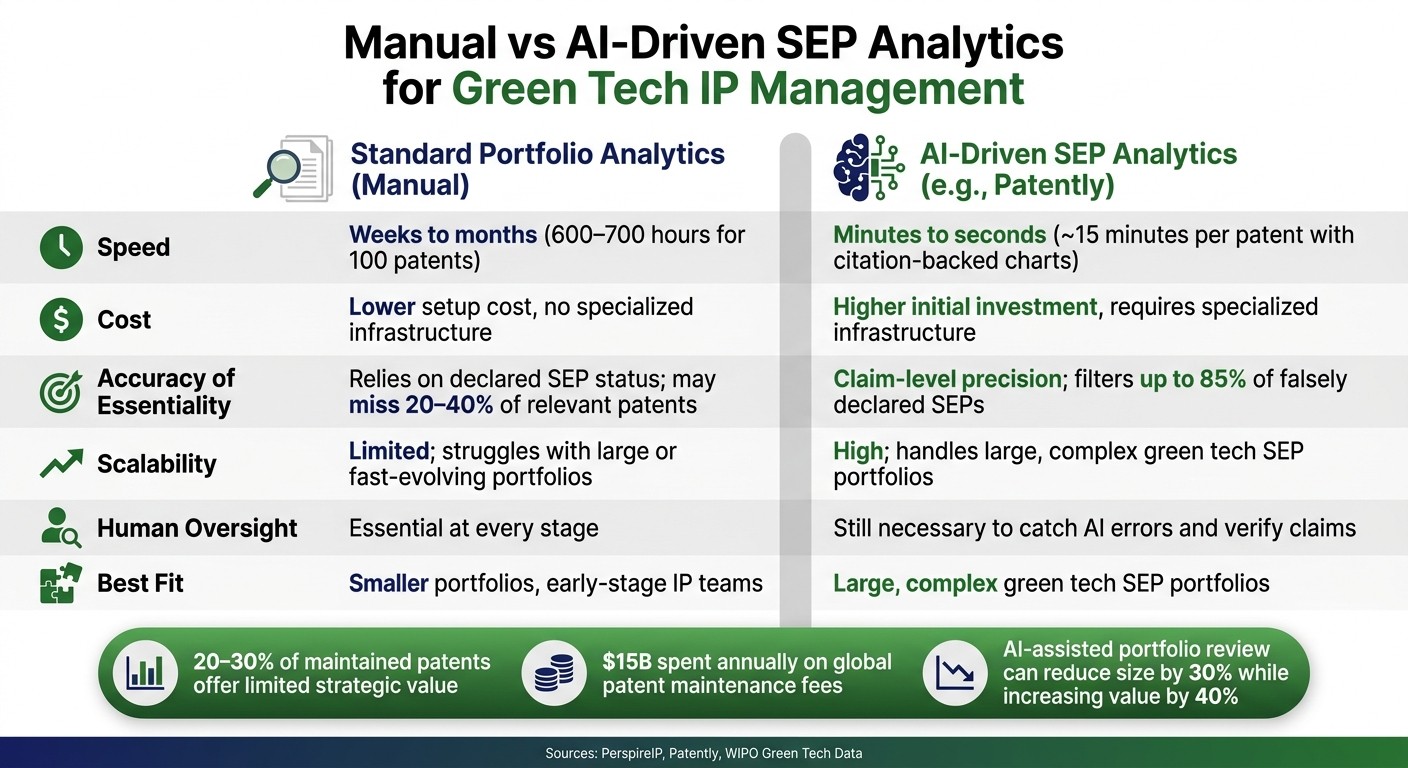
Manual vs AI-Driven SEP Analytics for Green Tech IP Management
How to Use Standard Essential Patent Data for a FRAND Defense Strategy
1. Standard Portfolio Analytics
Standard portfolio analytics relies on bibliographic data, such as patent counts, filing dates, family size, legal status, and market coverage in key regions like the U.S., Europe, China, Japan, and South Korea. For green tech, analysts also incorporate CPC Y02 classifications to identify climate-related patents. Forward and backward citation data help assess technological relevance and potential risks tied to prior art.
Data Inputs
In addition to filing data, this approach includes technical standards declarations, chain-of-title records, and sustainability metadata linked to the UN Sustainable Development Goals (SDGs). The SDGs provide 231 unique indicators that align patents with environmental objectives.
Key Metrics for Green Tech
Green tech evaluation in standard analytics revolves around three key metrics:
Metric | What It Measures |
|---|---|
CPPS (Climate Patent Portfolio Size) | Total Y02/Y04S patent families, reflecting the scale of R&D efforts |
CTCI (Climate Technology Contribution Index) | Forward citations weighted by growth rate, showing technological impact |
CSI (Climate Specialization Index) | Distribution across Y02 sub-categories, highlighting broad or niche technology focus |
A Competitive Impact score - determined by multiplying Technology Relevance with Market Coverage (weighted by Gross National Income) - adds a commercial perspective. This score helps rank assets for licensing or portfolio adjustments.
These metrics not only measure innovation but also guide decisions about which patents to keep or let go.
Impact on Prioritization
Strategic metrics allow IP teams to focus on high-impact green technology patents, ensuring resources are allocated to the most valuable assets. Research shows that 20–30% of maintained patents offer limited strategic value, yet companies collectively spend around $15 billion annually on global patent maintenance fees. By applying quality-based filters during annual reviews, companies often reduce portfolio sizes by 30% while increasing value by 40%.
"A small portfolio of broad, well-drafted patents covering commercially practiced technology is more valuable than a large portfolio of narrow, easily designed-around patents." - PerspireIP
Honda provides a compelling example: between 2020 and 2025, the company improved its Portfolio Improvement Index by 24.5% by cutting approximately 60% of its least valuable patent families.
Automation and AI Capabilities
Currently, standard portfolio analytics is a manual process that occurs quarterly or annually. Analysts gather data, apply CPC filters, run citation queries, and compile reports - a process that can take weeks. While top patent tools automate data collection, human judgment remains critical for interpreting results and making decisions. This delay highlights the need for AI-enabled patent analysis, which can provide faster and more adaptive insights as green tech standards continue to evolve.
2. AI-Driven SEP Analytics (e.g., Patently)

AI-powered platforms are reshaping how green tech SEP (Standard Essential Patent) management is handled. By continuously analyzing technical standard documents, these tools achieve a level of efficiency and depth that manual, periodic reviews simply can't match.
Data Inputs
These platforms go beyond basic bibliographic records by indexing the entire text of technical standards documents. Take Patently, for example - it directly maps patent claims to specific normative sections of standards like 5G and Wi‑Fi 6 (IEEE 802.11ax). This precise mapping is especially valuable in green tech, where aligning patents with key standards in wireless communication and video compression ensures innovations meet industry benchmarks. These detailed inputs pave the way for more accurate essentiality classifications.
Key Metrics for Green Tech
One standout feature of AI-driven SEP analytics is the ability to classify essentiality. Instead of treating all declared SEPs as equally important, Patently sorts claims into four distinct tiers:
Classification | Meaning |
|---|---|
Normative | Required by the standard |
Implied | Naturally follows from implementation |
Informative | Optional or illustrative |
Contextual | Foundational but not directly mandated |
This classification is critical, especially since research shows that up to 85% of declared SEPs in the cellular sector may not actually be essential to the referenced standard. By applying this filter, green tech portfolios can focus on patents that are genuinely worth defending or licensing, cutting through the noise of less relevant claims.
Impact on Prioritization
Armed with this classification system, IP teams can prioritize high-value green tech patents over those that are less likely to hold up under detailed scrutiny. This approach shifts the focus from sheer volume to patents with stronger technical and commercial significance.
Automation and AI Capabilities
Patently’s AI takes efficiency to the next level by creating citation-backed charts that map each patent limitation to its corresponding standard section - all in about 15 minutes. This automation not only saves time but also ensures a level of precision that's hard to achieve manually.
Pros and Cons
In managing green tech intellectual property (IP), finding the right balance between speed and accuracy is essential. Different approaches are better suited for different stages of green tech IP management. Standard portfolio analytics offers an accessible, cost-effective starting point. It doesn’t require specialized tools and works well for teams handling smaller portfolios without intricate standard-mapping needs. However, it has limitations - manual reviews often can’t keep up with fast-evolving standards like IEEE, and keyword searches might miss 20–40% of relevant patents.
AI-driven analytics, on the other hand, addresses many of these gaps. It can map patent claims to specific sections of standards in seconds, saving weeks of effort. This speed and precision make it particularly valuable for green tech portfolios where timing is critical. However, AI isn’t flawless. Misclassification remains a risk, especially in areas with rapidly changing terminology or emerging technologies.
Here’s a quick comparison of the two approaches:
Factor | Standard Portfolio Analytics | AI-Driven SEP Analytics (e.g., Patently) |
|---|---|---|
Setup cost | Low | Higher (requires specialized infrastructure) |
Accuracy of essentiality | Lower (relies on declared status) | Higher (offers claim-level mapping to standards) |
Speed | Slow (manual, periodic reviews) | Instant (seconds for initial analysis) |
Recall of relevant patents | May under-represent relevant art | Higher (conceptual and contextual matching) |
Processing emerging terminology | Immediate match | Dependent on training data |
Human oversight required | Essential | Still necessary to catch AI errors |
Best fit | Smaller portfolios, early-stage teams | Large, complex green tech SEP portfolios |
The right choice often depends on portfolio size and team maturity. While AI excels at handling synonyms and cross-language concepts, it struggles with brand-new technical terms - an area where traditional keyword methods sometimes perform better. This trade-off emphasizes the ongoing need for expert oversight, as described in later sections.
The main takeaway? Neither method works perfectly on its own. AI-driven tools are excellent for scaling and prioritizing, but human expertise is essential to catch errors, verify claims, and guide decisions on licensing or litigation. Choosing the right analytics approach is critical for advancing impactful green tech innovations.
Conclusion
Managing green tech IP is becoming increasingly intricate as sustainability standards continue to shift. One thing is evident from the comparison in this article: relying solely on either standard portfolio analytics or AI-powered tools isn't enough.
As discussed earlier, the decision between these approaches depends on the situation. Standard analytics works well for early-stage portfolios but struggles with larger ones, as manual processes can overlook 20–40% of relevant patents. This limitation makes scaling a challenge.
On the other hand, AI-driven SEP analytics - like Patently - offers significant advantages. It can map claims to standard sections in seconds, uncover undeclared patents that keyword searches might miss, and give IP teams a clearer view of their royalty stack and licensing risks. That said, these tools still need expert oversight to catch errors, especially in fast-evolving technical fields where terminology can change quickly.
For U.S. organizations managing sustainable IP portfolios, the best approach combines AI-driven analytics for speed and insight with expert judgment for accuracy. This blend ensures green tech innovations are managed effectively, aligning with the broader goal of focusing on impactful advancements in sustainability.
FAQs
How do I know which of my green tech patents are truly essential to a standard?
Identifying which green tech patents are genuinely essential goes beyond relying on self-reported claims, which can often be inconsistent. Patently steps in with its AI-powered semantic analysis and True Essentiality filter, enabling rapid matching of patent claims to technical standards - sometimes in just minutes. By examining inventor involvement in standard-setting organizations and cross-checking with independent data sources, Patently helps you zero in on patents with real technical significance, allowing for a sharper and more effective portfolio strategy.
When should an IP team use AI-driven SEP analytics instead of manual portfolio reviews?
When patent landscapes grow too complex and fast-moving for manual reviews, AI-driven SEP analytics becomes a smart choice for IP teams. Manual processes are not only slow but also expensive - claim charting alone can take days and cost anywhere from $4,159 to $7,860 per patent. AI platforms, such as Patently, tackle these challenges head-on by delivering rapid and scalable analysis. Tasks that once took days are completed in minutes, reducing inefficiencies like missed relevant prior art or delays in licensing discussions.
What human checks are still needed after AI maps claims to standard sections?
AI can accelerate the process of mapping claims to standards, but it’s the human review that ensures accuracy and reliability. Experts play a critical role in validating AI outputs by distinguishing between optional and mandatory technical features. They also step in to resolve data-quality issues or correct AI-generated errors, ensuring that each mapping is backed by solid reasoning. This final layer of review is what makes essentiality determinations strong enough to hold up in licensing discussions, legal challenges, and dispute resolution.