Semantic Search vs. Keyword Search for Patents
Intellectual Property Management
Mar 7, 2026
Compare semantic and keyword patent search methods, their strengths and limits, and why a hybrid workflow improves prior-art discovery and cross-language results.

Semantic and keyword searches are two primary methods for patent research, each offering distinct advantages. Keyword search relies on exact matches and Boolean operators, making it precise but limited when dealing with synonyms or cross-language queries. Semantic search, powered by AI, focuses on understanding the meaning behind queries, uncovering conceptually related patents even if the terminology varies.
Key Takeaways:
Keyword Search: Best for precision and specific terms; struggles with synonyms, multilingual content, and vague terminology.
Semantic Search: Excels at finding related concepts, cross-language searches, and handling large text inputs; may include irrelevant results.
Hybrid Approach: Combines both methods for broader coverage and precision, reducing missed patents and irrelevant results.
Search in the AI Era: How semantic search and agentic AI are revolutionizing information discovery
How Keyword Search Works
Keyword search is a simple method for finding specific terms in patent databases. When you type in a word or phrase, the system pulls up documents containing that exact term, without accounting for broader meanings or context. Think of it like flipping through an index to locate a specific entry.
Patent databases streamline this process by breaking down words into their core stems. For example, "driving" might be reduced to "driv", so a search for "drive" would include results like "driving" or "driven". However, this approach has its limits - conceptually related terms aren't linked. Searching "autonomous vehicle", for instance, won't bring up patents that use "self-driving car" instead.
To refine searches, Boolean operators come into play. Here's how they work:
AND: Ensures all specified terms appear in the results.
OR: Retrieves documents with at least one of the terms.
NOT: Excludes terms you don't want.
Some systems also support proximity operators and wildcards. For example, using an asterisk (*) allows for variations in spelling - searching "electri*" could match words like "electricity", "electrical", and "electronic".
According to XLSCOUT, "Boolean search is based on logic. The search engine returns results solely based on keywords combined with operators such as 'AND' and 'OR'".
This method works well if you're confident about the exact terminology in the patents you're searching. However, many databases impose a limit of 50 words per search to avoid slowing down their systems. Despite its accuracy, keyword search struggles with the complexity of diverse terminologies, especially across different languages.
Limitations of Keyword Search
While keyword search can be precise, it has some serious drawbacks. One major issue is the "vocabulary gap", which becomes even more pronounced in multilingual searches. Variations in terminology, combined with the shortcomings of machine translation, make it easy to miss relevant patents.
As BananaIP Counsels points out, "Machine translations in this context therefore more often than not fail to give rise to the right interpretation of a technical word".
Even small differences, like "color" versus "colour", can cause you to overlook important results if both spellings aren't included in your search.
Homonyms and abbreviations add another challenge. A search for "bill" might pull up results about invoices, legislation, or even currency - many of which could be irrelevant. On top of that, patent authors sometimes use obscure or newly coined terms to make their inventions harder to find through keyword searches. This intentional vagueness means even the most carefully constructed Boolean queries can miss critical prior art.
Another issue is the lack of relevance ranking in traditional keyword systems. This forces users to manually sift through massive lists of results to find what they need.
As Golam Rabiul Alam, PhD from Patent AI Lab, cautions: "Relying on Boolean alone is negligent (you will miss art)".
How Semantic Search Works
Semantic search changes the game for patent searching by focusing on meaning rather than exact words. Instead of scanning for specific terms, AI models convert patent text into vector embeddings - mathematical representations that capture the document's overall meaning. These embeddings, often spanning 200 to 600 dimensions, help uncover complex technical relationships within the text.
When you perform a search, the system doesn’t rely on literal matches. Instead, it uses algorithms like K-Nearest Neighbors (KNN) to find documents whose vectors are closest to the query. For example, if you search for "autonomous vehicle", the AI can recognize that "self-driving car" represents the same concept. It does this by calculating distances between vectors to measure how closely related the ideas are.
Modern tools take this approach even further by using transformer-based large language models (LLMs) specifically trained on patent data, ensuring they understand technical subtleties. Another standout feature of semantic search is its cross-language capability. Because it focuses on concepts rather than exact words, the AI can identify relevant patents in different languages without needing manual translation. This is particularly useful for accessing the 25% of Chinese patents that include technical details not available in English. By addressing the vocabulary limitations of traditional keyword searches, semantic search opens up a broader range of insights.
Benefits of Contextual Search
Semantic search brings a host of advantages when it comes to understanding context. It’s especially helpful when dealing with unfamiliar terms or emerging technologies, as it automatically links obscure or new terminology to established concepts.
Another strength lies in its ability to handle disambiguation. For instance, a keyword search might struggle with a term like "resistance", which could refer to either electrical properties or material durability. Semantic AI, however, uses the surrounding context to determine the intended meaning, cutting down on irrelevant results and false positives.
Semantic search also shines when processing large text inputs. Unlike keyword searches that are typically limited to short queries, semantic search can handle entire invention disclosures or abstracts containing hundreds of thousands of words. This added context leads to more precise results.
That said, semantic search does have its limitations. It might miss visual data or occasionally confuse similar functions across different fields. For these reasons, a hybrid approach that combines semantic and traditional keyword methods is often recommended. These features set the stage for a deeper comparison between the two search methods.
Keyword vs. Semantic Search Comparison
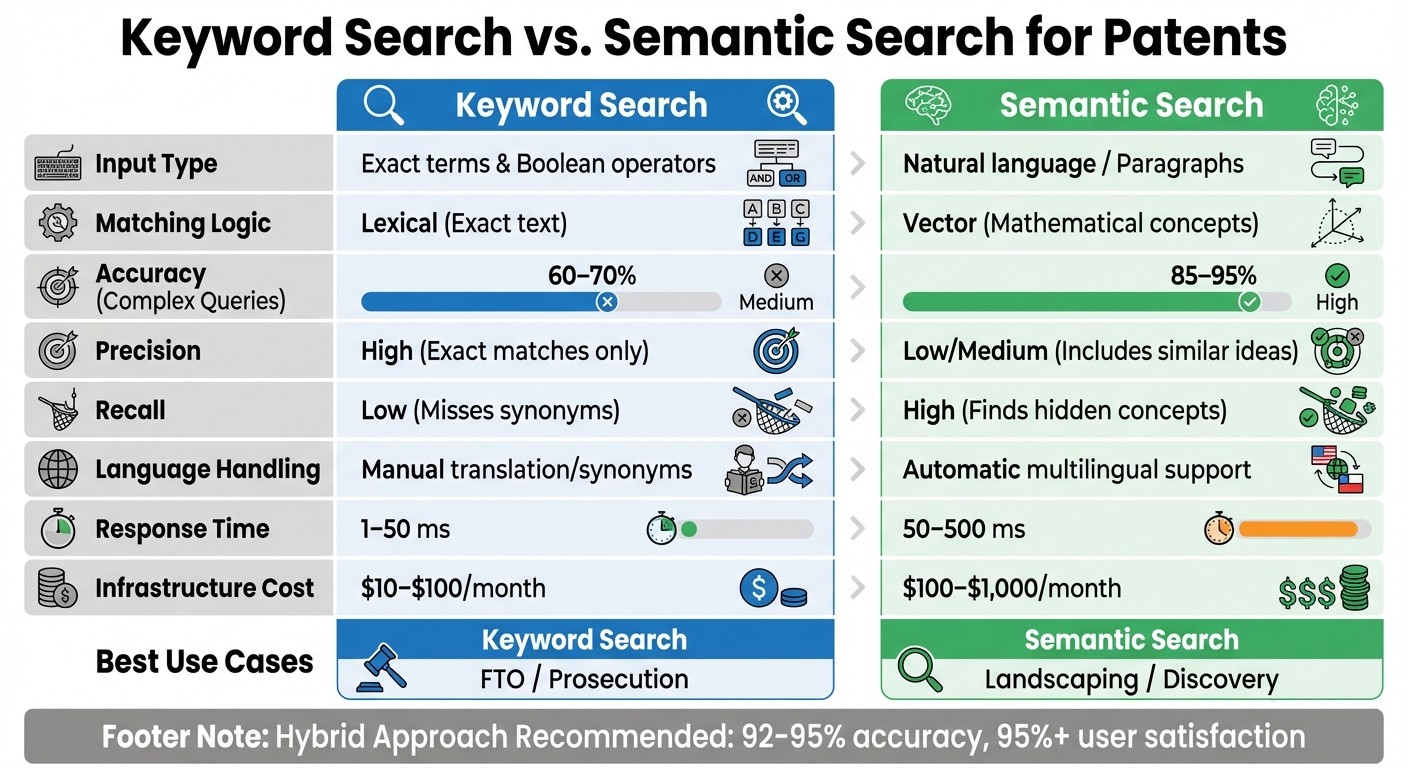
Keyword vs Semantic Search for Patents: Complete Comparison
Keyword search focuses on precision, delivering exactly what you ask for - provided you use the right terms. On the other hand, semantic search takes a broader approach, uncovering related concepts you might not have considered. In a 2026 benchmark, keyword search achieved 60–70% accuracy for complex queries, while semantic search reached an impressive 85–95% accuracy range. The table below highlights these distinctions.
The differences go beyond accuracy. Keyword search is lightning-fast, responding in just 1–50 milliseconds, making it ideal for situations where speed is critical. Semantic search, while slightly slower at 50–500 milliseconds, offers a time-saving advantage in query preparation. Instead of spending days or weeks crafting detailed Boolean queries, semantic search allows users to input full abstracts and get results in minutes.
Another area where semantic search stands out is cross-language efficiency. Keyword search depends on manual translations and synonym lists, which often fall short in capturing technical subtleties. Semantic search, however, automates cross-language mapping, making it a more versatile tool. These advanced capabilities come with higher costs; keyword search typically costs $10–$100 per month, while semantic search requires $100–$1,000 per month due to GPU demands.
By 2026, the professional standard has shifted toward hybrid search systems, blending the strengths of both methods. These systems combine the broad discovery capabilities of semantic search with the precision of keyword filtering. The result? Over 95% user satisfaction and accuracy rates of 92–95% or higher in real-world applications. This hybrid approach ensures the best of both worlds for diverse search needs.
Comparison Table
Criteria | Keyword Search | Semantic Search |
|---|---|---|
Input Type | Exact terms & Boolean operators | Natural language / Paragraphs |
Matching Logic | Lexical (Exact text) | Vector (Mathematical concepts) |
Accuracy (Complex) | 60–70% | 85–95% |
Precision | High (Exact matches only) | Low/Medium (Includes similar ideas) |
Recall | Low (Misses synonyms) | High (Finds hidden concepts) |
Language Handling | Manual translation/synonyms | Automatic multilingual support |
Response Time | 1–50 ms | 50–500 ms |
Infrastructure Cost | $10–$100/month | $100–$1,000/month |
Best Use Case | FTO / Prosecution | Landscaping / Discovery |
When to Use Each Method
Keyword search is your go-to for precision. Tasks like FTO (freedom-to-operate) searches and patent prosecutions require exact matches - missing even one term could lead to rejections or infringement risks. It’s also ideal when you need to filter patents by specific metadata, such as priority dates, CPC/IPC classifications, patent status (active or expired), or particular assignees and inventors. While each search method has its strengths, combining approaches ensures maximum effectiveness.
Semantic search, on the other hand, shines when dealing with vocabulary gaps caused by new terminology or synonyms. It’s especially useful for cross-language patent discovery, where machine translations often fall short in capturing the correct technical meaning of keywords. Semantic search is also great for preliminary tasks like technology landscaping, identifying relevant CPC classes, or spotting major players in emerging fields - without spending hours crafting complex Boolean queries.
Given the challenges of vocabulary gaps and language differences, a hybrid approach becomes essential. As Golam Rabiul Alam, PhD from Patent AI Lab, explains: "Relying on Boolean alone is negligent (you will miss art). Relying on Vector alone is dangerous (you will get noise)". By 2026, the professional standard is expected to be a hybrid workflow that combines both methods, achieving an estimated 99% prior art capture rate.
Start with semantic search to uncover broad terminology - like discovering that "wireless charging" might be referred to as "inductive power transfer" in some jurisdictions. Then, refine your results using precise Boolean queries for a final review. This hybrid method not only improves accuracy but also slashes search time from 10–15 hours to just 2–4 hours, all while maintaining the level of precision required for patent prosecutions.
For professionals working with the USPTO's ASAP program - which uses AI to identify prior art before the first office action - this hybrid approach is indispensable. It ensures you see the same results as examiners. While premium AI tools may cost around $200 per month, they can save up to 10 hours of attorney time, which is billed at $300 per hour. In other words, these tools pay for themselves in a single search. The next section will dive into how advanced platforms are implementing these strategies to refine semantic search capabilities.
How Patently Improves Semantic Search
Patently takes the power of semantic search to a whole new level, making patent discovery faster and more precise. By leveraging Vector AI through Elastic's Search AI Platform, it shifts from simple keyword matching to analyzing the conceptual meaning of patent documents. This approach ensures more accurate results, even when technical terms vary.
The platform handles an impressive database of over 135 million individual patents and 82 million patent families, with each patent categorized across 226 unique fields. Unlike older tools that rely on monthly updates, Patently incorporates real-time data, so your searches always reflect the latest filings. But it’s not just about staying up-to-date - Patently also introduces cutting-edge tools to refine searches.
One standout feature is the ability to input entire patent texts. Whether it’s an abstract, claims, or a full specification spanning thousands of words, you can paste it into the search tool. The AI then identifies contextually similar prior art in record time. In October 2024, Laurence Brown showcased this capability by locating relevant Sony patents for "In-ear headphones with noise isolating tips" in less than five minutes.
Jerome Spaargaren, the Founder and Director of Patently, highlighted this advancement:
"This powerful addition has positioned Patently as one of the most innovative platforms for semantic patent search and is core to our technology stack".
The platform’s machine learning algorithms focus on delivering the most contextually relevant results, cutting down on the time spent manually reviewing patents. Andrew Crothers, Creative Director, put it this way:
"With Elastic, it's like having a patent attorney with decades of experience guiding every search".
These insights emphasize how Patently simplifies the patent search process while improving accuracy.
Patently also excels in cross-language functionality. Its Vector AI identifies contextual links between terms across languages, a critical feature when over 70% of global patent filings are in non-English languages. Additionally, the platform integrates its semantic search capabilities with Onardo, an AI drafting assistant. This allows users to automatically pull up relevant prior art while drafting patent specifications, keeping the workflow smooth and contextually grounded.
Conclusion
Both methods bring unique strengths to patent searches. Keyword search provides precise and transparent results using Boolean logic, making it the standard for tasks like Freedom-to-Operate and prosecution work. However, its rigidity can lead to missed synonyms or related terms. On the other hand, semantic search bridges vocabulary gaps and handles cross-language queries effectively, offering a broader scope.
These differences underscore why combining both approaches has become the norm. By 2026, it's evident that neither method is sufficient on its own. As Golam Rabiul Alam, PhD, from Patent AI Lab, explains:
"Relying on Boolean alone is negligent (you will miss art). Relying on Vector alone is dangerous (you will get noise)".
A hybrid approach - using semantic search for comprehensive discovery and keyword search for pinpoint accuracy - ensures a thorough capture of prior art. Industry experts agree that this balanced workflow is essential for effective searches, often requiring the top patent tools.
Platforms like Patently illustrate how far semantic search has advanced, moving beyond basic concept matching to include features like AI drafting tools and cross-language functionality. These innovations make semantic search practical for everyday patent work, not just initial screenings.
For modern patent professionals, blending both methods is critical. By harnessing semantic search's expansive reach alongside keyword search's precision - an approach validated by the USPTO's ASAP pilot program, where examiners increasingly rely on AI to uncover prior art - professionals can achieve faster, more accurate results. This integrated strategy empowers thorough and efficient patent searches.
FAQs
How do I use semantic search for cross-language patent research?
Semantic search leverages AI to grasp the context and meaning behind patent descriptions, even across different languages. To use it, you simply enter your query into a platform like Patently. The platform transforms your input into a contextual vector - a representation of the core ideas in your query. This vector is then matched against a patent database, focusing on meaning rather than relying solely on exact keywords. The result? More precise and relevant outcomes, especially for multilingual searches.
When should I switch from semantic search to Boolean keyword filtering?
Switch to Boolean keyword filtering when you need pinpoint accuracy in your search results or when you're targeting specific, clearly defined terms. This method is perfect for situations like searching for exact patent classifications or technical jargon where precision is key.
On the other hand, semantic search works best for broader, exploratory searches. It shines when you want to uncover results based on context and related ideas rather than exact matches.
For the best of both worlds, consider combining these approaches: use semantic search to cast a wide net during discovery, then refine your results with Boolean filtering for greater accuracy. This blend ensures both depth and precision in your searches.
How can I reduce irrelevant “noise” in semantic search results?
To get better results in semantic search, try combining it with traditional keyword or Boolean searches. This mix helps narrow down the results by focusing on specific terms, cutting out less relevant matches. Another tip: use well-crafted, detailed prompts or input descriptions. Semantic tools work best when given clear instructions, which helps reduce false positives and delivers more accurate, context-aware results.