How AI Tracks Patents for SDG Progress
Sustainable Innovation
Mar 8, 2026
How AI uses semantic analysis and patent taxonomies to map millions of patents to UN SDGs, enabling real-time insights for R&D, policy, and ESG reporting.

AI is transforming how we track innovation tied to the UN's Sustainable Development Goals (SDGs). By analyzing over 4.7 million active patent families linked to SDGs, AI tools now provide clear insights into how technology supports global challenges like clean energy, poverty reduction, and climate action.
Key Points:
Patents are critical for measuring innovation: They reveal early-stage sustainable patent trends and provide objective evidence of R&D efforts.
AI automates SDG mapping: Using natural language processing (NLP) and semantic analysis, AI links patents to the 169 targets and 231 indicators of the UN's 2030 Agenda.
13 of the 17 SDGs are technology-driven: AI focuses on these goals, helping organizations track contributions and identify opportunities.
Real-time updates: AI-powered platforms like Patently and Patent2SDG offer weekly insights, ensuring organizations stay aligned with SDG targets.
AI-driven patent tracking is helping businesses, universities, and policymakers measure progress, identify gaps, and make data-backed decisions to advance the 2030 Agenda. This shift from manual analysis to AI-powered tools ensures innovation aligns with global sustainability goals.
Building SDG-Aligned Patent Taxonomies
Linking SDG Targets to Patent Classifications
The main challenge here is that the Sustainable Development Goals (SDGs) focus on societal outcomes, while traditional patent classification systems like the IPC (International Patent Classification) and CPC (Cooperative Patent Classification) are organized around technical fields like "chemistry" or "telecommunications." This creates a disconnect. SDGs emphasize real-world impacts - things like reducing poverty, ensuring clean water access, or taking climate action - but patent systems don’t align directly with those goals.
For example, if you’re looking for patents related to SDG 6 (Clean Water and Sanitation), you can’t simply search for a single CPC code and find everything relevant. Instead, it requires translating these sustainability goals into technical terms by identifying keywords, IPC/CPC codes, and related semantic concepts that describe the technology’s function and application. A water purification system, for instance, might be classified under multiple CPC codes and could contribute to both SDG 6 (Clean Water) and SDG 3 (Good Health) simultaneously.
One of the top patent tools that helps bridge this gap is the WIPO Technology Concordance, which maps specific technology fields to SDGs, offering a way to measure how much intellectual effort is directed toward each goal. However, creating a more precise taxonomy requires blending traditional patent classification methods with semantic analysis. This hybrid approach is particularly useful for capturing innovations that cross disciplines, like technologies supporting the circular economy. Such efforts lay the groundwork for building taxonomies that AI can use to track SDG contributions effectively.
Creating Taxonomies for AI-Based SDG Tracking
To build an AI-ready taxonomy, the starting point is the UN’s 2030 Agenda, which includes 169 targets and 231 unique indicators. A major hurdle is the lack of a standardized, labeled dataset that explicitly links patents to specific SDGs. This is where weak supervision comes into play.
Researchers address this by using "informative anchors." These are patents that cite scientific publications already tagged with SDG labels (commonly referred to as non-patent literature or NPL citations). While these anchors aren’t perfect, they act as proxies to create silver-standard training datasets for AI models.
Another key development is the use of semantic concept extraction powered by Large Language Models (LLMs). LLMs analyze patents to extract details about their functions, solutions, and applications, creating a structured framework for comparison. This enables AI to evaluate how a patent’s actual function aligns with the specific needs of an SDG. These taxonomies give AI the tools to systematically link patent data to the UN’s 2030 Agenda.
In early 2026, a joint study by XLSCOUT and NGB demonstrated the potential of explainable AI in this area. They manually curated detailed search queries for each SDG by analyzing UN metadata, creating a system for grouping technologies. This approach allows companies to monitor competitor portfolios and assess their strengths across all 17 SDGs.
Using Taxonomies in AI Platforms
Once these taxonomies are in place, AI platforms can integrate SDG insights into patent workflows. For example, Patently’s semantic search, powered by Vector AI, uses these taxonomies to help users find patents aligned with specific sustainability goals. By embedding both patent texts and SDG definitions into a shared vector space, the platform calculates similarity scores to uncover relevant innovations that traditional keyword searches might miss.
This capability helps corporate R&D teams benchmark their sustainability-focused innovations and demonstrate their commitments to stakeholders. Human experts play a crucial role in refining AI outputs, reducing noise, and ensuring the results are actionable. This collaboration between humans and AI also helps prevent greenwashing and ensures taxonomies stay relevant as new patents emerge and sustainability priorities shift. For organizations tracking their contributions to the UN’s 2030 Agenda, these tools provide a strategic edge.
Calling for Action How to Track and Measure Sustainable Innovation and Investments
How AI Maps Patents to SDGs
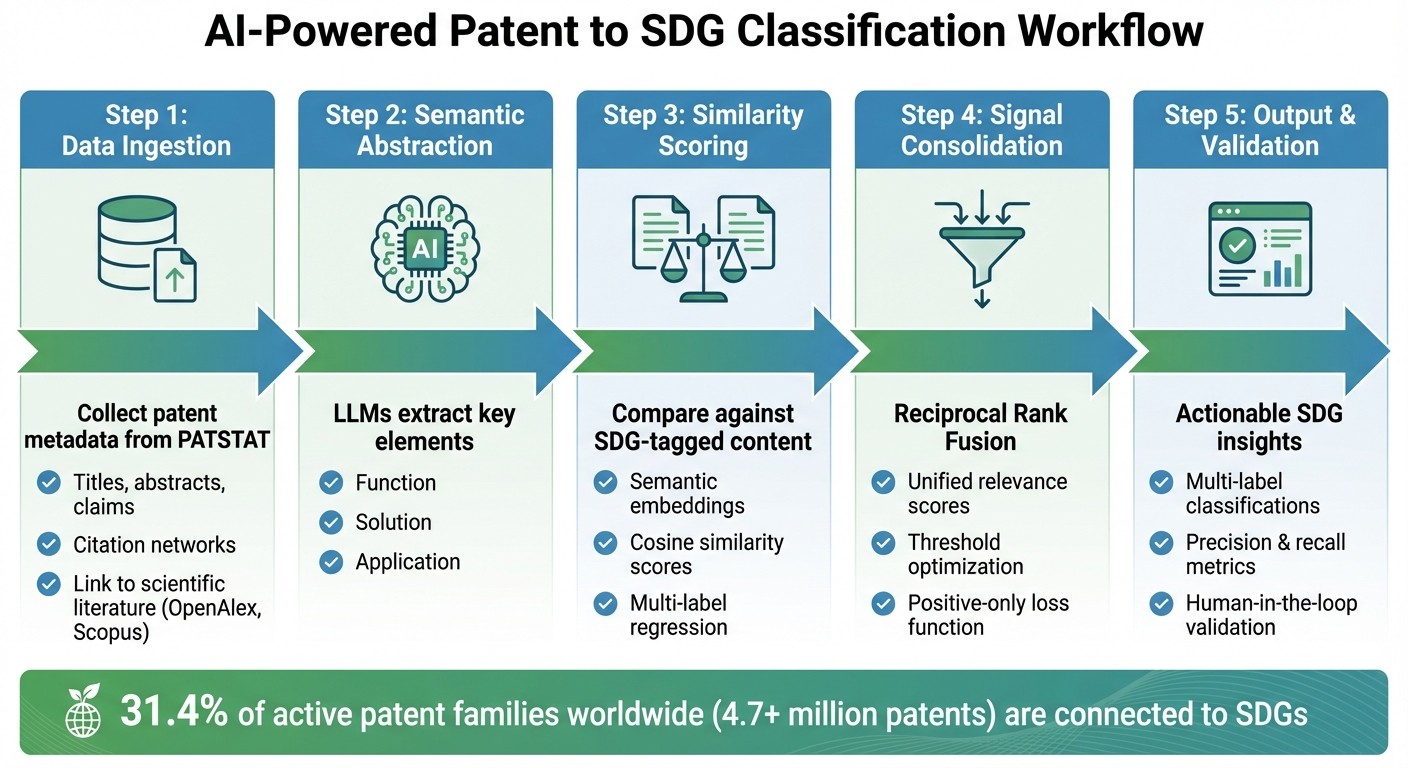
AI-Powered Patent to SDG Classification Workflow
AI Techniques for Patent Classification
Advanced AI tools are now bridging the gap between patent data and sustainability goals with impressive accuracy, thanks to SDG-aligned taxonomies.
Traditional keyword-based methods often lack the nuance needed for effective classification. For instance, a term like "rural" might lead to misclassification, while a crucial innovation like a water purification system could be missed if it doesn’t explicitly include sustainability-related terms. Modern AI approaches, such as weak supervision, help address these challenges. Instead of relying on a massive database of pre-labeled SDG-tagged patents, these models use citations to SDG-tagged academic publications as "noisy anchors" to generate training data. This is critical in a world where patent data holds nearly 70% of global technological knowledge, yet only 15% of the UN SDG targets are on track to meet the 2030 deadline.
Semantic embeddings take this a step further by converting patent abstracts and SDG target descriptions into vectors within a shared space. By calculating cosine similarity scores, these embeddings can identify patents that align conceptually with sustainability goals. Large language models (LLMs) add another layer of sophistication by abstracting the function, solution, and application of patents, effectively linking highly technical language to SDG outcomes.
The most effective systems combine multiple methods. They start with keyword and rule-based filters that use thesauri derived from UN Agenda 2030 metadata, incorporate CPC and IPC classification codes, and then apply semantic analysis to identify enabling technologies that simpler searches might miss. This hybrid approach is essential, as an estimated 31.4% of active patent families worldwide are connected to SDGs.
Step-by-Step Workflow for SDG Classification
The process begins with data ingestion, collecting patent metadata (e.g., titles, abstracts, claims, and citation networks) from databases like PATSTAT. These patents are then linked to scientific literature via platforms such as OpenAlex or Scopus, identifying those that cite SDG-tagged research papers. LLMs abstract key elements of the patent - its function, solution, and application - and similarity scoring is used to compare these conceptual representations against SDG-relevant scientific content.
Since a single patent can impact multiple goals (e.g., a water purification system contributing to both clean water and good health), the models are designed for multi-label regression rather than single classifications. Techniques like Reciprocal Rank Fusion consolidate different semantic signals into a unified relevance score, while an optimization step fine-tunes model thresholds. This uses a positive-only loss function, which rewards the recovery of known anchors while allowing the discovery of new SDG connections. Together, these techniques turn complex patent data into actionable insights tied to sustainability goals.
In June 2025, the European Patent Office highlighted the potential of these methods by selecting the "Patent2SDG" project for its CodeFest Spring 2025. The project demonstrated how tools like SBERT and NetworkX could identify "idea gaps" for startups and help policymakers track sustainability-driven innovations.
Improving SDG Mapping with Patently
Patently incorporates these advanced workflows into practical tools for SDG mapping, making it easier for organizations to connect their innovations to sustainability goals.
Using Vector AI, Patently’s semantic search embeds both patent texts and SDG definitions into a shared vector space. This allows users, especially corporate R&D teams, to uncover sustainability-aligned innovations that traditional keyword searches might miss. It also facilitates benchmarking against the 13 SDGs identified in global patent data.
Patently’s project categorization tools further enhance this process by organizing patents according to SDG alignment. These custom taxonomies mirror the UN’s 169 targets and 231 indicators, enabling teams to track how their innovation pipelines align with sustainability goals. Validation metrics like precision and recall ensure the AI outputs remain reliable and actionable. Additionally, the platform’s collaboration features support a human-in-the-loop approach, reducing the risk of greenwashing by focusing on meaningful innovations rather than sheer patent volume.
For organizations aiming to monitor their contributions to the 2030 Agenda, Patently’s export and reporting tools turn SDG mapping into a strategic asset. These features are particularly useful for ESG reporting and investor communications, transforming what might otherwise be a research challenge into a clear advantage.
Creating AI-Powered SDG Patent Dashboards
Core Components of SDG Patent Dashboards
To build effective SDG dashboards, it's essential to integrate global patent data (spanning over 170 million patents across 100+ countries) with non-patent resources. These dashboards map metadata to all 17 UN SDGs, focusing on quality and impact rather than sheer volume. Metrics such as the Patent Asset Index, Competitive Impact, and Derwent Strength Index (DSI) are critical for distinguishing companies that file numerous weak patents from those developing impactful innovations.
For instance, in February 2024, LexisNexis analyzed the automotive industry using "Competitive Impact" (average patent quality) on the vertical axis and "Portfolio Size" on the horizontal axis. Bubble sizes represented overall portfolio strength. This analysis highlighted Toyota Motors as a leader in sustainable automotive innovation. Tesla, however, didn’t rank among the top due to its strategy of licensing much of its technology rather than maintaining a large portfolio of SDG-related patents.
Geographic and sector-specific data provide additional insights. For example, China has shown rapid growth in clean energy patents, leading in several SDGs. Meanwhile, Chemistry and Instruments dominate as the sectors with the largest share of SDG-relevant patents. Tools like the Innovation Maturity Matrix differentiate "hot topics" (high volume, high growth) from "emerging areas" (low volume, high growth), helping identify future opportunities.
AI Features for Real-Time Monitoring
Modern SDG dashboards go beyond static reporting, offering real-time, dynamic insights powered by AI. Automated weekly updates ensure monitoring stays current with global patent filings. AI-driven semantic classification continuously links new patents to the 100 sustainable technology categories associated with the 13 tech-driven SDGs. This is particularly relevant as 31.4% of active patent families - over 4.7 million patents - are now tied to the SDGs, with numbers increasing daily.
AI also identifies emerging trends by analyzing patent growth rates across different SDGs. For example, SDG 13 (Climate Action) and SDG 7 (Affordable and Clean Energy) are experiencing the strongest growth. Meanwhile, SDG 1 (No Poverty), SDG 4 (Quality Education), and SDG 14 (Life Below Water) are gaining traction, showing recent growth despite having lower absolute numbers. By incorporating external datasets - such as scientific citations and ownership data - these dashboards offer a clearer picture of which organizations are genuinely committed to sustainable innovation versus those merely posturing.
Building SDG Dashboards with Patently
Patently’s Vector AI semantic search forms the backbone of SDG dashboard development. By embedding patent texts and SDG definitions into a shared vector space, it enables corporate R&D teams to uncover sustainability-aligned innovations that traditional keyword searches might miss. This approach also facilitates benchmarking against the 13 SDGs reflected in global patent data.
With project categorization tools, the platform organizes patents based on SDG alignment using custom taxonomies that mirror the UN’s 169 targets and 231 indicators. This allows teams to track how their innovation efforts align with specific sustainability goals. Additionally, Patently’s export and reporting tools transform SDG mapping into actionable insights for ESG reporting and investor communications. This is increasingly relevant as 75% of the top 100 corporate patent portfolio owners now recognize the UN SDGs as integral to their business strategies.
Patently’s automated updates and customizable dashboards eliminate the need for manual data processing, making it easier to maintain visibility into SDG-aligned innovation trends. This integration directly supports the role of innovation in advancing the 2030 Agenda.
Applying AI-Driven SDG Patent Insights
Corporate R&D and ESG Teams
Businesses are turning to AI-driven SDG patent mapping to replace subjective ESG ratings with objective, patent-based data. This approach allows R&D teams to measure innovation with concrete evidence rather than relying on inconsistent third-party assessments. For example, in February 2024, Merck KGaA utilized LexisNexis PatentSight+ to evaluate the social and environmental impact of its R&D efforts, focusing on smart home technologies that align with sustainability goals. Similarly, Siemens incorporated PatentSight SDG analyses into its Annual Reports in early 2024 to provide objective evidence of its innovation progress.
Patent analytics also help companies identify "whitespaces", or untapped technological areas within specific SDGs, which can highlight new investment opportunities. By distinguishing between patents with direct SDG impacts and enabling technologies, firms can better allocate resources across their portfolios. This is particularly relevant, as meeting the SDGs by 2030 is estimated to unlock economic opportunities worth $12 trillion.
Beyond internal strategies, AI-driven patent insights also play a role in mergers, acquisitions, and partnerships. They help companies identify potential licensing partners or acquisition targets in sustainable technology fields. Additionally, patent data serves as a clear indicator of progress in sustainability reports, allowing corporations to effectively communicate their innovation achievements.
These corporate applications pave the way for broader uses by academics, investors, and policymakers.
Universities, Investors, and Policymakers
Expanding on corporate use cases, academic institutions, investors, and policymakers are leveraging AI-powered patent tracking to uncover research gaps and identify innovation clusters. In April 2024, the World Intellectual Property Organization (WIPO) partnered with LexisNexis to publish the "Mapping Innovations: Patents and the Sustainable Development Goals" report. This analysis revealed that the Chinese Academy of Sciences had recently surpassed the University of California as the top academic institution for SDG-related innovation.
"The report provides data-driven insights that we hope will inform discussions on how intellectual property can serve as an important catalyst to promote innovation and collaboration to achieve the United Nations' Sustainable Development Goals."
Andrew Czajkowski, Director of Technology and Innovation Support, WIPO
For investors, patent network analysis offers a way to identify innovation clusters and technology gaps, helping them focus on underserved areas in sustainable development. Patent data acts as a reliable indicator of technological trends, enabling investors to track the pace and direction of emerging technologies. With generative AI projected to create between $2.6 trillion and $4.4 trillion in value across industries, analyzing large-scale patent datasets can reveal dominant technologies and emerging innovation hotspots.
Policymakers, on the other hand, use these insights to understand how current technological trends align with specific SDGs. This helps them design targeted funding initiatives and innovation policies. For instance, in June 2025, the European Patent Office (EPO) adopted the "Patent2SDG" AI engine during CodeFest Spring 2025. This tool uses advanced techniques like semantic embedding and graph-based modeling to connect patents with SDG targets, guiding policymakers and startups toward areas of opportunity. However, challenges remain, as different AI algorithms can produce inconsistent results - studies show only 52% agreement when mapping publications to SDG-3. To address this, a hybrid approach combining automated mapping with expert review is recommended.
Using Patently to Implement SDG Insights
Patently builds on these AI and taxonomy methods, offering practical tools for a wide range of stakeholders. Its generative AI patent drafting tools enables companies to create patent applications that explicitly align with SDG targets, establishing patent mapping as a key metric for sustainability. Additionally, Patently's export and reporting tools turn SDG mapping into actionable insights for ESG reporting and investor communications.
For universities and investors, Patently’s semantic search capabilities make it easier to identify research clusters and emerging startups focused on sustainability-related innovations. Automated updates provide continuous tracking of SDG innovation trends, especially in high-growth areas like SDG 13 (Climate Action) and SDG 7 (Affordable and Clean Energy). This kind of real-time monitoring is critical, given that only 17% of SDG targets are currently on track to be achieved by 2030.
Conclusion
AI has taken over the task of classifying patents for the Sustainable Development Goals (SDGs), replacing manual methods with advanced techniques such as semantic mapping, natural language processing (NLP), and graph analysis. Today, nearly 31.4% of active patent families - more than 4.7 million patents - are linked to 13 SDGs, highlighting the growing demand for automated solutions. This shift not only boosts efficiency but also allows for a clearer understanding of how innovation impacts sustainability.
AI-powered patent mapping offers objective insights that go beyond traditional, subjective ESG ratings. As Christopher Harrison, WIPO Patent Analytics Manager, explains:
"Patents represent 13 of the 17 goals, and nearly one in three patents now relate to the SDGs".
This objectivity helps businesses pinpoint innovation gaps, measure themselves against competitors, and communicate progress on sustainability to stakeholders. The result is data-driven decision-making that aligns with strategic goals.
Patently builds on these advancements by transforming complex patent data into actionable metrics for sustainability. Its tools, such as semantic search and AI-assisted drafting, align patents with SDG targets. Features like exportable reports and automated updates turn patent mapping into practical ESG insights, keeping pace with ongoing patent filings.
With an estimated $12 trillion in economic opportunities tied to achieving the SDGs, the importance of efficient patent tracking is clear. By moving from manual processes to AI-driven insights, the industry is making meaningful progress toward the UN's 2030 Agenda. These tools provide the precision and scalability needed to translate patent data into real-world advancements for global sustainability.
FAQs
How does AI decide which SDG a patent supports?
AI uses advanced natural language processing (NLP) and machine learning to identify which Sustainable Development Goal (SDG) a patent aligns with. By examining the patent's content, metadata, and semantic relationships, AI can match patents to specific SDGs. This process involves techniques like citation analysis, structured ontologies, and calculating relevance scores to determine the connection. The approach relies on datasets that are already labeled with SDG-related information, ensuring a precise classification of how patents contribute to sustainable development.
Can one patent map to multiple SDGs and targets?
Patents often intersect with multiple Sustainable Development Goals (SDGs) and their targets. Through patent analytics, it's clear that many inventions have a broad reach, impacting several areas tied to sustainable development. This highlights their varied contributions toward advancing these global objectives.
How can my team use Patently to report SDG impact for ESG?
Patently's AI tools offer a way for your team to dive into patent analysis and connect them with the Sustainable Development Goals (SDGs). With features like semantic searches and patent data analysis, the platform helps measure how your innovations align with these global goals. Beyond analysis, Patently simplifies patent drafting, encourages seamless collaboration, and streamlines project management. It also makes generating reports easier - providing clear, patent-based evidence to showcase sustainable innovations and support ESG disclosures effectively.