AI vs. Manual IP Risk Management
Intellectual Property Management
Mar 9, 2026
AI speeds IP risk management—cutting review time and costs—while human experts ensure legal nuance, strategy, and final validation.

Managing intellectual property (IP) risks can be costly and complex. With patent litigation in the U.S. averaging $3.5 million per case and small businesses spending over $115,000 annually on enforcement, organizations must choose between traditional manual methods and AI-driven solutions. Here's the key takeaway: AI tools process data faster, reduce errors, and cut costs, but human oversight remains critical for nuanced legal strategy and decision-making.
Key Points:
Manual Methods: Time-intensive, prone to human error, and reliant on spreadsheets and keyword searches. High risk of missed deadlines and administrative delays.
AI-Driven Tools: Use natural language processing (NLP) for faster, more accurate searches, risk prioritization, and global monitoring. Can cut review time by up to 70%.
Challenges: AI systems can produce errors ("hallucinations") and lack contextual understanding, requiring human validation for critical decisions.
Cost Savings: AI reduces IP costs by 25%-70% and scales efficiently as portfolios grow, making it ideal for large organizations.
Quick Comparison:
Factor | Manual IP Management | AI-Driven IP Management |
|---|---|---|
Speed | Weeks to months | Seconds to minutes |
Accuracy | Prone to human error | Consistent but needs oversight |
Cost | High, scales with workload | Predictable, reduces expenses |
Scalability | Limited | Handles large portfolios easily |
Bottom line: AI enhances efficiency and reduces costs, but pairing it with human expertise ensures better outcomes for IP risk management.
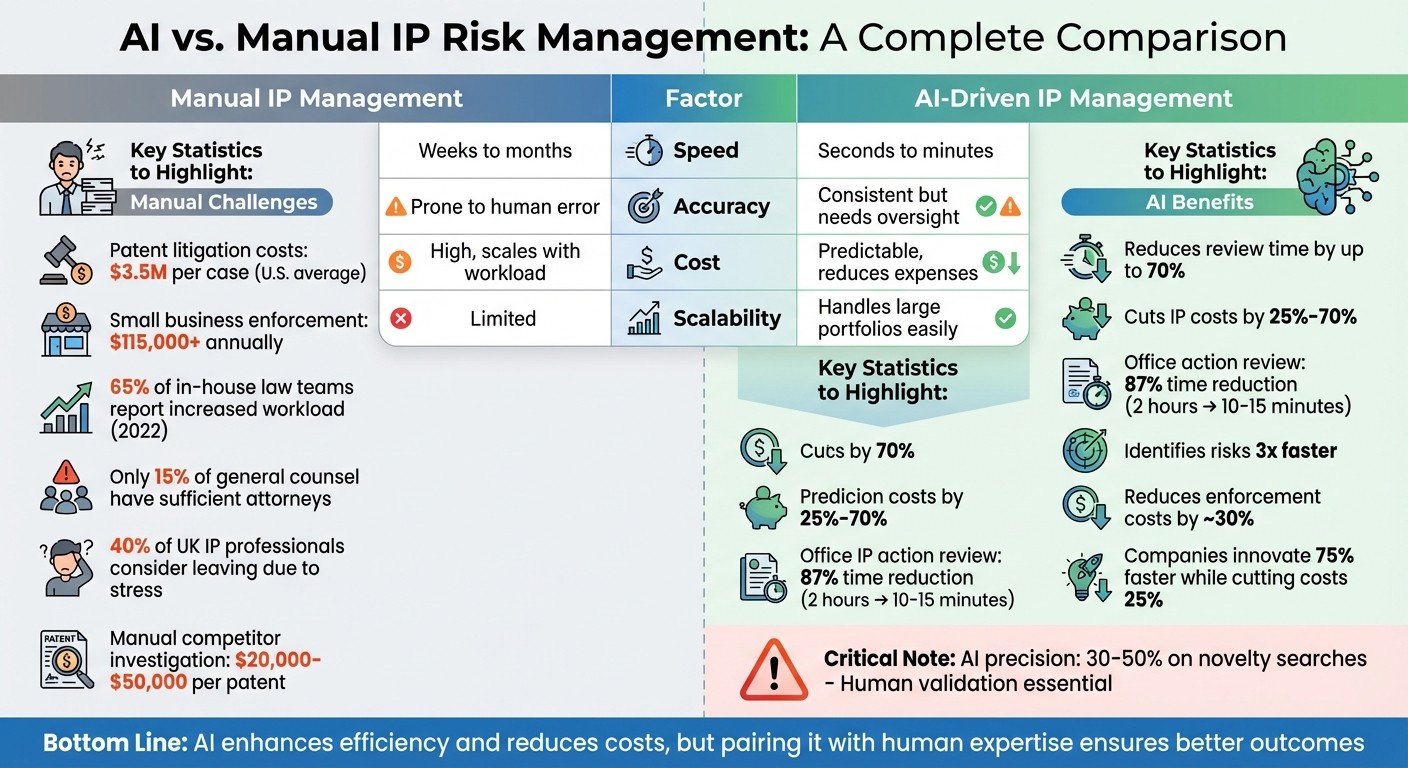
AI vs Manual IP Risk Management: Speed, Accuracy, Cost and Scalability Comparison
Manual IP Risk Management: Processes and Challenges
How Manual IP Risk Management Works
Traditional intellectual property (IP) risk management often leans on manual processes that require both time and precision. Teams usually begin by compiling a central record - often in a spreadsheet - listing all IP assets such as patents, trademarks, copyrights, and trade secrets, along with their associated business values. From there, patent professionals manually search global patent databases and non-patent literature, relying on keyword matching to uncover prior art and evaluate novelty.
The process also involves docketing and deadline tracking, where legal teams manually input and monitor critical dates, including filing deadlines, claim details, and maintenance fee schedules. For Freedom-to-Operate (FTO) analyses, attorneys compare product features against existing patent claims to determine whether commercialization could lead to infringement. Risk registers are often maintained to track potential threats like missed filings or unclear ownership, with prioritization managed through a manual "traffic-light" system.
While these processes are widely used, they come with inherent inefficiencies and risks that can jeopardize the protection of IP assets.
Challenges of Manual Methods
Despite their widespread use, manual IP management methods are riddled with inefficiencies and vulnerabilities. One of the most pressing issues is administrative delays. As Toni Nijm, Chief Product Officer at Anaqua, explains:
"The IP workflow is often bogged down by time-consuming, manual tasks like complex docketing, deadline tracking, and managing invention disclosures".
These manual processes are highly susceptible to human error, especially when dealing with the intricate jurisdictional rules of multiple countries. Missing something as critical as a renewal deadline can result in the irreversible loss of IP rights.
Another challenge is the reliance on disparate spreadsheets and tools that require constant manual verification. This lack of synchronization often leaves teams in a reactive mode, addressing infringement issues only after they’ve caused financial damage. As businesses expand and more stakeholders - such as freelancers, vendors, and partners - become involved, tracking ownership and managing work-for-hire agreements manually becomes increasingly complex and error-prone.
The strain on legal teams is also a growing concern. In 2022, 65% of in-house law teams reported an increase in workload, yet only 15% of general counsel believed they had enough attorneys to handle it. In the UK, 40% of IP professionals surveyed by IP Inclusive considered leaving the field due to stress and workload-related anxiety. With global patent filings rising by 2.7% in 2023 and the IP management software market forecasted to hit $54.9 billion by 2037, the demand to transition away from manual methods is becoming more urgent.
AI-Driven IP Risk Management: Features and Benefits
Core Capabilities of AI in IP Risk Management
AI-powered platforms go beyond basic keyword searches by leveraging Natural Language Processing (NLP) to analyze patent claims. This enables them to identify conflicts even when different terms are used. For instance, they can determine that "mobile device" and "handheld communication apparatus" refer to similar concepts . With continuous global monitoring and predictive analytics, these tools help organizations spot risks early and prioritize them effectively .
One standout feature is predictive risk analytics, which evaluates factors like litigation history, legal status, and market relevance to assign risk scores to patents. This allows legal teams to focus on the most pressing threats instead of spreading their attention across all potential risks. In 2024 alone, Non-Practicing Entities (NPEs) targeted 1,889 defendants - a 21.6% increase from 2023. This sharp rise underscores the importance of prioritizing risks efficiently.
These capabilities form the foundation of Patently's approach to AI-driven IP management.
How Patently Supports AI-Driven IP Management

Patently tackles the challenges of manual IP management with a suite of AI-driven tools designed to streamline processes. Features like the Vector AI semantic search and the AI patent drafting assistant (Onardo) simplify patent reviews and document creation. The platform’s Forward and Backward citation browser further aids teams in mapping patent relationships and identifying potential infringement risks within their technology ecosystem.
These tools ensure smoother coordination across IP workflows, cutting through the inefficiencies of manual processes. For organizations managing standard-essential patents, Patently offers SEP analytics for 4G/5G technologies, delivering detailed insights that would otherwise take weeks to compile manually.
Patently’s advanced tools highlight several advantages over traditional methods.
Advantages Over Manual Methods
The benefits of AI-driven IP management are clear and measurable. In September 2025, Abnormal Security dramatically reduced its investigation time - from weeks to mere minutes - thanks to Patently's AI-powered infringement detection and automated claim chart generation .
"We had so many patents, and we struggled to determine what or who they covered. That makes patents hard to defend, which in turn lowers the value of patents."
– Kenneth Jenq, Director of IP and Litigation, Abnormal Security
AI can cut manual review time by up to 70% and identify risks three times faster. With global patent filings exceeding 3.4 million in 2021, manual review processes simply cannot keep pace.
In addition to speed, AI ensures consistency and precision when analyzing vast datasets. It breaks down complex patent claims into logical components and translates dense legal language into plain terms, enabling teams to quickly assess a patent's relevance .
The financial impact is just as significant. As intangible assets among the world’s largest companies reached a record $79.4 trillion in 2024, the cost of missing a critical patent or deadline has never been higher. AI-driven platforms provide scalable solutions, making comprehensive IP risk management accessible to organizations that might otherwise lack the resources for extensive manual reviews.
Comparing Efficiency and Accuracy: AI vs. Manual Approaches
Efficiency and Time Savings
The growing complexity of intellectual property (IP) management highlights the advantages of AI over manual methods, particularly in terms of efficiency and cost. AI systems can process vast amounts of data in mere seconds, a task that would take human teams weeks or even months. This speed not only accelerates workflows but also allows organizations to focus their resources on strategic legal planning and portfolio growth.
For example, AI can reduce the time needed to review an office action from around two hours to just 10–15 minutes - an impressive 87% reduction. Companies managing extensive IP portfolios also benefit from AI's ability to perform multiple searches simultaneously. Additionally, real-time monitoring of potential infringements across platforms like app stores, domain registries, and e-commerce sites enables quicker, more proactive enforcement measures.
Accuracy and Consistency
When it comes to accuracy, both AI and manual approaches have their strengths. AI excels at applying consistent criteria across large datasets. It's particularly adept at detecting subtle phonetic similarities or complex patterns that might elude even the sharpest human reviewers. However, AI has limitations, such as difficulty interpreting nuanced cultural contexts or intricate legal language - areas where human expertise remains indispensable .
One concern with AI is the potential for "hallucinations", where the system generates fabricated case law or technical details. In a 2025 survey, 42% of patent professionals cited accuracy and hallucinations as key challenges when using AI tools. On the other hand, manual reviews, while offering deeper contextual understanding, are susceptible to errors caused by fatigue or subjective judgment.
Factor | Manual IP Management | AI-Driven IP Management |
|---|---|---|
Search Speed | Weeks to months | Seconds to minutes |
Consistency | Varies by researcher | Uniformly applied |
Pattern Recognition | Limited by human capacity | Excels at phonetic/semantic matching |
Contextual Understanding | Strong for legal intent | Limited; may miss nuances |
Error Risk | Fatigue and oversight | Algorithmic bias, hallucinations |
Cost Implications
AI's financial benefits go beyond cutting labor costs. For instance, manually investigating a single competitor's patent can cost between $20,000 and $50,000. Startups using AI tools often report reducing their overall IP expenses by two to five times. Automated monitoring systems can also lower enforcement costs by roughly 30%.
AI platforms frequently operate on fixed-fee or subscription models, offering predictability compared to the fluctuating costs of manual legal reviews. This shift allows companies to move from reactive cost management to proactive revenue generation by identifying previously undetected infringements, which can open doors to new licensing opportunities. For mid-size firms, annual budgets for surveillance and enforcement - typically $100,000 to $150,000 - can become more manageable with AI tools.
Another major advantage is scalability. While manual teams face rising costs as portfolios expand, AI systems can scale operations without proportional increases in expenses. Companies leveraging AI-powered solutions report innovating 75% faster while cutting costs by 25%.
These combined benefits of speed, accuracy, and cost efficiency make a strong case for integrating AI with human oversight in managing IP risks.
Balancing Automation and Human Oversight
When Manual Review is Necessary
AI can handle massive datasets with incredible speed, but when it comes to strategic IP risk management, human oversight is indispensable. AI acts as a powerful filter, but the final decision-making requires human expertise. For instance, while AI can scan millions of patent documents in seconds, it’s the "judgment zones" - where legal nuance, strategy, and business goals intersect - that demand human intervention.
Take strategic alignment, for example. AI lacks the ability to determine whether a patent should block competitors or generate licensing revenue. It also doesn’t have the context of your product roadmap. High-stakes scenarios like litigation, patent invalidation, and due diligence are other areas where human involvement is crucial. AI might spot semantic similarities, but it can’t interpret complex legal concepts like claim construction, obviousness, or eligibility. Similarly, it’s up to humans to confirm technical relevance - AI might flag a document as similar but fail to grasp the invention’s intent, leading to errors. This need for nuanced judgment highlights the importance of collaboration between AI and human experts.
"AI is a speed-and-scope booster, and can dramatically improve the quality of search results. That said, it is not a substitute for professional judgment." - Michael Montembeau, Search & Analytics Team Manager, MaxVal
Human-in-the-Loop Approaches
To get the most out of IP workflows, many teams treat AI as a "junior associate" that handles repetitive tasks under the supervision of experienced professionals. This "assisted AI" model lets the system handle data synthesis and structuring while humans focus on strategy and quality assurance.
Active learning loops strengthen this collaboration. When AI encounters uncertain cases, human experts validate the results and provide detailed feedback. This feedback not only corrects errors but also helps the AI refine its accuracy over time. Instead of simply marking something as wrong, teams can explain why the system missed the mark, enabling better adjustments in future cycles.
Platforms like Patently incorporate these principles by offering decision traceability. Rather than operating as a mysterious "black box", the system reveals its reasoning and source inputs. This transparency allows experts to audit the AI’s logic, building trust and catching biases or over-weighted variables before they escalate. Such collaboration ensures teams don’t fall into the trap of over-relying on automation.
Feature | AI Handles | Humans Handle |
|---|---|---|
Data Processing | Scanning millions of documents quickly | Validating technical relevance and intent |
Pattern Recognition | Identifying keyword clusters and similarities | Interpreting legal nuances and claim construction |
Strategy | Providing broad technology mapping | Aligning filings with business goals |
Refinement | Initial filtering and noise reduction | Reframing queries and rejecting false positives |
Avoiding Over-Reliance on Automation
AI tools generally achieve only 30%–50% precision, making human validation a must. Over-reliance on automation can also lead to a loss of manual expertise, where teams become less adept at critical tasks because they’ve delegated too much to AI.
A clear accountability structure is essential. Assign specific individuals or teams to take ownership of final outcomes. This avoids "diffused responsibility", where errors are blamed on the system instead of being addressed by people. When reviewing AI-generated claims, adopt an examiner’s mindset - critically evaluate the findings rather than accepting them at face value.
Here’s a practical tip: analyze AI outputs as if you were a competitor. Look for "escape routes" or loopholes the AI might have missed. Then, map the results against your core revenue drivers to confirm that the system is safeguarding the features that matter most to your business.
"The future is not man or machine. It is man with machine - built on trust, clarity, and purposeful design." - PowerPatent
The goal isn’t to replace humans but to position them where their expertise adds the most value, while AI manages the heavy lifting. Together, they form a partnership that combines speed with precision.
Conclusion: Choosing the Right Approach for Your Organization
Key Takeaways
Manual methods work well for small portfolios or situations requiring detailed legal analysis but become overwhelming when dealing with large patent volumes. On the other hand, AI-driven platforms like Patently deliver speed and scale that manual methods simply can't match. Tasks that could take weeks or months manually can now yield actionable results in mere minutes with AI tools. While AI shines in handling high-volume tasks - like prior art searches, infringement monitoring, and portfolio segmentation - human experts remain essential for providing strategic judgment and legal precision that machines lack.
Patent litigation in the U.S. often costs between $2–$4 million per case, and manual infringement investigations can range from $20,000 to $50,000 per instance. AI platforms can significantly lower these costs, reducing initial screening expenses by up to 70% and cutting manual review times by 80%, all while maintaining high levels of accuracy. However, with AI achieving only 30%–50% precision on novelty searches, human verification remains a critical step. These insights highlight the importance of balancing AI and human expertise when adopting new tools.
Factors to Consider When Implementing AI
When integrating AI into intellectual property (IP) processes, several factors come into play. Start by considering the size of your portfolio. For smaller collections, manual methods may suffice. However, for organizations managing substantial portfolios - like IBM, which holds over 155,000 patents - automation becomes a necessity. Speed of innovation is another key consideration. Companies launching updates weekly or daily need IP processes that can keep up, as delays in manual workflows risk leaving innovations exposed.
Budget is a crucial factor as well. Traditional watch services can cost between $500 and $3,000 annually per jurisdiction, and attorney-led infringement opinions range from $5,000 to $20,000 each. In contrast, AI platforms often operate on fixed-fee models that scale predictably with portfolio size. For organizations focused on monetizing IP - whether through licensing, spin-offs, or identifying underused assets - AI’s ability to map patents to competitor products offers a level of insight that manual tracking cannot replicate.
A phased implementation strategy can be highly effective. Start by automating a single high-friction area, such as trademark monitoring or patent searches, before gradually expanding AI across your workflows. Establish clear protocols to evaluate and document AI-generated insights, and incorporate IP risk assessments early in the R&D process, rather than waiting until product launch. As Krish Gupta, SVP of Litigation & Intellectual Property at Dell, aptly notes:
"It's not people who will lose their jobs to AI, it's the people that don't adopt AI who will be replaced by people who do utilize AI".
How AI Is Reshaping Patent Strategy and Portfolio Management - with Shandon Quinn of Clarivate

FAQs
What IP tasks should I automate first with AI?
Start by using AI to handle tasks such as patent filing prioritization, infringement detection, and patent management. With AI, you can pinpoint high-value inventions, simplify infringement searches, and organize documentation, deadlines, and workflows more effectively. These steps not only save time but also help cut costs and boost accuracy in managing your intellectual property processes.
How do I validate AI results to avoid hallucinations?
To ensure AI-generated results are reliable and free from inaccuracies, it's crucial to include human oversight. Patent experts should carefully review claims or data produced by AI to confirm their accuracy, relevance, and adherence to legal standards. A balanced approach - using AI for tasks like drafting or searching, followed by a thorough human review - can help identify and correct any mistakes. The key is to verify technical details, legal strength, and alignment with intellectual property objectives, ensuring the outputs can hold up under examination by patent offices, investors, or competitors.
When should attorneys still do manual IP review?
Attorneys play a critical role in conducting manual IP reviews, especially when nuanced judgment, strategic thinking, or understanding practical implications is required. While AI tools are excellent at processing data quickly and analyzing patterns, they lack the ability to fully grasp business contexts, interpret subtle claim details, or ensure the reliability of their outputs. By combining AI's efficiency with the depth of human expertise, a balanced approach emerges - AI handles repetitive tasks, while attorneys focus on complex, high-stakes decisions. This collaboration ensures both accuracy and a thorough evaluation of the limitations inherent in automated systems.