How Standards Contributions Impact SEP Portfolios
Intellectual Property Management
Mar 10, 2026
Track standards contributions to predict SEP ownership, improve licensing and litigation strategies, and boost portfolio value by focusing on acceptance rates.

When companies like Ericsson, Samsung, and Huawei work on wireless technology, they don't just file patents - they shape the standards that define how devices communicate. Standards contributions, or technical proposals submitted to organizations like 3GPP and IEEE, play a key role in determining the rules for technologies like 5G and Wi-Fi. These contributions often lead to Standard Essential Patents (SEPs), which are critical for interoperability and must be licensed under FRAND terms.
Here’s why standards contributions matter:
Early Insights: Contributions are public immediately, offering a head start on tracking competitor R&D and predicting future SEP ownership - months before patent applications are disclosed.
Quality Over Quantity: A high acceptance rate for contributions often signals strong technology, influencing licensing negotiations and portfolio valuation.
Strategic Benefits: Contribution data can identify market trends, improve patent defense strategies, and enhance a company’s reputation in standards development.
Tracking and analyzing standards contributions is essential for building and managing strong SEP portfolios. Companies that focus on quality contributions and align their R&D with standards development gain a competitive edge in licensing and litigation.
Standard Essential Patents and Standardisation Explained
Benefits of Tracking Standards Contributions
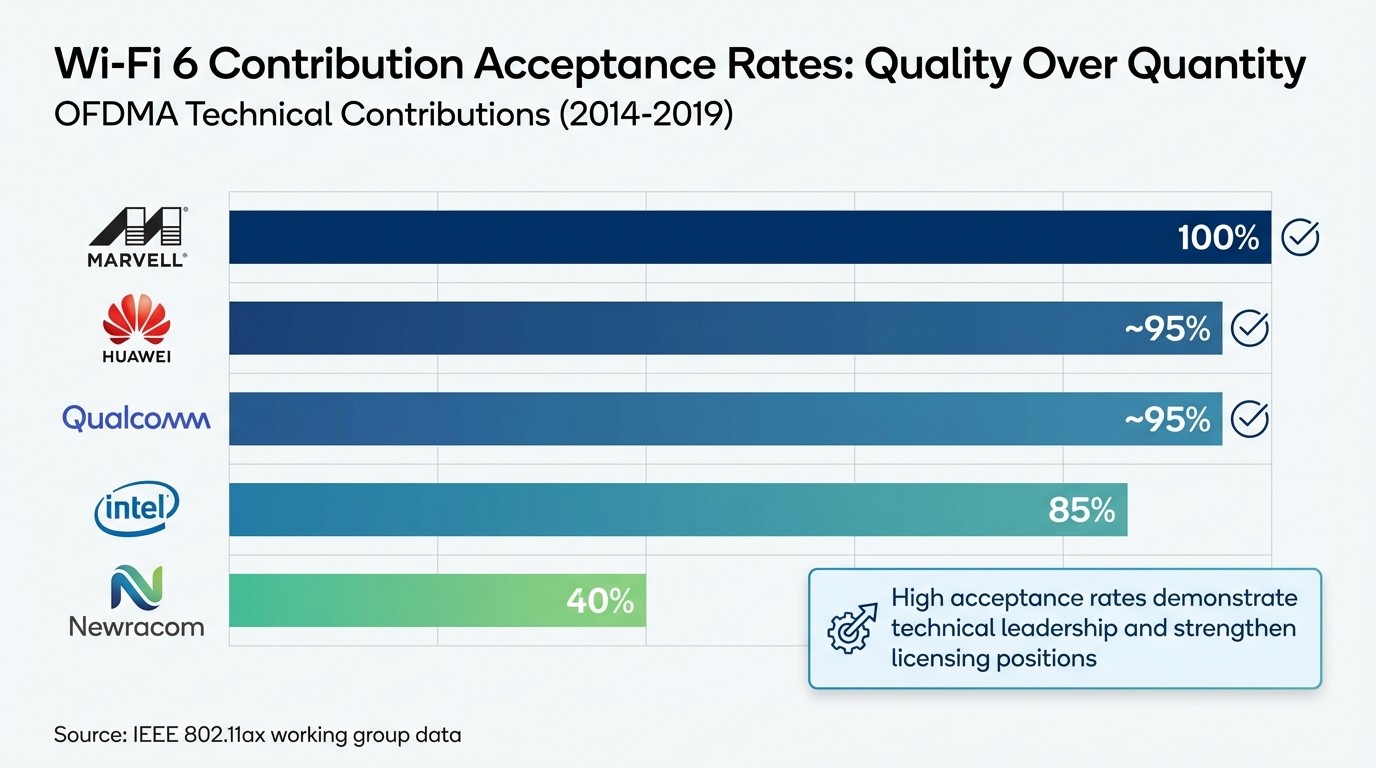
Wi-Fi 6 Standards Contribution Acceptance Rates by Company
Tracking standards contributions offers companies a range of strategic advantages. By keeping an eye on technical submissions, businesses can gain early insights into competitor strategies, improve their negotiating power, and boost their credibility in the market.
Increasing Market Influence
Being actively involved in standards development helps position a company as a leader in technology. When a company's technical proposals are approved by working groups, it highlights their role in shaping the industry's future. This approval process, backed by consensus from hundreds of global experts, reinforces the company's credibility and influence.
It's not just about submitting a large number of proposals - it’s about the quality of those contributions. For example, during the development of IEEE 802.11ax (Wi-Fi 6) between 2014 and 2019, Marvell had a 100% acceptance rate for its OFDMA contributions, even though it submitted fewer proposals than competitors. In comparison, Newracom had a 40% acceptance rate, while Huawei and Qualcomm achieved approximately 95%, and Intel saw 85% of its contributions accepted. This kind of technical influence strengthens a company’s position in licensing and litigation as well.
Supporting Licensing and Litigation Strategies
Standards contribution data plays a key role in licensing negotiations and legal defenses. For FRAND royalty calculations, companies need to estimate their share of essential technologies within a standard. Contribution data helps fill in the gaps, especially in areas like Wi-Fi or HEVC, where SEP declaration databases are often incomplete.
High acceptance rates for contributions also demonstrate that standards organizations have validated the technology’s superiority. This can justify higher royalty rates based on technical strength rather than sheer patent numbers. Additionally, contribution documents often serve as prior art, which can be used to challenge the validity of SEPs, further enhancing a company’s patent defense strategy.
Improving Portfolio Valuation and Industry Reputation
Standards contributions also enhance portfolio valuation and a company’s reputation. In industries where declaration databases are incomplete, the number of approved contributions can be a strong indicator of SEP ownership and portfolio strength. By cross-referencing patent inventors with attendees of standard-setting meetings, companies can increase the perceived value and essentiality of their patents.
"Technical standard contribution data can drastically change how a technology, portfolio or competitor is viewed."
– Tim Pohlmann, Managing Director, LexisNexis IPlytics
This improved reputation can lead to significant financial benefits. For instance, claim charting costs can range from $4,159 to $7,860, and assessing the essentiality of 700 SEPs in the MPEG standard has been estimated at $5.25 million. Companies with strong contribution records reduce uncertainty in portfolio valuation, making their assets more appealing to licensees and potential buyers.
Analyzing Standards Contribution Data
Standards contribution data offers a glimpse into potential future SEP ownership well before patents are publicly disclosed. Contributions are made visible immediately upon submission to working groups, while patent applications can stay under wraps for up to 18 months. This early access to information provides companies with a strategic look at competitors' moves and helps set the stage for analyzing how contribution data predicts SEP ownership.
Predicting SEP Ownership from Contribution Data
When declaration databases are incomplete - like those for Wi-Fi (IEEE) or video compression standards (HEVC/VVC) - contribution data becomes a key resource for identifying potential SEP owners using AI-enabled patent analysis. To put this into perspective, only 10%-20% of Wi-Fi SEPs are declared at the IEEE, and around 20%-30% of HEVC SEPs are declared at the ITU-T. Without analyzing contributions, a large portion of the patent landscape remains invisible.
To improve predictions, contributions can be filtered by criteria like approval status, technical focus, and the contributor’s role. Cross-referencing this with patent inventors and attendance records from standards meetings (e.g., 3GPP, JVET) can offer better insights into essentiality. Additionally, patents that cite non-patent literature - such as meeting minutes or change requests - are often more likely to qualify as true SEPs.
Practical Applications of Contribution Analysis
These insights enable companies to align their R&D and patent strategies more effectively. For example, filing provisional patent applications before submitting contributions ensures that resulting SEPs can be integrated into the final standard. Companies can draft patent applications with AI to accelerate this process and maintain alignment with evolving standards. The 18-month confidentiality period for patent applications allows companies to refine claims as contributions evolve.
In fields like smart energy, this approach highlights technical leadership trends. As of August 2021, Qualcomm led with 2,448 smart energy patent families, including 550 declared SEPs and 19 contributions. Meanwhile, Intel had fewer patent families (138) but led in contributions with 67. These patterns not only reveal competitive dynamics but also help identify potential partners in emerging technologies.
"Understanding new standard contributions early on provides insight into what the competition is working on and that may become important for future access to SEPs for relevant standards."
– Tim Pohlmann, Managing Director, LexisNexis Intellectual Property Solutions
Contribution documents also play a critical role as prior art for challenging patent validity. A significant portion of non-patent literature citations for declared SEPs originates from these documents. This connection directly supports strategies for optimizing SEP portfolios, which will be explored further in later sections.
Tools for SEP Analytics and Contribution Tracking
With advancements in analytics tools, tracking and managing contributions to standards-essential patents (SEPs) has become more precise and efficient. Managing an SEP portfolio now goes beyond just monitoring patent filings. Professionals need tools that provide instant visibility into standards contributions, automate essentiality checks, and cross-reference diverse data sources. Modern AI-powered platforms simplify this process, offering actionable insights in just minutes.
How Patently Supports SEP Analytics

Patently is designed to support key wireless standards like IEEE 802.11ac/ax (Wi-Fi) and 3GPP 5G releases, maintaining a comprehensive indexed library. Its automated essentiality analysis produces detailed, citation-backed claim charts that align patent claims with specific sections of a standard. Even more impressive, this analysis is completed in 15 minutes or less.
The platform organizes mapped sections into four categories to streamline assessments for licensing or litigation:
Normative: Covers explicitly required functionalities.
Implied: Includes natural implementations needed to meet requirements.
Informative: Focuses on optional functionalities.
Contextual: Provides foundational definitions.
For standards with incomplete declaration databases, such as Wi-Fi, Patently offers contribution tracking. This feature allows users to monitor competitor activities months before their patents are published, serving as an early warning system for strategic decision-making.
These capabilities form the backbone of Patently’s platform, setting the stage for additional interactive tools that enhance productivity for patent professionals.
Features for Patent Professionals
Patently goes beyond essentiality mapping with AI Chat Agents, enabling users to ask follow-up questions about generated charts, clarify specific standard sections, or dive into technical details. The platform also supports multi-standard analysis in a single workflow, reflecting the convergence of technologies like cellular, wireless networking, and video compression in modern devices.
Additionally, patent professionals can analyze unpublished drafts alongside current standards to refine claim scopes. This seamless integration across the patent lifecycle - from drafting to portfolio management - elevates SEP analytics from a one-off activity to an ongoing strategic process.
Optimizing SEP Portfolios with Standards Contributions
To build a strong SEP portfolio, a precise, data-driven approach is essential, especially when leveraging early standards contributions. Let’s break down how to do this effectively.
Best Practices for Contribution-Based Strategies
Not all contributions to standards development carry the same weight. To maximize impact, contributions should be categorized by type, category, and status - for example, distinguishing between work items and change requests, or technical and editorial contributions. Contributions that are purely editorial or involve minor functional changes are unlikely to result in essential patents, so filtering them out helps avoid overestimating their value.
Monitor acceptance rates to gauge the quality of contributions. For instance, during the development of Wi-Fi 6, companies like Marvell achieved a 100% acceptance rate, while Huawei and Qualcomm were close behind with around 95%. Intel reached 85%, and Newracom managed roughly 40%. According to Gene Quinn, a high "motion pass rate" often reflects the technical validity of contributions as recognized by working groups.
Another key step is to cross-reference patent inventors with SDO participant lists. This ensures that inventors were directly involved in the working groups, which increases the likelihood that filed patents will align with the final standard. Contribution data can also act as an early warning system, offering insights into competitors’ R&D activities before their patent applications are publicly available.
Additionally, integrating contribution data into prior art searches can enhance patent quality and expose weaknesses in competitor portfolios. To make the most of these efforts, it’s crucial to coordinate R&D, standards, and patent prosecution teams, ensuring that priority applications align with relevant contributions.
These steps not only refine your portfolio but also lay the groundwork for evaluating the trade-offs involved in these strategies.
Benefits vs. Risks of Contribution-Based Strategies
Strategy Element | Benefits | Risks/Limitations |
|---|---|---|
Tracking Contribution Volume | Highlights market influence and technical leadership. | High volume doesn’t guarantee quality; larger firms may skew overall numbers. |
Analyzing Acceptance Rates | Reflects technical merit and increases chances of essentiality. | Could be influenced by political alliances among major players. |
Early Data Monitoring | Offers insights into competitor R&D up to 18 months before patents are published. | Contributions may be rejected or significantly altered before standards are finalized. |
Essentiality Mapping | Aids in licensing discussions and improves portfolio valuation. | Requires time-intensive manual analysis and expert knowledge. |
Inventor Cross-Referencing | Confirms alignment between R&D and standards development. | Relies on detailed SDO attendee lists and internal documentation. |
With the global SEP royalty market surpassing $35 billion in 2024 and projected to hit $55 billion by 2028, tracking contributions strategically is more important than ever. However, it’s worth noting that only 35-45% of declared SEPs typically pass independent technical analysis for actual essentiality. This highlights the importance of thorough verification before making formal declarations.
Conclusion
Standards contributions go far beyond mere technical details - they're a strategic tool that directly impacts the value of SEP portfolios. As Tim Pohlmann explains, patented contributions embed SEPs into standards, offering crucial insights into competitive dynamics within connectivity technologies like 5G, Wi-Fi, and video compression standards.
These contributions provide a rare early look into competitors' R&D activities - sometimes up to 18 months before patent disclosures occur. For patent professionals working in fast-evolving industries, this information can be a game-changer.
When it comes to standards, quality beats quantity every time. Submission numbers alone don’t tell the full story. Instead, acceptance rates are a far better measure of technical leadership. Gene Quinn highlights that a high "motion pass rate" is a clear indicator of such leadership. This is especially important given that independent analyses confirm only 10–47% of declared SEPs are genuinely essential.
To stay ahead, patent professionals should focus on tracking contributions, emphasizing acceptance rates, and analyzing inventor involvement. Understanding how standards contributions translate into portfolio value isn't just helpful - it’s critical for staying competitive in a world that’s more connected by the day. Companies that excel in contribution-driven strategies now will set the stage for tomorrow's patent landscape in connectivity technologies. These insights underscore why integrating standards contribution data is a must for effective SEP portfolio management.
FAQs
How do standards contributions predict future SEP ownership?
Contributions to standards can hint at future ownership of Standard-Essential Patents (SEPs), as they reflect a company's influence in developing critical technologies within a standard. Companies that make notable contributions, especially to widely adopted standards like 4G, 5G, or Wi-Fi, often build large SEP portfolios. By analyzing these contributions, it becomes easier to pinpoint which companies are shaping the direction of standards and are likely to hold key patents tied to those technologies.
Why do contribution acceptance rates matter more than volume?
High acceptance rates for contributions matter more than sheer volume. Why? Because they reflect the quality and relevance of contributions in shaping critical standards. A higher acceptance rate signals a greater impact on SEP portfolios, whereas focusing solely on volume might include contributions that are less meaningful or off-target. By prioritizing acceptance rates, we get a better sense of a company's real influence in the development of standards.
How can standards contributions be used as prior art in SEP disputes?
Standards contributions play an important role in SEP disputes by potentially serving as prior art to question the validity of patent claims. Technical submissions and related documentation from the standards development process can show whether a patented technology was previously disclosed or would have been considered obvious. If such evidence exists, it could undermine the validity of the patent. Examining these contributions is key to assessing whether the claims are genuinely new or essential, offering valuable evidence in disputes and shaping patent strategies.