Slow Patent Research? Try Vector Search
Intellectual Property Management
Aug 1, 2025
Explore how vector search technology revolutionizes patent research by enhancing accuracy, speed, and multilingual capabilities.

Patent research is becoming harder due to the sheer volume and complexity of data. Traditional keyword-based searches often fail to deliver accurate results because they rely on exact matches and struggle with synonyms, creative phrasing, and multilingual patents. Enter vector search technology - a more effective, AI-driven method that understands the meaning behind words, not just the words themselves. Here's why vector search is a game-changer for patent professionals:
Handles Large Databases: Processes millions of patent documents efficiently without slowing down.
Semantic Understanding: Finds related patents even when different terminology is used (e.g., "mouse trap" vs. "rodent extermination device").
Multilingual Support: Identifies patents across languages with ease.
Time-Saving: Cuts search times from weeks to minutes.
Platforms like Patently use vector search to simplify patent research, offering tools such as natural language queries, semantic filters, and advanced collaboration features. Whether you're searching for prior art, conducting invalidation searches, or analyzing patent landscapes, vector search delivers faster, more accurate, and context-aware results.
Pricing: Patently offers a free plan for individuals, with advanced features starting at $125/month per user.
Why it matters: In a world where patent data grows daily, vector search ensures you stay ahead by finding the most relevant results quickly and effectively.
Build a Patent Search App with Gemini and Vector Search
What Is Vector Search Technology
Vector search is reshaping how patent research is conducted. Instead of relying solely on exact word matches, this AI-powered approach focuses on understanding the meaning and context of patent documents. Think of it as consulting a knowledgeable librarian who understands your needs, rather than just searching for an exact title. Let’s explore how this technology works and why it’s more effective than traditional keyword searches.
"Vector search in artificial intelligence (AI) is a method that utilizes machine learning to transform unstructured data, such as text or images, into numerical representations in the form of vectors. These vectors enable searches based on semantic similarity rather than exact keyword matching." – Jean KOÏVOGUI, Newsletter Manager for AI, NewSpace, and Technology, Copernilabs
Traditional keyword searches often fall short when dealing with creative language or the varied ways patent documents are written. For example, vector search can recognize that a "rodent extermination device" and a "mouse trap" describe the same concept, even though the words are entirely different.
How Vector Search Works
Vector search transforms patent text into mathematical representations called vectors - essentially numeric arrays that capture the meaning of the content. When you input a search query, the system converts it into a vector and then finds patent documents with similar vector patterns.
This process relies on embedding models trained on vast amounts of text data. These models learn to identify relationships between words, phrases, and broader concepts. For instance, they understand that "automobile" and "vehicle" are closely related, or that "wireless communication" and "radio transmission" share similar meanings.
The system measures the "distance" between vectors. Patents with vectors that are closer together are considered more semantically similar, while those farther apart are less related. This nuanced approach captures relationships that traditional keyword searches often miss.
Vector Search vs. Keyword Search
Vector search offers a distinct advantage over traditional keyword-based methods. Keyword searches rely on exact matches - if you search for "battery", you’ll only see results containing that exact term. Vector search, on the other hand, understands that terms like "power cell", "energy storage device", and "rechargeable unit" all refer to similar concepts.
Another strength of vector search is its ability to handle multilingual queries. It can identify patents describing the same invention, regardless of whether they’re written in English, German, or Japanese, thanks to its semantic understanding.
This technology also handles large-scale datasets with ease. While keyword searches can become sluggish and inefficient as databases grow, vector search maintains its speed and accuracy even when processing millions of patent documents. Its mathematical approach to comparing vectors ensures efficient performance across massive datasets.
Perhaps the most impressive benefit is the time it saves. Traditional methods might take weeks to thoroughly analyze relevant patents and technical documents. Vector search, powered by AI, can reduce this process to just hours - or even minutes. Not only is it faster, but its ability to understand context and meaning often leads to more relevant and comprehensive results than keyword searches. This efficiency addresses many of the challenges faced with traditional patent research methods.
Benefits of Vector Search for Patent Professionals
Vector search has transformed patent research by delivering faster, more accurate, and highly relevant results. Its ability to understand the context and semantics of patent documents provides clear advantages in productivity, precision, and the overall quality of patent analysis.
Better Search Accuracy and Speed
Vector search excels at retrieving relevant results quickly, cutting through the clutter of irrelevant documents that often slow down traditional patent research. This allows professionals to concentrate on analyzing key prior art without wasting time sifting through unrelated material.
Even when working with massive collections of patent documents, vector search maintains consistent performance. This reliability ensures research timelines remain predictable, regardless of the search's scope.
The technology’s accuracy stems from its ability to grasp context and meaning. By recognizing semantic relationships, vector search identifies relevant patents even when different terminology is used. For instance, in 2024, XLSCOUT's Invalidator LLM showcased this capability during invalidation searches. Using vector embeddings and large language models trained on patent literature, the tool helped patent attorneys uncover prior art that traditional keyword searches missed. This led to more effective patent challenges and better outcomes for clients. These efficiency gains also pave the way for discovering additional relevant patents.
Find More Relevant Patents
Beyond speed and accuracy, vector search broadens the scope of relevant patent discovery. This reduces the chances of missing critical prior art, even when inventors use varied or unusual terminology. Such comprehensive coverage is crucial for patentability assessments and freedom-to-operate analyses.
Here’s an example: when searching for patents related to a "wearable heart rate monitor", vector search can identify patents describing "portable biometric sensors" or "fitness tracking devices." Even if those exact terms aren’t used, the semantic similarity allows them to surface. A traditional keyword search, on the other hand, would likely miss these results unless all possible term variations were accounted for.
This feature is particularly valuable in fast-changing technical fields where terminology evolves rapidly. Patent professionals benefit from shorter research times, better recall of relevant prior art, and the ability to uncover similar patents that keyword-based searches might overlook.
Additionally, vector search can identify patents written with creative language or industry-specific jargon. Instead of requiring researchers to anticipate every possible descriptor, vector search automatically handles linguistic variations, ensuring more thorough prior art coverage.
Vector Search vs. Keyword Search Comparison
The advantages of vector search become even clearer when compared to traditional keyword methods across factors that matter most to patent professionals:
Factor | Vector Search | Keyword Search |
|---|---|---|
Precision | High (semantic/contextual matching) | Variable (literal term matching) |
Recall | High (finds related concepts) | Often low (misses synonyms/paraphrases) |
Speed | Fast (handles large datasets efficiently) | Slower as dataset size increases |
Ease of Use | Intuitive (natural language queries) | Requires complex query construction |
Use Cases | Prior art, invalidation, FTO, analytics | Basic lookup, exact term search |
One of the most user-friendly aspects of vector search is its natural language query capability. Instead of crafting intricate Boolean queries with multiple keyword combinations, professionals can describe the technology in plain language. This intuitive approach simplifies the search process, allowing more time for analysis and less time spent on query formulation.
For example, when Patently integrated real-time vector search and natural language processing in October 2024, legal teams were able to collaborate more effectively. The time required to find relevant patents decreased, while research accuracy improved. These benefits highlight the potential of vector search to enhance patent research workflows, setting the stage for Patently’s advanced features discussed in the next section.
How Patently Uses Vector Search for Patent Research
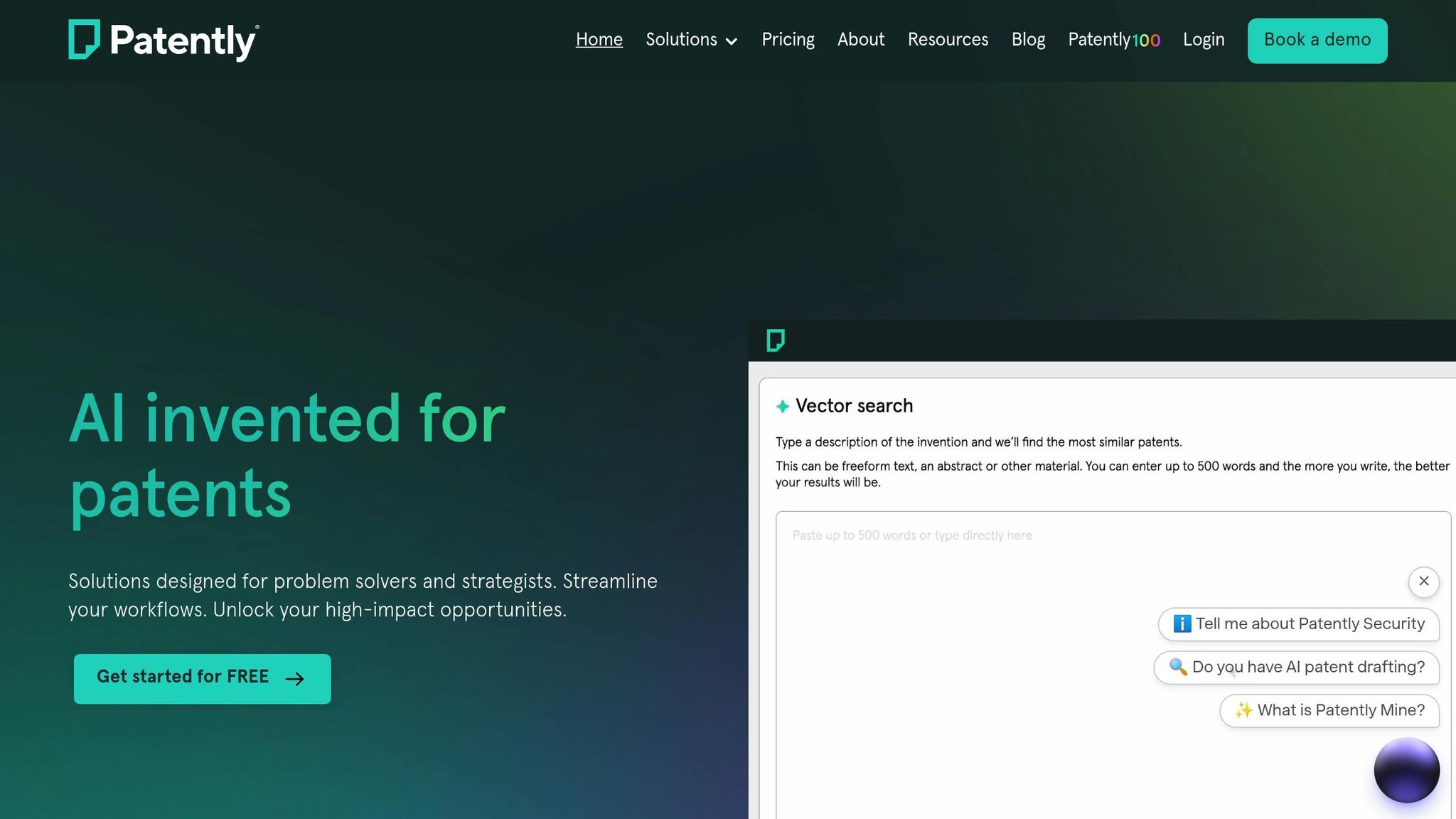
Patently utilizes Vector AI to simplify patent research and improve workflow management. By combining semantic search capabilities with a massive database of patent data from 166 patent offices worldwide, the platform processes over 80 million patent families and 176 million individual assets. This database is updated every 30 days, ensuring users have access to the latest information. These extensive resources fuel Patently's advanced vector-based search functionality.
Key Features of Patently's AI Platform
Patently's Vector AI delivers a smarter, faster way to search patents using semantic search.
"Semantic search using Vector AI makes the process of searching for patents faster, more intuitive, and precise."
The platform also offers hybrid search, which combines semantic and exact searches, and merges results from multiple sources into a single, unified list. With the Forward and Backward (FAB) browser, users can explore citation links between patent families, making research more thorough and interconnected.
For US patent professionals, Patently provides tools specifically tailored to their needs. One standout feature is Onardo, an AI-powered patent drafting assistant that can reduce drafting time by up to 90%. The platform also supports team collaboration with features like shared project access, real-time progress tracking, and commenting.
Features for US Patent Professionals
Patently goes a step further by catering to the specific requirements of US patent practice. For example, it provides SEP analytics for 4G and 5G technologies, offering valuable insights for professionals in telecommunications. A hierarchical project categorization system allows users to organize their work by department, client, or case - an especially useful feature for law firms and corporations managing large, complex portfolios.
In October 2024, Laurence Brown used Patently's Vector AI to search for "In-ear headphones with noise isolating tips" with a priority date before 2000. The tool delivered 300 results, and relevance sorting helped him identify Sony patents in less than five minutes.
"With Elastic, it's like having a patent attorney with decades of experience guiding every search."
Andrew Crothers, Creative Director at Patently
"The mechanism operates quickly. When working with millions of patents, it's imperative that we obtain findings as rapidly as possible."
Andrew Crothers, Creative Director at Patently
Patently also integrates seamlessly into existing workflows. Users can export reports in various formats and connect the platform to external data sources, making it easy to adopt without disrupting established processes.
Pricing Plans in US Dollars
Patently offers flexible pricing plans to suit professionals at all levels. Here's a breakdown of the available options:
Plan | Price | Key Features | User Limits |
|---|---|---|---|
Free | $0 | Search with filters, full patent details, family browsing, link sharing | 1 user |
Starter | $125/month/user (billed annually) | Semantic search, analytics, FAB browser, team collaboration, project management | Up to 10 users |
Business+ | Custom pricing | AI patent drafting, custom fields, fee tracking, view challenges | Unlimited users |
Law Firm+ | Custom pricing | Matter-centric management, client access | Unlimited users |
Enterprise | Custom pricing | Fully customizable solutions | Unlimited users |
The Free plan is ideal for individual professionals, offering essential features like filters, detailed patent information, and family browsing. The Starter plan unlocks advanced AI tools such as semantic search, analytics, and the FAB browser, along with team collaboration and project management tools - perfect for small teams. For larger organizations, the Business+, Law Firm+, and Enterprise plans offer custom pricing and access to more advanced features. The annual billing for the Starter plan ensures cost stability, while the higher-tier plans allow organizations to pay for only the features they need.
How to Start Using Vector Search
You don’t need to completely change your research process to start using vector search. Patent professionals can dive right in by combining natural language descriptions with traditional filtering methods. Let’s explore how natural language input can simplify your initial patent searches.
Getting Started with Patently's Vector Search
Forget the hassle of creating complicated Boolean queries or trying to guess the perfect keywords. With Patently's Vector AI, you can describe your invention in plain English. Just paste your description or type it directly into the search box. For instance, instead of crafting a query like "wireless AND communication AND device AND antenna", you could simply write, "smartphone with improved antenna design for better signal reception." The system uses semantic analysis to understand the concept behind your words and delivers results based on meaning, not just keyword matches.
Patently’s system further refines results by applying fixed counts or similarity scores to highlight the most relevant patents. You can also narrow your search using filters for criteria like task type, live assets, priority dates, publication dates, and patent offices.
Using Filters and Metadata for Better Results
After running your initial search, you can refine the results even more using structured metadata. Combining vector search with metadata creates a hybrid approach that balances broad coverage with precision. Start with pre-filters to apply metadata criteria, which speeds up and sharpens your search. Then, use post-filters to fine-tune the results for greater accuracy.
Fuzzy filtering is another handy feature. It tackles common issues like typos or spelling variations, ensuring you don’t miss relevant documents because of minor errors in metadata entries. Plus, automatic metadata tagging works in the background to optimize your workflow, saving you time and effort.
Adding Vector Search to Your Current Workflow
Vector search isn’t just accurate and fast - it’s also easy to integrate into your existing research routine. Start by using exploratory searches to uncover relevant technology areas. Once you’ve mapped out the landscape, you can complement your findings with traditional keyword searches to verify details and conduct in-depth claim element analysis. This combination ensures you get the best of both worlds in your patent research.
Conclusion: How Vector Search Changes Patent Research
Key Takeaways
Vector search is transforming the way patent research is conducted by focusing on the meanings behind words, rather than just the words themselves. Traditional keyword searches often fall short because they struggle with variations in terminology, synonyms, and the dense technical language found in patent documents. Vector search solves these challenges by analyzing the semantic meaning of patent texts, making it possible to uncover related patents even when different terms or phrases are used.
This method works by converting patent texts into semantic vectors, which unlocks several benefits: greater accuracy, less time spent on manual reviews, and the ability to find patents that keyword searches might miss. Additionally, it supports more complex queries, allowing researchers to explore broader concepts or technical solutions rather than being limited to specific terms. This makes vector search particularly useful for addressing intricate or multidisciplinary innovations.
Why Patently Is the Right Solution
Patently takes these advancements in vector search and tailors them specifically for US patent professionals. The platform combines cutting-edge vector search technology with features designed to meet the unique needs of the US market. It integrates USPTO data and offers transparent pricing in US dollars, ensuring both efficient research and straightforward budgeting.
One standout feature is Patently’s Vector AI, which allows users to describe inventions in plain English. The platform then applies advanced semantic analysis to deliver precise results. With tools like advanced filtering, metadata search, and workflow integration, Patently simplifies the research process while fitting seamlessly into existing workflows.
For professionals in the US aiming to modernize their approach to patent research, Patently offers a range of options. From a free plan for individual users to enterprise-level solutions, there’s flexibility to suit different needs. The Starter plan, priced at $125 per month per user, provides access to semantic search, analytics, and team collaboration features - effectively addressing the gaps left by traditional keyword-based methods.
In today’s competitive environment, managing complex patent databases requires tools that go beyond basic searches. By adopting AI-driven solutions like vector search, patent professionals can perform more precise, thorough, and strategic research, staying ahead in an increasingly demanding field.
FAQs
How does vector search make patent research faster and more accurate compared to keyword-based methods?
Vector search leverages AI-powered semantic analysis to uncover connections between patents based on their meaning, rather than relying solely on exact word matches. This means it can surface relevant results even when different terminology or phrasing is used - something traditional keyword searches often struggle with.
By prioritizing context over specific keywords, vector search enhances precision and cuts down the time spent sorting through unrelated results. It's a game-changer for professionals aiming to simplify their patent research process and avoid mistakes caused by variations in language.
Can vector search handle patents in different languages, and how does it manage this complexity?
Yes, vector search can work seamlessly with patents written in different languages by leveraging multilingual embeddings and cross-lingual retrieval systems. These AI-driven methods focus on the meaning behind the text, rather than exact language matches. This allows the system to spot semantic similarities between patents, no matter the language they’re written in.
To tackle the challenges of multilingual data, vector search platforms often integrate features like language detection, translation, and semantic mapping. These tools help bridge language gaps, ensuring accurate and efficient patent research, even when navigating databases with diverse linguistic content.
What features make Patently's platform ideal for patent professionals in the United States?
Patently's platform is built to make patent research easier and more efficient for professionals in the U.S. By using AI-powered vector search and natural language processing, it analyzes patents based on their semantic similarities. This means searches are not only quicker but also more precise.
The platform also offers features like project categorization, access control, and collaboration tools. These are specifically designed to address the unique challenges faced by U.S. patent professionals, helping teams work more effectively, organize their projects better, and save time during the research process.