Trade Agreements vs. Patent Sustainability Goals
Intellectual Property Management
May 22, 2026
How trade deal IP rules shape patent flexibility for green tech, create conflicts with sustainability, and require new compliance strategies.

Trade agreements shape how patents are issued, enforced, and shared globally. At the same time, patent-related sustainability goals focus on equitable access to technology and reducing barriers to innovation for public benefit. The challenge? Aligning these two priorities without creating conflicts.
Key Points:
Trade Agreements Impact Patents: Provisions like stricter enforcement, investment protection, and genetic resource disclosure influence patent management and limit flexibility for developing countries.
Sustainability Goals: Focus on technology sharing, local innovation, and access to essential tools like renewable energy systems and climate-resilient crops.
Conflicts: Rules like TRIPS-plus provisions, compulsory licensing restrictions, and ISDS mechanisms often hinder flexibility needed for sustainability.
Opportunities: Trade agreements can support global emissions reductions (e.g., 2.8% among major emitters) by facilitating technology transfers.
Quick Insight:
Research shows that full technology sharing under trade frameworks could cut global emissions by 587 million metric tons, highlighting the potential for collaboration between trade policies and sustainability efforts.
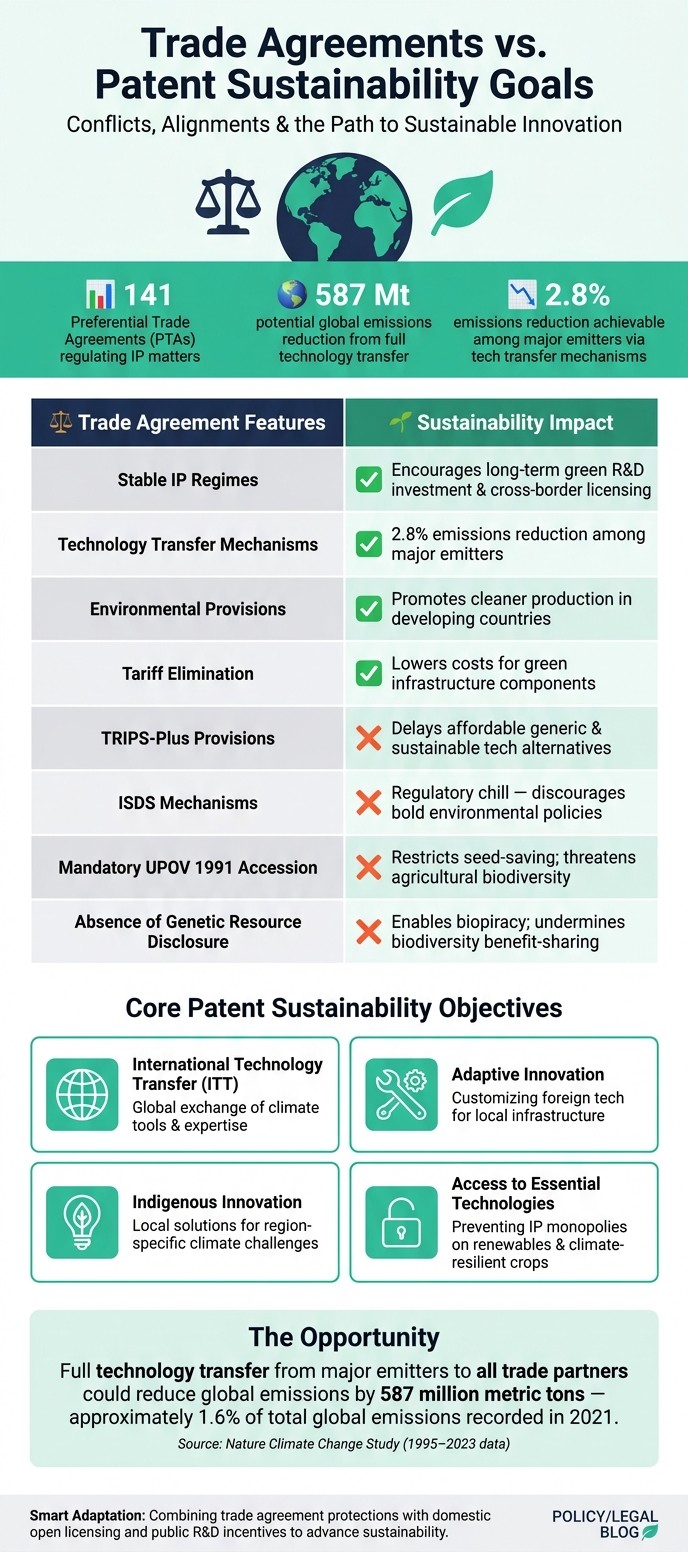
Trade Agreements vs. Patent Sustainability Goals: Key Conflicts & Opportunities
Intellectual Property and Sustainable Development
How Trade Agreements Shape Patent Management
Trade agreements now include extensive intellectual property (IP) provisions that directly influence how patents are issued, enforced, and exchanged across borders. There are currently at least 141 Preferential Trade Agreements (PTAs) that regulate IP matters. This growing focus on IP in trade agreements highlights the need to examine the specific provisions shaping patent management.
Key Provisions in Trade Agreements
Several types of provisions in trade agreements significantly impact patent management. For starters, enforcement standards in PTAs have become more detailed, making local adaptation of enforcement strategies more challenging. Investment protection clauses, which classify patents as safeguarded assets, can restrict the use of compulsory licensing, even when public interest might demand it.
Additionally, recent Free Trade Agreements (FTAs) contain disclosure requirements for genetic resources (GRs) and traditional knowledge (TK). These rules mandate that patent applicants disclose the origins of biological materials used in their inventions, aligning with the Convention on Biological Diversity (CBD) and the Nagoya Protocol. For companies in sectors like biotechnology and pharmaceuticals, such requirements introduce an extra compliance layer into their patent management processes.
Provision Type | Impact on Patent Management | Policy Flexibility Effect |
|---|---|---|
Enforcement Standards | Adds complexity to IP protection | Reduces local adaptability for sustainability goals |
Investment Protection | Defines patents as protected assets | Limits compulsory licensing for green technologies |
Patent Disclosure | Requires origin data for GRs/TK | Aligns with the Nagoya Protocol |
Tech Transfer Clauses | Encourages cross-border technology sharing | Boosts decarbonization and development opportunities |
How Trade Agreements Affect Policy Flexibility
While stricter enforcement standards benefit patent holders in developed economies, they often create challenges for developing nations. As Burcu Kilic from Harvard University explains:
"Developing countries often accept these [IP] commitments in exchange for preferential trade benefits."
This trade-off highlights the balancing act between gaining access to global markets and retaining the flexibility to address local policy needs.
Patent Sustainability Goals
Trade agreements often set the stage for how patents are managed globally, but sustainability goals push us to rethink those boundaries to better serve the public. The concept of patent sustainability seeks to reshape intellectual property systems to distribute the benefits of innovation more equitably and ensure wider access to critical technologies. The overarching goal? To fuel progress while breaking down barriers that limit access to technologies essential for public welfare.
Core Sustainability Objectives
Research highlights four primary objectives for patent professionals and policymakers:
International Technology Transfer (ITT): This involves facilitating the global exchange of climate-related tools and expertise, whether through trade, investments, or licensing agreements.
Adaptive Innovation: Supporting the customization of foreign technologies to align with local infrastructure and climate needs.
Indigenous Innovation: Encouraging local entrepreneurs to create solutions specifically designed to address region-specific climate challenges.
Access to Essential Technologies: Ensuring intellectual property rights don’t lead to cost barriers or monopolies that block the spread of crucial technologies like renewable energy systems or drought-resistant crops.
These goals have tangible, real-world stakes. For instance, in countries like Bangladesh, where agriculture employs around 37.7% of the population, there’s an urgent need for climate-adaptive technologies. Yet, the majority of climate-related patents are held by just three nations - the United States, Japan, and Germany - highlighting the global imbalance in innovation access.
Together, these objectives illustrate the challenge of aligning technological progress with public needs.
Balancing Innovation with Broader Outcomes
Climate technologies provide a dual benefit: they spur innovation while also serving as a global public good by reducing emissions. This combination makes them worthy of extra policy attention and support.
As UN Secretary-General António Guterres aptly noted:
"[R]emoving obstacles to knowledge sharing and technological transfer – including intellectual property constraints – is crucial for a rapid and fair renewable energy transition."
However, simply relaxing intellectual property rules isn’t enough to meet sustainability goals. Countries also need to build what’s known as absorptive capacity - the ability to understand, maintain, and effectively use imported technologies. Without skilled engineers, proper infrastructure, or sufficient funding, even a licensed patent can remain underutilized.
The most effective strategies blend intellectual property flexibility with broader initiatives such as institutional support, co-development programs, and policies that encourage adoption - like environmental regulations and reduced tariffs on green technologies.
Where Trade Agreements and Patent Sustainability Goals Align
Trade agreements can play a significant role in promoting sustainability by enabling the sharing of technology across borders. While challenges exist, these agreements often complement patent sustainability goals by supporting the transfer of clean technologies internationally.
Supporting Green Innovation
One area where trade agreements and sustainability align is through stable intellectual property (IP) regimes. These regimes, embedded in trade agreements, provide the legal certainty companies need to confidently license green patents across borders. Without this stability, businesses might hesitate to share their technologies internationally, which could hinder innovation and cross-border collaboration.
A great example of this alignment is the EU–India Free Trade Agreement, finalized in January 2026. This agreement includes a robust IP chapter covering copyrights, trademarks, industrial designs, and plant variety protections. It also introduces a digital platform designed to help smaller companies navigate regulatory challenges in both regions, making it easier for them to engage in green innovation.
"The IP chapter is designed to... lower trade frictions while stimulating investment in a way that contributes to sustainable and inclusive economic growth." - European Innovation Council and SMEs Executive Agency
This type of framework supports sustainability by encouraging international technology transfer and fostering adaptive innovation.
Further evidence comes from a study published in Nature Climate Change, which analyzed trade and patent data from 1995 to 2023. The study found that general technology transfers - not just those focused on climate-specific innovations - drive the majority of decarbonization effects among trade agreement participants.
"Incorporating technology transfer mechanisms into trade agreements is critical for maximizing their decarbonization potential." - Nature Climate Change
Agreement Features and Sustainability Benefits
The table below highlights how specific trade agreement features contribute to sustainability goals:
Trade Agreement Feature | Sustainability Benefit |
|---|---|
Stable IP Regimes | Provides legal certainty, encouraging long-term investment in green R&D and cross-border licensing |
Environmental Provisions | Promotes cleaner production methods in developing countries to meet export standards |
Technology Transfer Mechanisms | Enables a 2.8% emissions reduction among major emitters through technological diffusion |
Regulatory Co-operation (TBT) | Reduces non-tariff barriers for environmental goods, accelerating sustainable solutions deployment |
SME-Specific Chapters | Helps smaller green-tech firms protect and enforce patents globally using top patent tools by lowering resource barriers |
Tariff Elimination | Cuts costs for importing components like machinery and chemicals needed for green infrastructure |
The Nature Climate Change study also revealed that full technology transfer from major emitters to all their trade partners could reduce global emissions by 587 Mt - about 1.6% of the total emissions recorded in 2021. This underscores the potential of trade frameworks to make a measurable impact on meeting Paris Agreement targets, largely through their emphasis on IP and technology provisions.
Where Trade Agreements and Patent Sustainability Goals Conflict
Trade agreements may encourage green innovation in certain areas, but they also create tensions that can work against broader sustainability objectives.
Restrictive Provisions That Limit Flexibility
While trade agreements can support innovation, they often include provisions that limit flexibility. For instance, compulsory licensing, a key mechanism for addressing public interest emergencies, is restricted by many agreements. Trade deals like the USMCA and CETA include TRIPS-plus provisions, which impose intellectual property (IP) protections that go beyond WTO standards. These measures delay the introduction of affordable generic alternatives, making it harder to address pressing public health and environmental needs.
The Investor-State Dispute Settlement (ISDS) mechanism is another sticking point. It allows corporations to challenge government IP regulations, discouraging reforms that might benefit public health or the environment. A striking example is Australia's battle over its tobacco plain packaging laws. Defending against a claim by Philip Morris under the Australia-Hong Kong Bilateral Investment Treaty cost the country about A$23 million. This case sent a chilling message, discouraging bold regulatory actions.
"ISDS has become highly controversial due to the rising number of cases, including several high-profile cases over environmental and public health policies." - Globalization and Health
The Trans-Pacific Partnership (TPP) also illustrates these challenges. Under Article 18.7, member nations, including developing countries like Vietnam and Peru, were required to join UPOV 1991, an international convention on plant variety protections. This requirement limits traditional seed-saving practices, which are vital for agricultural biodiversity in regions where such practices form the backbone of local farming systems.
Adding to this, "consistency" clauses in agreements like the TPP further narrow the scope for sustainability-focused policies. Article 18.3 of the TPP allows governments to adopt measures for public health or environmental protection - but only if those measures align with the IP chapter. In practice, this restricts the ability to prioritize sustainability over strict patent rules.
"A Party may, in formulating or amending its laws and regulations, adopt measures necessary to protect public health and nutrition... provided that such measures are consistent with the provisions of this Chapter." - TPP Article 18.3
Another issue is the lack of mandatory disclosure requirements for the origin of genetic resources (GRs) and traditional knowledge (TK) in many free trade agreements (FTAs). Without such rules, companies can patent products derived from biological materials without compensating or crediting the communities that developed them. This practice, often referred to as biopiracy, directly undermines the Access and Benefit Sharing (ABS) goals of the Convention on Biological Diversity.
"Bilateral and regional Free Trade Agreements (FTAs) have increasingly included robust intellectual property (IP) protections, driven by developed countries' offensive interests in (over)protecting IP." - Burcu Kilic, Harvard University/CIGI
Comparison Table: Agreement Features vs. Sustainability Tradeoffs
Trade Agreement Feature | Sustainability Tradeoff |
|---|---|
TRIPS-Plus Patent Term Extensions | Delays affordable generic and sustainable technology alternatives from entering the market |
Investor-State Dispute Settlement (ISDS) | Creates a regulatory chill; governments avoid enacting environmental or health policies to sidestep costly litigation |
Mandatory UPOV 1991 Accession | Restricts traditional seed-saving practices; threatens agricultural biodiversity in developing nations |
"Consistency" Clauses | Limits policy space for environmental or health exceptions when they conflict with IP obligations |
Absence of Genetic Resource Disclosure Rules | Enables misappropriation of genetic resources and traditional knowledge; undermines biodiversity benefit-sharing goals |
High Enforcement Standards | Diverts public resources from sustainability initiatives toward administrative IP policing |
Evergreening Practices | Extends monopolies and delays access to affordable technologies |
These challenges underline the importance of finding strategies to navigate the complex relationship between trade agreements and sustainability goals through AI-enabled patent analysis.
Compliance Strategies for Patent Portfolio Management
Portfolio Planning Around Trade Agreement Provisions
Managing a patent portfolio in light of trade agreements requires a proactive approach. Start by conducting a targeted audit to identify gaps between your portfolio and the obligations outlined in trade agreements. Pay particular attention to TRIPS-plus provisions in agreements like USMCA or CETA, which may extend patent terms or impose restrictions on compulsory licensing.
A critical area to address is Access and Benefit Sharing (ABS) compliance. Industries like pharmaceuticals, diagnostics, food ingredients, and cosmetics often rely on biological materials, which are subject to ABS regulations under the Nagoya Protocol and EU Regulation 511/2014. These regulations mandate prior consent and require maintaining records for 20 years, making early documentation a priority.
"Users must seek, keep and transfer to subsequent users an internationally recognised certificate of compliance." - Osborne Clarke
Beyond ABS, aligning your filing strategies with trade agreement partners can open up opportunities for technology transfer. This alignment isn't just about compliance - it can also drive growth. Trade agreements often promote cross-border technological collaboration, which can lead to meaningful emissions reductions and new market opportunities.
"Incorporating technology transfer mechanisms into trade agreements is critical for maximizing their decarbonization potential." - Nature Climate Change
To navigate these complexities effectively, leveraging advanced tools is no longer optional - it’s essential.
Using Tools Like Patently to Manage Compliance
Manually tracking compliance obligations is nearly impossible. This is where AI-driven platforms like Patently come into play. With semantic search powered by Vector AI, Patently can identify green technology assets across your portfolio, even when different regions use varying terminology. For example, it can link "carbon sequestration" filings with "CO₂ capture" classifications across frameworks like WIPO, OECD Env-Tech, and the IPC Green Inventory. This kind of mapping is vital for conducting thorough compliance audits.
Patently also offers collaborative project management tools that streamline the cross-functional reviews needed for ABS compliance. Teams from sustainability, ethics, legal, and compliance can work together within the same platform to track patents involving genetic resources, manage compliance documentation, and set automated alerts for critical assets. This is particularly important for staying ahead of new requirements, such as the WIPO Treaty on Intellectual Property, Genetic Resources and Associated Traditional Knowledge (GR-ATK), which mandates disclosure of genetic resource origins in patent filings.
Having a centralized and searchable system like Patently isn’t just helpful - it’s the foundation for maintaining a strong compliance framework.
Conclusion
Navigating the intricate connection between trade agreements and patent sustainability demands a thoughtful approach to achieve meaningful progress in sustainable innovation. While trade agreements provide legal clarity for cross-border investments and technology scaling, their rigid provisions can sometimes restrict the flexibility patent professionals need to support sustainability goals.
The concept of "smart adaptation" offers a way forward. This approach involves working within the framework of international trade obligations while employing domestic policy tools - like open licensing models or public R&D incentives - to advance sustainability efforts. By combining the protections offered by trade agreements with intentional domestic strategies, countries can better align their patent practices with sustainability objectives.
"In the 21st century, the countries that thrive won't just be the ones with the best inventors. They will be the ones who build systems - legal, strategic, and diplomatic - that let those inventors shape the world." - PatentPC
The numbers highlight the potential impact of finding this balance. Research shows that trade agreement participation can contribute to measurable decarbonization. For instance, full technology transfer to all trade partners could reduce global emissions by 587 million metric tons, equating to about 1.6% of total global emissions in 2021.
This balancing act is essential for unlocking sustainable innovation. Patent professionals play a pivotal role here. Utilizing advanced tools like Patently Create can help streamline these complex workflows. They must carefully assess trade obligations when shaping long-term technology strategies, ensure compliance with disclosure requirements for portfolios involving biological materials, and foster collaboration across legal, sustainability, and trade teams. As the intersection of trade law and patent management grows more intricate, it also presents some of the most promising opportunities for advancing sustainability.
FAQs
What trade deal clauses most limit patent flexibility for sustainability?
Clauses in trade agreements that restrict patent flexibility for sustainability frequently involve TRIPS-Plus IP protections. These include measures like patent term extensions, data exclusivity, and patent linkage. Such provisions can delay the introduction of generic alternatives or environmentally friendly technologies. By extending patent monopolies, they limit options like compulsory licensing or early patent expiration, making it harder for governments to adjust policies in support of sustainability objectives.
How can technology transfer in trade agreements cut emissions in practice?
Technology transfer embedded in trade agreements plays a crucial role in lowering global emissions by spreading climate mitigation technologies across borders. By enabling wider access to these technologies, particularly in developing countries, emissions among major emitters could see a 2.8% reduction, with the potential to cut global emissions by a staggering 587 million tons.
Key strategies driving this include:
Tariff reductions: Lowering tariffs makes climate technologies more affordable and accessible.
Improved access provisions: Trade agreements often include measures that facilitate the sharing of climate-related innovations.
One significant challenge, however, lies in navigating intellectual property rights. Addressing these barriers ensures that innovations are not only shared but also tailored to meet the specific needs of different regions and contexts.
What should patent teams do to stay compliant with genetic resource disclosure rules?
Patent teams need to ensure they clearly disclose the origins of genetic resources or any associated traditional knowledge when submitting patents, as mandated by international agreements. If the source is genuinely unknown, they can state this or provide the known source with a declaration of its accuracy. To avoid complications such as allegations of fraud, misrepresentation, or challenges to the patent's validity, it’s essential to stay informed about current regulations, maintain thorough records of disclosures, and promptly correct any errors.