Frameworks for Valuing Renewable Energy Patents
Intellectual Property Management
May 21, 2026
Renewable energy patents require hybrid valuation: cost floors, income ceilings, real options and portfolio scoring.

Valuing renewable energy patents is challenging due to varying methods, rapid industry changes, and regulatory complexities. Here's what matters most:
Common Valuation Methods:
Cost-Based: Focuses on R&D, reproduction, or replacement costs but misses future revenue potential.
Market-Based: Uses comparable transactions (e.g., settlements, licenses) but struggles with limited data.
Income-Based: Projects future cash flows or avoided royalties, ideal for commercialized patents.
Real Options: Models patents as flexible assets, valuable under uncertain market conditions.
Portfolio Scoring: Ranks patents by impact and strategic importance, useful for large portfolios.
Key Challenges:
Practical Insights:
No single method fits all scenarios; combining approaches improves accuracy.
For instance, pairing a cost-based "floor" ($80M–$120M) with an income-based "ceiling" ($373M–$403M) provides a defensible valuation range.
Using top patent tools for AI-driven mapping can streamline the process.
Valuation isn't just about numbers - it's about understanding market dynamics, technology life cycles, and strategic goals. Keep these factors in mind as renewable energy IP continues to evolve.
How to Value Patents in the Renewable Energy Sector
1. Cost-Based Valuation
Cost-based valuation determines a patent's value by estimating the cost to recreate or replace the technology it protects. While straightforward, it’s also limited - it focuses strictly on development costs, offering a baseline or "floor" value.
This method uses three key cost measures:
Creation costs: The actual R&D expenses incurred.
Reproduction costs: The expense of duplicating the technology.
Replacement costs: The cost to develop a comparable technology using current methods.
In fast-evolving industries, like solar energy, replacement costs are often more relevant. Why? Because older patents, though legally valid, may no longer align with current technical standards. For instance, in the First Solar vs. Adani Solar case involving TOPCon solar cell technology, the R&D replacement cost for passivated contact processes was estimated between $80–$120 million. This figure served as a baseline for negotiations, but it didn’t reflect the patent's full market potential.
The major drawback of this method is its inability to account for future value. As noted by WIPO:
"A cost-based valuation is divorced from the future value of a technology which could have repercussions on negotiations."
Real-world market factors often push a patent’s value far above - or below - these cost estimates. Additionally, patents lose value over time, depreciating 20–30% annually after their third year due to obsolescence.
This approach is most suitable for early-stage patents (Technology Readiness Levels 3–5) that lack a proven commercial history. It’s also commonly applied to defensive patents - those held to block competitors rather than generate licensing income. This strategic positioning is often mapped through AI-enabled patent analysis to identify landscape gaps. However, cost-based valuations should be adjusted for inflation, especially for R&D projects spanning multiple years. While this method provides a starting point, it doesn’t capture the broader market dynamics that other valuation frameworks address.
2. Market-Based Valuation
While cost-based valuation sets a baseline, market-based valuation shows what buyers are actually willing to pay. This method relies on comparing similar transactions - like sales, licenses, or litigation settlements - to establish benchmarks.
In practice, this involves digging into transaction databases, SEC filings, and licensing agreements to find "comparables." These are patents with similarities in technology, claim scope, and geographic coverage. For renewable energy, geographic reach is particularly important. For instance, a solar patent that covers the U.S., Europe, and China is far more valuable than one limited to a single region because it addresses a much larger revenue potential. While these comparables help ground valuations in real-world data, the challenge lies in dealing with limited or incomplete data.
There are concrete examples to back this up. In 2019, SunPower and LG resolved a solar cell patent dispute with a settlement of about $30 million. This figure now serves as a benchmark for crystalline silicon technology. Similarly, Meyer Burger's licensing program for heterojunction (HJT) solar technology brought in over $50 million in revenue, making it another useful reference point for high-efficiency solar process IP. These real-world cases anchor theoretical valuations in actual deal behavior.
"Court-awarded royalties typically reflect conservative, real-world licensing behavior, rather than the higher figures sometimes produced by purely financial valuation models." - Patentitech Case Study
Here's how market-based valuation stacks up against other methods when applied to solar patents:
Valuation Approach | Basis | Indicative Value (Solar) |
|---|---|---|
Market Comparables | Historic settlements (e.g., SunPower-LG) | $20–60M per license |
Income (Relief-from-Royalty) | 0.5–1% royalty on ~$12B market | $60–130M per year |
Cost (R&D Replacement) | Cost to independently develop process | $80–120M floor |
Market-based valuation adds depth to cost-based estimates, offering a broader perspective for valuing renewable energy IP.
However, this method isn’t without its challenges. The biggest hurdle is often data availability. For one-of-a-kind or groundbreaking technologies, finding close comparables can be nearly impossible, making the method less reliable on its own. Effective use of this approach also requires a team of specialists - patent attorneys to evaluate claim strength, certified valuation experts for appraisals, and industry consultants who understand the market dynamics of the technology. As WIPO notes, "The value of a particular patent to one company may be vastly different from that of a competitor, depending on their market position or product portfolio". This kind of context is something no database can provide on its own.
3. Income-Based Valuation and Royalty Relief
Unlike market comparables, which depend on identifying similar deals, income-based valuation focuses on projecting future economic benefits and discounting them back to their present value using Net Present Value (NPV) calculations. For renewable energy patents, this means estimating revenue streams, accounting for R&D and production costs, and applying a discount rate that reflects the risks involved - typically ranging from 15–25% for technology assets due to factors like rapid innovation and regulatory challenges. This method has two key approaches, each suitable for different types of patents.
The incremental income method evaluates the additional profit generated, such as improved margins from advanced solar cell manufacturing processes. On the other hand, the Relief-from-Royalty (RFR) method takes a different angle: it asks, how much would you pay to license this technology if you didn’t already own it? The hypothetical savings from owning the technology define its value. For instance, a 2025 valuation of First Solar’s TOPCon solar patents (US 9,130,074 and US 9,666,732) used a 1.25% royalty rate applied to an addressable market of $4.4 billion to $6.6 billion. This resulted in per-patent values between $373 million and $403 million under the RFR method.
"The Relief from Royalty method is the most widely applied technique for valuing intangible assets in professional practice... its strength is its reliance on market-observable royalty rates." - Opagio
Choosing between these methods depends on the type of patent. The RFR method is ideal for broad platform patents, such as foundational designs for solar panels or wind turbine blades, where industry benchmarks for royalties exist. Meanwhile, the incremental income method works better for process patents that focus on reducing production costs, like a new way to manufacture silicon wafers at a lower expense. For renewable energy technologies, royalty rates generally fall between 2–6% of net sales. This distinction reflects the varied market dynamics within the renewable energy sector.
One key consideration for renewable energy patents is the difference between their legal life and economic life. While patents are legally valid for 20 years, the commercial relevance of hardware and process patents in this sector often diminishes within 3–5 years due to the pace of technological advancements. Ignoring rapid depreciation risks overvaluing the asset. Accurate modeling, including adoption curves and sensitivity analyses for assumptions like royalty rates, growth projections, and discount rates, is critical. Even a modest 1% change in royalty assumptions can shift valuations by 20–30%.
4. Real Options and Scenario-Based Approaches
When it comes to valuing renewable energy intellectual property (IP), there's an approach that goes beyond traditional income-based methods and market comparisons: accounting for future decision flexibility. While Net Present Value (NPV) methods tend to penalize uncertainty by using higher discount rates, Real Options Analysis (ROA) flips the script. It views uncertainty as an opportunity, making it especially useful for renewable energy IP, where factors like regulatory changes, technological advancements, and market adoption curves are notoriously unpredictable.
ROA treats a patent much like a call option. Essentially, it gives the patent holder the right, but not the obligation, to develop the technology. This right is only exercised if and when market conditions become favorable. To measure this value, two financial models are commonly used: the Black-Scholes model and the Binomial Option Pricing Model (BOPM). The BOPM, in particular, is well-suited for renewable energy IP because it uses a decision-tree framework. This structure mirrors the multi-stage nature of clean energy development - think R&D, pilot testing, and navigating regulatory hurdles - all while capturing the flexibility that ROA values.
"Real options analysis values the flexibility to make future decisions as uncertainty resolves. This is particularly relevant in technology transfer where projects may proceed through multiple uncertain stages." - WIPO
To apply ROA, you’ll need five key inputs:
The current value of the IP
The exercise price (cost to develop or license the technology)
A risk-free rate (commonly based on U.S. Treasury yields)
The time remaining until the patent expires or becomes obsolete
Asset volatility
Among these, estimating volatility is often the trickiest part, especially for early-stage clean energy technologies that lack historical data. This makes sensitivity analysis an essential tool in the process.
Instead of delivering a single valuation, ROA generates a range of potential outcomes, reflecting various future scenarios. However, because it relies on complex financial models and requires collaboration between IP attorneys, financial experts, and renewable energy specialists, ROA works best when combined with income-based or market-based valuation methods rather than being used in isolation.
5. Portfolio and Scoring Frameworks
When dealing with large collections of renewable energy patents, the focus often shifts from evaluating individual patents to understanding which ones hold the most strategic value. This is where portfolio and scoring frameworks come into play. These methods prioritize patents based on their overall impact, complementing traditional valuation techniques by offering a broader perspective.
These frameworks combine quantitative metrics - such as forward citations, claim counts, patent family size, and geographic reach - with qualitative insights from managers and industry experts. Together, they provide a structured approach to ranking and prioritizing patents within a portfolio, rather than valuing each one in isolation.
"The framework employs determinants of patent value that are elicited from patent databases, such as claims, citations, and market coverage, and that are expressed in terms of judgments achieved by interviewing involved managers." - Michele Grimaldi
A popular tool in this field is the two-dimensional portfolio matrix, similar to the BCG Matrix. This matrix plots patent activity (the volume of granted patents) against quality (technological impact), grouping assets into categories like Stars, Cash Cows, Problem Children, and Dogs. It provides R&D and IP teams with a clear visual guide for making decisions about where to invest or divest resources. For renewable energy portfolios, this tool is especially valuable. A 2024 analysis of 194,485 granted patents revealed that solar technologies alone account for over 60% of renewable energy patent volume. This highlights the need for a more detailed analysis of subsectors, rather than applying a uniform scoring system.
There’s also a distinction worth noting: patent portfolio analysis is ideal for benchmarking your company against global competitors, while technology portfolio analysis focuses on specific niches, such as offshore wind or utility-scale solar. Combining these two approaches offers both a big-picture view and detailed insights into R&D strengths and gaps.
However, scalability can be a challenge. Frameworks that depend heavily on managerial interviews for strategic scoring are time-consuming and less practical for large datasets. On the other hand, machine learning-based scoring frameworks - which use methods like ensemble models or Latent Dirichlet Allocation (LDA) for analyzing patent text - can process thousands of patents quickly. The trade-off? These automated systems often lack the strategic nuance that human judgment provides. A hybrid approach works best: automated tools identify high-value candidates, while experts focus on refining the results. This balance ensures efficiency without losing the depth of insight that human expertise brings.
Pros and Cons at a Glance
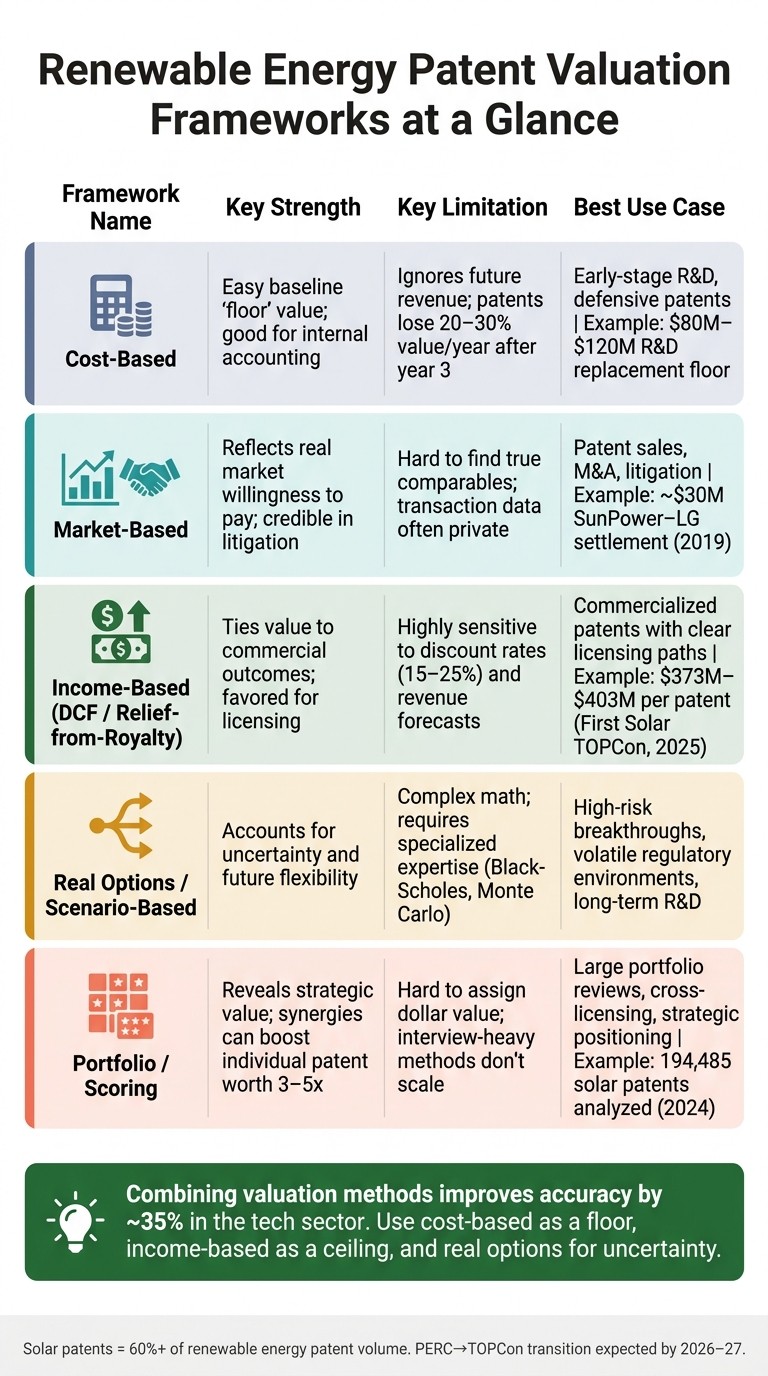
Renewable Energy Patent Valuation Methods: Pros, Cons & Best Use Cases
Here’s a quick overview of the strengths and weaknesses of different frameworks for valuing renewable energy patents. Each method works best depending on the technology’s stage, the availability of market data, and the purpose of the valuation. Interestingly, combining methods can improve accuracy by about 35% in the tech sector.
The table below breaks down how each framework performs across key dimensions for renewable energy intellectual property (IP):
Framework | Methodology | Strengths | Limitations | Best Use Case for Renewable Energy Patents |
|---|---|---|---|---|
Cost-Based | Adds up R&D, legal, and prosecution costs | Easy to calculate; provides a baseline "floor" value; good for internal accounting | Doesn’t consider market demand or future revenue; overlooks technological impact; patents lose 20–30% of their value annually after year three | Ideal for early-stage R&D, defensive patents, or as financing collateral |
Market-Based | Benchmarks against comparable sold or licensed patents | Reflects actual market willingness to pay; highly credible in litigation and settlements | Difficult to find true comparables for unique renewable technologies; transaction data is often private | Best for patent sales, M&A benchmarking, or litigation (e.g., the ~$30M SunPower–LG settlement in 2019 serves as a market reference) |
Income-Based (DCF / Relief-from-Royalty) | Projects future cash flows or avoided royalties, discounted to present value | Ties value directly to commercial outcomes; favored for licensing and investment decisions | Very sensitive to revenue forecasts and discount rates (often 15–25% for tech assets) | Suited for commercialized technologies with clear adoption paths or licensing programs |
Real Options / Scenario-Based | Models patents as financial options using tools like Black-Scholes or Monte Carlo simulations | Accounts for uncertainty and flexibility better than static models | Complex math; requires specialized expertise | Works well for high-risk breakthroughs, volatile regulatory settings, or long-term R&D |
Portfolio / Scoring | Uses metrics (e.g., citations, claim count, geographic reach) combined with expert input to rank patents | Highlights strategic value - blocking positions and synergies can boost individual patent worth by 3–5x; identifies portfolio gaps | Hard to assign a specific dollar value; interview-heavy methods don’t scale easily | Perfect for strategic positioning, cross-licensing deals, or large-scale portfolio reviews |
Each valuation method tackles the unique challenges of renewable energy IP differently. For instance, patents tend to depreciate consistently, making regular revaluation critical - especially as industry trends evolve. A good example is the expected shift from PERC to TOPCon as the leading solar cell architecture by 2026–27.
Conclusion
There’s no one-size-fits-all method for valuing renewable energy patents. The best approach depends on factors like the stage of the technology, the availability of market data, and the specific purpose of the valuation - whether it's for licensing, investment, or other strategic goals.
Generally, income-based methods are ideal when the patent has a clear commercial trajectory. When data is limited, cost-based methods can provide a baseline, while market comparables are useful when reliable transaction data exists. For patents in early development or with high uncertainty, real options modeling can offer additional depth by accounting for future scenarios. By combining these methods, you can achieve a more balanced and accurate valuation, rather than relying on a single approach. This ties back to the broader strategies highlighted earlier in the discussion.
A practical way to approach this is by establishing a valuation range instead of pinpointing a single number. For instance, a cost-based R&D replacement floor - often between $80M and $120M for complex solar process patents - can be paired with an income-based ceiling derived from a blend of relief-from-royalty and discounted cash flow models. This gives negotiators and financiers a defensible range to work with, reinforcing the importance of combining methods for precision.
"For financiers, the spread between USD 200M (conservative) and USD 900M (theoretical) is not confusion - it's optionality." - Patentitech
As renewable energy markets shift rapidly, these valuation strategies must also evolve. Regular revaluation becomes crucial to stay aligned with market dynamics. Tools like Patently make this process easier by using AI. Features like semantic search and Vector AI help map patent claims to changing adoption trends, identify comparable transactions, and maintain up-to-date portfolios - cutting down on manual effort and ensuring valuations remain relevant.
FAQs
How do I choose the right valuation method for my renewable energy patent?
The best valuation method for your technology depends on factors like its development stage, the availability of data, and your overall objectives. Experts often recommend combining methods to get a more balanced perspective:
Cost Approach: Ideal for early-stage patents or situations where revenue data is scarce.
Income Approach: Works well for licensing or investment scenarios, as it focuses on predicting future earnings.
Market Approach: Useful when you have access to comparable transaction data, offering objective benchmarks.
Each method has its strengths, so blending them can provide a clearer picture.
What inputs most affect a relief-from-royalty valuation?
The relief-from-royalty (RFR) method is a way to estimate the value of a patent by determining the royalty payments the owner would make if they didn’t actually own the technology. Essentially, it calculates how much the patent is "saving" the owner in royalty costs.
To use this method effectively, several key inputs are required:
Projected revenue generated by the patented technology.
Royalty rate based on similar transactions in the market.
The remaining useful life of the patent.
A discount rate to account for the time value of money.
Additionally, the comparability of royalty benchmarks can be influenced by factors such as the legal rights tied to the patent and the specific terms of comparable transactions. These elements help ensure the royalty rate reflects the patent's true market value.
How should I account for fast technology obsolescence in patent value?
To tackle the challenge of fast-changing technology, it’s better to zero in on the expected commercial lifespan of the innovation instead of relying solely on the full patent term. A practical way to do this is by using valuation models like the income-based Discounted Cash Flow (DCF) method, but with adjusted timeframes that align with the technology's realistic market relevance.
When applying this approach, consider key factors such as:
Displacement risk: How likely is it that a newer technology will replace this one?
Market adoption rates: How quickly will the market embrace the technology?
Technology lifecycle stages: Is the technology in its early growth phase, at its peak, or nearing obsolescence?
Additionally, use a discount rate that accounts for the risk of competitive obsolescence. This ensures your valuation remains grounded and reflects the fast-paced nature of evolving technologies.