AI in Carbon Capture Patent Search
Intellectual Property Management
Jun 18, 2026
How AI semantic search improves carbon-capture patent recall, cuts noise, and works best when paired with expert review.

Keyword-only CCS patent searches often miss 30% to 40% of relevant prior art. My main takeaway is simple: if you rely on keywords and class codes alone, you will miss patents, review too much noise, and spend more time screening. AI semantic search helps by matching patents on meaning, which tends to improve recall, trim false hits, and cut first-pass review time.
Here’s the short version:
CCS patent search is hard because the same idea can be described in different ways across capture, use, storage, and monitoring.
Keyword search still has a role, but it can pull lots of junk. In one dataset, 266 records dropped to just 53 relevant patents after review.
AI semantic search helps find related patents even when the wording changes.
Hybrid workflows work best: keywords + CPC/IPC filters + semantic search + expert review.
Benchmarks show better retrieval for AI-based methods, including Recall@3 of 0.4046 for a Graph Transformer versus 0.1866 for BM25 in one novelty benchmark.
Human review still matters, especially for FTO, prior art, licensing, and enforcement.
If you work on CCS patent landscapes, prior art, or FTO and novelty searches, the message is clear: use AI search as a stronger first pass, not as a replacement for expert judgment.
Method | What it does well | Main issue |
|---|---|---|
Keyword/classification search | Good starting filter; easy to run | Misses term variants and brings in noise |
AI semantic search | Finds conceptually similar patents across wording changes | Still needs validation by a domain expert |
Hybrid approach | Better balance of coverage and review effort | Takes setup and review discipline |
That’s the core of the article: AI improves CCS patent retrieval, but the best results come from layered search and manual checking.
CCS Patent Landscape and Research Data
Main CCS Technology Areas and Patent Data Sources
Many CCS patent studies sort inventions into four big buckets: capture, utilization, storage, and system control. On the capture side, researchers usually track chemical absorption, solid sorbent adsorption, and membrane separation. That sounds neat on paper, but there’s a catch: each area often uses different terms, so search results can vary a lot from one CCS subfield to another.
The data sources that show up most often are the Derwent Innovations Index (DII), Espacenet, Google Patents, and Lens.org. These top patent tools let researchers review patent families across many offices instead of just counting filings in one country. DII comes up often because it includes data from more than 41 patent offices across 100 countries.
Studies also tend to organize datasets around the earliest priority year and earliest priority country. That helps show when and where an invention first began, instead of where it was later filed. This matters a lot in CCS. China, the U.S., and Japan make up 85.78% of all CCUS patents, so broad cross-jurisdiction coverage isn’t optional; it’s the only way to see the full picture.
Limits of Keyword and Classification Search
CCS searches still lean on Boolean strings, CPC/IPC codes, and hand-built term lists. The trouble is simple: those methods can miss alternate wording and also drag in a pile of unrelated records. The codes used most often include CPC Y02C-20/40 and IPC B01D-53.
The biggest headache is noise. For example, the acronym "CCS" can pull results tied to electric vehicles or computer science instead of carbon capture and storage. In one study, the scale of that problem was hard to ignore: the first keyword search returned 266 unique patent records, but after manual review, only 53 were actually relevant.
Classification search has its own weak spot: classification lag. Static codes don’t always keep up with fast-moving technical language or inventions that sit across category lines. That’s a real issue for boundary-spanning work, like hybrid capture flowsheets, which can slip through the cracks. This is the gap semantic search is meant to close.
Search Limitation | Practical Impact |
|---|---|
Synonymy/Polysemy | Misses patents using newer terminology; retrieves unrelated noise |
Classification Lag | Fails to capture boundary-spanning technologies like hybrid capture flowsheets |
Geographic Bias | High Chinese filing volume can obscure specialized innovation in other regions |
Data Hygiene | Inconsistent patentee names skew analysis of who leads in a given area |
18–24 Month Time Lag | The most recent 18–24 months of filings are underrepresented in most datasets |
These gaps hit the core jobs people care about most: FTO, prior art, and patent landscape work. If the search misses key records, the analysis can drift off course fast. That’s why AI semantic search is now being tested as a way to improve coverage and cut down on manual screening. Put plainly, it aims to reduce the weak spots built into keyword and classification search.
How AI Semantic Search Is Applied to CCS Patents
To cut down the keyword and classification gaps above, CCS studies now test semantic search that matches patents by meaning.
Models, Embeddings, and Vector Search Workflows
AI semantic search links patents by technical meaning, not exact wording. Instead of looking for the same terms, the system turns patent text into numerical vectors. Patents that describe similar ideas end up with similar vector representations, even when they use different language. That matters because it can surface patents that a standard keyword search would miss.
Researchers usually rely on transformer models trained on patent or scientific text. And because patents are long, they often need models built to handle extended context.
After embeddings are created, researchers index them with FAISS (Facebook AI Similarity Search). FAISS supports fast cosine-similarity and nearest-neighbor retrieval. In one study, it searched 1 million patents in under 0.01 seconds per 100 queries after the embeddings had already been built.
A newer method goes past flat text embeddings. Graph Transformer models treat patents as invention graphs, where technical features become nodes and relationships become edges. In head-to-head testing, a Graph Transformer reached a Recall@3 of 0.4046 for citation pairs used as novelty benchmarks. That beat both 0.2734 for Stella and 0.1866 for BM25 keyword matching.
Researchers then test those embeddings against screened CCS corpora to see how well retrieval performs.
How Studies Build and Test CCS Search Sets
Researchers usually begin with broad CCS search sets and then manually screen them into evaluation corpora. To check whether AI retrieval beats that starting point, studies often use citation-graph benchmarks, where forward and backward citations stand in as a proxy for technical similarity.
One benchmark tested 22 embedding models on 113,148 WIPO patents using 46,069 citation-graph queries and 128,623 relevance judgments. The top model reached an nDCG@10 of 0.197, and hybrid BM25-dense fusion delivered gains of up to 9% over zero-shot dense models alone.
That points to a practical issue for CCS work: training on one patent landscape can weaken retrieval on another landscape.
Where Patently Fits in Day-to-Day Practice
The same workflow also maps well to routine CCS patent work. In day-to-day use, Patently's Vector AI supports CCS landscape, prior art, and citation review by retrieving patents based on technical meaning, not just exact wording.
What Studies Report: Accuracy, Time Savings, and Search Coverage
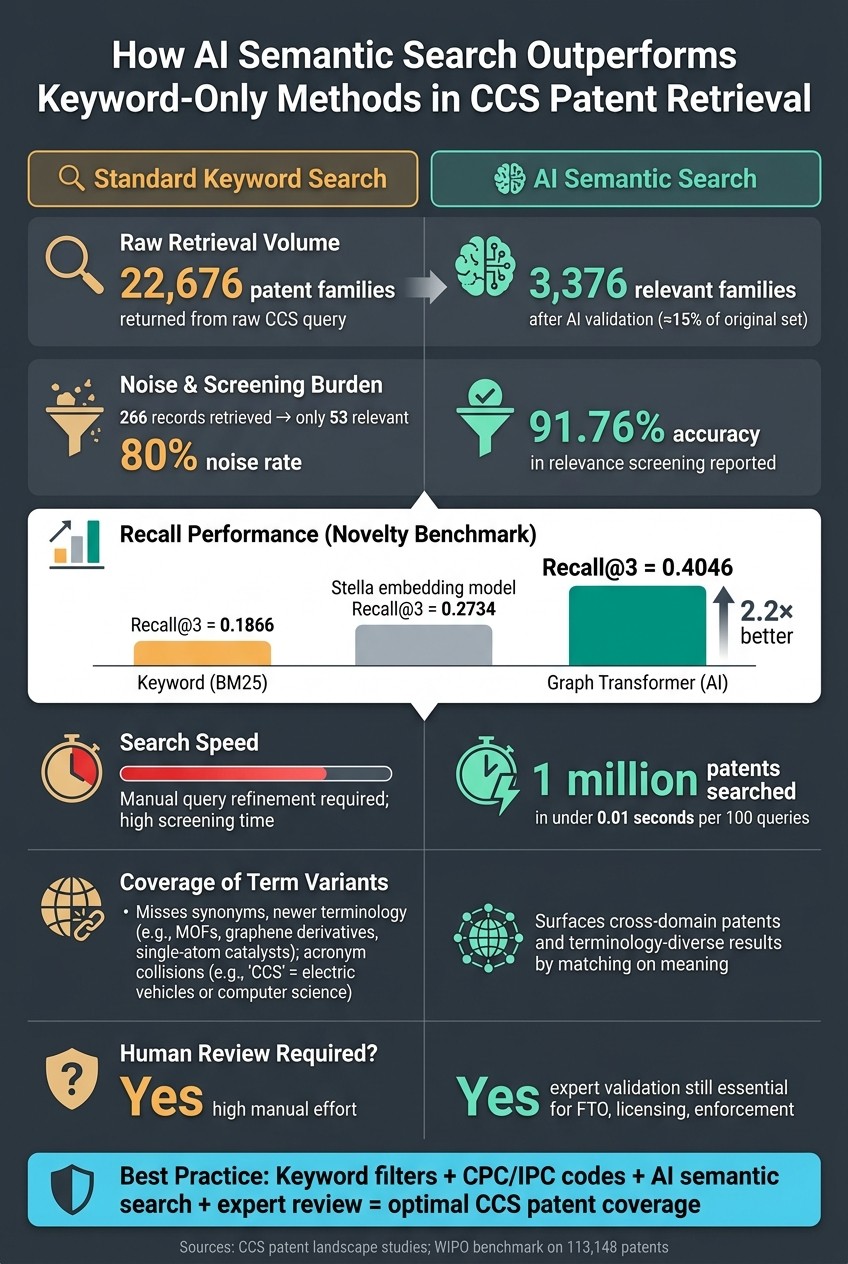
AI vs. Keyword Patent Search for CCS: Key Metrics Compared
Reported Gains in Recall, Precision, and Discovery
These workflow bottlenecks show up fast in CCS patent search. And that’s where the studies start to get interesting.
Several reports point to clear gains in retrieval quality and screening speed when teams use AI semantic search. One CCS landscape study is a good example: a raw keyword query pulled 22,676 patent families, but after screening and AI validation, that number dropped to 3,376 relevant families. That’s about 15% of the original set. In the same study, a keyword-plus-AI workflow reached 91.76% accuracy in relevance screening.
Coverage also improves. Researchers report that semantic analysis can surface cross-domain patents and term variants that keyword lists often miss. That includes newer adsorbents such as metal-organic frameworks (MOFs), graphene derivatives, and single-atom catalysts.
Search Time and Cost Effects for IP Teams
For IP teams, the biggest time savings come early in the process. The first pass is usually where the slog happens: too many hits, too much noise, and too much manual filtering.
AI semantic search cuts that load by removing irrelevant results sooner, which reduces the amount of screening needed for large CCS landscapes. One study found that a Graph Transformer model reached a Recall@3 of 0.4046 for citation pairs used as novelty benchmarks, compared with 0.1866 for standard Okapi BM25. That kind of gap matters when a team is trying to sort signal from clutter without burning hours on documents that go nowhere.
Comparison Table: Standard Search vs. AI Semantic Search
The table below sums up the day-to-day difference between standard search and AI semantic search.
Search Method | Key Metrics | Screening Burden | Main Strengths | Main Limitations |
|---|---|---|---|---|
Standard Keyword Search | Raw CCS query: 22,676 families; 3,376 remained after screening | High manual effort for query refinement and screening | Easy to implement; broad initial reach | Acronym collisions such as "CCS" in EV-related patents; high noise ratio |
AI Semantic Search | Reported accuracy of 91.76%; Graph Transformer Recall@3 of 0.4046 for citation pairs used as novelty benchmarks | Less first-pass screening and manual filtering | Filters irrelevant results; surfaces cross-domain and terminology-diverse patents | Still requires expert validation |
Practical Takeaways for CCS Patent Strategy
Using Semantic Search for FTO, Prior Art, and Trend Monitoring
Those retrieval gains show up in three day-to-day CCS jobs: FTO, prior art, and trend monitoring. In practice, semantic search works best when you pair it with CPC/IPC filters for FTO and prior art.
For freedom-to-operate work, modular or mobile capture systems, such as offshore or vehicle-mounted units, often describe the same function with different wording. That’s where a fixed keyword list can fall short. If your search is tied too tightly to a narrow set of terms, it can miss patents that matter.
Prior art work gets a similar lift. Semantic queries can surface integrated capture-conversion processes that class-based search often splits across separate buckets. Put simply, the invention may hang together as one concept, while the classification system treats the pieces separately.
Trend monitoring is another strong use case. Direct Air Capture (DAC) patent applications have climbed sharply compared with general carbon capture patents, especially after 2021. Semantic alerts can help spot new filings before classification updates catch up. Patently's Vector AI can help with steady CCS monitoring by finding patents that are close in concept. But that kind of output still needs domain-specific validation.
Limits, Validation Needs, and Open Research Questions
Higher coverage does not remove the need for human review, especially in high-stakes work. General models can stumble on CCS language. Terms like "sorbent-coated web" or "cryogenic separation" may be misunderstood by models that were not trained on patent corpora. That gap matters, and the research shows it clearly: models trained on patent language outperform general models by 15–25% on recall benchmarks.
For high-stakes decisions - FTO opinions, licensing talks, and enforcement - the research points to a layered workflow: keyword search, semantic search, and then expert review. That sequence makes sense. You cast a broad net, add concept-level retrieval, and then let a subject-matter expert sort what holds up.
Cross-database checking matters too, because no single source gives full CCS patent coverage. Geographic filtering matters just as much. China's dominant share of CCUS filings can skew volume-based trend analysis if you don’t account for it.
Conclusion: What the Research Shows
The research points to a clear pattern: better recall, less noise, and faster screening. Semantic patent search beats keyword-only methods on recall, and AI-assisted workflows cut both time and cost. Still, those gains hold up only when semantic search is paired with citation review, structured validation workflows, and human oversight from people who know the domain. In other words, it’s a smarter and faster starting point for expert patent work - not a fully automated CCS patent strategy.
FAQs
How does semantic patent search work?
Semantic patent search goes past exact keyword matching. It uses NLP and machine learning to read the meaning and context behind patent text.
Patently uses Vector AI to turn claims, abstracts, and other patent text into numerical vectors. A query gets mapped into that same vector space, so the system can find patents based on conceptual similarity instead of exact wording.
That matters more than it may seem at first glance. Patent language is often dense, technical, and inconsistent from one filing to the next. Two patents can describe the same idea in very different words. Semantic search helps close that gap, including cases involving synonyms and translated text.
When should I use AI search instead of keywords?
Use AI-powered semantic search when plain keyword searches might miss relevant patents. That usually happens when inventors use different terms for the same idea, when patents appear in different languages, or when a manual synonym list just doesn't go far enough.
This matters even more in fast-moving fields like carbon capture, where wording can change from one industry, region, or author to another. Patently’s semantic search uses Vector AI to read the conceptual meaning behind the text, which helps teams find prior art and run landscape analysis with more speed and better accuracy.
Why is expert review still necessary?
Expert review still matters. AI-powered semantic search can speed things up and surface more possible matches, but it can’t make the final call on tricky legal and technical details.
Patent attorneys and other professionals still need to judge final relevance, review claim scope, and work through prior art issues. Patently helps by highlighting claim elements and making collaborative rating easier, but expert judgment is still the last step.