How AI Improves Flexibility in Patent Management
Intellectual Property Management
May 13, 2026
AI turns rigid patent processes into flexible, error‑reduced systems, freeing teams to focus on strategic IP decisions.

AI is reshaping patent management by streamlining workflows, reducing errors, and enabling better collaboration. It transforms rigid, step-by-step processes into dynamic systems where tasks like drafting, prior art searches, and portfolio analysis happen simultaneously. Here’s what makes AI essential for modern patent teams:
Fewer Errors: Error rates in patent applications dropped from 8.9 in 2020 to 6.55 in 2025 with AI tools.
Faster Drafting:Generative AI patent drafting tools generate structured first drafts, saving time for attorneys to refine applications.
Smarter Searches: Semantic search identifies related concepts, improving prior art searches by 20–40%.
Custom Workflows: AI allows teams to tailor workflows for different projects and adjust as priorities change.
Improved Collaboration: Real-time dashboards and automated task routing keep teams aligned.
Global Strategies: AI adapts claims for international filings, reducing errors and improving protection.
AI doesn’t replace professionals - it handles repetitive tasks, enabling patent teams to focus on strategic decisions. Tools like Patently integrate drafting, searching, and project management, offering a unified solution for patent professionals.
AI Agent-Powered Autonomous Patent Management & Monetization Webinar
Automating Repetitive Tasks with AI
Patent professionals often find their days consumed by repetitive tasks like formatting claims, conducting keyword searches, and cross-referencing prior art databases. These activities are not only time-consuming but also prone to human error. AI offers a practical solution by handling these routine tasks efficiently, allowing professionals to dedicate more time to strategic decisions, client interactions, and the nuanced judgment calls that demand their expertise. Here's how AI is transforming patent drafting and prior art searches.
AI-Powered Patent Drafting
Drafting a patent application is no small feat. It involves structuring claims, maintaining consistent terminology, and ensuring descriptions align with technical drawings - a process that can take days. AI drafting tools are changing the game by generating structured first drafts from invention disclosures or technical inputs, significantly speeding up the process.
Take Onardo, Patently's AI drafting assistant, as an example. Designed specifically for patent professionals, it produces drafts that meet industry standards, cutting down the time spent starting from scratch. Instead, attorneys and agents can focus on refining and strengthening applications. For teams managing a high volume of filings, this shift can drastically improve efficiency.
Automating Prior Art Searches
Traditional keyword-based searches for prior art often fall short because they rely on exact matches. Studies reveal that these methods miss 20% to 40% of relevant prior art, which can lead to costly issues during prosecution or litigation.
AI-powered semantic search addresses this limitation. Tools like Patently's Vector AI use mathematical vectors to analyze patent text, identifying related documents based on their conceptual meaning rather than exact wording. For instance, a search for "wireless energy transfer system" might also bring up results for "inductive charging" or "resonant power coupling", even if those terms aren’t explicitly mentioned in the query.
Here’s how traditional keyword searches compare to AI-driven semantic searches:
Feature | Traditional Keyword Search | Vector AI (Semantic Search) |
|---|---|---|
Search Basis | Matches exact words/phrases | Understands concepts and context |
Query Type | Requires Boolean operators and complex syntax | Accepts natural language input |
Synonym Handling | Manual (requires listing every variation) | Automatic (recognizes related terms) |
Recall | Lower (misses 20–40% of relevant results) | Higher (captures conceptually similar results) |
Speed | Slower (manual refinement takes hours or days) | Near-instant results |
Cross-Language | Limited by translation quality | Matches concepts across languages |
Beyond improving accuracy, AI tools also streamline workflows. Many platforms now integrate FTO and validity searches directly into the drafting environment, eliminating the hassle of exporting data between separate tools. This integration keeps the process smooth and uninterrupted, enabling teams to stay agile and focus on higher-level tasks.
Customizing Workflows to Fit Your Needs
Patent projects can differ dramatically. Filing a fast-moving software feature is nothing like tackling a high-stakes biotech application. AI-powered platforms recognize this diversity, offering patent teams the flexibility to design workflows that suit their unique needs - rather than cramming every project into the same rigid framework.
Building Workflows That Match Your Projects
Patently's project management tools empower teams to structure their workflows around the specific stages and objectives of each filing. You can tag projects based on business strategies - like blocking competitors, supporting licensing deals, or increasing portfolio value - ensuring tasks align with overarching goals. Custom fields make it easy to capture critical details unique to each project type.
A practical example? Match the workflow's intensity to the pace of innovation. For software teams working in quick sprints, a streamlined workflow keeps things moving efficiently. Meanwhile, biotech or deep R&D projects benefit from a more detailed, attorney-driven process that ensures every critical aspect is covered. The beauty lies in the flexibility to toggle between these modes without starting from scratch every time.
Once you've created a workflow that works, save it as a template. This way, when a similar project arises, your team isn’t reinventing the wheel. This is especially handy for firms juggling filings across different product lines or tech areas. These templates provide a solid starting point while allowing for quick adjustments as project needs evolve.
Adjusting Workflows as Projects Change
Even the best-tailored workflows need to adapt when projects take unexpected turns. Patent work is rarely predictable - a claim might get challenged, a new inventor could join, or deadlines might shift. Your workflow must evolve with these changes. AI tools make this easier by using rule-based logic to automate responses based on conditions like risk level, jurisdiction, or review status.
For instance, if a primary reviewer hasn’t acted on a document within 48 hours, the system can automatically reroute the task to a backup reviewer. This kind of automation helps avoid bottlenecks and keeps projects moving without requiring constant manual oversight. The result? A workflow that stays responsive and efficient, no matter what surprises come up.
Improving Team Collaboration and Access Control
Attorneys, inventors, R&D teams, and outside counsel often find themselves working together on complex projects. Without the top patent tools, this collaboration can spiral into chaos - think endless email chains, conflicting document versions, and missed updates. AI tools step in to simplify and streamline these challenges.
Collaborative Patent Project Management
AI doesn’t just automate tasks; it also improves how teams work together. Tools like Patently's collaborative project management features provide a shared, real-time view of project progress. This eliminates the need for constant status meetings. For instance, live dashboards offer up-to-the-minute updates, while shared claim construction ensures everyone - attorneys, litigation experts, and others - is using consistent terminology. This can save legal teams over 10 hours a week that would otherwise be spent on check-in calls. By keeping everyone aligned with a single source of truth, miscommunication becomes a thing of the past.
AI also helps teams prioritize effectively. Instead of assigning tasks based solely on availability, AI can analyze incoming workloads and route assignments based on their complexity. This means senior attorneys can spend their time on strategic, high-value tasks rather than routine filings.
Controlling Access to Sensitive Patent Data
Managing access to sensitive information is just as important as improving collaboration. Different roles require different levels of access. For example, a pending application with sensitive claims should only be visible to specific team members. AI-powered access controls make it easy to set precise permissions based on roles, project stages, or data sensitivity, and they automatically enforce these restrictions.
Patently’s built-in access control features allow teams to decide who can view, edit, or comment on a given project. This is especially critical for law firms handling confidential client matters. Beyond basic permissions, AI can also identify "permission creep", where users accumulate unnecessary access over time.
Karthik Krishnan, Founder and CEO of Concentric AI, highlights this issue:
"Without a clear way to define appropriate access levels, it becomes difficult to accurately assess whether a user has been granted excessive or unnecessary permissions. Our unique technology provides a way for enterprises to identify over-permissioned users so they can address this risk."
Using a least-privilege approach - where team members only access the information they truly need - minimizes the chances of sensitive intellectual property being exposed, whether by accident or through misuse. These advanced access controls align perfectly with the dynamic demands of modern patent management.
Scaling Patent Operations with AI
As patent portfolios grow, managing the sheer amount of data, deadlines, and decisions can quickly become overwhelming. AI steps in to simplify this complexity, helping organizations handle expanding portfolios without needing to hire significantly more staff or compromise on quality. Let’s explore how AI enhances portfolio management and supports international patent filings.
Managing Large Patent Portfolios
The challenge with large portfolios often isn't filing new patents - it's keeping track of the ones you already have. Relying on traditional tools like spreadsheets or disconnected databases can make it difficult to fully understand the value of your portfolio. AI changes the game by centralizing all patent data into a unified, searchable system. This allows attorneys to see their portfolio as an interconnected network rather than isolated files, enabling strategic decisions that adapt to shifting markets and legal landscapes.
With AI, identifying high-value patents, spotting underutilized assets for licensing, or flagging infringement risks becomes almost instantaneous - even across hundreds or thousands of patents. This transforms portfolio management from a logistical burden into a strategic advantage.
Patently facilitates this kind of large-scale oversight with features like hierarchical project structures and role-based access controls. These tools help large teams stay organized while ensuring sensitive data remains secure as portfolios expand.
Once local portfolios are optimized, the next step is tailoring strategies for international protection.
Supporting Global Patent Strategies
Navigating international filings is no small task, thanks to varying legal requirements and deadlines across regions. A simple "copy-paste" approach to filing in multiple countries often results in costly mistakes, like rejections or gaps in protection. AI helps by dynamically adapting claims to fit the legal and commercial requirements of each region, rather than merely duplicating the original application. This ensures that global strategies remain flexible and effective.
Patently's Vector AI plays a key role here by bridging language and terminology gaps across regions. For instance, a search for "unmanned aerial vehicle" will also uncover patents using entirely different terms to describe the same technology. According to research from PatSnap, AI can cut prior-art search times by 60–80% while simultaneously improving the quality of the results.
"PatSnap research demonstrates that AI reduces prior-art search time by 60–80%, whilst simultaneously improving result quality." - PatSnap
The global IP management software market reflects this growing reliance on AI, with its value reaching $11.83 billion in 2025 and projected to climb to $31.89 billion by 2033, growing at a CAGR of 13.2%.
For organizations dealing with standard-essential patents (SEPs), Patently's SEP analytics provide a significant advantage. These tools automate the mapping of patent claims against technical standards like 5G and Wi-Fi. What once took weeks - creating claim charts and assessing essentiality - can now be done in minutes. This speed is crucial in industries where global standards evolve rapidly, and staying competitive requires a clear understanding of your portfolio's strengths.
Key Benefits of AI in Patent Management
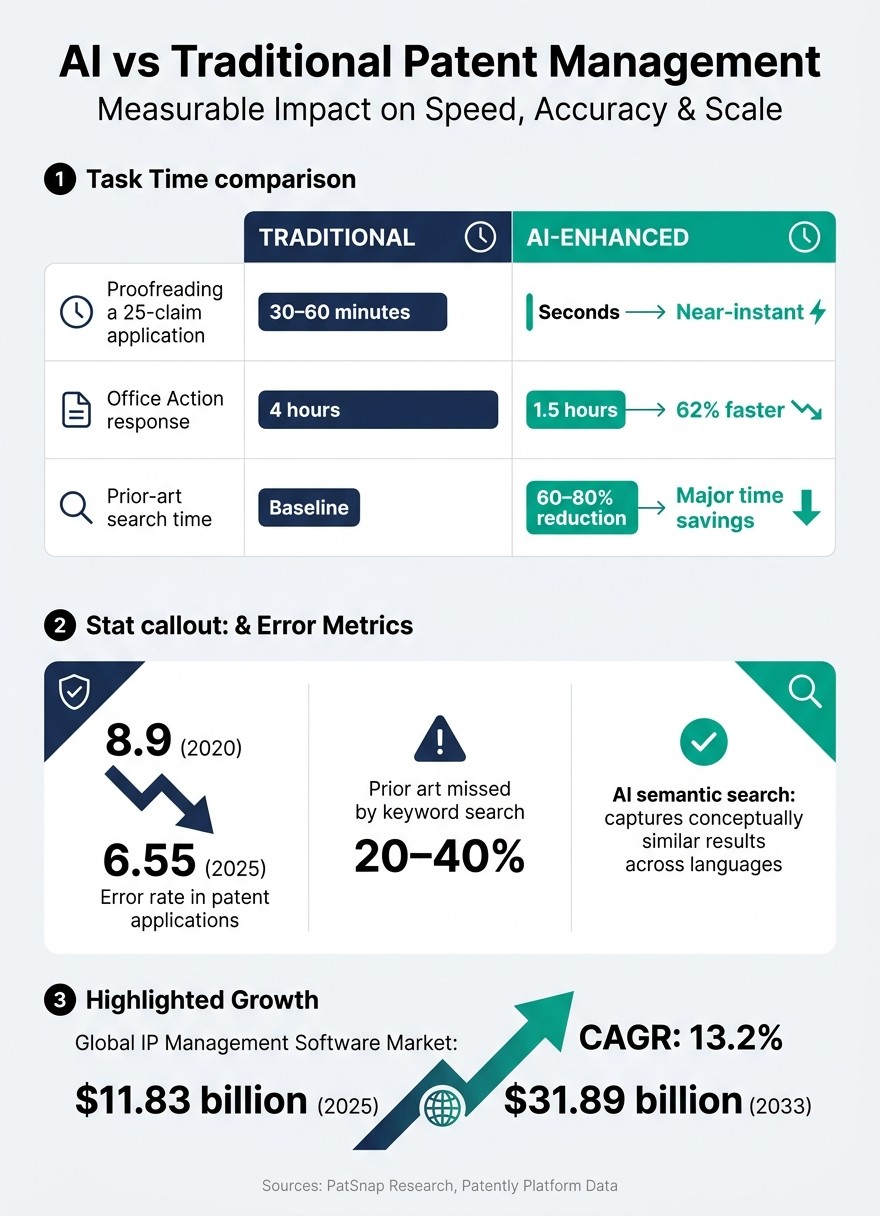
AI vs Traditional Patent Management: Key Performance Metrics
AI's role in patent workflows goes beyond streamlining tasks - it brings measurable improvements like faster turnaround times, fewer errors, and more opportunities to focus on strategic priorities.
Reducing Patent Application Backlogs
Patent backlogs can lead to missed deadlines and compromised quality. AI addresses this by acting as an intelligent filter, pre-processing large volumes of filings, assessing risks, and categorizing drafts based on complexity. This ensures attorneys focus only on the tasks that require their expertise.
AI also transforms how teams handle deadlines. Instead of reacting to looming due dates, AI systems monitor jurisdictional requirements and flag deadlines 30 to 60 days in advance. This proactive approach replaces last-minute stress with a well-organized, planned process.
Beyond managing deadlines, AI enhances the accuracy of patent drafting and searching - two critical aspects of patent management.
Improving Accuracy in Patent Drafting and Searching
Errors in patent drafts can be costly. A single inconsistency or poorly crafted claim might result in a Section 112 rejection, leading to additional office actions, delays, and higher expenses. AI tools, equipped with advanced proofreading and consistency checks, catch these errors early, preventing them from escalating.
The time savings are impressive. For example, manually proofreading a 25-claim application takes 30–60 minutes, but AI completes the task in seconds. Similarly, AI reduces the time spent on Office Action responses from 4 hours to just 1.5 hours - a 62% reduction.
Task | Traditional Time | AI-Enhanced Time | Impact |
|---|---|---|---|
Proofreading a 25-claim application | 30–60 minutes | Seconds | Allows attorneys to focus on strategic work |
Office Action response | 4 hours | 1.5 hours | Cuts response time by 62% |
With platforms like Patently integrating these capabilities directly into drafting and search workflows, teams can produce higher-quality results without increasing staff or slowing down their operations.
Conclusion: Using AI for More Flexible Patent Management
AI is transforming how patent work gets done by streamlining drafting, search, and analysis into a unified process. This eliminates the disjointed workflows that often slow things down and lead to inconsistencies, paving the way for more efficient and accurate operations.
On top of these improvements, AI enables teams to shift from merely reacting to being more proactive. Instead of spotting errors after the fact or rushing to meet deadlines, AI acts as an intelligent filter - sorting drafts by complexity and ensuring they’re handled appropriately.
Still, the human element remains at the core of this process. As discussed earlier, AI takes care of repetitive, time-sensitive tasks, but attorneys and IP professionals maintain full control over critical decisions like legal strategy and claim scope. This balance between automation and human oversight is what makes AI a practical tool rather than just an intriguing concept.
For those ready to take the next step, Patently offers a comprehensive platform that combines AI-powered drafting, semantic search, collaborative project management, and SEP analytics - built for patent professionals who prioritize precision and adaptability.
FAQs
How do I validate AI-generated patent drafts?
To ensure the accuracy of AI-generated patent drafts, it's essential to use a detailed review process that combines automated tools with human expertise. AI can assist by identifying issues such as broken claim dependencies or mismatched references. However, these tools are not a substitute for the critical eye of a qualified professional, who can assess the legal and technical details.
Additional features like semantic search can help verify prior art, while version control makes it easier to track changes throughout the drafting process. Ultimately, the human review is crucial for meeting patent standards and addressing the subtleties that AI might overlook.
What data can semantic search find that keywords miss?
Semantic search dives deeper than just matching keywords - it reveals conceptual relationships, technical contexts, and subtle connections that traditional keyword searches might miss. This means it can identify related prior art, spot emerging technology trends, and interpret nuanced claims, offering a richer and more comprehensive understanding of patent data.
How should teams control access to sensitive patent data in AI tools?
Teams can protect sensitive patent data when using AI tools by implementing role-based access controls, ensuring strong data security protocols, and maintaining strict confidentiality standards. These methods support responsible AI usage, helping to secure critical information throughout patent-related processes.