How AI Improves Patent Keyword Searches
Intellectual Property Management
May 19, 2026
How semantic AI and hybrid workflows boost patent keyword searches—improving recall, precision, and team collaboration.

AI has transformed patent keyword searches by focusing on meaning rather than exact word matches. Traditional searches using Boolean logic often miss 20–40% of relevant prior art due to inconsistent terminology, synonyms, and evolving jargon. AI-powered tools solve this by analyzing the context and concepts behind queries, enabling more accurate and efficient results.
Key advancements include:
Semantic Search: AI uses vector models to group related patents by concepts, even if they use different terms.
Keyword Expansion: AI automatically identifies synonyms, variations, and cross-lingual terms (e.g., "self-driving car" and "autonomous vehicle").
Improved Precision: AI ranks results based on relevance, reducing irrelevant matches.
How Is AI Improving Patent Prior Art Searches? - Trademark and Patent Law Experts
Why Standard Patent Keyword Searches Fall Short
For decades, Boolean logic has been the go-to method for patent searches. It works by building queries like (wireless OR contactless) AND (power OR energy). While this approach seems straightforward, it often misses the mark when it comes to synonyms and variations. To catch every possible term, you'd have to manually add every variant into your query - a daunting and inefficient task. This is where AI offers a fresh perspective.
Handling Complex Technical Language
One of the biggest challenges with standard searches is the inconsistency in technical terminology. AI, with its ability to understand semantics, addresses this issue head-on. Take, for example, a situation where one inventor refers to a device as a "drone", while another calls it an "unmanned aerial rotorcraft." Both terms describe the same concept, but a Boolean search for "drone" would completely overlook the second patent.
It gets trickier when acronyms or evolving jargon come into play. A term used in a patent from 1998 might be entirely different from the language used for the same technology today. Unfortunately, traditional keyword searches can't automatically bridge these gaps.
Lack of Contextual Understanding
Keyword searches focus solely on text, ignoring the underlying meaning. This lack of contextual awareness means related ideas often go unnoticed. It also creates an industry-wide disconnect. For instance, a braking mechanism designed for aerospace might function similarly to one used in medical devices, but because the terminology differs, a keyword search would never link the two. Add in the vague language that inventors sometimes use, and the limitations of Boolean logic become even clearer. This highlights the importance of AI-driven semantic search, which can interpret meaning rather than just matching words.
How AI Improves Patent Keyword Searches
Traditional vs. AI vs. Hybrid Patent Search: Key Differences
Traditional patent searches rely on exact word matching, often missing the deeper intent behind a query. AI, however, takes a different approach by interpreting meaning and context, which significantly enhances the search process.
Semantic Search and Context Awareness
AI revolutionizes the way patent searches work by focusing on meaning rather than just words. It uses models that transform patent texts into multidimensional vectors, capturing the essence of the content. In this "vector space", patents with similar concepts naturally group together. This allows AI-powered semantic search to identify related patents even if they use different terminology. For example, it can connect patents discussing the same idea, whether one uses "energy storage system" and another says "battery management."
This approach overcomes the limitations of traditional Boolean queries and other patent tools, which rely solely on rigid keyword matches and often miss relevant results expressed in varied terms.
AI-Driven Keyword Expansion
One of AI's standout features is its ability to expand keywords automatically. Instead of requiring users to manually input synonyms or variations, AI identifies related terms and concepts on its own. For instance, it can associate "autonomous vehicle" with "self-driving car" or even link terms across languages, such as "brake system" with the German term Bremssystem. This cross-lingual capability ensures more comprehensive search results without needing exact translations.
To maximize this feature, start by defining the invention's core functionality and include key technical aspects. This gives the AI a strong foundation to expand its search intelligently.
Filtering Noise and Improving Precision
While AI expands search parameters to capture a broader range of results, it also excels at refining them. Broader searches can introduce irrelevant results, but AI addresses this by ranking results based on their relevance to the query's conceptual intent rather than simple keyword frequency.
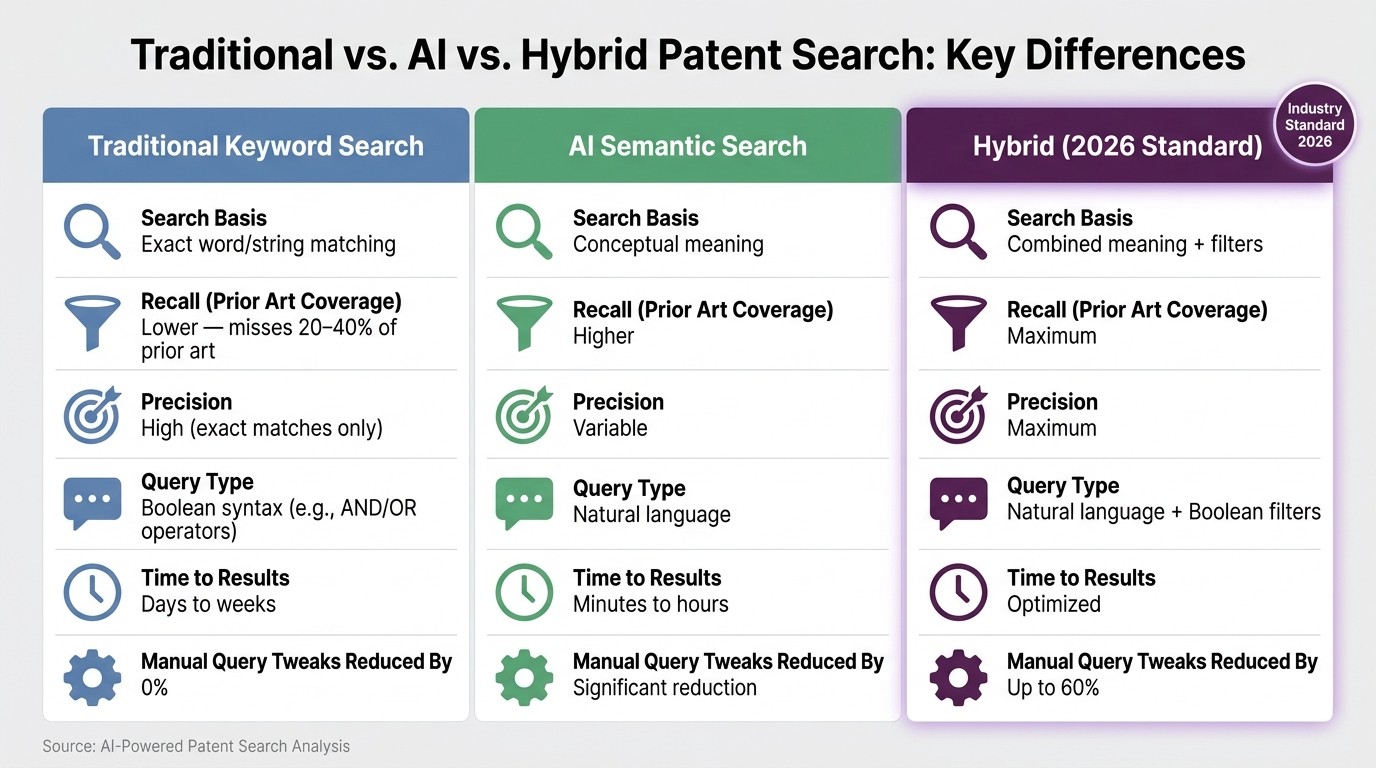
By 2026, a hybrid approach has become the industry standard. This combines vector-based semantic search for broad initial discovery with Boolean filters to fine-tune the results. Here’s a quick comparison of these methods:
Feature | Traditional Keyword Search | AI Semantic Search | Hybrid (2026 Standard) |
|---|---|---|---|
Search Basis | Exact word/string matching | Conceptual meaning | Combined meaning + filters |
Recall | Lower (misses 20–40% of prior art) | Higher | Maximum |
Precision | High (exact matches only) | Variable | Maximum |
Query Type | Boolean syntax | Natural language | Natural language + filters |
Time to Results | Days/weeks | Minutes/hours | Optimized |
Platforms like Patently demonstrate the power of this hybrid approach. Their Vector AI technology enables semantic searches across patent databases, and the "More Like This" re-ranking feature lets users refine results by selecting a particularly relevant document. The system then adjusts the rankings based on that document’s vector, saving time and effort by eliminating the need to rebuild queries from scratch. This makes the search process faster and more efficient for patent professionals. For large-scale projects, teams often use AI-enabled patent analysis to further shorten cycle times and improve collaboration.
Building an AI-Assisted Patent Search Workflow
Setting Up a Starting Keyword Strategy
Creating an effective keyword strategy begins long before running your first search. Start by translating internal jargon into terms that align with public-domain language - words that describe what the technology does, not just what your team calls it. Focus on the invention's function and its primary challenges to develop solid seed terms. Once you have these core concepts, input them into your AI tool to generate related phrases, regional variations, and industry-specific terminology. You can also ask the AI to analyze a sample set of patents and suggest alternative terms for your key ideas, helping you build a broader and more nuanced language profile before diving into a full search.
Treat your initial search as a testing phase. Use it to refine your seed terms and adjust your approach. Once you’ve fine-tuned these terms, you can optimize your search results further with the help of AI tools.
Refining Results with AI Tools
After generating an initial set of results, leverage relevance feedback tools to fine-tune and direct your search. For instance, if your results highlight patents from a different industry that use similar mechanisms, that’s a valuable lead to explore. An example? Vibration-dampening methods initially designed for drone stabilization might also apply to heavy machinery mounts, despite the industries being vastly different. AI can uncover these unexpected connections that a manual keyword search might overlook entirely.
One of the quickest ways to boost precision is by identifying a highly relevant patent and using it to re-rank your results. This iterative process - expand, review, refine, and repeat - allows you to continuously improve your search without starting from scratch. Incorporating team collaboration tools into this workflow can make managing these insights even more efficient.
Using Patently's Features for Team Collaboration
AI-enhanced search strategies become even more effective when paired with robust collaboration tools. Patent searches often require input from attorneys, engineers, and analysts, making alignment on search scope, findings, and next steps a logistical challenge. Patently addresses this need by offering collaborative project management features that centralize search results, findings, and workflows in a single platform.
With tools like hierarchical project categorization and built-in access controls, teams can organize their work by client, technology area, or specific projects - ensuring the right people have access to the right information. Instead of juggling spreadsheets and email threads, teams can store search results and annotations in one place. This is especially helpful for tasks like freedom-to-operate analyses or prior art investigations, where multiple reviewers need to evaluate the same data set. Patently’s Starter plan, priced at $125 per user per month, includes these collaboration tools along with semantic search capabilities, making it a practical choice for small to mid-sized teams that need both functionality and affordability without requiring a custom enterprise solution.
Conclusion: What AI Means for Patent Searches Going Forward
The move from manual keyword searches to AI-powered workflows is transforming patent research. It’s not just about speeding up the process - AI also uncovers results that traditional methods might miss. Keyword searches often fall short because inventors and examiners use different terminology. AI bridges this gap by interpreting the underlying concepts rather than relying solely on exact word matches. This shift from rigid keyword techniques to concept-based AI searches signals a major evolution in how patent searches are conducted.
By 2026, the integration of semantic AI with Boolean search precision will redefine the landscape. This hybrid approach ensures a balance between comprehensive recall and pinpoint accuracy, cutting down on the need for manual query tweaks by as much as 60%. For intellectual property professionals, this means less time spent refining search syntax and more time dedicated to high-value tasks like analyzing strategic portfolios and verifying AI-generated results. These advancements pave the way for more efficient, collaborative workflows.
Collaboration plays a key role in this transformation. When search results, annotations, and team discussions are unified on a single platform - rather than scattered across emails and spreadsheets - the entire process becomes faster and more accurate. Platforms like Patently combine semantic search powered by Vector AI with built-in project management and team collaboration tools. This allows attorneys, engineers, and analysts to work seamlessly from the same data, eliminating coordination headaches. Such integration of AI and teamwork highlights the future of patent research.
AI isn’t here to replace skilled patent professionals - it’s here to remove inefficiencies and let their expertise shine.
FAQs
How is semantic search different from Boolean keyword search?
Semantic search uses AI to grasp the meaning behind text, rather than just matching exact words. This allows it to find related documents even when different terminology is used.
Unlike Boolean searches - which depend on precise matches and logical operators like AND, OR, and NOT - semantic search converts text into numerical vectors. These vectors represent concepts, enabling the system to compare meanings instead of just words.
This method boosts both recall (finding more relevant results) and relevance (delivering better matches) by tackling challenges like vocabulary differences and ambiguous language. It’s particularly effective for tasks like patent searches, where technical terms and synonyms can vary widely.
How do AI tools expand my patent keywords automatically?
AI tools enhance patent keyword searches by relying on semantic understanding rather than sticking to exact matches. These tools transform patent text into numerical data, allowing them to detect related terms and concepts - like associating "drone" with "unmanned aerial rotorcraft." Using techniques such as cosine similarity, they refine search results, retrieving relevant patents even when the exact keywords aren't used. This approach boosts recall, minimizes manual work, and streamlines the patent search process for broader and more accurate results.
How can I validate AI search results for completeness and accuracy?
To ensure AI search results are reliable, start by cross-checking them against trusted patent databases and platforms equipped with advanced semantic search capabilities. It's also crucial to evaluate the scope of database coverage to confirm that the search includes a wide range of relevant prior art. Lastly, incorporate human review to validate key findings. By blending AI tools with expert analysis, you can achieve more thorough and precise results, especially when making critical decisions.