10 Features of AI IP Collaboration Platforms
Intellectual Property Management
Feb 26, 2026
Top 10 AI features reshaping IP workflows: automation, semantic search, AI drafting, analytics, security, integrations, and real-time collaboration.
AI-powered IP collaboration platforms are transforming how intellectual property (IP) is managed. They simplify complex workflows, reduce manual tasks, and improve team collaboration. Here's what you need to know:
Efficiency Gains: Automate routine tasks like docketing, deadline tracking, and document preparation, saving up to 70% of administrative time.
Centralized Systems: Connect tools like patent databases, R&D trackers, and document editors for seamless data flow.
Real-Time Collaboration: Teams can work simultaneously on documents with features like in-line comments and version control.
Data-Driven Insights: AI analytics provide actionable insights, from prior art searches to competitor analysis, cutting research time by up to 75%.
AI Drafting: Generate complete patent drafts in minutes, reducing costs and freeing up time for strategic work.
Enhanced Security: Role-based access control, encryption, and audit trails protect sensitive data.
Predictive Tools: Analyze trends, predict filing success rates, and monitor competitor activity for smarter decision-making.
Integration: Sync with tools like Salesforce, Jira, and Power BI to streamline workflows.
Project Management: Dashboards track goals, deliverables, and risks, improving team visibility and reducing bottlenecks.
Semantic Search: Use NLP to find relevant patents faster by focusing on meaning, not just keywords.
These platforms are reshaping IP management, delivering faster results, reducing costs, and improving collaboration.
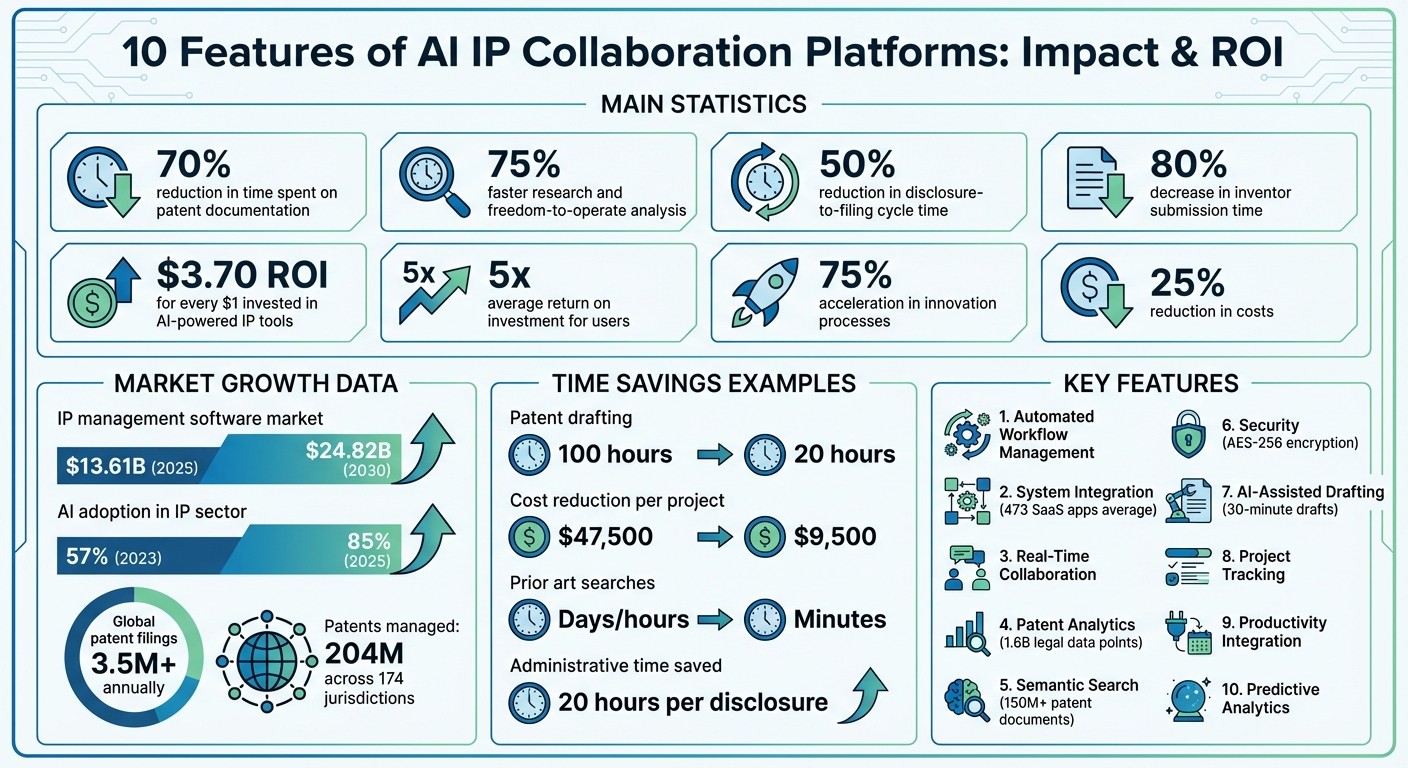
AI IP Collaboration Platforms: Key Benefits and ROI Statistics
Integrated AI Workflows for Patent Prosecution IPWatchdog Webinar

1. Automated Workflow Management
Patent professionals often lose valuable hours to repetitive, time-consuming tasks. Automated workflow management steps in to streamline these processes by handling routine activities like tracking deadlines, assigning tasks, and routing documents - all without the need for manual intervention. Instead of spending time logging dates or chasing team members for updates, AI platforms handle these responsibilities seamlessly in the background.
The impact is significant. IP teams report saving 20 hours per disclosure and cutting inventor submission time by 80%. Even more impressive, the disclosure-to-filing cycle is reduced by 50%, turning a weeks-long process into just a few days. Across patent-related tasks, firms experience a 70% decrease in time spent on AI patent drafting tools and other administrative duties.
"Our AI-powered workflows give IP teams the information they need to understand new disclosures and run more efficient patent committee meetings, reducing time from disclosure to filing by 50%." - Tradespace
These platforms excel at managing the details that typically slow down legal teams. For instance, automated docketing systems keep track of deadlines across 180+ jurisdictions, calculate fees, and send USPTO reminders. When office actions are issued, the system automatically updates due dates and assigns tasks to the right attorney. Meanwhile, filing compliance tools perform pre-submission checks, scanning drafts for any missing legal requirements to avoid costly mistakes. Many teams now use hybrid intelligence to combine AI speed with human expertise during this critical drafting phase.
What sets these systems apart is their ability to shift teams from reactive to proactive management. Standardized templates ensure consistency, eliminating last-minute deadline chaos and formatting errors. Custom style templates accommodate each firm’s preferences, while lock features safeguard critical text during collaborative edits. Features like role-based task assignments, instant notifications, and streamlined templates help maintain document quality and continuity with minimal back-and-forth communication.
2. System Integration and Data Connectivity
Patent teams manage an average of 473 SaaS applications, making integration across tools essential. Modern AI collaboration platforms tackle the chaos of disconnected systems by creating a centralized "source of truth". These platforms link IP management systems, global patent databases, cloud storage, and essential business tools. Instead of manually transferring data between USPTO filings, docketing systems, and R&D trackers, these platforms automatically sync information across the entire tech stack.
This seamless integration delivers both financial and operational advantages. By shifting from fragmented tools to interconnected ecosystems, organizations see real results. For instance, companies report earning an average return of $3.70 for every dollar invested in AI-powered IP tools, while cutting research and freedom-to-operate analysis time by up to 75%. Real-time updates replace outdated batch processing, enabling instant access to new patent filings or legal changes. For example, when a patent office issues an action, the system immediately updates all connected tools - from law firm databases to corporate portfolio systems - eliminating the inefficiency of "double docketing".
The benefits go beyond legal departments. These platforms integrate with R&D tools (like Jira and Asana), sales systems (such as Salesforce), financial software (SAP), and dashboards (Power BI), ensuring smooth data flow across teams. With this setup, data entered once - for example, during an invention disclosure - automatically populates all related documents, reducing errors and eliminating repetitive data entry. Open APIs and plug-and-play architectures allow custom connections to proprietary databases, while SOC 2 Type II certifications safeguard sensitive information during transfers.
The demand for integrated, cloud-based IP management tools is driving significant market growth. By 2025, the IP management software market is expected to reach $13.61 billion, climbing to $24.82 billion by 2030. As AI adoption in the IP sector rises from 57% in 2023 to 85% in 2025, the ability to connect diverse systems has become a standard expectation. Today's platforms now manage 204 million patents across 174 jurisdictions and handle 2 billion data points.
3. Real-Time Team Collaboration
Patent teams are moving away from the old back-and-forth of emailing static documents. Today, top patent tools and AI-powered collaboration platforms allow teams to work together in real time, much like editing in Google Docs. These tools let inventors, attorneys, and outside counsel draft, revise, and refine patent applications simultaneously - without the risk of overwriting each other's contributions. Automatic conflict resolution ensures that everyone's input is preserved seamlessly.
One standout feature is the ability to add in-line comments directly to specific sections of a document. Team members can also use @mentions to tag colleagues, making it easy to request feedback or clarification. Conversations stay tied to the exact text being discussed, keeping everything organized. Every change is tracked with detailed audit trails, so it’s clear who made edits and when, ensuring accountability throughout the process.
Beyond editing, these platforms maintain your document's layout, arrangement, and even scrolling position. This eliminates the hassle of reorganizing files when you return to them. External collaborators, like outside counsel, can securely join projects through whitelisted domains or shared links - no need for clunky file transfers. Smart notifications keep everyone informed about mentions or updates, but they’re designed to avoid overwhelming users with unnecessary alerts.
These tools have transformed how patent teams manage documents and collaborate, saving users up to 70% of the time typically spent on patent documentation. This is a game-changer in an industry where legal professionals face high-pressure workloads, with a 41% burnout rate.
For global teams, real-time collaboration now supports multiple languages, including English, Korean, Japanese, and Chinese. This ensures consistent terminology for international filings. Enterprise-grade security measures, such as JWT-based authentication, AES-256 encryption, and row-level security, safeguard sensitive patent data during these collaborative sessions. These advancements make it easier than ever to streamline IP workflows and improve team efficiency.
4. Patent Analytics and Data Insights
AI takes patent strategy to the next level by turning raw data into actionable insights. With the ability to process and analyze vast amounts of information, AI-powered platforms make it possible to navigate the complexities of global intellectual property (IP). For example, these platforms can analyze millions of patents across 174 jurisdictions, incorporating 1.6 billion legal data points, including litigation, licensing, and ownership transfers. This level of analysis is essential in a world where global patent filings surpass 3.5 million annually.
One standout feature is AI-driven visualizations. Tools like heat maps identify technology clusters, citation networks highlight influential patents, and "white space" analysis reveals areas with low patent density but high scientific potential. These insights are invaluable for guiding research and development (R&D) efforts with pinpoint accuracy.
Unlike basic keyword searches, AI analytics dig deeper. They deliver invalidity risk scores, assess freedom-to-operate risks, and even map patent claims to competitor products to uncover potential use signals. By tracking metrics like filing and citation velocity, these platforms can identify emerging technology trends, enabling organizations to innovate 75% faster while cutting costs by 25%. This level of precision and efficiency has a tangible impact, as illustrated in the following example.
In October 2024, IP expert Laurence Brown leveraged Patently's Vector AI to locate prior art for in-ear headphones with a priority date before 2000. Using relevance-based sorting and filters focused on Sony applications, Brown reduced 300 relevant results to a few target patents in under five minutes - a task that would have taken weeks manually.
AI doesn’t just stop at analysis - it shifts the entire approach to IP management. Instead of periodic manual reviews, AI enables continuous portfolio monitoring. It tracks competitor office actions, new filings, and even movements of key inventors, delivering real-time alerts without requiring manual input. This always-on intelligence fits seamlessly into the broader goal of centralizing and automating IP management.
5. Semantic Search Capabilities
Traditional keyword searches often struggle with linguistic differences, where the same technical concept is described using various terms depending on the industry, region, or even individual patent applications. With over 150 million patent documents to sift through, relying solely on exact keyword matches can lead to missing critical prior art.
Semantic search changes the game by focusing on meaning rather than just text. Using Natural Language Processing (NLP) and vector search, AI-powered tools grasp the technical context and intent behind a query. This means they can identify synonyms, conceptual equivalents, and paraphrases that traditional searches might miss. Some advanced systems even break down complex claim language into structured technical features, aligning these features with relevant prior art passages.
The efficiency gains are impressive. Semantic search tools can cut prior art searches from hours - or even days - to just minutes. Instead of being bogged down by exact keyword matches, these tools prioritize technical concepts, enabling professionals to quickly sort through hundreds of results using relevance-based sorting and targeted filters.
"With Elastic, it's like having a patent attorney with decades of experience guiding every search." - Andrew Crothers, Creative Director, Patently
One standout example is IP Copilot, which achieved 96% accuracy in retrieving the correct patents from 160 disclosure-patent pairs. This level of precision is possible because the AI focuses on the technical ideas behind the patents, even when keywords don't match exactly. Additionally, the system enhances transparency by linking claim elements to specific excerpts in the prior art. It even generates automated claim charts that are ready for legal review. This blend of speed and precision lays a strong foundation for secure and controlled collaboration in later stages.
6. Access Control and Security Features
When patent data flows between inventors, attorneys, and external partners, such as those involved in licensing and SEP analytics, managing access becomes a top priority. AI collaboration platforms use Role-Based Access Control (RBAC) to assign permissions based on the specific needs of a project rather than relying on job titles. For instance, a contractor working on a single invention disclosure can only access relevant data, while a junior engineer won't have editing rights to finalized patent drafts. This tailored approach to access lays the groundwork for more advanced security measures.
At the technical level, platforms often implement Row-Level Security (RLS) within their databases, restricting users to only the data rows they are authorized to see. To protect data during transmission and storage, many platforms use TLS 1.3 for encryption in transit and AES-256 for encryption at rest. Additionally, authentication systems frequently rely on JSON Web Tokens (JWT) combined with a PKCE flow, reducing the risk of unauthorized session hijacking.
"The question isn't 'who's senior?' The question is 'who needs access to what, and why?'" – PowerPatent
Beyond access controls, audit trails play a critical role in maintaining accountability. These trails log every action - whether it's viewing, editing, or sharing data - and create a searchable history that supports security audits. Some enterprise platforms retain this interaction history for up to 90 days to facilitate thorough reviews.
Permissions are also designed to adapt as projects evolve. For example, an external consultant may have full access during the drafting phase, but their permissions are revoked once their contract ends. This prevents "permission creep", where users retain unnecessary access. Additionally, pre-disclosure checkpoints ensure sensitive content undergoes a protection review before being shared. These dynamic, adjustable permission settings strengthen the platform's ability to deliver secure and efficient collaboration.
7. AI-Assisted Patent Drafting
AI is reshaping how patents are drafted, turning invention disclosures into complete first drafts - including claims, specifications, abstracts, and figure descriptions - in just about 30 minutes. This level of efficiency is a game-changer for the intellectual property (IP) field.
Take, for example, an Am Law 100 firm that, in July 2025, slashed project time from 100 hours to just 20 hours. At the same time, internal costs dropped from $47,500 to $9,500 per project. A Chief IP Counsel at a biotech company summed it up well:
"Right off the bat, we're saving at least 10 to 15 hours by generating high quality claim sets, and that translates directly into financial savings".
AI platforms ensure legal accuracy by using block-based claim designers that organize independent and dependent claims while running automated checks for consistent terminology and proper antecedent basis. Features like "pinning" allow users to lock critical phrases, ensuring they remain untouched during revisions.
Beyond drafting, AI serves as a strategic ally. It suggests alternative phrasings for claims, offers structural adjustments, rewrites specifications based on feedback, and manages claim logic with tools like dependency tracking. All of this is done with enterprise-grade security to protect user data.
The benefits go beyond time and cost savings. A law firm president highlighted how automating routine drafting tasks frees up time for more strategic legal work. With up to 70% of time saved on patent documentation, AI-assisted drafting has become a cornerstone of modern IP management.
8. Project Tracking and Team Visibility
Managing IP projects often involves juggling multiple tasks and coordinating across teams working on different schedules. AI-powered platforms simplify this process by offering centralized dashboards that bring together goals, deliverables, deadlines, and outcomes from various sources into one place. This unified view makes it easier to manage projects efficiently.
These platforms also go a step further with predictive risk detection. By analyzing portfolio patterns, they can identify potential bottlenecks 2–3 weeks ahead of time. Teams using AI forecasting tools have reported a 35% improvement in the accuracy of predicting sprint completions. This means resources can be reallocated proactively, and stalled tasks can be addressed before they become major issues.
For tasks specific to IP work, such as patent reviews or freedom-to-operate analyses, project-specific dashboards provide a clear picture of progress over time. Features like real-time notifications and automated status updates help global teams stay on the same page while significantly reducing the time spent on manual reporting. In fact, organizations have seen up to a 30% drop in communication costs thanks to these automated tools. By streamlining team efforts and providing forward-looking insights, these solutions enhance the efficiency of IP project execution.
9. Productivity Tool Integration
Jumping between apps can disrupt focus and slow down workflows, especially in intellectual property (IP) tasks. AI-powered IP collaboration platforms solve this by integrating with the tools teams already rely on to change the way they work with patents - like email clients, calendars, and document editors. This creates a centralized workspace where patent professionals can handle tasks without constant app-switching.
Email integration is a game-changer for patent prosecution. AI assistants can draft emails to inventors requesting missing details or prepare responses to office actions directly within platforms like Outlook or Gmail. Tools like Microsoft Copilot and Google Gemini take it further by summarizing long email threads and generating draft replies, cutting down the time attorneys spend on routine communication. Similarly, integration with document editing tools ensures workflows stay smooth and uninterrupted.
For collaborative document work, these platforms eliminate the outdated back-and-forth of emailing Word or PDF files. Instead, they enable real-time editing, similar to Google Docs. Inventors and attorneys can comment, edit simultaneously, and automatically resolve conflicting changes - all while working on the most up-to-date version of the document. This approach avoids version control issues and ensures no one is stuck working on outdated drafts.
These platforms bring everything under one roof - legal databases, word processors, and AI assistants - reducing the need for disruptive context-switching. Advanced systems even integrate with enterprise tools like CRM and ERP software, ensuring data flows seamlessly across the organization.
10. Predictive Analytics and Trend Analysis
Patent data holds the key to spotting emerging trends. With over 3.5 million patent filings globally each year, it's impossible to rely on manual analysis alone. That’s where AI-powered predictive analytics comes in. These tools analyze global filing patterns, citation networks, and litigation data to identify shifts long before they become mainstream. For example, the USPTO reported a 33% increase in AI-related patent applications in 2025, showcasing how quickly trends can evolve.
Predictive tools don't just analyze the present - they look ahead. Using historical data, grant probability models estimate the success of patent applications, helping organizations make smarter decisions about budgeting and strategy. Companies leveraging AI-driven IP insights have reported accelerating their innovation processes by 75% while cutting costs by 25%.
AI also evaluates patents based on factors like citation velocity, novelty, and relevance. This scoring helps businesses decide whether to maintain, license, or sell their assets. By pinpointing patents with high litigation risks or strong monetization potential, AI turns portfolio management into a dynamic, data-driven process.
Another fascinating capability of AI is detecting technology convergence - where different industries overlap. By tracking filing speeds, it can even estimate where a specific technology is in its lifecycle. Patents also act as a window into competitor strategies, often revealing plans 18 to 24 months before new products hit the market. Real-time alerts on changes in competitor filing activity can signal shifts in their priorities, giving teams a crucial advantage.
Conclusion
AI-powered platforms are reshaping the way intellectual property (IP) management is handled, bringing a blend of advanced technology and streamlined processes. These tools have revolutionized patent professionals' workflows by automating tasks like drafting and prior art searches, cutting down on the time spent on documentation tasks significantly. Instead of relying on scattered tools, centralized workspaces now allow teams to focus on strategic priorities without the hassle of managing multiple systems.
The results speak for themselves: organizations leveraging AI-driven innovation tools report a 75% boost in innovation speed and a 25% reduction in costs. Users of AI-powered IP tools also see an impressive average return on investment of 5x. Adoption of these platforms is on the rise among IP professionals, with features like real-time collaboration and predictive analytics making every stage of the IP process more efficient. Teams can work simultaneously on documents, maintain consistent terminology across languages, and turn patent data into actionable insights - all from a single, unified interface.
Patently exemplifies this transformation by integrating AI-assisted drafting, semantic search powered by Vector AI, collaborative project management, and robust analytics into one seamless platform. Whether you're an independent practitioner or part of a large firm, Patently offers flexible options - from a free plan tailored for individual users to enterprise solutions with unlimited users and customizable features.
Curious about how AI can elevate your IP workflow? Dive into Patently's capabilities and see how the right platform can enable smarter decisions, effortless collaboration, and more strategic patent management.
FAQs
How does AI reduce patent filing cycle time?
AI cuts down the time it takes to file patents by automating critical steps such as drafting patent documents, running prior art searches, and preparing applications. By handling these tasks, it speeds up the process, minimizes errors, and reduces the need for manual work. This allows professionals to focus on higher-value tasks while saving time and working more efficiently.
What security controls protect sensitive IP data?
Patently employs a variety of security measures to safeguard sensitive intellectual property (IP) data. These include JWT-based authentication with a PKCE flow, which adds an extra layer of security during user verification. Additionally, row-level security ensures data access is restricted based on user permissions, while comprehensive audit trails provide detailed tracking of activity for accountability. To further enhance protection, the platform incorporates rate limiting to prevent abuse and DDoS protection to defend against large-scale cyberattacks. Together, these measures help shield data from unauthorized access and online threats.
How can semantic search improve prior art results?
Semantic search improves prior art results by diving deeper into feature-level understanding. It pinpoints critical patentable features and aligns them with relevant prior art passages. This method makes searches more structured, evidence-backed, and easier to justify, simplifying the patent research workflow.