AI Tools for Multilingual Patent Search
Intellectual Property Management
Feb 25, 2026
AI-powered semantic search and patent-trained translation speed multilingual prior-art searches, cut manual translation, and surface hidden global patents.
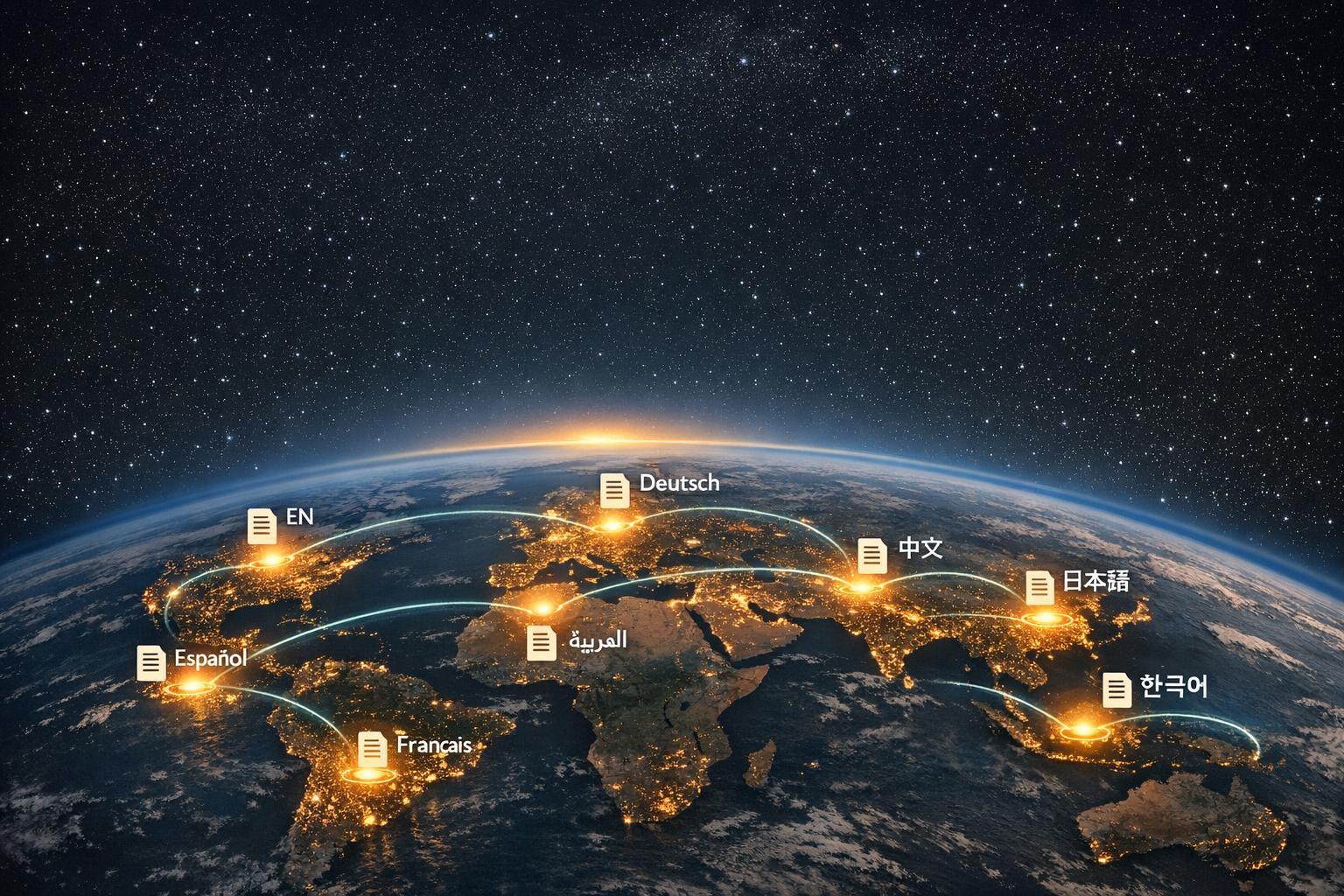
AI tools are transforming multilingual patent searches by enabling faster, more accurate analysis of foreign-language documents. With over 70% of patents published in languages other than English, these tools address challenges like specialized "patentese" terminology and fragmented global systems. Platforms like Patently, Patsnap, Derwent Innovation, Orbit Intelligence, PatSeer, Lens.org, and Google Patents use AI-driven semantic search, neural machine translation (NMT), and cross-lingual capabilities to improve search precision, reduce manual translation needs, and save time.
Key Takeaways:
Why It Matters: Over 150 million global patents exist, with major offices like USPTO, EPO, JPO, and CNIPA operating in different languages.
AI Solutions: Tools like NMT and Cross-Lingual Information Retrieval (CLIR) reduce human translation by 60%-90% and cut review times from weeks to 24-72 hours.
Platform Features: Semantic search, multilingual translation, and technical terminology preservation are common across platforms, with specialized tools for industries like life sciences and materials research.
Free vs. Paid Options: Free tools like Google Patents and Lens.org offer basic capabilities, while enterprise platforms like Patsnap and Derwent provide advanced analytics and features.
AI-powered patent search tools are essential for navigating the global IP landscape efficiently, ensuring critical prior art isn't missed due to language barriers.
Why Multilingual Patent Search Matters
Navigating the global patent landscape is no small feat. Major patent offices around the world operate in different languages: the USPTO works in English, the EPO in English, French, and German, the JPO in Japanese, and the CNIPA in Chinese. This creates a fragmented system, with over 150 million patent documents worldwide. Tackling this complexity requires more than just basic translation tools.
Patents are written in "patentese", a highly specialized and technical language that differs across regions and industries. A concept described in one way in a U.S. patent might use entirely different terminology in a Japanese or Chinese filing. This variability makes traditional keyword searches unreliable, often leading to "false negatives" where critical prior art is missed simply because it’s phrased differently.
"Misinterpretation due to language barriers can lead to costly legal disputes, delayed patent approvals, and missed opportunities for inventors and businesses." - PowerPatent
AI-driven semantic search technologies are stepping in to address these challenges. Unlike standard keyword searches, these systems focus on context and meaning. They break down complex patent claims into technical features, enabling concept-based searches. Tools like Neural Machine Translation (NMT) and Cross-Lingual Information Retrieval (CLIR) allow researchers to query foreign patent databases in English, automatically bridging technical vocabulary gaps across languages. This approach doesn’t just expand search coverage; it also makes the process faster and more accurate.
For patent professionals conducting global freedom-to-operate searches or prior art or novelty searches, these AI tools are reshaping the way intellectual property workflows are managed, making the daunting task of multilingual patent searches far more manageable.
1. Patently
Patently is an AI-driven platform built on Elastic's Search AI technology, managing a massive dataset of 135 million patents grouped into 82 million families. It's tailored for patent professionals needing thorough prior art searches across multiple languages and jurisdictions.
Semantic and Hybrid Search Capabilities
Patently's Vector AI goes beyond simple keyword matching by interpreting entire sentences, making it particularly effective for multilingual patent searches where technical concepts differ across languages. This approach addresses the challenges of technical and multilingual patent language head-on. For example, in October 2024, Laurence Brown used Patently's Vector AI to locate in-ear headphone patents filed before 2000. Within five minutes, the tool returned 300 relevant results, which he narrowed down to Sony applications, helping him pinpoint key patents efficiently.
The platform allows users to combine natural language queries with traditional filters, exact matches, and Boolean syntax for more precise results. Additionally, it supports cross-lingual searches, including non-Latin scripts, enabling users to find relevant patents across various regions.
"With Elastic, it's like having a patent attorney with decades of experience guiding every search".
These advanced search tools are complemented by robust patent family and jurisdictional features.
Patent Family and Jurisdictional Coverage
Patently provides full-text search capabilities for major patent offices, including the EPO, USPTO, China, Japan, South Korea, PCT, UK, Germany, France, Canada, and Australia. Bibliographic data is available for over 100 jurisdictions. The platform uses a proprietary "Genetic family" structure, grouping patents by the subject matter of individual inventions rather than strictly following priority rules. This method offers a more intuitive way to track technological developments.
With real-time data intake, users gain immediate access to the latest patents. Tools like the C-Tree enable visual exploration of family relationships, such as priority claims, while the FAB (Forward & Backward) browser helps users analyze deduplicated citations at the family level.
This extensive coverage supports a range of specialized analytical tools.
Specialized Features
Patently integrates Onardo, a multi-modal AI assistant designed to maintain technical accuracy in drafting and prior art searches. Another standout feature is Patently License, which focuses on searching and analyzing Standard Essential Patents (SEPs). It fully indexes ETSI/3GPP declarations, making technical specifications easily searchable.
Each patent is mapped to approximately 226 fields, streamlining even the most complex retrieval tasks. This data integration is central to how the platform helps bring knowledge together for collaborative IP projects.
2. Patsnap
Patsnap is a powerful enterprise platform that boasts a database of 207.3 million patents across 174 jurisdictions. It leverages a domain-specific large language model trained on decades of patent data, legal records, and scientific literature, enabling advanced multilingual patent analysis. This foundation supports its standout features like multilingual translation and semantic search.
Multilingual Language Coverage and Technical Terminology Preservation
Patsnap offers AI-powered translation across more than 50 languages while ensuring the accuracy of technical terms during global prior art searches. This is a crucial feature for patent professionals, as it preserves the meaning of complex terms like "polymer substrate" or "semiconductor junction" across languages. Using transformer-based neural networks, the platform understands intricate technical concepts and semantic relationships, avoiding the common pitfalls of general translation tools.
Semantic and Hybrid Search Capabilities
The platform excels in semantic search, identifying conceptually similar inventions even when different terminology is used. For instance, it links terms like "wireless communication device" and "mobile handset" as related concepts. Patsnap also indexes translated content, allowing users to conduct searches in English and retrieve patents originally filed in languages such as Chinese, Japanese, or Korean. By combining natural language processing with structured data from scientific literature, litigation records, and market intelligence, Patsnap provides what it calls a "360-degree view of the innovation landscape".
This hybrid search approach delivers impressive results, achieving over 90% accuracy and cutting research time by as much as 70% compared to traditional Boolean methods.
Specialized Features
Patsnap goes beyond standard patent analysis with specialized tools like 3D chemical structure search and bio sequence similarity matching, tailored for life sciences and materials research. Its database integrates over 2 billion structured data points, including patents, scientific studies, and litigation details. The "Eureka" innovation intelligence module connects patent data with scientific literature and clinical trials, helping teams validate their technology strategies. Additionally, the platform normalizes assignee names, resolving variations and acquisitions to improve competitive benchmarking.
"Patsnap's breadth of data is unrivalled, pulling patent, non-patent literature, and chemical information globally... This has helped me tremendously when analyzing different jurisdictions and simplified the reading of foreign language patents."
– Noel Rudie, Director of Innovation, Michael Foods
3. Derwent Innovation
Derwent Innovation takes a human-first approach to multilingual patent searches. Instead of relying solely on machine translations, the platform employs a team of over 800 experts who manually rewrite patent titles and abstracts into clear, standardized English. This process forms the Derwent World Patents Index (DWPI), featuring over 70 million invention families summarized in straightforward English.
These expertly crafted summaries serve as the backbone for the platform's AI-powered search, ensuring technical accuracy across multiple languages.
Multilingual Language Coverage and Technical Terminology Preservation
The DWPI team works on patents from 60 jurisdictions, distilling them into concise summaries that highlight an invention’s novelty, functionality, and benefits. This editorial effort removes the complexity often found in legal patent language while maintaining the precision of technical terms. For example, phrases like "polymer substrate" or "semiconductor junction" are rewritten to preserve their technical meaning while improving clarity for researchers. The platform further expands its reach with enhanced full-text patent data from 76 jurisdictions and bibliographic data from 109 jurisdictions, covering a staggering 178 million enhanced patent records.
This meticulous editorial process ensures that Derwent Innovation delivers accurate and meaningful results through its advanced search tools.
Semantic and Hybrid Search Capabilities
The platform’s AI Search tool leverages a colBERT language transformer model, trained on over 66 million human-authored patent summaries. This enables the system to understand technical concepts more effectively than models trained on raw patent text. With its "Smart Searches", users can input text like invention disclosures or draft claims, and the tool automatically identifies technical keywords and synonyms for a comprehensive global search. The hybrid search approach combines AI-driven semantic capabilities with traditional Boolean logic, ensuring researchers get precise results without overlooking related concepts.
"With other patent search tools, you often need to review up to 50 or even 200 results to find the most relevant records. With Derwent AI Search, the most relevant records are at the top of the list."
– Susan Johnson, Patent Agent and IP Researcher, Boston Scientific
Specialized Features
Derwent Innovation extends its capabilities with tools tailored for specific research needs:
Derwent Chemistry Research: Facilitates chemical structure searches across over 33 million chemical substances, with 6 million indexed by experts.
Derwent Sequence Search: Supports biological sequence analysis using indexed sequence data.
PatentStrength Score: Evaluates patent value using 30 predictive variables for objective analysis.
Litigation data from over 140 jurisdictions, encompassing 2.2 million cases.
Access to over 73 million non-patent literature publications sourced from 13,600+ journals curated by the Web of Science editorial team.
These features, combined with its semantic and multilingual strengths, make Derwent Innovation one of the top patent tools for research and analysis.
4. Orbit Intelligence
Orbit Intelligence combines AI-powered search tools with an extensive global database of patent data, streamlining multilingual patent research. It provides access to over 100 million patents, 17 million designs, and 150 million non-patent literature records, covering patent offices that account for more than 99.7% of the world's patent applications. This includes full-text data from the IP5 offices (China, United States, Japan, South Korea, and Europe), which collectively handle 85% of global patent filings.
The platform is designed to simplify complex language challenges inherent in patent research.
Multilingual Language Coverage and Technical Terminology Preservation
Orbit Intelligence removes language barriers by ensuring that over 97% of its database is accessible in English, either as native text or through high-quality pre-translations. Its Sophia Query AI Assistant allows users to search in any language, automatically generating technical Boolean queries with translated terms and International Patent Classification (IPC) codes. Additionally, the Keywords Auto-Translation feature enhances search results by refining terms with relevant synonyms.
"To date, more than 97% of our collection is in English, native or pre-translated, allowing for a wider and more comprehensive search even of Asian patent documents." – Questel
Semantic and Hybrid Search Capabilities
Orbit Intelligence’s search tools are designed to handle complex technical language with ease. The Sophia Search tool uses advanced neural embeddings to perform semantic searches, focusing on the context and meaning of technical disclosures rather than just keywords. Results are ranked by a "Semantic Match" score, ranging from "Weak" (92-94.99%) to "Perfect" (99-100%).
For hybrid searches, the platform combines AI-generated queries with traditional Boolean logic, enabling users to refine results by specifying details like jurisdictions, inventors, assignees, and filing dates. If a Freedom to Operate (FTO) search is indicated, the system prioritizes claims and active patents automatically.
Patent Family and Jurisdictional Coverage
Orbit Intelligence employs a proprietary FAMPAT family grouping system that accounts for variations in how patent offices define inventions. This approach improves the capture of technical disclosures, including those from Japan. The FAMPAT system integrates strict EPO family rules with additional connections, such as links for U.S. divisional applications, Japanese "brother" patents, PCT extensions, and U.S. provisional-to-published links. Depending on the research objective, users can switch between FAMPAT for strategic insights and FULLPAT for individual patent counts.
Specialized Features
Beyond its core search capabilities, Orbit Intelligence offers specialized tools for specific research needs:
Orbit Chemistry: Supports molecule structure and Markush structure searches.
Orbit Biosequence: Facilitates searches for DNA/RNA, peptides, and proteins using BLAST/FASTA algorithms.
Sophia Lab: An AI reading assistant that generates patent summaries, identifies objects of invention, and creates interactive claim graphs to visualize dependencies.
The interface is available in multiple languages, including English, French, German, Japanese, and Chinese, making it accessible to a global audience.
5. PatSeer
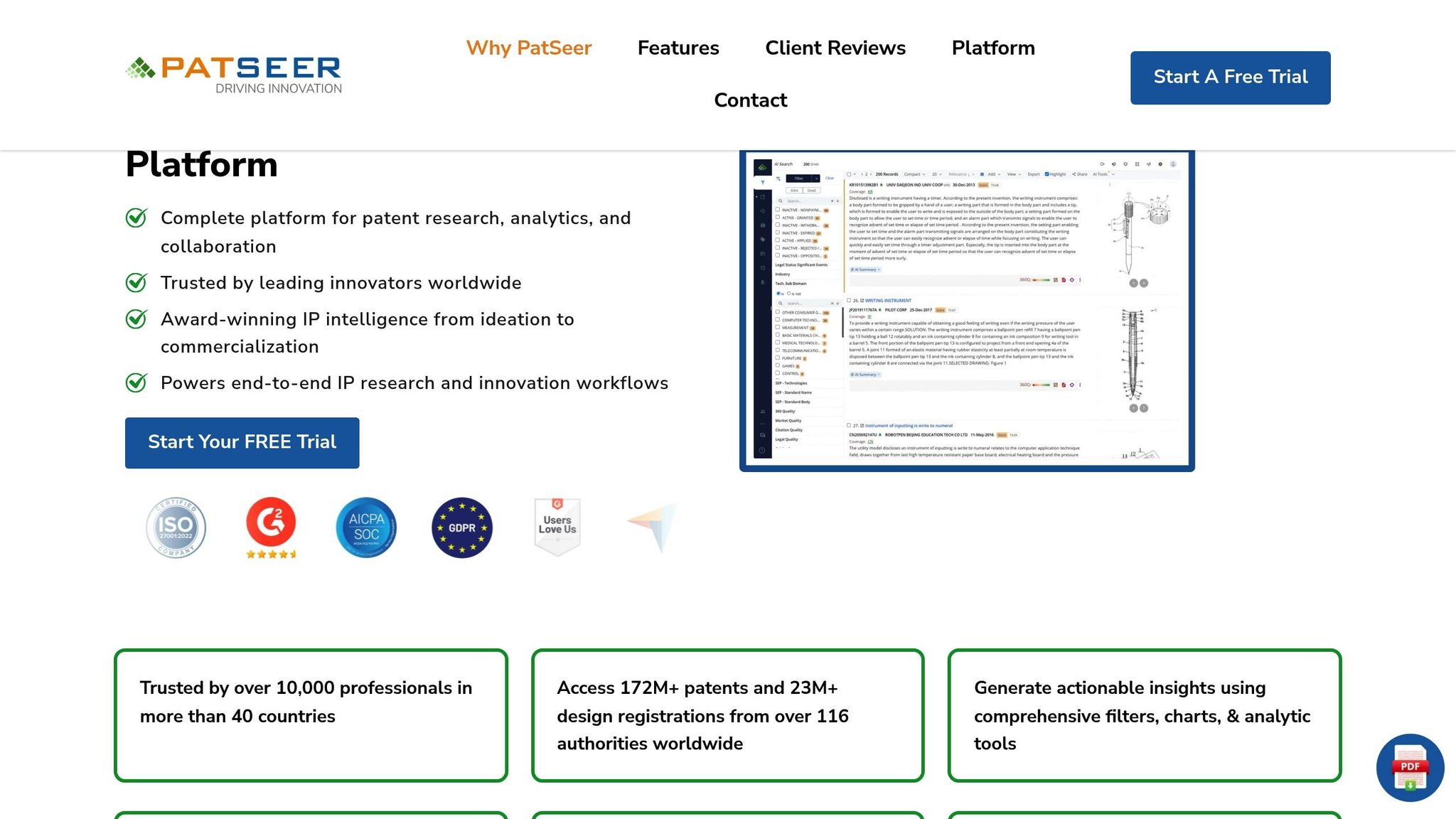
PatSeer combines AI-driven semantic analysis with Boolean logic to search through an impressive 172.5 million records from 108 patent authorities. At its core is a custom-trained GPT model, specifically designed to grasp patent semantics, making it adept at interpreting the intent behind technical descriptions. This feature proves especially useful for multilingual searches, where technical terms often vary widely across regions.
Multilingual Language Coverage and Technical Terminology Preservation
PatSeer offers machine translations for over 70.6 million records from major patent offices, including those in Japan, China, Russia, France, and Germany. These translations are powered by a custom-trained Large Language Model that integrates ReleSense™ semantic rules - crafted from over 12 million rules derived from patent documents. This tailored approach ensures that complex technical terms are accurately preserved, even for non-Latin company names.
"By custom-training the underlying LLM model to understand patent semantics, PatSeer new AI search brings a huge leap in result accuracy and precision based on tests run across various fields of science." – Manish Sinha, Chief Technology Officer, PatSeer
In June 2023, PatSeer's AI Classifier demonstrated its precision by achieving a 95% accuracy rate in distinguishing between highly similar positive and negative patent sets in fields like Quantum Computing and Cannabinoid Edibles. These advancements contribute to its powerful semantic search capabilities.
Semantic and Hybrid Search Capabilities
PatSeer's ReleSense™ NLP engine supports combining Boolean operators (AND, OR, NOT) with semantic search in a single query, offering users a flexible and powerful search experience. The AI Recommender identifies relevant records that might be overlooked by traditional Boolean searches, while the AI Refine tool helps cut down false positives by understanding context. The platform also allows long-form text inputs of up to 10,000 characters, enabling more detailed semantic queries. Users can easily toggle between original language displays and English translations, ensuring technical terms are analyzed with precision.
Specialized Features
PatSeer includes tailored tools for specific needs. For chemical searches, it simplifies complex IUPAC nomenclature by treating hyphens, parentheses, and commas as spaces, making queries more straightforward. Its AI-powered image similarity search allows users to upload images to find relevant prior art for industrial designs. Beyond patents, PatSeer provides access to over 240 million non-patent literature records, such as PubMed and ArXiv, for a comprehensive search experience.
The platform also prioritizes security and data privacy, holding ISO 27001:2022 and SOC 2 Type 2 certifications. Importantly, it ensures that user search data is never used to train public AI models. Together, these features make PatSeer a powerful tool for global patent analysis and research.
6. Lens.org

Lens.org is a free, open-access platform that provides access to more than 153.2 million patent records from over 105 jurisdictions. Since its launch in 1999, it has been a reliable source of global patent data, catering to users with varying budgets.
"In the patent world, many excellent databases are closed off to all but those with large budgets. Lens.org is an exception to this rule, providing global data of the highest calibre that anyone can access, enabling any research to be tested by third parties." – Dr. Kathleen Liddell, Director of the LML at the University of Cambridge
This commitment to accessibility makes Lens.org an essential tool for researchers who need cost-effective solutions.
Multilingual Search and Technical Term Handling
Lens.org takes its open-access mission further by enabling multilingual search capabilities. Users can search across core patent fields - such as titles, abstracts, claims, descriptions, and full text - in multiple languages. English is the default processing language, but the interface is also available in Arabic, Chinese, French, Russian, and Spanish.
For handling technical terms, the platform uses a toggleable stemming feature powered by the KStem algorithm. By default, stemming reduces words to their root forms (e.g., "running" becomes "run") to improve search recall. However, users working with specialized technical terms can disable stemming for greater precision. Hybrid queries are also supported, allowing users to target unstemmed fields, like title.en.text.unstemmed, while applying stemming to other parts of the search.
Combining Semantic and Structured Search
Lens.org offers a hybrid search approach that merges structured Boolean functions with algorithmic relevance ranking, ensuring users find the most relevant documents. Its Structured Search feature allows users to refine their queries by focusing on specific fields, such as "Claims" or "Abstract", which helps filter out irrelevant results, even when searching across multiple languages.
Standout Features
Lens.org includes several specialized tools that set it apart:
PatSeq: The world’s largest publicly available database of biological sequences, featuring over 525.6 million DNA, RNA, and protein sequences derived from patents.
PatCite: A unique tool that connects patent records with over 200 million scholarly works, enabling researchers to trace the academic influence behind innovations.
"The Lens is a brilliant tool to create IP transparency and enable open innovation strategies around digital sequence information. It provides a utility which otherwise can only be achieved with expensive subscription tools and is a 'must have' for users both in the public and private sector." – Michael Kock, Former Head of Intellectual Property at Syngenta
Additional features include dynamic dashboards for technology landscaping and citation network analysis. Users can export up to 1,000 records in various formats, making data management more efficient. While the platform is free for general use, institutions can access advanced features like API integration and bulk downloads through tiered pricing plans. For public-good organizations, the Lens Equitable Access Program (LEAP) offers free or subsidized access.
7. Google Patents
Google Patents is a free public search tool that provides access to patent documents from more than 100 offices, including USPTO, EPO, WIPO, JPO, KIPO, and CNIPA. While it may not cover every single patent, it’s a great starting point for researchers, especially those working with tight budgets. One of its standout features is its multilingual and semantic search capabilities, similar to how you can draft patent applications with AI to ensure technical accuracy from the start.
Multilingual Language Coverage and Technical Terminology Preservation
Google Patents uses Patent Translate, a neural machine translation service developed in collaboration with the European Patent Office. This tool supports patent documents in 32 languages. What makes it special is its optimization for technical patent language. Trained on over 100 million patent publications, it uses a BERT (Bidirectional Encoder Representations from Transformers) model to handle "patentese" - the dense legal and technical language that’s often hard to interpret.
"The patent corpus is large... complex... unique (patents are characterized by specialized 'legalese'), and highly context dependent." - Rob Srebrovic and Jay Yonamine, Data Scientists, Google
To ensure accuracy, the platform includes a dual-language display that shows the original text when you hover over translations. This feature is particularly useful for preserving technical terms, treating adjacent words like "safety belt" as a single concept rather than splitting them into separate terms.
Semantic and Hybrid Search Capabilities
Google Patents combines classic Boolean search methods with modern semantic search powered by AI. Thanks to the BERT model, it offers context-aware retrieval, which goes beyond simple keyword matching. The system automatically includes synonyms and plurals in searches, while operators like NEAR, ADJ (adjacent), WITH (within 20 words), and SAME (within 200 words) help refine results based on word proximity.
For more refined searches, users can pair keywords with Cooperative Patent Classification (CPC) codes. These codes are language-independent and focus on technical concepts rather than specific terms. The platform also integrates non-patent literature from Google Scholar, enabling users to search patents and academic works simultaneously. A machine classification model applies CPC codes to scientific journals and books, making it easier to find related research.
Specialized Features
Google Patents offers tools tailored for advanced research. For example, it supports chemistry-specific searches, allowing users to find exact matches for IUPAC names, trade names, and even perform substructure and similarity searches using .MOL files or SMILES/SMARTS strings.
For those who need raw data, Google Patents Public Datasets on BigQuery provides full-text and metadata from major patent offices. These datasets are updated weekly and come with a generous free tier, making them an excellent resource for R&D.
Feature Comparison Table
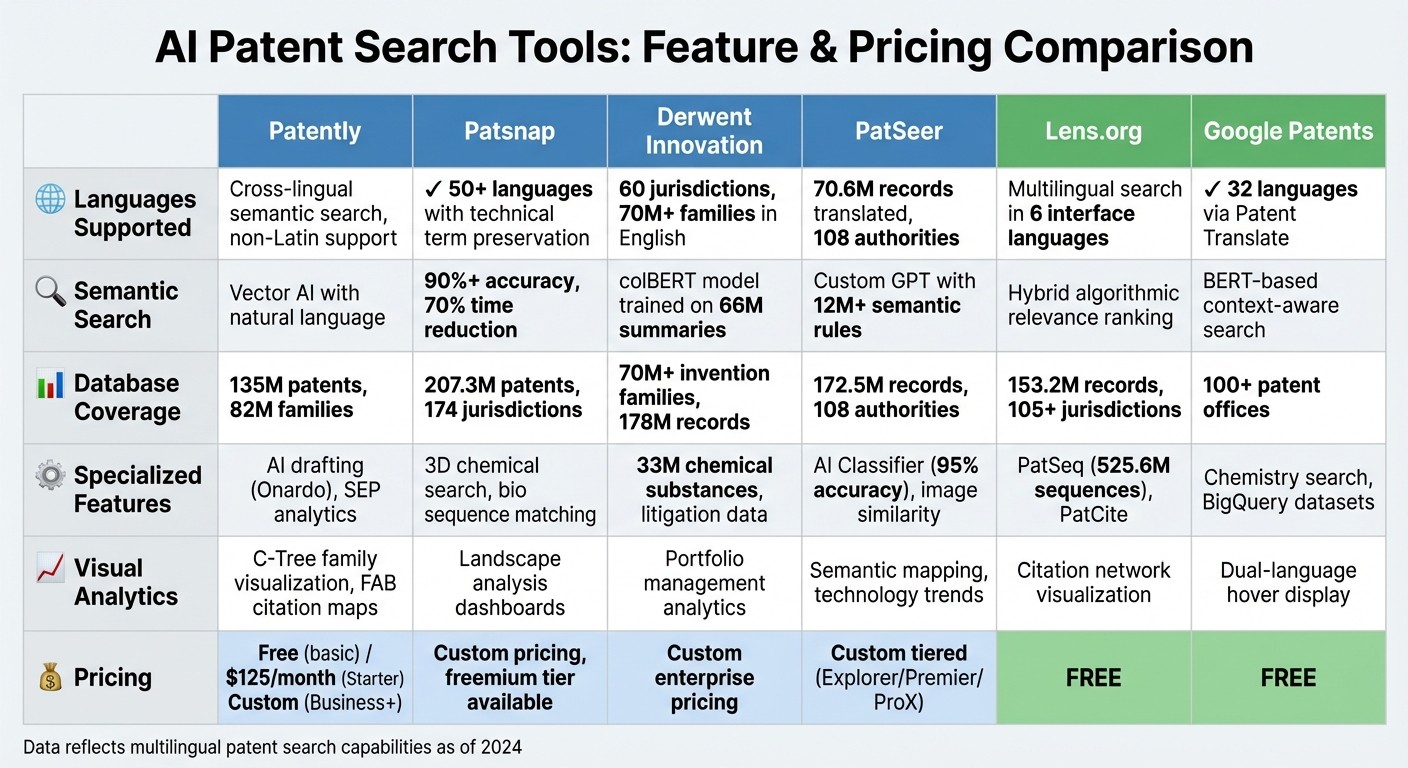
AI Patent Search Tools Comparison: Features, Languages, and Pricing
Selecting the right tool hinges on your priorities - whether it's affordability, language capabilities, or seamless workflow integration. Here's a side-by-side look at six leading AI-powered platforms, showcasing the features that matter most for multilingual patent searches:
Tool | Languages Supported | Semantic Search | Patent Family Coverage | Specialized Features | Visual Analytics | Pricing |
|---|---|---|---|---|---|---|
Patently | Offers cross-lingual semantic search, on-demand machine translation, and support for non-Latin characters | Vector AI semantic search with natural language inputs | Features proprietary "Genetic Families" grouped by subject matter; C‑Tree for priority visualization | Includes AI patent drafting (Onardo), SEP analytics for 4G/5G, and FAB citation browser | Provides interactive family trees and forward/backward citation maps | Free (basic), $125/month per user (Starter), Custom pricing for Business+/Law Firm+ |
Patsnap | Supports semantic search across 172 jurisdictions with full-text machine translation | AI-powered search identifies conceptually similar patents and non-patent literature (NPL) | Covers global patents, academic literature, and technical repositories | Offers product patent mapping and agents tailored for biopharma and materials science | Features landscape analysis and prior art scoring dashboards | Custom pricing; freemium tier available for limited searches |
Derwent Innovation | Enterprise-grade multilingual search with human-curated DWPI abstracts | Combines AI with editorial summaries for precise relevance | Extensive global jurisdiction coverage | Human-curated abstracts enhance technical clarity; advanced portfolio analytics | Includes tools for portfolio management analytics | Custom pricing (enterprise-focused) |
PatSeer | Global database with semantic suggester; delivers AI summaries in under 30 seconds | Offers advanced AI Classifier in higher-tier plans | Comprehensive global patent data with family grouping | Features chemical structure searches and AI-generated summaries to speed up reviews | Provides semantic mapping and technology trend visualizations | Custom pricing (tiered: Explorer/Premier/ProX) |
Lens.org | Multilingual search with basic translation functionality | Semantic search enriched by citation context | Open access to global patent families | Combines scholarly and patent data; free public access | Offers citation network visualization | Free |
Google Patents | 32 languages supported via Patent Translate (BERT-based NMT trained on over 100M patents) | Context-aware semantic search using BERT, handling synonyms and plurals automatically | Covers 100+ patent offices, including USPTO, EPO, WIPO, JPO, KIPO, and CNIPA | Includes chemistry-specific searches (IUPAC, SMILES), CPC code integration, and BigQuery dataset access | Features dual-language hover displays and advanced proximity operators (NEAR, ADJ, WITH, SAME) | Free |
This comparison underscores how each platform leverages AI to streamline multilingual patent searches, showcasing their distinct strengths in simplifying global IP workflows.
Conclusion
AI is reshaping how multilingual patent searches are conducted. With more than 70% of global patent literature published in languages other than English - and China alone filing over 1.5 million patents annually - relying solely on English searches is no longer practical. Modern AI tools leverage semantic search, cross-lingual retrieval, and domain-specific neural machine translation to break down language barriers. These tools can cut the need for full human translations by 60% to 90% and reduce the time required for an initial opinion from weeks to as little as 24 to 72 hours.
When selecting tools, consider your jurisdictional focus - ensure platforms cover key offices like USPTO, EPO, JPO, KIPO, and CNIPA - and assess technical requirements such as chemical structure searches, SEP analytics, or real-time drafting capabilities. For those working within tighter budgets, starting with free screening tools and transitioning to advanced solutions like Patently for integrated semantic search can be a smart strategy.
To maximize efficiency, patent professionals should adopt a hybrid workflow: use AI for initial triage and discovery across vast foreign-language datasets, while reserving human expertise for detailed claim analysis and final legal validation. This approach not only speeds up the search process but also ensures accuracy and protects innovation.
"The language of patents, once a barrier, is now a bridge to global innovation, thanks to the power of artificial intelligence." - PowerPatent
The right AI tool doesn’t just save time - it can uncover hidden prior art, provide insights into competitor strategies across regions, and strengthen your portfolio against potential oversights. Whether you’re an independent practitioner or part of a larger IP team, embracing AI-driven multilingual search is key to staying competitive in today’s global patent environment.
FAQs
How reliable is AI translation for patent claims?
AI translation tools have become a reliable option for translating patent claims, particularly with the advancements in machine translation technology. These systems are built to manage technical jargon and intricate terminology, making them a helpful resource for conducting multilingual patent searches. That said, the quality of translations can depend on the tool's capabilities and the complexity of the claims being translated. While these tools work well for preliminary searches, it's wise to have a human review the translations when dealing with critical legal matters or patent prosecution. This extra step ensures precision and safeguards the value of the patent.
What’s the best workflow for combining AI search with human review?
The best workflow blends the speed and scale of AI with the nuanced judgment of human expertise. Begin by using AI tools to conduct a broad search, utilizing semantic and vector-based methods to gather a wide range of data. After that, manually review the results to evaluate their relevance, understand subtle details, and fine-tune the search through iterative adjustments. This combination ensures a process that is both efficient and thorough, taking advantage of AI's capabilities while relying on human insight for accuracy and depth.
How can I reduce false negatives in multilingual prior art searches?
To minimize the chances of missing relevant prior art in multilingual searches, leverage AI-powered translation tools specifically trained on patent-related language. These tools help maintain the precision of technical terms during translation. Pair them with semantic search platforms that support multiple languages, incorporate classification codes like IPC and CPC, and use relevance-ranking algorithms. This combination improves search accuracy, reduces overlooked prior art, and ensures thorough coverage across different languages.