AI Models for Patent Lifecycle Prediction
Intellectual Property Management
Apr 4, 2026
AI predicts patent renewals, expirations, PTAB outcomes and LOE with high accuracy, helping optimize portfolio and R&D risks.

AI is transforming how we predict the lifecycle of patents, especially in industries like pharmaceuticals where timing and cost are critical. Here's the key takeaway: AI models now achieve up to 90% accuracy in predicting patent renewals and expirations, compared to just 40% with traditional methods. This means better resource allocation, smarter R&D investments, and reduced financial risks.
Key Highlights:
Patent Lifecycles: Maintenance fees are due at 3.5, 7.5, and 11.5 years. Failure to pay leads to early lapses.
Pharma Impact: Drug patents face shorter market exclusivity (7–12 years) due to lengthy development times and high costs (up to $2.6 billion per drug).
AI Accuracy: Models like LightGBM achieve 90% accuracy for renewal predictions using bibliographic data, applicant history, and textual analysis.
NLP Insights: Text features like claim structure and word counts help assess patent value early, avoiding reliance on lagging indicators like citations.
Portfolio Management: AI aids in renewal decisions, litigation predictions, and identifying vulnerable competitor patents. You can also draft patent applications with AI to streamline the filing process.
Why It Matters:
Top patent tools not only provide accurate forecasts but also help industries manage risks, optimize patent strategies, and maintain competitive advantages. For example, pharmaceutical companies can better prepare for the "patent cliff", where revenue losses from expiring patents are projected to hit $236–$400 billion between 2025 and 2030.
This article dives deeper into how AI models work, their applications, and the benefits they bring to patent lifecycle management.
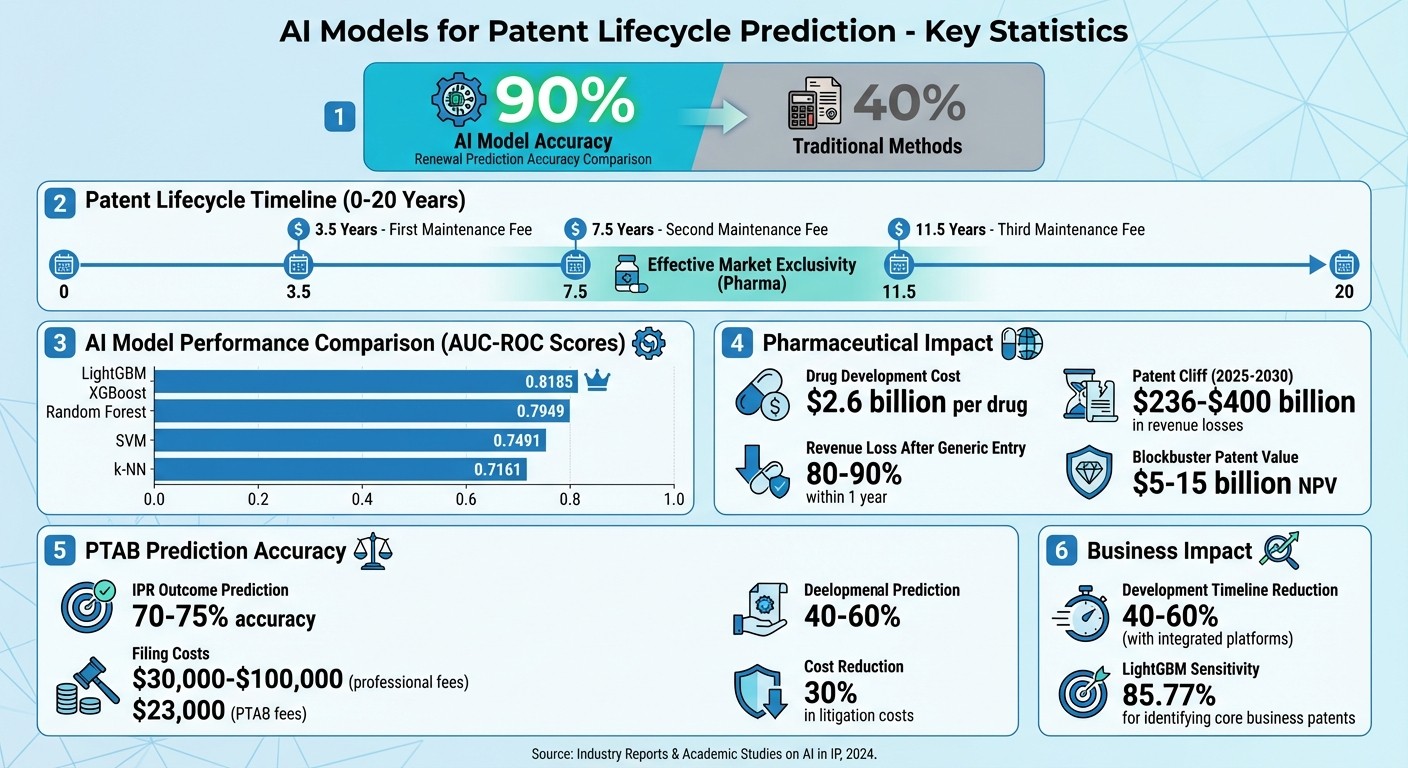
AI Patent Lifecycle Prediction: Key Statistics and Model Performance Comparison
AI Methods for Predicting Patent Lifecycles
Machine Learning and Predictive Analytics
When it comes to forecasting patent lifecycles, gradient boosting algorithms have emerged as the most effective tools. In a comparative study, LightGBM paired with a customized Focal Loss function stood out, achieving an impressive AUC-ROC of 0.8185 and 74.47% accuracy in predicting whether patents would be maintained for their full term. This performance outpaced other methods like XGBoost (0.8076 AUC), Random Forest (0.7949 AUC), and SVM (0.7491 AUC). The Focal Loss function plays a key role here by focusing on more challenging cases, making it particularly suited for the imbalanced datasets often encountered in patent analytics.
These models rely on a mix of bibliographic data (e.g., claim counts, citations), applicant-specific details (like prior filing experience), and technical environment indicators to improve their accuracy. For instance, a predictive model using XGBoost reached 0.854 ROC-AUC and 77% accuracy in forecasting patent grants by analyzing factors such as the applicant's experience, the length of the application, backward citations, and the size of the patent family. Such insights are invaluable for firms aiming to focus their R&D efforts and safeguard promising innovations.
For predicting patent renewals, two-stage hybrid models have proven to be game-changers. Patent renewal data often shows unusual patterns - some patents are never renewed (year zero), while others last the full twenty years. This complexity makes standard regression models fall short. A two-stage hybrid approach, combining a Support Vector Classifier to categorize patents with Binomial Regression to predict expirations, achieved 90% accuracy compared to 40% with standard XGBoost. While these models handle structured data effectively, NLP methods add another layer of insight by extracting qualitative information.
Natural Language Processing (NLP) and Semantic Analysis
NLP techniques complement machine learning by uncovering early textual indicators of a patent's complexity and potential. These methods analyze textual features from patent documents, such as word counts in abstracts and full texts, the number of independent and dependent claims, and the average word count per independent claim. These intrinsic features, available shortly after filing, provide a way to assess a patent’s potential without waiting for lagging indicators like forward citations.
For example, a LightGBM model that incorporated textual indicators from a dataset of 952,408 patents achieved 85.77% sensitivity in identifying core business patents - those maintained until expiration. The structure of claims is particularly telling: longer and more numerous independent claims often signal higher technical influence and a longer lifespan. While transformer architectures can convert these textual and categorical features into contextual embeddings, gradient boosting models often outperform them when datasets lack sufficient categorical diversity. By leveraging these NLP-driven insights, companies can better predict renewals and expirations early in a patent's lifecycle.
"The duration of a patent is directly linked to its commercial viability and economic worth... the longer a patent remains valid after it is first filed, the more likely it is to have direct or indirect economic importance." - PeerJ
How AI is Used in Patent Management
Predicting Renewal and Maintenance Fees
AI simplifies decisions about maintenance fees by evaluating the balance between a patent's cost and its strategic importance. Predictive models use historical payment data, patent details, and market trends to estimate the "renewal life" - the number of years a patent remains active before being abandoned or expiring.
One standout example is a two-stage hybrid model combining a Support Vector Classifier with binomial regression. This model achieved a 90% accuracy rate in predicting whether a patent would be abandoned early, expire prematurely, or reach full maturity - far surpassing the 40% accuracy rate of XGBoost. Such models are adept at handling the often irregular patterns found in patent renewal data.
For pharmaceutical companies, the stakes couldn't be higher. A single compound patent for a blockbuster drug can carry a net present value ranging from $5 billion to $15 billion. AI-driven portfolio analysis helps identify underutilized patents that could be abandoned, reallocating resources to more valuable assets while keeping a close watch on competitors.
While these predictions enhance portfolio management, similar AI approaches are also proving invaluable in litigation and PTAB outcome forecasting.
Predicting Litigation and PTAB Outcomes
AI doesn't just help with renewal predictions; it also sharpens forecasts for litigation and Patent Trial and Appeal Board (PTAB) outcomes. By analyzing factors like technology classifications, claim breadth, prosecution history, and patterns from petitioners and judge panels, AI tools achieve 70% to 75% accuracy in predicting decisions for Inter Partes Review (IPR) proceedings. Considering that filing an IPR petition costs between $30,000 and $100,000 in professional fees, plus $23,000 in PTAB fees, this level of precision is crucial for efficient resource management.
AI's capabilities extend to judicial profiling as well. By studying past rulings and behavioral patterns, AI predicts how specific judges might interpret the law or rule on certain cases. This has led to a 30% reduction in litigation costs in some cases. In high-stakes disputes, AI has provided win-probability predictions as high as 80%, giving firms the confidence to pursue litigation instead of settling out of caution.
"The combination of AI-driven analytics and human expertise enables us to identify opportunities and assess risks with unprecedented precision." – Audley Capital Investment Committee
For developers of generics and biosimilars, AI pinpoints which patents in a competitor's "patent thicket" are most vulnerable and cost-effective to challenge. Natural Language Processing tools powered by AI can condense weeks of document review into just days, identifying inconsistencies and estimating potential damages early. In fiscal year 2024, the PTAB handled 1,737 IPR petitions, with institution rates fluctuating between 56% and 67% over the past five years.
Pharmaceutical Patent Expiry Analysis
AI also plays a critical role in safeguarding market positions by predicting patent expiry risks. It accurately forecasts Loss of Exclusivity (LOE) dates and assesses vulnerability to Paragraph IV challenges. The pharmaceutical industry is bracing for a "patent cliff" between 2025 and 2030, with revenue losses projected between $236 billion and $400 billion. Once a small-molecule blockbuster faces generic competition, it typically loses 80% to 90% of its value within a year. Accurate expiry predictions are essential for managing inventory and guiding investor decisions.
Machine learning classifiers evaluate a patent portfolio's exposure to Paragraph IV challenges by analyzing historical Abbreviated New Drug Application (ANDA) filing data and Orange Book patent details. AI also incorporates legal status, manufacturing trends (like surges in Drug Master File filings), and commercial data to predict LOE dates. It even calculates complex statutory adjustments, such as Patent Term Adjustment (PTA), Patent Term Extension (PTE), and Pediatric Exclusivity. For instance, Pediatric Exclusivity can add six months to a patent's life, potentially generating $2.5 billion in additional revenue for a drug with $5 billion in annual sales.
Take the case of Pfizer v. Teva over Protonix: Teva and Sun Pharma launched generics before litigation concluded. When the court upheld Pfizer's patent, the generic companies were ordered to pay $2.15 billion in damages. Similarly, in AbbVie v. Amgen (Humira), AbbVie negotiated fixed entry dates for Amgen's biosimilar, allowing European entry in 2018 but delaying U.S. entry until 2023.
"A forecast error of a single quarter can represent a variance of hundreds of millions of dollars in cash flow, creating unacceptable risks for inventory management, R&D allocation, and investor guidance." – DrugPatentWatch
For biologics, AI tracks the "patent dance" and monitors manufacturing process patents under the Biologics Price Competition and Innovation Act (BPCIA). It also models the impact of the Inflation Reduction Act, which sets Medicare price negotiation timelines at nine years for small molecules and 13 years for biologics. Though patents nominally last 20 years, the effective market exclusivity period for a drug typically ranges from 7 to 12 years due to lengthy development timelines. These expiry predictions complement broader lifecycle management strategies, ensuring firms can maintain strong market positions from filing to exclusivity.
Case Studies and Research Findings
Hybrid Models for Renewal Predictions
Recent case studies have highlighted how hybrid AI models are reshaping the accuracy of patent renewal predictions. In research published by PLOS ONE, hybrid models demonstrated a 90% accuracy rate, a significant improvement over traditional methods. The challenge lies in the clustering of renewal data - patents are often either abandoned early or carried through to full maturity, a pattern that conventional models struggle to handle.
To address this, researchers developed a two-stage hybrid model. This approach combined a Support Vector Classifier with binomial regression, achieving the impressive 90% accuracy rate. In comparison, XGBoost, another machine learning method, only managed 40% accuracy. Among the predictors analyzed, "Filing Year" emerged as the most critical factor for renewal, while "Number of Claims" had minimal impact on a patent's lifespan.
"The assessment of patents and the recognition of patents with high value can furnish decision-makers with valuable information to guide their investment decisions in technology and patent applications." – PLOS ONE
These findings underscore the potential of hybrid models and pave the way for applying AI to more complex legal and administrative contexts, such as PTAB decisions.
AI in PTAB Decision Predictions
AI has also shown promise in predicting outcomes for PTAB (Patent Trial and Appeal Board) cases. A study leveraging a LightGBM model enhanced with Focal Loss (LightGBM-FL) demonstrated its effectiveness, achieving an AUC-ROC score of 0.8185 and a sensitivity of 0.8577 in forecasting whether patents would remain valid until their expiration. The use of a customized loss function allowed the model to handle challenging cases more effectively, surpassing standard machine learning methods.
For comparison, k-NN and SVM models achieved AUC-ROC scores of 0.7161 and 0.7491, respectively. Meanwhile, deep learning methods like TabTransformer struggled with patent datasets due to the limited availability of categorical data. This highlights the need for specialized AI approaches tailored to the unique characteristics of patent-related data.
These advancements demonstrate how AI can refine predictions in both renewal and adjudication scenarios, offering tools that are more precise and adaptable than traditional methods.
How Patently Supports Patent Lifecycle Prediction
Patently takes the predictive capabilities of advanced AI models and turns them into actionable tools for managing the patent lifecycle. By combining AI analytics, semantic search, and collaborative features, the platform helps patent professionals handle the complexities of searching, drafting, and prosecution with greater efficiency.
AI-Powered Lifecycle Analytics
Patently delivers insights into legal statuses and technology trends, enabling professionals to manage patent rights more proactively. One standout feature is the "delta" view, which pinpoints changes in legal status and highlights newly published documents since the last review. This feature ensures teams stay on top of portfolio updates without getting bogged down in manual tracking.
The platform also provides automated updates and generates smart reports every 30 days to keep projects aligned with the latest developments. Using advanced natural language processing and AI, Patently speeds up prosecution by offering amendment support and tools to craft, structure, and refine responses to office actions.
To complement these analytics, Patently's semantic search capabilities take patent evaluation to the next level.
Semantic Search with Vector AI
Patently’s search engine leverages Vector AI to support natural-language queries based on concepts and problem-solution analysis, rather than relying solely on rigid Boolean syntax. This makes it easier to find patents with conceptual similarities, even when different terminology is used. It simplifies tasks like assessing novelty and searching for relevant prior art.
The platform also introduces a proprietary classification system inspired by CPC and IPC headings but designed to be more user-friendly. This helps users navigate unfamiliar or emerging technology areas with ease. Additionally, Patently's Genetic family grouping organizes documents by invention subject matter, rather than just priority-based groupings. This approach gives teams a clearer view of patent family development and helps them refine their global coverage strategies.
While its search tools are impressive, Patently also shines in its ability to streamline collaboration and project management.
Project Management and Collaboration
Patently organizes projects using a matter-centric structure that can be tailored by department, profit center, or client. Teams can take advantage of features like shared comments, star ratings, risk indicators, and "traffic light" systems to prioritize assets effectively while maintaining ethical boundaries across different matters.
Collaboration is further enhanced with live AI dashboards that provide a real-time "shared source of truth", cutting down on lengthy status meetings. Shared claim construction tools ensure consistent terminology across documents and eliminate the need for manual updates. Audit trails track the evolution of legal strategies, reducing the time spent on compliance reporting and ensuring accuracy throughout the patent lifecycle.
Conclusion
AI is reshaping how patent professionals handle lifecycle prediction and portfolio management. By addressing past data challenges, AI shifts patent intelligence from a passive role to an active force in real-time R&D planning. Machine learning models now offer precise predictions for patent renewals and PTAB outcomes, making AI-driven insights a critical tool for organizations aiming to stay competitive. These advancements directly help reduce financial risks in significant ways.
Take the pharmaceutical industry, for example. When a single compound patent expires or is invalidated, companies can lose 30–80% of revenue within just 18 months of generic competition entering the market. For blockbuster drugs, this translates to billions of dollars lost. AI-powered platforms allow teams to simulate these scenarios, pinpoint weaknesses early, and take action well before crucial deadlines.
"AI does not replace the patent attorney, the IP strategist, or the drug development team. It removes the computational ceiling that has always constrained how much data those professionals can work with." – DrugPatentWatch
The biggest breakthroughs come when organizations use integrated platforms that connect every stage of the innovation lifecycle - from brainstorming to bringing products to market. Companies using this approach have reduced development timelines by 40–60%, far surpassing the smaller gains seen with standalone tools. Platforms like Patently, which combine lifecycle analytics, semantic search powered by Vector AI, and collaborative project management, empower teams to make quicker, smarter decisions.
FAQs
What data do AI models need to predict patent renewals?
AI models depend on a variety of patent-related data to function effectively. This includes details like classification information, retrieval data, valuation metrics, and historical patent renewal records. These inputs allow the models to identify patterns and provide precise predictions regarding future patent renewals.
How early can NLP estimate a patent’s value from the claims text?
Natural Language Processing (NLP) can play a key role in estimating a patent's value early in its lifecycle by analyzing the claims text. Research indicates that factoring in patent text significantly improves prediction accuracy. This method also supports timely valuations, such as gauging how investors react to patent grants. By pinpointing value indicators right from the start of the patent process, this approach offers a clearer understanding of a patent's potential.
How can AI forecast Loss of Exclusivity dates for U.S. drug patents?
AI helps forecast Loss of Exclusivity (LOE) dates for U.S. drug patents by examining patent landscapes, regulatory filings, and legal safeguards. Through advanced semantic search and predictive modeling, it identifies patent expiration events with precision, enabling patent professionals to make informed decisions.