AI Patent Analytics for Startup Growth
Intellectual Property Management
May 8, 2026
AI patent analytics accelerates prior-art searches, spots white-space opportunities, lowers IP costs, and guides strategic filings.

AI patent analytics is reshaping how startups approach intellectual property (IP). These tools, powered by Natural Language Processing (NLP) and machine learning, transform millions of global patent documents into actionable insights in seconds.
Key Points:
Faster Patent Searches: Reduces research time by 60–80%, saving startups weeks of manual work.
Market Opportunities: Identifies "white spaces" (low patent activity areas) and competitor trends up to 2 years ahead.
Cost Savings: Cuts patent search costs by up to 80% and legal expenses by $20,000–$50,000 per case.
Better IP Strategies: Aligns patents with business goals, ranks patents by value, and streamlines maintenance.
Why It Matters:
For startups, patents are more than legal protections - they're assets that drive fundraising, valuation, and market positioning. Leading AI patent tools provide startups with the speed and precision needed to thrive in competitive markets by enabling smarter, faster IP decisions.
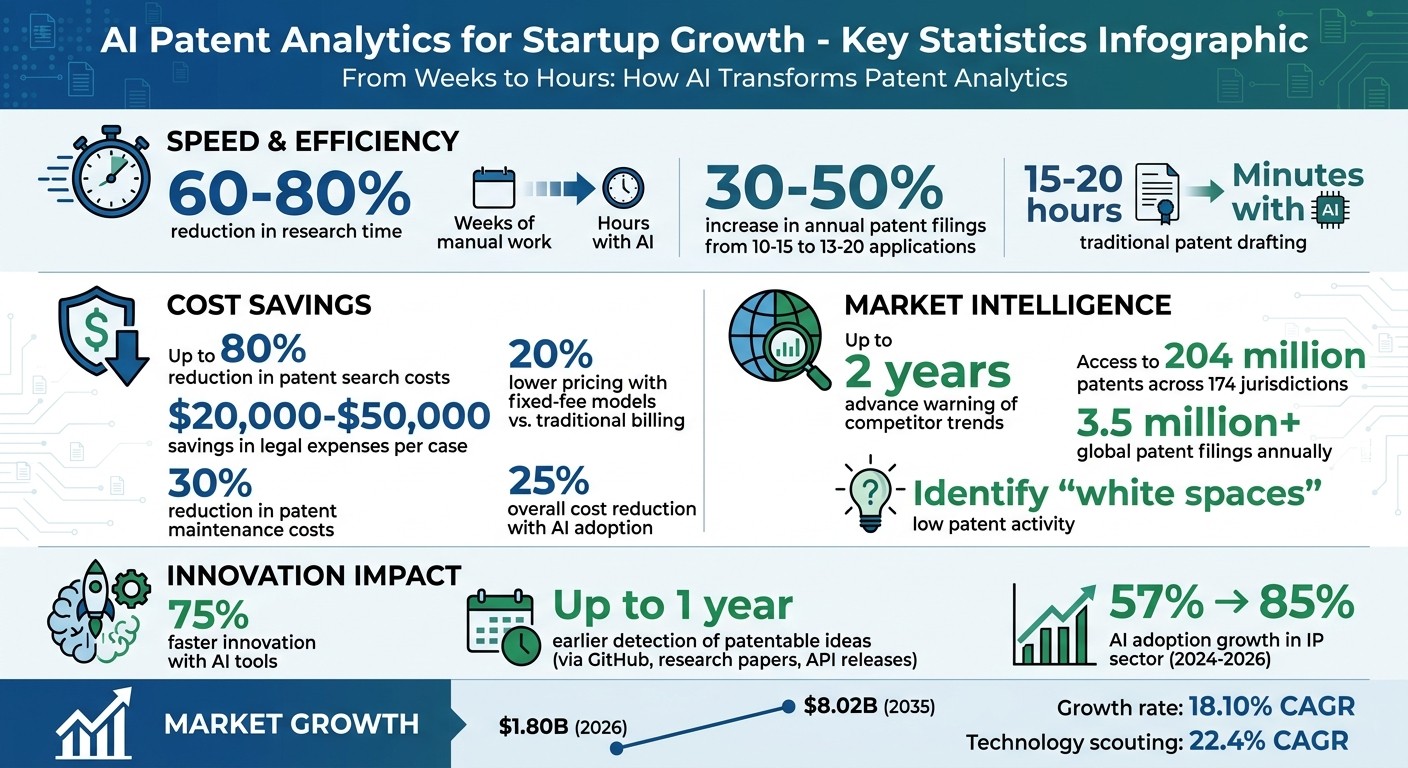
AI Patent Analytics Benefits for Startups: Key Statistics and Cost Savings
Tech Optimist | #52: Meet the Start-Up Reinventing Patent Work With AI
How AI Patent Analytics Supports Startup Growth
AI-powered patent analytics is transforming how startups approach intellectual property (IP) as a startup. Instead of just reacting to legal challenges, founders can now use these tools to shape proactive market strategies. By analyzing how crowded specific technology areas are, startups can focus on patents that are defensible and impactful. This shift turns IP from a compliance task into a key driver for product development, fundraising, and competitive positioning. The result? Faster research, better market insights, and smarter IP strategies.
Faster Patent Research
In competitive markets, speed is everything. AI-powered patent search tools slash prior-art research time by 60–80%, turning weeks of work into just a few hours. These tools use advanced semantic search techniques, making the process faster and often more affordable through subscription or fixed-fee models. For startups, this means they can quickly validate the novelty of their ideas before sinking money into R&D or filing fees.
What’s more, integration with platforms like GitHub, Jira, and Slack allows startups to capture ideas in real time and move them from concept to filing in a matter of days.
Finding Market Opportunities
The speed of AI tools doesn’t just help with research - it also opens doors to new market opportunities. Patent filings often reveal competitors’ investments long before their products hit the market. AI tools can identify "white space", or areas with low patent activity, giving startups a chance to claim these territories before larger companies step in. Heat maps make it easy to visualize these open areas as well as crowded zones.
AI also detects patent clustering, where competitors focus heavily on a specific niche. This insight helps startups pivot to adjacent opportunities or strengthen their position in related areas. Additionally, tracking competitors' filing trends can provide early warnings - sometimes up to two years in advance - about their strategic moves.
"IP isn't a legal thing. It's a product thing. It's a growth thing. It's about choosing what to protect, when to protect it, and how it fits into your long-term plan."
Automated Freedom-to-Operate (FTO) analyses further reduce risks by identifying potential infringement issues early. This allows startups to adjust their designs, saving time and money while avoiding costly patent disputes.
Building Better IP Strategies
With the foundation of faster research and sharper market insights, startups can now weave IP strategy directly into their product and fundraising plans. AI tools rank patents based on their strategic value, helping startups clean up their portfolios by cutting out patents that cost more to maintain than they’re worth. This optimization can lower patent maintenance costs by as much as 30%.
Startups can also treat IP as a dynamic part of their product roadmap. After each product sprint, quick invention reviews can identify new technical solutions worth protecting. This approach ensures that IP strategy evolves alongside product development.
For fundraising, AI provides data-driven "defensibility stories" that highlight how a startup’s IP occupies unique market spaces. This can boost credibility and valuation during investor pitches.
"The patent goes to whoever files first, not who thought of it first."
PowerPatent
AI’s ability to process millions of records quickly helps startups identify overlapping claims, group similar ideas, and pinpoint high-value areas. This speed and precision give startups a competitive edge, allowing them to position themselves strongly against larger rivals.
Metrics for Measuring Patent Analytics Results
Startups can use specific metrics to measure the effectiveness of AI-driven patent analytics, which is critical for justifying intellectual property (IP) investments, refining portfolios, and appealing to investors. These metrics provide the data needed to make informed decisions about IP strategies.
Portfolio Alignment Percentage evaluates how closely a company’s patents align with its business goals and growth areas. For example, showing that five patents contribute to 60% of product revenue highlights their strategic importance. On the other hand, Gap Coverage identifies areas where patents or trademarks are missing, such as high-growth product categories or key markets. Together, these metrics guide decisions on where to invest or cut back.
A patent’s citation count reflects its technological influence and value. AI tools can even predict which patents are likely to become influential before they fully mature. Another key metric, the Cost-to-Value Ratio, compares the benefits of a patent - whether it’s blocking competitors or driving revenue - against its costs for filing and maintenance.
Efficiency metrics like Time-to-file and cycle time reduction also matter. AI tools can increase the number of annual patent filings by 30%–50%, raising output from 10–15 applications to 13–20 applications. Additionally, AI-driven platforms offer fixed-fee pricing that’s about 20% lower than traditional billing models, aligning with the 71% of legal clients who now prefer flat fees.
Metrics such as Filing velocity and jurisdiction spread - the speed and geographic reach of patent filings - demonstrate a company’s strategic intent. Meanwhile, Evidence of Use (EoU) leverages AI-generated claim charts to identify potential infringement and protect IP rights, which can enhance valuation. However, startups should avoid focusing on "vanity metrics", like total patent counts, which often have little connection to actual business outcomes.
Future Developments in AI Patent Analytics
The rapid evolution of AI is set to further transform how startups manage their intellectual property (IP). These advancements will allow startups to treat IP as a dynamic growth tool, shifting its role from a reactive legal necessity to a proactive strategy that directly influences product development and competitive positioning. By 2026 and beyond, the landscape of AI patent analytics is expected to change dramatically, offering startups new ways to navigate the complexities of IP management.
Real-Time IP Monitoring
The days of relying on quarterly reports or manual searches are quickly becoming outdated. Future AI tools will act as an "innovation radar", continuously monitoring over 204 million patents across 174 jurisdictions, with daily updates. Considering that global patent filings now exceed 3.5 million annually, manual tracking is no longer feasible.
These advanced tools will go beyond formal filings to identify innovation signals from sources like GitHub commits, research papers, and API releases - often spotting patentable ideas up to a year earlier. Technologies like semantic search, such as Vector AI, will analyze the intent behind filings, ensuring that competitors can't mask similar innovations by using different terminology.
By integrating these tools directly into developers' workflows, startups can receive instant alerts on critical IP developments. For example, these systems can automatically flag technical milestones worth patenting, enabling startups to adopt "dynamic filing timing." This approach lets them file patents strategically, based on competitor activity rather than arbitrary deadlines. To make the most of these tools, startups should assign an IP Signal Lead to review AI-generated alerts daily, which typically takes just 15–20 minutes, to identify potential infringement risks or shifts in competitor strategies.
Beyond real-time insights, predictive analytics will play a crucial role in refining long-term IP strategies.
Better Predictive Analytics
While real-time monitoring focuses on immediate actions, predictive analytics offers a forward-looking perspective. These tools are becoming increasingly adept at forecasting patent trends, approval probabilities, and processing timelines. For instance, AI can analyze historical examiner data, filing patterns, and patent office workloads to predict the likelihood of approval and the expected duration of the process. This allows startups to tailor their applications, taking into account specific examiner behaviors, such as rejection rates or preferences for certain claim language.
The market for AI in patent and market intelligence is projected to grow from $1.80 billion in 2026 to about $8.02 billion by 2035, with a compound annual growth rate of 18.10%. Similarly, technology scouting - used to identify disruptive innovations up to a year earlier than traditional methods - is expected to grow at a CAGR of 22.4%. Predictive tools will also provide startups with estimates of the future economic value of their IP portfolios, offering critical insights for fundraising and mergers or acquisitions.
Additionally, these analytics will help identify "white spaces" - less crowded technical areas where startups can secure patent protection with minimal competition. AI can automatically tag potential claims based on their competitive threat level, defensibility, and long-term business value. Before filing, startups can use these tools to analyze an examiner's historical decisions, refining their claims to align with the examiner's preferences.
More Automation for Routine Tasks
While predictive analytics shapes strategy, automation is revolutionizing everyday patent tasks. Between 2024 and 2026, AI adoption in the intellectual property sector surged from 57% to 85%, enabling organizations to innovate 75% faster while cutting costs by 25%.
Invention capture is moving away from manual submission forms to continuous discovery. AI now monitors R&D workflows, research documents, and code repositories to identify patentable milestones in real time. Patent drafting, once a labor-intensive process requiring 15–20 hours of work, is now expedited with top generative AI patent drafting tools that generate initial drafts and claim structures by analyzing existing patents and technical documents. Similarly, prior art searches that previously took weeks can now be completed in minutes using natural language semantic search.
"A single IP counsel, armed with the right AI tools, can do the work of a full team. That's a massive cost and time advantage." - PatentPC
This level of automation allows startups to redirect their budgets from routine tasks to higher-value activities like market positioning and licensing negotiations. Non-legal teams, such as product managers and engineers, can also take on preliminary IP checks and novelty assessments, reducing the burden on legal departments. By linking AI monitoring tools to platforms like GitHub, startups can flag unique technical solutions as they are committed and provide outside counsel with detailed, context-rich summaries for further analysis.
Conclusion
Key Takeaways
AI-driven patent analytics is changing the game for startups managing intellectual property. What used to take weeks of manual work now happens in just minutes. This shift allows startups to move from reacting to IP challenges to proactively using their IP for innovation and strategy. PowerPatent puts it simply:
"IP isn't a legal thing. It's a product thing. It's a growth thing".
The numbers back this up. Startups using AI tools gain speed and cost advantages while accessing over 204 million patents from 174 jurisdictions almost instantly. In a first-to-file system, where timing is everything, this speed can be a game-changer. AI also helps identify untapped opportunities in crowded markets, refine patent portfolios by eliminating low-value assets, and build strong IP positions that appeal to investors.
By integrating AI tools with platforms like GitHub and JIRA, startups can track real-time innovations, conduct quick invention reviews, and adapt strategies on the fly. Take TechCore, for example: they used analytics to categorize patents based on market demand, pivoted to AI-driven healthcare, and gained a first-mover advantage while cutting maintenance costs.
With these advantages clearly laid out, startups are now better equipped to take actionable steps toward embedding AI into their IP strategies.
Next Steps for Startups
Start small and scale up. Automate one task at a time - like prior art searches, trademark monitoring, or competitor tracking. Incorporate AI tools into existing workflows to flag patentable milestones automatically and set up real-time alerts for competitor filings.
Shift your mindset: treat IP as a product decision, not just a legal formality. Perform Freedom-to-Operate checks early to avoid expensive course corrections, and align patent filings with future product goals rather than past accomplishments. Platforms like Patently (https://patently.com) provide tools like AI-assisted patent drafting, advanced semantic search with Vector AI, and detailed analytics to help you create a strong, defensible IP portfolio. As PowerPatent emphasizes:
"The patent goes to whoever files first, not who thought of it first".
This underscores the importance of speed. With AI, you can file faster, protect your innovations, and stay ahead of the competition.
FAQs
How accurate are AI prior-art searches compared to human searches?
AI-powered prior art searches can dramatically cut down the time it takes to find relevant information, turning what used to take weeks into just a few hours. These tools are incredibly fast and cover a broad range of data, making them a powerful resource. However, their accuracy relies heavily on the quality of the algorithms and the depth of the data they analyze. While AI is excellent at uncovering prior art, it’s important to pair these results with human expertise. A thorough review by a person ensures the findings are valid and accounts for intricate technical details that AI might miss. By combining the speed of AI with human judgment, patent searches become both faster and more reliable.
When should a startup run Freedom-to-Operate (FTO) checks?
Startups should perform Freedom-to-Operate (FTO) checks before rolling out a product, entering a new market, or pursuing key business moves like fundraising, partnerships, or licensing. These checks are crucial for spotting potential patent conflicts, helping to avoid expensive lawsuits or the need for major product adjustments later on.
How do I choose which inventions to patent first?
Deciding which inventions to patent first involves careful planning, and AI-driven tools can make this process much easier. Start by examining the patent landscape to pinpoint areas with fewer competitors and untapped opportunities. Look for inventions that are not only new but also defensible and closely tied to your business objectives.
Focus on those with strong market potential and act quickly - filing early ensures you lock in a solid priority date, which is critical since patent law operates on a "first-to-file" basis.