Patent Benchmarking Trends in 2026
Intellectual Property Management
May 7, 2026
AI-driven patent benchmarking now favors quality and explainability, reshaping portfolio valuation and SEP analytics.

Patent benchmarking in 2026 has shifted focus from patent quantity to quality, with AI tools revolutionizing how companies analyze and manage intellectual property. Companies now prioritize metrics like the Patent Asset Index, which evaluates citation impact and geographic coverage, over sheer filing numbers. AI adoption in IP management has surged to 85%, drastically reducing the time needed for tasks like patent classification and search while improving accuracy.
Key highlights:
AI tools achieve over 90% recall for relevant prior art, leveraging semantic search to bridge vocabulary gaps.
Comprehensive databases covering at least 150 global patent authorities, including full-text and legal status data, are essential for effective benchmarking.
Explainable AI models ensure transparency and compliance, critical with regulations like the EU AI Act coming in 2026.
Specialized tools for Standard Essential Patents (SEPs) in technologies like 5G provide tailored insights for licensing and portfolio optimization.
AI-driven benchmarking is now a baseline requirement for staying competitive in the evolving IP landscape.
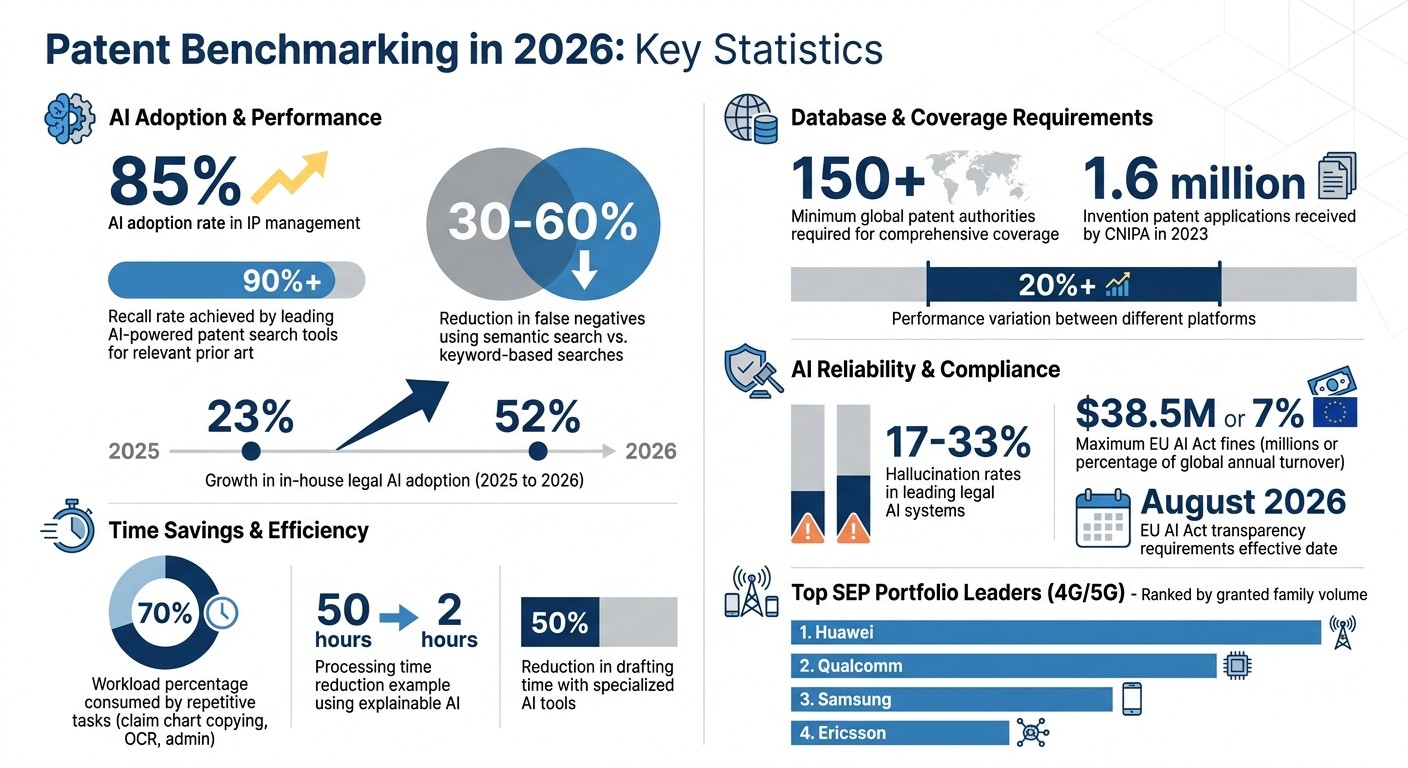
Patent Benchmarking Key Metrics and AI Adoption Statistics 2026
Core Metrics for Patent Benchmarking
Recall and Precision in Patent Search
When it comes to patent benchmarking tools, recall and precision are the two metrics that carry the most weight. Recall tells us how well a tool can locate all relevant documents, while precision ensures that irrelevant results are filtered out. For IP professionals, this balance is critical - high recall ensures no important prior art is missed, and high precision saves time by reducing the number of irrelevant documents to review.
By 2026, leading AI-powered patent search tools are projected to achieve over 90% recall for relevant prior art in standardized test sets. These tools leverage semantic search, which has been shown to lower false negatives by 30%–60% compared to traditional keyword-based searches.
One of the biggest advancements driving this improvement is the move from keyword matching to semantic analysis. This shift addresses the "vocabulary gap", where different inventors might describe the same concept using entirely different terms. For instance, one patent might use "friction-based closure", while another refers to "seals without adhesive." A traditional keyword search would fail to link these terms, but AI-driven semantic tools are designed to understand the underlying concepts and make the connection.
Of course, search performance is only part of the equation. Comprehensive database coverage is equally vital.
Database Coverage and Relevance
A benchmarking tool is only as good as its database. In 2026, any reliable tool must provide access to at least 150 global patent authorities, along with full-text data and up-to-date legal status information. Without comprehensive coverage, blind spots can emerge. For example, the China National Intellectual Property Administration (CNIPA) received over 1.6 million invention patent applications in 2023 alone. Excluding such major offices could lead to significant risks.
But patents aren’t the only source of valuable prior art. Non-patent literature (NPL) - like scientific journals, conference papers, and technical disclosures - has become increasingly important in uncovering prior art. Tools that only index abstracts often miss critical claim-level details that could invalidate a patent. This is why full-text indexing is essential. In fact, differences in platform performance can vary by more than 20%, making it crucial to evaluate multiple tools to find the one best suited for your specific needs.
AI-Driven Patent Analytics in 2026
Transparent and Explainable AI Models
The days of black-box AI are fading as Explainable AI frameworks take center stage. These frameworks are reshaping how AI tools are used, ensuring compliance, minimizing risks, and building trust among users.
Today's AI tools come equipped with features like training data attribution, which links outputs to the exact data points that influenced them, and influence scoring, which ranks how much each data point contributed to the result. For intellectual property (IP) professionals, having traceable outputs is no longer optional - it’s essential for meeting compliance requirements. As Daniel J. Holmander and Michel Morency, Ph.D., from Adler Pollock & Sheehan explain:
"The bottleneck is no longer information gathering; it is interpretation".
Regulatory developments are fueling this shift. For instance, the EU AI Act's transparency requirements will go into effect in August 2026. Non-compliance could result in fines as steep as $38.5 million or 7% of global annual turnover. The Seekr Team captured the urgency of this trend perfectly:
"If you can't explain it, you can't deploy it".
For patent professionals, explainability is no longer just a desirable feature - it’s now a critical factor when choosing AI tools. But transparency isn’t the only area where AI is transforming the industry.
Workflow Integration and Time Savings
Explainable AI isn’t just about clarity; it’s also unlocking massive time savings through streamlined workflows. The key lies in integrated platforms that eliminate the inefficiencies caused by switching between multiple tools. By centralizing workflows, these platforms break down data silos and make team collaboration smoother than ever.
Take the example of Stephano Slack, which cut processing time from 50 hours to just 2 hours by leveraging explainable AI agents. In patent work, similar automation is reducing the burden of repetitive tasks like claim chart copying, OCR processing, and administrative tasks - activities that traditionally account for 70% of the workload.
The adoption of in-house legal AI has skyrocketed, jumping from 23% to 52% between 2025 and 2026. This surge is largely due to the efficiency gains these tools provide. Real-time collaboration features now allow multiple analysts to work together on shared claim constructions, with updates instantly reflected across infringement heatmaps and drafting modules. The result? Patent teams can focus less on gathering data and more on interpreting it strategically.
Technology-Specific Benchmarking and SEP Analytics
Advancements in AI have paved the way for sharper, more precise portfolio benchmarking tailored to specific technologies.
SEP Analytics for 4G/5G Technologies
Standard Essential Patents (SEPs) have become a cornerstone of the telecommunications industry, particularly in the realm of 4G and 5G. As we approach 2026, significant shifts are reshaping portfolio benchmarking. Leading the global rankings in granted family volume and standards contributions are Huawei, Qualcomm, Samsung, and Ericsson. However, the competitive landscape is anything but static. Early in 2026, LG surpassed Samsung in 5G patent counts, securing its spot among the top three cellular SEP owners.
But raw patent counts only tell part of the story. Today, "value-adjusted" indicators are critical for assessing portfolio strength across key markets. As Tim Pohlmann, Director of SEP Analytics at LexisNexis Intellectual Property Solutions, explains:
"In a licensing environment of this scale, even small differences in how 5G patent portfolios are measured can materially influence negotiations."
Modern tools like Patently are stepping up to meet this need, offering SEP analytics tailored specifically for 4G and 5G technologies. These platforms allow patent teams to benchmark their portfolios against competitors using customized technology filters. Features like four-tier essentiality ratings, which align patent claims with technical standards, provide a more nuanced view of portfolio strength.
This kind of precise benchmarking unlocks deeper insights into specific technology areas, offering a competitive edge.
Why Technology-Specific Insights Matter
Focusing on technology-specific benchmarking gives companies a clearer understanding of their competitive positioning and helps guide strategic decisions. By analyzing SEP portfolios within specific technology domains - such as 5G-Advanced or the emerging 6G standards - organizations can gain critical leverage during licensing negotiations and identify areas where their coverage may fall short.
The move from binary classifications of "essential" versus "non-essential" to granular essentiality ratings is reshaping how portfolios are optimized. This shift allows patent teams to prioritize resources toward patents that most strongly support standards compliance. For instance, distinguishing between a Normative rating (which indicates a requirement explicitly stated by the standard) and an Informative rating (which is described but not mandatory) can have a significant impact on licensing strategies.
Conclusion and Takeaways
Major Trends in Patent Benchmarking for 2026
As we look ahead to 2026, AI-driven patent benchmarking is shaping up to be a game-changer. AI has become a cornerstone of the intellectual property (IP) landscape, with adoption rates hitting an impressive 85%. François-Xavier Leduc, CEO and Co-Founder of DeepIP, highlights this shift:
"By 2026, artificial intelligence will no longer be a 'nice to have' in corporate IP departments. It will be a baseline requirement for managing invention capture, patent quality, portfolio scale, and legal risk".
One notable evolution is the move from focusing solely on portfolio size to emphasizing qualitative benchmarks that reflect true innovation. For example, while IBM leads in generative AI portfolio size, Alphabet stands out for portfolio quality, as measured by the Patent Asset Index. This demonstrates how assessing value rather than volume is becoming the priority. Additionally, specialized insights - like those in Standard Essential Patent (SEP) analytics for 4G and 5G - are transforming how companies assess their competitive position and licensing strategies.
These trends highlight the growing importance of crafting strategies tailored to specific technologies in IP management.
Recommendations for IP Professionals
Given these shifts, IP professionals should consider adopting the following practices to stay ahead:
Ensure transparency in AI tools: Select AI systems that provide clear explanations for classifications to reduce legal risks. This is crucial since leading legal AI systems still show hallucination rates between 17% and 33%, making human oversight indispensable.
Opt for top patent tools that are domain-specific: Platforms like Patently, which offer AI-powered semantic search with Vector AI and SEP analytics for technologies like 4G and 5G, are better suited for patent work than general-purpose AI tools. These specialized platforms can streamline workflows, cutting drafting time by up to 50%, without sacrificing accuracy.
Document AI usage: Keep detailed records of how AI tools are used to minimize malpractice risks and maintain transparency. Start small by testing tools on low-stakes projects using pay-as-you-go pricing models before committing to larger contracts. Combine quantitative data with qualitative insights to uncover high-value competitive threats that raw patent numbers might overlook.
FAQs
What should I use to measure patent quality in 2026?
In 2026, assessing patent quality takes a leap forward with AI-powered analytics tools. These tools dive deep into factors such as relevance, strategic importance, and technological influence. By using advanced semantic analysis and processing vast amounts of data, AI provides a sharper and more detailed evaluation of patent quality. This approach brings precision and depth to patent assessments like never before.
How can I validate an AI patent search tool’s recall and precision?
To evaluate how well an AI patent search tool performs, focus on two key metrics: recall and precision. Recall measures the tool's ability to find all relevant prior art, while precision assesses how accurate the retrieved results are in terms of relevance. The best way to test these is by comparing the tool’s results against a verified dataset, such as one that includes manually reviewed references. Additionally, understanding the AI’s methodology is crucial - clear and transparent processes help build trust in its accuracy and dependability.
What does the EU AI Act mean for patent AI tools in 2026?
The EU AI Act requires high-risk AI systems to be registered. If this registration process involves sharing technical details, it might qualify as public disclosure. This could impact the ability to secure patents in Europe. To maintain patent rights, it's crucial to file patent applications before any such disclosures take place.