AI Tools for Renewable Energy Patent Analysis
Intellectual Property Management
May 6, 2026
AI semantic search and analytics speed renewable-energy patent review, map sustainability metrics, and reveal innovation gaps.

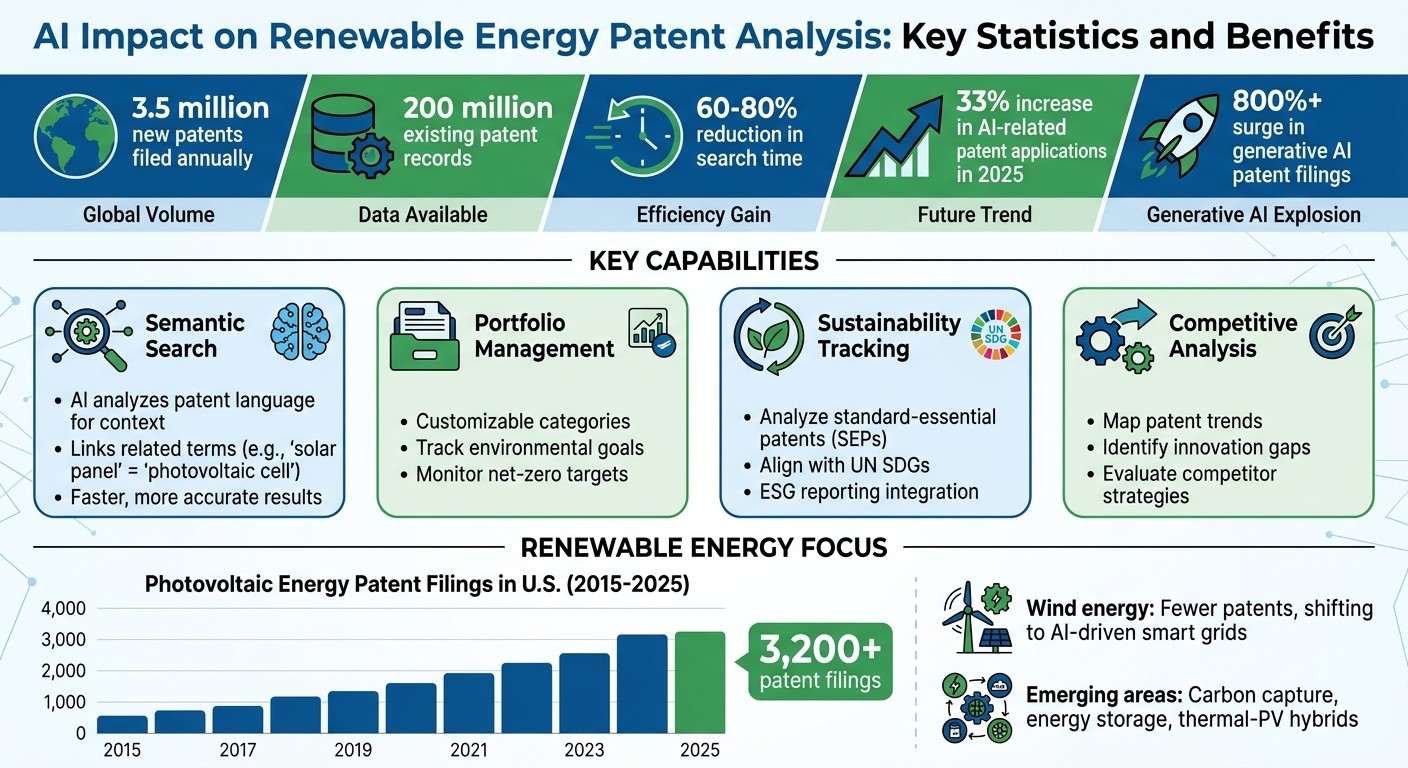
AI is transforming how renewable energy patents are analyzed, making it easier to process massive datasets while uncovering key trends in innovation. With over 3.5 million new patents filed annually and more than 200 million existing records, manual analysis is no longer feasible. AI tools like Patently streamline this process by using semantic search, customizable portfolio management, and sustainability tracking to help intellectual property (IP) professionals manage renewable energy technologies such as solar, wind, and carbon capture.
Key Highlights:
Semantic Search: AI-powered tools analyze patent language for context, linking related terms like "solar panel" and "photovoltaic cell" for faster, more accurate searches.
Portfolio Management: Organize patents with tailored categories and track metrics like environmental goals or net-zero targets.
Sustainability Tracking: Analyze standard-essential patents (SEPs) and align portfolios with global sustainability frameworks like the UN Sustainable Development Goals.
Competitive Analysis: AI maps patent trends, identifies gaps in innovation, and evaluates competitors' strategies.
Efficiency Gains: AI reduces the time spent on patent analysis and drafting by up to 60%-80%, helping teams focus on strategic tasks.
These tools not only improve the efficiency of patent analysis but also align innovation efforts with global sustainability objectives. By integrating AI with renewable energy patent analysis, companies can better navigate the competitive landscape and drive advancements in green technologies.
AI Impact on Renewable Energy Patent Analysis: Key Statistics and Benefits
E158 - Patenting AI innovations - Rasmus Fredlund and Daniel Enetoft
Patently: AI-Powered Tools for Advanced Patent Analysis
Patently is transforming how renewable energy patents are analyzed, offering tools that simplify the process for intellectual property (IP) teams. By combining AI-driven semantic search, project management, and analytics, Patently helps users identify trends, monitor sustainability goals, and manage renewable energy patent portfolios more effectively.
Semantic Search with Vector AI
Patently leverages cutting-edge AI to improve patent searches. Traditional keyword searches often miss a significant portion of relevant prior art because they rely on exact matches. In contrast, Patently's Vector AI focuses on the context behind patent language. It identifies related concepts, including synonyms and terms in different languages, almost instantly. For example, in renewable energy patents, terms like "photovoltaic cell", "solar panel", and "PV module" often describe similar technologies. Patently’s approach ensures comprehensive results without depending solely on translation accuracy.
Customizable Portfolio Management for Renewable Energy
Patently’s project management tools offer a tailored way to organize renewable energy patents. Users can sort patents using hierarchical categorization systems aligned with frameworks like the WIPO Green Inventory or OECD Env-Tech classifications. Additionally, teams can create custom ESG fields to track specific metrics such as environmental impact, sustainability goals, and net-zero targets throughout the patent lifecycle. This setup encourages collaboration among R&D, legal, and environmental teams by enabling them to collectively review, annotate, and manage portfolios. Beyond organization, these tools make it easier to monitor sustainability efforts within patent portfolios.
Sustainability Metrics Tracking and SEP Analytics
Patently takes sustainability tracking a step further by analyzing standard-essential patents (SEPs) for green technologies. This feature helps teams monitor how their work aligns with industry standards and environmental objectives. With the ability to securely export detailed reports and integrate external data, Patently ensures that teams have all the tools they need to meet their sustainability goals.
Applications of AI in Renewable Energy Patent Analysis
Identifying Emerging Trends in Renewable Energy Innovation
Patently stands out in tracking new advancements across solar, wind, and energy storage technologies by analyzing extensive patent databases. Using Vector AI semantic search, it links conceptually similar technologies, even when different terms are used. For instance, it can automatically connect "carbon sequestration" with "CO2 capture." This feature speeds up tech scouting, uncovering patterns and cross-industry applications that might otherwise go unnoticed - like applying robotics algorithms to renewable energy sensors.
One particularly useful tool is whitespace analysis, which identifies gaps in innovation where competitors have minimal activity. Combined with a forward and backward citation browser, this helps track the progress of developments and spot opportunities in areas like thermal-PV hybrids or marine energy. For example, in the U.S., photovoltaic energy has led renewable innovation with over 3,200 patent filings between 2015 and 2025. By contrast, wind energy shows fewer patents, despite its widespread market use, as the focus shifts towards AI-driven smart grid integration and intelligent control systems. Beyond identifying trends, AI also enhances competitive analysis.
Analyzing the Competitive Landscape
After mapping out trends, AI goes a step further by refining competitive analysis. It examines renewable energy patent portfolios, analyzing filing patterns, citation networks, and technology clusters. This allows teams to pinpoint competitors' focus areas and potential weaknesses. Through sustainable patent trends like SDG mapping, AI aligns patent portfolios with the UN Sustainable Development Goals, creating a maturity matrix that highlights high-growth "hot topics" and emerging areas. These insights help guide sustainable R&D investments and uncover opportunities for differentiation.
Improving Patent Drafting for Sustainability Innovations
AI simplifies the patent drafting process for sustainability-focused technologies. With generative AI patent drafting tools, professionals can cut search time by 60% to 80%. The USPTO has reported a 33% increase in AI-related patent applications in 2025, alongside an over 800% surge in generative AI patent filings. Patently's AI drafting assistant further supports this by enabling professionals to draft accurate, high-quality applications quickly. This ensures that innovations in green technology are well-protected while adhering to industry-specific terminology and standards, helping secure advancements in sustainable solutions.
Benefits of AI Tools for IP Professionals in Renewable Energy
Improved Efficiency and Accuracy
AI tools can process massive amounts of documents in just minutes, taking care of time-consuming tasks like error detection and prior art searches. This frees up patent professionals to focus on more strategic work, such as optimizing their patent portfolios. Automation also plays a key role in reducing drafting errors by identifying issues like antecedent basis problems and dependency mistakes. This ensures patent applications meet technical standards before submission, saving time and avoiding potential setbacks.
Detailed Data Insights
AI tools don't just speed up routine tasks - they also provide critical data insights that help with risk management. For example, some platforms automatically calculate blocking scores (ranging from 0–100) and assess Freedom to Operate risks (categorized as Critical, High, or Low) by analyzing assignee activity and litigation records. This allows IP teams to evaluate whether a new solar panel design or energy storage technology might face legal hurdles before investing heavily in R&D.
In addition to risk assessments, AI tools can map patents to frameworks like the UN Sustainable Development Goals (SDGs) and regulatory standards, such as the EU CSRD and SEC requirements. This simplifies sustainability reporting obligations and enhances transparency for ESG-focused investors. IP professionals can even track metrics like carbon reduction potential and energy efficiency directly within their patent portfolios, making it easier to align innovation with environmental goals.
Supporting Collaboration and Innovation
AI-powered platforms don't just deliver insights - they also improve teamwork. By centralizing R&D, legal, and sustainability teams into one system, these tools make it easier for cross-functional teams to review, annotate, and discuss patents together. This streamlined collaboration speeds up decision-making and can lead to groundbreaking innovations. Centralized platforms also uncover hidden connections across disciplines, sparking new ideas and opportunities.
These capabilities - efficiency, insightful data, and enhanced collaboration - show how tools like Patently are helping IP professionals lead the charge in sustainable innovation.
Conclusion: The Future of AI in Renewable Energy Patent Analysis
Key Takeaways
Patently is reshaping how renewable energy patents are analyzed by moving beyond traditional keyword searches. Instead, it uses semantic insights to connect technical classifications with the UN Sustainable Development Goals. This approach ensures that green technologies are identified, even when regional terminology varies.
With features like automated ESG reporting, detection of evergreening strategies, and whitespace analysis, IP teams can focus on genuine advancements rather than minor updates. By linking patent portfolios to sustainability metrics, Patently offers objective data for sustainability reporting, turning patent analysis into a tool for driving meaningful climate action.
Looking ahead, the next step involves exploring how new technologies can further improve sustainable patent practices.
Looking Ahead: AI and Sustainability
AI’s role in renewable energy patent analysis is set to deepen, especially as it integrates with other technologies. For instance, combining AI with IoT sensors and blockchain could lead to "living environmental ledgers." These ledgers would provide real-time, tamper-proof verification of green technology claims, delivering a new level of transparency to sustainability reporting and addressing greenwashing concerns.
AI is also paving the way for responsible licensing models that emphasize access over ownership - particularly valuable for green technologies in underserved regions. Predictive analytics, powered by AI, will help forecast trends in renewable energy and carbon capture, steering R&D investments toward areas with the greatest environmental impact.
Collaboration across industries is gaining momentum. For example, tech companies and energy providers are working together to power data centers with renewable energy, guided by AI-driven patent scouting. As platforms adopt enterprise-grade security standards like ISO 27001 and SOC 2 Type 2 certifications, they ensure that sensitive renewable energy IP remains secure while fostering the collaboration needed to address global climate challenges.
FAQs
How does semantic search find relevant prior art without exact keywords?
Semantic search leverages Natural Language Processing (NLP) to grasp the meaning and context behind patent content, rather than just matching exact keywords. This approach helps uncover relevant prior art even when different terms or phrases are used, leading to more precise and thorough results.
How can I map my patent portfolio to UN SDGs and ESG metrics?
AI-powered tools such as Patently make it easier to connect your patent portfolio with UN SDGs and ESG metrics. By leveraging semantic analysis and patent taxonomy mapping, these tools associate patents with technology-related SDGs and evaluate how well they align with sustainability objectives. They also handle tasks like automating ESG scoring, tracking the impact of patents, and delivering actionable insights. This helps organizations ensure their innovations address global issues like clean energy and climate action, while also improving transparency.
What data do I need to run whitespace and competitor trend analysis?
To analyze whitespace opportunities and competitor trends, you'll need access to patent data like filings, classifications, assignee information, and insights into technology trends. Leveraging AI tools with features like semantic search and patent analytics can simplify the process, making it easier to spot market gaps and emerging patterns.