Top Trends in Green Tech Patents 2026
Intellectual Property Management
May 5, 2026
AI accelerates green tech patents in 2026—powering batteries, perovskite solar, PV intelligence while patent thickets drive collaborative licensing.

In 2026, green technology patents are shaping the future of energy, with AI playing a central role in accelerating innovation and reducing costs. Key trends include:
AI's Role: AI is drastically cutting research timelines, optimizing energy use with "carbon-aware computing", and identifying new innovation opportunities.
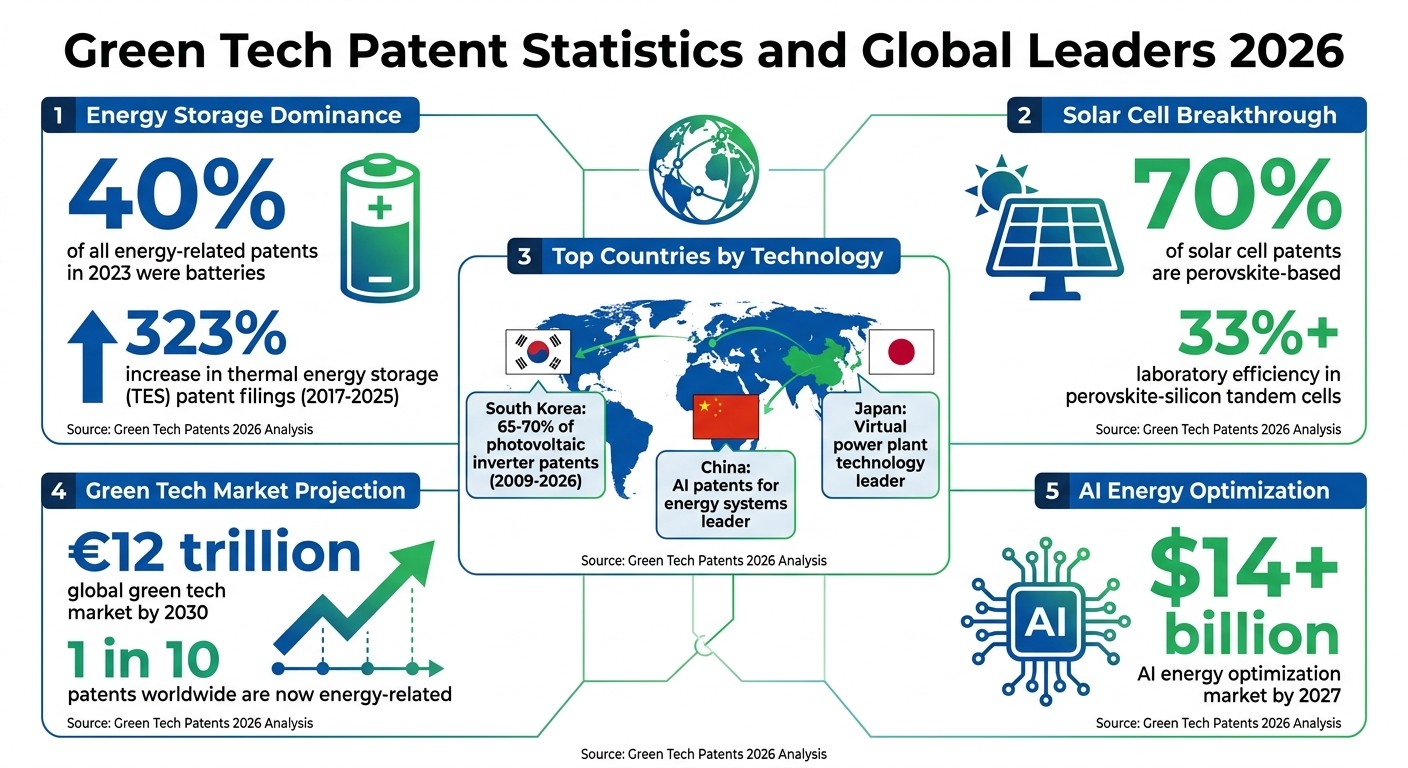
Global Leaders: China dominates AI patents for energy systems, while South Korea leads in photovoltaic inverters, and Japan excels in virtual power plant technologies.
Energy Storage Growth: Batteries accounted for 40% of energy-related patents in 2023, with thermal energy storage seeing a 323% filing increase since 2017.
Solar Innovation: Perovskite solar cells now represent 70% of material-related solar patents, achieving efficiencies over 33%.
Challenges: Overlapping claims, "patent thickets", and geographic concentration of IP create barriers to innovation and collaboration.
AI tools are revolutionizing patent drafting and analysis, making processes faster and more efficient. Collaborative strategies like patent pools and open platforms are essential to overcoming challenges and driving the adoption of green technologies.
Green Tech Patent Statistics and Global Leaders 2026
Key Trends in Green Tech Patent Filing
Top Countries and Organizations Filing Green Patents
South Korea has taken the lead in photovoltaic inverter patents, accounting for 65–70% of records from 2009 to 2026. Meanwhile, Japan’s Chugoku Electric Power Co. filed 5–6 virtual power plant (VPP) patents between 2023 and 2025. With the global green tech market expected to hit €12 trillion (around $13 trillion) by 2030, competition among countries and corporations to secure intellectual property rights in this booming sector is intensifying.
This competitive landscape is driving advancements in areas like energy storage and solar technology.
New Technologies in Green Patents
Energy storage has become a hotbed of innovation, with batteries making up 40% of all energy-related patents filed in 2023. Thermal energy storage (TES) patent filings alone saw a massive 323% increase between 2017 and 2025. In 2025, South China University of Technology emerged as a leader in thermal storage innovation, filing 21 patents - making up 53.8% of the top-10 applicant portfolio - focused on high energy density solutions aimed at industrial decarbonization.
In the solar sector, perovskite solar cells dominate, accounting for over 70% of solar cell patents by material. These cells have achieved laboratory efficiencies exceeding 33% in perovskite-silicon tandem configurations. Meanwhile, PV inverter patents are shifting their focus. Initially centered on hardware reliability, they now emphasize "Advanced Intelligence", incorporating technologies like digital twins, AI fault diagnostics, and VPP integration. As PatSnap Insights notes:
VPP integration is shifting inverters from passive converters to active grid assets - inverter firmware interoperability with VPP APIs is becoming a key product differentiator.
Self-powered IoT devices are also gaining momentum, thanks to triboelectric nanogenerators (TENGs). Patent filings for TENGs have been on the rise since 2019. By 2025, Inha University in South Korea developed a high-output TENG system capable of achieving a peak voltage of 305 V and a power density of 10.9 W·m⁻², successfully powering devices like LEDs and LCDs.
Common Challenges in Patent Filing
Despite these advancements, challenges in patent filing remain significant. The surge in green tech filings has led to overlapping claims and cross-jurisdictional disputes, driving up enforcement costs and increasing the risk of infringement. With roughly one in ten patents worldwide now energy-related, the resulting "patent thickets" complicate freedom-to-operate analyses and slow the pace of renewable energy innovation.
Geographic concentration adds another layer of complexity. For example, developers working on TENGs must navigate foundational circuit IP controlled by the Beijing Institute of Nanoenergy and Nanosystems. Similarly, South Korea’s dominance in PV inverter patents could create licensing bottlenecks for international developers. These obstacles highlight the importance of collaborative strategies and effective IP management to sustain the rapid growth of green tech innovation.
Research into Patents: Following trajectories of green technology patents
How AI Is Used in Green Patent Analysis
With the growing complexity of overlapping claims and the challenge of navigating patent thickets, AI tools are reshaping the way green patents are analyzed. As filings for sustainable patent trends increase, AI-powered platforms are making the processes of drafting, searching, and analyzing intellectual property far more efficient.
AI-Assisted Patent Drafting
AI is simplifying the creation of green technology patents by automating tasks that traditionally require significant time and effort. A great example is Patently's Onardo tool, which automates several aspects of patent drafting. It extracts claim features to create drag-and-drop parts lists, generates editable diagrams, writes descriptions, and even auto-labels features - all in one platform. The tool also uses dynamic referencing, meaning when a part is moved or reordered, all related references are updated instantly. Martin Schweiger, an expert in AI Patent Drafting, praised the platform, calling it:
the drafting robot with the best UI and best Figure editor.
This type of automation is especially valuable as green technology evolves from hardware innovations to software-driven solutions.
Semantic Search for Green Tech Innovations
Traditional keyword-based searches often fall short, missing 20–40% of relevant patents because they rely on exact word matches. Patently's Vector AI takes a different approach by using semantic search, which understands the context behind terms and connects related concepts. For instance, it links terms like "autonomous vehicle" and "self-driving car" or bridges modern terminology with older language found in legacy patents. This capability is crucial for identifying "enabling technologies" that support sustainability goals, even if they aren't explicitly labeled as "green" in traditional classifications.
The platform also enables cross-language discovery, matching patents with similar concepts across different languages without requiring precise translations. By aligning patent portfolios with the UN Sustainable Development Goals, these tools provide data-driven insights for ESG reporting and help uncover new areas for research and development.
SEP Analytics for Energy-Enabling Technologies
AI is also transforming the analysis of standard-essential patents (SEPs), which are vital for hybrid technologies that merge physical energy infrastructure with digital intelligence. These tools help organizations navigate the challenges of patent thickets and disputes across jurisdictions. For example, between 2022 and 2025, Chugoku Electric Power Co. in Japan filed 5–6 patents focused on virtual power plant formation and integration control systems, solidifying its leadership in grid-aggregation intelligence. Similarly, in 2022, GE Energy Power Conversion Technology Ltd. filed a patent for grid fault ride-through control, aligning with IEEE grid interconnection standards.
With digital communication expected to account for 11.1% of PCT applications by 2025 and semiconductors projected to grow by 6.1%, early tracking of infrastructure filings can help organizations minimize duplication and identify strategic licensing opportunities. AI-driven SEP analytics are proving essential for managing these developments effectively.
Solutions to Patent Thickets Through Collaboration
Patent Pools and Public-Private Partnerships
Collaborative frameworks provide practical ways to address the challenges posed by patent thickets, which can block the entry of green technologies into the market by driving up costs and legal risks. Patent pools are one such solution. By bringing together multiple patent holders under standardized licensing agreements, these pools help reduce litigation risks and transaction costs. This makes it easier for companies, especially smaller ones, to access the innovations they need. Similarly, Public-Private Partnerships (PPPs) play a key role by combining government funding with licensing rules that prioritize affordability and local production. This ensures broader access to essential green technologies.
Take the example of electric vehicle batteries: between 2010 and 2020, coordinated industrial policies and economies of scale helped drive down their costs by over 90%. However, small and medium enterprises often face licensing costs that are about 50% higher than those for larger corporations. Professor James Chen from Stanford University highlights the urgency of addressing these barriers:
The current patent system wasn't designed for the scale and urgency of climate change. We're seeing critical technologies locked behind patent thickets that prevent their widespread deployment in regions that need them most.
Real-world examples show how collaborative efforts can work. CATL (Contemporary Amperex Technology Co. Limited), for instance, uses multiple green patents for Lithium Iron Phosphate batteries in electric vehicles. With state funding, they’ve managed to lower risks and scale production faster. In the European Union, Siemens Gamesa has foundational patents for wind turbine blade designs and control systems, which are shared through collaborative licensing frameworks to encourage broader adoption and reduce redundancy. Similarly, Konica Minolta supports green innovation by sharing advanced solar technology patents via Japan's green patent databases, backed by tax incentives to encourage voluntary licensing.
These collaborative licensing strategies are further bolstered by open innovation platforms that expand access to green technologies.
Global Platforms for Green Innovation
Open platforms are stepping in to connect innovators with the resources they need to turn patents into actionable solutions. WIPO GREEN, for example, is an online marketplace that links technology providers with seekers. As of 2025, it hosts over 140,000 listed technologies, needs, and experts, and has facilitated more than 1,000 connections through its projects. By categorizing innovations - such as Clean Energy, Smart Farming, and Green Building - it simplifies the process of finding impactful technologies. These platforms not only promote licensing but also help accelerate the spread of clean technologies.
Another example is SKF’s "The Patent Bay", launched in 2025. This platform focuses on sharing and licensing green technologies to support climate goals. These initiatives address a critical challenge: the average time it takes to transition from scientific discovery to patented clean technology is 8–14 years. To ensure successful adoption, simultaneous investments in infrastructure - like EV charging networks or grid upgrades for solar power - are essential.
John Frey, Chief Technologist for Sustainable Transformation at Hewlett Packard Enterprise, underscores the importance of collective action:
The world needs radical collaboration to meet this critical moment in the climate crisis. To achieve net-zero emissions by 2050, we need to work together to innovate faster.
Conclusion
Green technology patents in 2026 highlight a major shift in how innovation unfolds. The emphasis is moving from hardware-based solutions toward software-driven intelligence - concepts like digital twins and predictive diagnostics are leading the way. This evolution is already transforming industries, with the AI energy optimization market expected to exceed $14 billion by 2027.
Generative AI is changing the game in design through physics-informed neural networks, while carbon-aware computing enables workloads to align with low-carbon periods. These strategies are not just theoretical; companies are adopting practical measures such as auditing flexible energy loads and using metrics like Power Usage Effectiveness (PUE) to benchmark data center efficiency.
Patent professionals are also leveraging AI tools like Patently to simplify complex tasks. These tools enhance efficiency in drafting, enable advanced semantic searches, and provide SEP analytics, making it easier to identify prior art and draft applications.
Looking ahead, success in this evolving landscape will rely on advanced technologies paired with collaborative efforts. Initiatives like patent pools, public–private partnerships, and platforms such as WIPO GREEN are breaking down barriers, speeding up the adoption of clean technologies, and bridging the gap between innovation and market readiness. When combined with AI-driven patent management, these efforts are paving the way for faster commercialization of green innovations.
As the climate crisis demands immediate action, using AI to manage patents is more than a tool for efficiency - it’s a way to help deliver the groundbreaking solutions the world urgently needs. For patent professionals, this represents not just an opportunity to streamline their work but a chance to contribute to the rapid deployment of technologies vital to addressing our planet’s climate challenges.
FAQs
How is AI changing green tech patent work in 2026?
AI is transforming the way green tech patent work is handled in 2026, making processes smoother and more efficient. With tools like semantic search, patent research has become faster and more precise, as these tools can grasp complex technical details. Meanwhile, generative AI is taking on the heavy lifting of drafting patents, allowing professionals to channel their energy into driving innovation.
AI isn't just about speed; it's also about accuracy and strategy. It helps streamline workflows, spot errors, and even assess patents for their environmental impact. This ensures that patent strategies align with ESG (Environmental, Social, and Governance) goals. The result? Greater efficiency, better precision, and smarter decision-making in the world of green tech patents.
What are the biggest green tech patent risks for new innovators?
New players in green technology often encounter challenges like patent thickets - dense clusters of overlapping patents - along with tactics such as evergreening, which can stifle progress. This is especially evident in highly competitive fields like photovoltaic technology, hydrogen energy, and energy storage. To tackle these hurdles, it’s crucial for innovators to perform detailed patent searches and use AI-powered tools to analyze potential risks. These strategies can help them steer clear of infringement issues and stay agile in an ever-changing patent environment.
How can companies clear patent thickets without slowing deployment?
Companies can tackle the challenge of patent thickets more effectively by leveraging AI-powered tools and smart patent strategies. For instance, AI platforms such as Patently offer features like semantic search and generative drafting. These tools help identify overlapping patents and minimize redundant filings, saving both time and resources.
Another approach is embracing collaborative strategies like patent pooling or open licensing. These methods can simplify access to green technologies, ensuring a balance between protecting intellectual property and accelerating advancements in areas like renewable energy and smart grids.