AI Patent Drafting: Quality Metrics Explained
Intellectual Property Management
Apr 13, 2026
AI-driven quality metrics make patent drafting more defensible and faster by improving claims, compliance, and terminology.
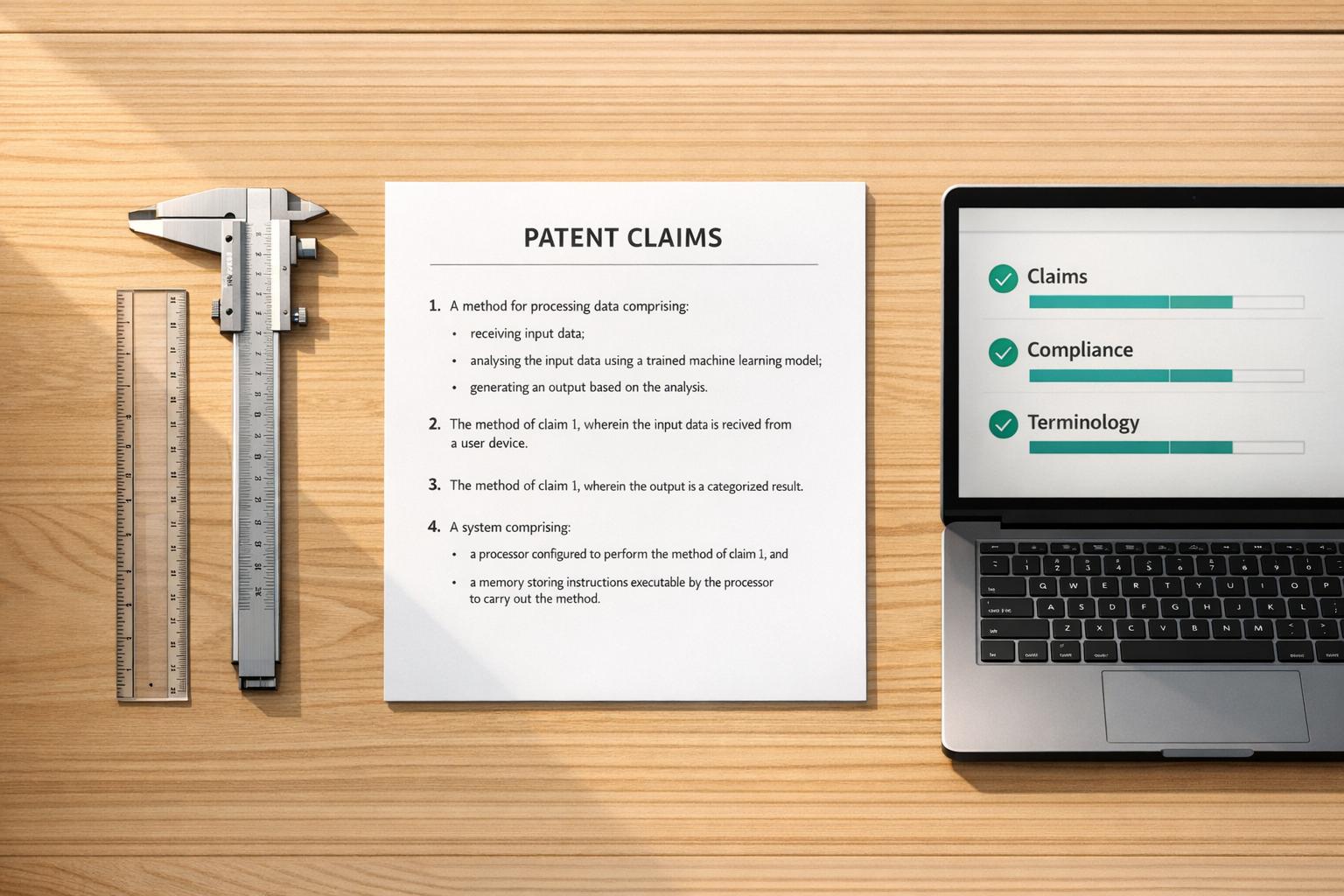
AI is transforming patent drafting by saving time and improving precision. Traditional patent drafting can take 30–40 hours and cost $5,000–$15,000 per application. With over 3 million patent applications filed annually, Top 10 patent tools are becoming essential for streamlining the process while maintaining strict legal and technical standards.
Key takeaways:
Why quality metrics matter: AI-generated drafts must meet structural, legal, and semantic standards to avoid rejections or legal issues. Metrics ensure compliance and highlight errors like ambiguous terms or missing antecedent bases.
Challenges with evaluation tools: General tools like BLEU and ROUGE fail to assess the legal and structural nuances of patents. Specialized frameworks, like PatentScore, address these gaps effectively.
AI's role in patent quality: AI enhances accuracy by flagging inconsistencies, verifying compliance, and simulating examiner scrutiny. It also identifies vulnerabilities, ensuring stronger claims that withstand challenges.
Key metrics to assess AI drafts: Focus areas include claim quality and scope, statutory compliance, and terminology consistency. These ensure patents align with business goals and legal requirements.
Efficiency gains: AI reduces drafting time by up to 40%, cutting costs and boosting first-time approval rates. For example, AI workflows save $5,000–$7,500 per filing and deliver a 350% ROI within 14 months.
AI tools, when paired with attorney oversight, create a powerful combination. They handle repetitive tasks, allowing professionals to focus on strategic elements like aligning claims with market goals and anticipating competitive risks. This approach improves patent quality, reduces costs, and accelerates the drafting process.
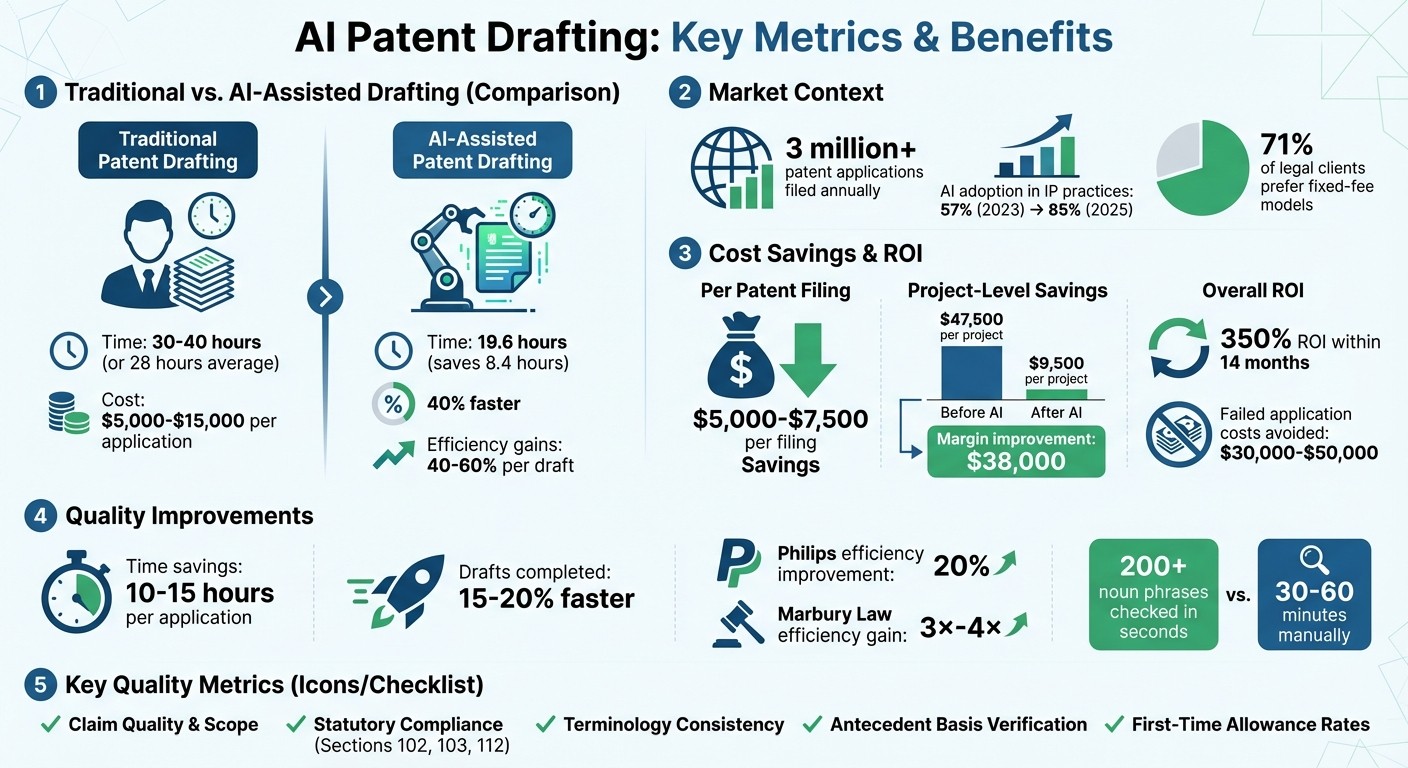
AI Patent Drafting: Cost Savings, Time Reduction, and ROI Statistics
Why Quality Metrics Matter in AI-Assisted Patent Drafting
Quality metrics transform AI from being just a text generator into a reliable partner in patent drafting. Without these metrics, even the most advanced AI might produce claims that look polished but fail to meet the stringent requirements of the USPTO or withstand competitive challenges. By ensuring that every AI-generated draft aligns with key aspects of patent quality - like structural compliance, legal validity, and semantic accuracy - these metrics establish a high standard for drafting patents.
Even small mistakes, such as an ambiguous term or a missing antecedent basis, can lead to rejections, weaken patent protection, or create loopholes for competitors to exploit. Quality metrics act as real-time safeguards, catching these issues before they escalate into expensive problems. They also help avoid misaligned claims, where technically correct language fails to encompass the invention's most commercially valuable features. These complexities underline why rigorous quality metrics are indispensable.
Challenges in Measuring Patent Quality
Applying quality metrics effectively starts with understanding the shortcomings of current evaluation tools. Metrics like BLEU and ROUGE, which measure text similarity, often miss the nuances that make a patent legally robust. These general tools can't detect structural flaws - like improper punctuation, missing antecedent bases, or ambiguous claim scope - that could lead to costly litigation.
Patent quality is inherently multi-faceted. A thorough review must ensure USPTO formatting compliance, consistent terminology across sections, and accurate references to invention elements with a clearly defined scope. However, manually checking all these factors is time-intensive and prone to human error, especially when attorneys are juggling multiple applications.
AI also introduces its own set of challenges, such as phantom features - fabricated elements that the AI might insert to fill perceived gaps in the invention description. If these non-existent components go unnoticed, they could compromise the enforceability of the patent during litigation. The PatentScore framework addresses this issue by evaluating AI-generated claims across structural, legal, and semantic dimensions, achieving a Pearson correlation of r = 0.819 with expert human reviews.
How AI Improves Patent Quality
Despite these challenges, AI plays a critical role in both speeding up the drafting process and enhancing claim quality. It doesn’t just make drafting faster - it brings greater accuracy through automated checks that are hard for humans to maintain consistently. For instance, modern AI tools can flag inconsistencies in terminology, verify antecedent bases in real time, and ensure that every technical detail in the claims is backed by the detailed description. This immediate feedback allows professionals to correct errors on the spot, reducing the likelihood of receiving Office Actions later.
AI's real strength lies in its ability to mimic examiner scrutiny during the drafting phase, often through AI-enabled patent analysis that identifies potential weaknesses early. It can spot areas where claims might overlap with prior art or where vague language could weaken the patent's defensibility. Additionally, AI can test claims against hypothetical scenarios - like alternative materials or designs - to uncover "escape routes" competitors might use to bypass the patent with slight modifications. This proactive approach shifts the focus from fixing problems after the fact to creating claims that are both approval-ready and resistant to challenges.
"AI is most valuable when used as a drafting accelerator, not as the final authority."
Key Metrics for Evaluating AI Patent Drafting
When assessing AI-generated patent drafts, three key metrics stand out: claim quality and scope, statutory compliance, and terminology consistency. Each addresses a unique aspect of ensuring patents are not only legally sound but also strategically aligned with business goals. These metrics form the backbone of reviewing and refining AI-drafted patents, bridging the gap between legal precision and commercial impact.
Claim Quality and Scope
Claims are the heart of a patent - they don't just describe an invention; they protect its competitive edge. Evaluating AI-generated claims means ensuring they align with the features that drive business value, not just technical novelty. A technically accurate claim might still fail if it doesn't cover the elements that give a company its market advantage.
Balancing breadth and precision is a critical part of this process. Claims must be wide enough to block competitors from creating workarounds but precise enough to stand up to prior art challenges. AI tools assist by simulating competitive analysis, essentially viewing claims through the lens of a rival to identify possible loopholes.
Another focus is on functional outcomes rather than specific configurations. By targeting performance metrics or results, AI-generated claims can prevent competitors from achieving the same outcomes through alternative technical means. However, this requires stripping away unnecessary modifiers and overly complex jargon, which can weaken a patent's enforceability. In short, claims must not only meet legal standards but also protect the invention's market position.
Statutory Compliance and Legal Standards
Beyond crafting strong claims, patents must adhere to strict legal requirements. AI tools play a pivotal role here, conducting real-time audits to ensure compliance with Section 112. This includes verifying that every claim term is supported by a clear written description and enablement in the original disclosure. Without this, claims risk rejection for introducing unsupported language.
AI also performs validity checks to identify potential risks under Sections 102 and 103, flagging issues related to novelty and non-obviousness before filing. Additionally, pre-draft audits ensure invention disclosures are complete, covering all necessary technical fields, embodiments, and processes. For example, Rivian's IP team adopted AI-driven workflows in January 2026, achieving improved consistency across their patent portfolio while reducing drafting time and back-and-forth with inventors.
Terminology Consistency and Antecedent Basis
Precision in terminology is non-negotiable. AI tools help identify inconsistencies, such as referring to the same component as "data transfer module" in one section and "file sender" in another. These small discrepancies can lead to USPTO delays or even rejections by creating ambiguity about what the patent protects.
Ensuring language alignment across the abstract, summary, and detailed description is another challenge. AI tracks noun phrases through dependency chains, sometimes spanning five to seven levels deep - something human reviewers struggle to maintain after about 20 minutes of intensive cross-referencing. For context, a single patent application might require over 200 noun phrase verifications against 500 references. AI can handle this in seconds, compared to the 30–60 minutes it takes for manual proofreading.
Real-time error detection also addresses missing antecedent bases, a common issue under 35 U.S.C. § 112(b). Every definite reference using "the" or "said" must have a prior indefinite introduction with "a" or "an." These errors are glaringly obvious in patents and can be exploited by competitors to challenge clarity or enforceability during litigation.
Efficiency and Time-to-Quality Improvements in AI Drafting
AI tools for patent drafting are reshaping the process by significantly reducing timelines without compromising quality. Traditionally, drafting a patent application required around 28 hours of work, but with AI, this can drop to roughly 19.6 hours - saving 8.4 hours per application. This acceleration means that what once took weeks or months can now be completed in mere days or even hours. These time savings not only cut costs but also improve the precision and reliability of submissions, linking faster results with higher-quality outcomes.
Reduced Drafting Time
AI simplifies tasks like analyzing technical documents and verifying terminology, slashing drafting time from 28 hours to 19.6 hours per application. For example, terminology checks that might take hours are completed in seconds. Real-time error detection further eliminates the need to wait for feedback from attorneys or examiners.
By 2025, AI adoption in intellectual property (IP) practices is expected to rise from 57% in 2023 to 85%. Advanced users report efficiency gains of 40% to 60% per draft. Many teams have seen time savings of 10 to 15 hours per application, with drafts completed 15%-20% faster. For law firms operating on fixed-fee models - favored by 71% of legal clients - these efficiency gains directly boost profitability. Internal project costs have plummeted, dropping from $47,500 to just $9,500 per project.
Improved First-Time Allowance Rates
AI doesn’t just save time - it also enhances the likelihood of securing approval on the first attempt. Integrated tools conduct validity searches to flag prior art and potential weaknesses, while automated Section 112 audits ensure claims are well-supported. These proactive checks shift risk management from reacting to rejections to addressing issues during the drafting stage, improving first-time allowance rates. This fusion of speed and accuracy makes AI a valuable asset for meeting the stringent demands of patent filings.
"AI doesn't skip steps. It doesn't get tired. It sees everything - especially the technical stuff that founders often struggle to explain in plain words."
PowerPatent
Setting KPIs for AI Patent Drafting
When measuring the impact of AI in patent drafting, it's crucial to use specific KPIs that go beyond vague claims of "better quality" or "faster work." Instead, focus on metrics that align with your organization's goals - whether that's increasing licensing revenue, enhancing market protection, or improving operational efficiency. A well-rounded approach includes metrics for volume, quality, cost, and timelines to give a complete view of your legal operations. Below, we break these down into two key areas: drafting accuracy and efficiency.
Drafting Accuracy Metrics
Accuracy KPIs focus on minimizing rejections and improving claim quality before filing. For example, tracking reductions in Section 112 rejections - those related to written description, enablement, and definiteness - can be a game-changer. AI tools that verify claim support in source materials can significantly reduce these types of rejections.
Another critical metric is terminology consistency. Pay attention to how often errors like missing antecedent bases or inconsistent technical terms occur across your specifications and claims. Additionally, monitor how well AI tools mitigate prior art risks by flagging issues related to novelty (Section 102) and non-obviousness (Section 103) during drafting. Catching these risks early can save your organization from costly "failed applications", which can incur downstream expenses of $30,000 to $50,000.
Regression testing is another valuable tool. By running historical patent matters through your AI system and comparing the results with previous human-drafted versions, you can identify performance gaps and improvements. Adopting an examiner’s mindset during the review process also helps uncover ambiguities, unnecessary complexity, or overlaps with prior art before filing.
Efficiency and Collaboration Metrics
While accuracy ensures the legal soundness of your claims, efficiency and collaboration metrics measure how AI enhances workflows and team dynamics.
Start with efficiency KPIs like time-to-draft, which tracks the percentage reduction in hours spent per application. Many organizations report saving 10–15 hours per patent application with AI tools. Another useful metric is the change in billable hours, which reflects internal cost savings and improved margins. For instance, one Am Law 100 firm reduced the time spent on a standard project from 100 hours to 20 hours, slashing internal costs from $47,500 to $9,500 and boosting project margins by $38,000.
Collaboration metrics also play a vital role. Track the number of revision cycles between attorneys and inventors - fewer rounds often indicate greater efficiency. AI tools that perform early checks on invention disclosures can streamline this process. Additionally, monitor workflow integration by measuring how often your team switches between tools or completes manual export-import tasks. Embedding AI into tools like MS Word can reduce such disruptions.
Lastly, assess the financial ROI. AI-assisted workflows typically save $5,000–$7,500 per patent filing, while integrated AI analysis can cut $20,000–$30,000 per claim chart. On average, legal AI solutions in patent management deliver a 350% ROI within 14 months. For example, Philips reported a 20% efficiency improvement in drafting and prosecution workflows during a trial period. Similarly, a patent attorney at Marbury Law noted a 3×–4× efficiency gain, allowing the firm to handle fixed-fee work at partner rates with full team support.
"The biggest gain isn't just faster drafts, it's better allocation of legal expertise." - Patlytics
Conclusion
Quality metrics in AI-assisted patent drafting lay the groundwork for creating patents that are not only stronger but also more defensible, all while boosting efficiency. With AI, drafting timelines shrink dramatically - from weeks to mere hours - while common pitfalls that could lead to costly USPTO rejections are flagged early on.
The real magic happens when AI tools are combined with human expertise. By handling tasks like structural verification, AI allows attorneys to focus on the strategic aspects of patent drafting. As PowerPatent puts it, "AI is powerful, but it works best when guided by experienced eyes. When paired with attorney oversight, it's like having both a high-speed engine and a skilled driver." This partnership lets patent professionals concentrate on critical elements like aligning claims with revenue goals and anticipating possible workarounds, all while ensuring consistency and compliance across the document. This collaborative approach strengthens patent claims and keeps them aligned with evolving intellectual property strategies.
On top of improving quality, AI-assisted drafting also delivers financial benefits. By catching errors early and streamlining the prosecution process, these tools can lead to substantial cost savings. Platforms like Patently (https://patently.com) make it easier for patent professionals to integrate these quality metrics into their workflows. Their Generative AI patent drafting tools ensure consistency in terminology, compliance with USPTO standards, and real-time feedback to identify weaknesses before filing. They also help draft broader claims to cover future product variations while flagging formatting issues that could otherwise delay the process.
FAQs
What should I measure to judge an AI patent draft?
To assess an AI-generated patent draft, pay attention to several critical factors:
Accuracy and clarity of claims: Ensure the claims use precise, unambiguous language that clearly defines the invention's boundaries.
Completeness of the description: Verify that the draft thoroughly explains how the invention works, highlighting its distinctive features.
Strategic alignment of claims: Check that the claims are crafted to provide the appropriate level of protection, neither too broad nor too narrow.
Semantic quality: Confirm that the language adheres to both legal and technical standards, creating a strong and defensible patent.
These elements collectively determine the draft's overall quality and its potential to withstand scrutiny.
How can I spot AI “phantom features” before filing?
To spot potential AI “phantom features” before filing, take the time to carefully review the claims. While AI-generated claims might seem polished, they can sometimes fall short in capturing the full scope or critical details of the invention. Pay close attention to ensure the claims are precise and fully address the essential components of the invention to secure proper protection.
Which KPIs best prove AI drafting ROI to leadership?
When evaluating ROI in AI-assisted patent drafting, the most telling KPIs focus on patent quality. Key metrics include patent strength, clarity, and defensibility - all crucial indicators of a well-drafted patent. Another critical measure is error reduction in issued patents, which demonstrates improved accuracy and consistency. These metrics effectively showcase the practical value AI tools bring to the drafting process, making a strong case to leadership.