Top 7 AI Trends in Sustainable Patents
Intellectual Property Management
Apr 14, 2026
Seven AI trends—semantic search, generative drafting, automated workflows and analytics—are transforming sustainable patent research and management.

AI is reshaping patent processes in green technology, driving efficiency and precision. Here's what you need to know:
Semantic Search: AI tools analyze patent content contextually, reducing research time and costs while improving accuracy.
Generative AI: Automates patent drafting tools and predicts trends, helping companies focus on impactful innovations.
Automated Workflows: AI detects errors and simplifies complex tasks, enabling better portfolio management.
Eco-Pharma Patents: AI handles dense patent clusters, aiding in eco-friendly drug development.
Data Analytics: Links patents to global sustainability goals, offering actionable insights for businesses.
Evergreening Detection: Identifies minor, redundant patents, ensuring resources target meaningful advancements.
Tech Scouting: AI accelerates the discovery of emerging green technologies across disciplines.
AI tools like Patently are transforming green patenting by improving research, drafting, and management processes, ensuring faster adoption of impactful technologies.
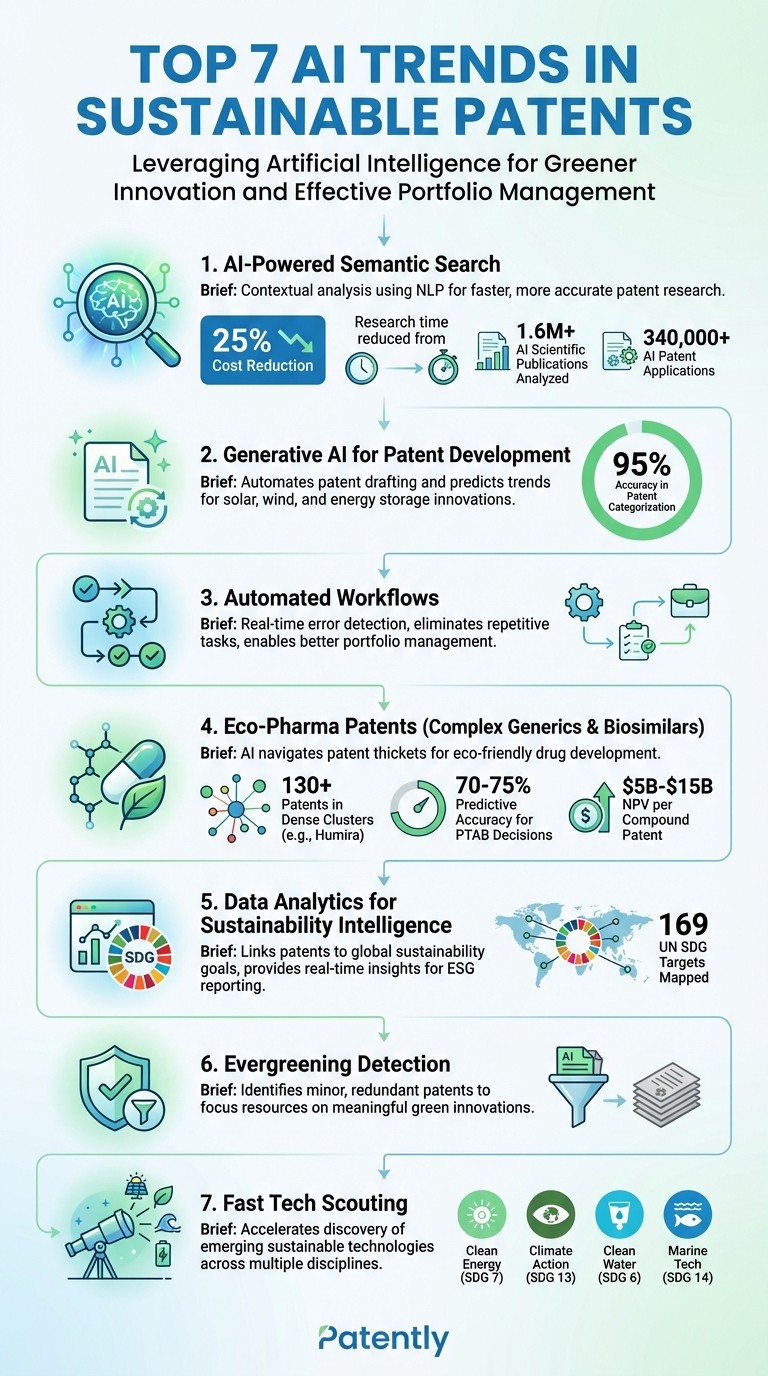
7 AI Trends Transforming Sustainable Patent Management
1. AI-Powered Semantic Search for Green Patent Research
AI-driven Innovation Impact
AI-powered semantic search is changing the game for green patent research. Unlike traditional keyword-based searches that rely on exact matches, semantic search uses Natural Language Processing (NLP) to understand the meaning, context, and technical intricacies of green patents. This is a big deal for sustainability-focused patents, where the same technology might be described with completely different terms depending on the industry or region.
The impact goes beyond just accuracy - it’s about efficiency, too. AI-driven research can cut costs by 25% and reduce research timelines from weeks to mere hours. Considering there are over 1.6 million AI-related scientific publications and nearly 340,000 AI-related patent applications, manually reviewing such volumes is nearly impossible. AI steps in to process millions of records in seconds, making it an indispensable tool for green technology applications.
Application to Sustainability-Focused Patents
Semantic search is particularly effective in tackling the challenges of green technology research, such as vocabulary mismatches. For instance, it can connect terms like "mobile apparatus" and "phone", ensuring relevant prior art isn’t overlooked. It also keeps pace with rapid technological advancements that often outstrip legal terminology. Beyond text, advanced AI techniques can interpret visual elements like chemical structures, formulas, and diagrams - key components in green tech innovations.
Another standout feature is its multilingual capability. Semantic models trained on diverse datasets can link conceptually similar patents across languages. For example, it can match the German term "Datenverarbeitung" with its English equivalent, "data processing". This cross-language functionality helps uncover innovations that might otherwise go unnoticed in traditional search methods.
Efficiency and Scalability Improvements
With the surge in green patent filings, semantic search offers a scalable solution for managing this growth. AI tools allow continuous monitoring of the patent landscape, helping organizations stay informed about new competitors and shifting green regulations. Over time, feedback-driven training further sharpens the precision of these searches.
Semantic tools also reveal unexpected connections between patents in different domains. For example, they might link an AI algorithm used in robotics with a sensor designed for renewable energy systems. These insights can lead to breakthroughs that might not have been obvious otherwise.
Platforms like Patently are already harnessing advanced Vector AI technology to deliver these capabilities. By doing so, they empower patent professionals to navigate the increasingly complex landscape of green technology with unmatched speed and accuracy.
2. Generative AI for Developing Sustainable Inventions
AI-Driven Innovation Impact
Generative AI is reshaping the way sustainable inventions are developed. AI-powered tools now handle the automation of drafting precise patent claims for technologies like solar panels, wind turbines, and energy storage systems. This automation not only ensures compliance with strict patent office requirements but also captures both the technical and environmental aspects of these innovations.
Predictive analytics powered by AI are making waves by forecasting patent performance and identifying emerging technologies. By analyzing trends in patent filings and scientific publications, these tools guide strategic R&D decisions. With classifiers achieving an impressive 95% accuracy rate on gold-standard datasets for patent categorization, organizations can confidently rely on AI to streamline their innovation strategies.
Application to Sustainability-Focused Patents
Clean energy sectors are seeing significant benefits from generative AI. Drafting precise claims is critical in these fields, where navigating complex patent landscapes can be challenging. AI tools excel in creating the "claims" section of patents, ensuring technical details and environmental impacts are well-documented. This capability allows patent professionals to generate multiple claim variations quickly, a game-changer in fast-moving industries. The result? Timely patent protection that aligns with evolving technologies and supports scalable innovation.
Efficiency and Scalability Improvements
Generative AI doesn't just speed up drafting - it transforms R&D planning. By pinpointing high-potential sustainable innovations, AI helps companies make smarter decisions about where to allocate limited R&D budgets. This is particularly crucial in sectors reliant on grants or impact investors, who demand clear evidence of both environmental and financial returns. Tools like Patently are leading the charge by integrating AI-assisted patent creation into their platforms. These tools enable professionals to handle larger volumes of green technology applications, making it easier to scale sustainable innovation efforts across diverse technology domains.
3. Automated Workflows for Green Patent Management
AI-Driven Innovation Impact
AI-powered workflows are changing the game in managing sustainability portfolios by catching errors in real time. For example, these tools can quickly identify mechanical issues like antecedent basis and dependency chain errors, which are common culprits behind § 112(b) rejections during rapid amendment cycles. This is particularly crucial in fast-evolving areas like renewable energy and carbon capture, where technical details can shift frequently and demand absolute precision. By handling error detection, AI allows teams to focus more on driving innovation instead of troubleshooting.
AI is also redefining how teams work. Legal professionals are moving away from repetitive administrative duties and taking on more strategic roles. For instance, patent attorneys can now focus on optimizing portfolios rather than spending time on routine tasks, channeling their expertise toward fostering innovation.
Application to Sustainability-Focused Patents
AI workflows go beyond compliance to tackle the unique complexities of sustainable technologies. Green tech often combines elements from different fields - materials science, electrical engineering, and environmental science - which makes it inherently challenging. AI tools excel here by interpreting technical language across disciplines and uncovering applications that might otherwise be overlooked. Imagine a patent for battery technology: AI could flag its potential relevance for both electric vehicles and large-scale energy storage systems, connecting the dots across industries.
Centralized AI platforms further enhance collaboration by breaking down data silos. These platforms bring together R&D, legal, and sustainability teams, making it easier to showcase both technical advancements and environmental benefits to investors and regulators.
Efficiency and Scalability Improvements
The financial benefits of automated workflows are hard to ignore. Platforms like Patently provide top AI-enabled patent tools for drafting and analytics that simplify repetitive tasks such as prior art searches and OCR processing. By automating these processes, legal teams can manage a higher volume of green technology patents without needing to expand their workforce, saving both time and money. This builds on earlier AI advancements, collectively pushing the boundaries of sustainable patent management.
Relevance to Green Technology Sectors
In sustainability-focused industries, automated workflows are becoming indispensable for meeting regulatory requirements. As frameworks like the SEC's climate rules or the EU's Corporate Sustainability Reporting Directive (CSRD) evolve, AI helps streamline compliance. For example, these tools can automatically align patent portfolios with frameworks like the UN Sustainable Development Goals (SDGs), making it easier to demonstrate progress on sustainability initiatives while staying within regulatory guidelines.
4. AI in Complex Generics and Biosimilars for Eco-Friendly Pharmaceuticals
AI-Driven Innovation Impact
The pharmaceutical industry often wrestles with patent thickets - dense clusters of overlapping patents, such as the 130-plus patents protecting adalimumab (Humira). AI tools are changing the game by automating the analysis of these intricate networks. They can process data on amino acid sequences, host cell lines, and purification methods with remarkable speed. Machine learning models also predict the likelihood of success for Inter Partes Review (IPR) challenges and Paragraph IV certifications, achieving predictive accuracy rates of 70% to 75% for PTAB decisions.
"AI does not replace the patent attorney, the IP strategist, or the drug development team. It removes the computational ceiling that has always constrained how much data those professionals can work with."
This ability to handle massive datasets is essential when tackling the complexities of eco-friendly pharmaceutical patents.
Application to Sustainability-Focused Patents
In the push for eco-friendly pharmaceuticals, AI-driven tools are bridging gaps in chemical language and patent scope. Semantic search, combined with NLP and chemical structure analysis systems like SMILES and InChI, enables AI to identify patents for "green" processes in Active Pharmaceutical Ingredient (API) synthesis. By navigating broad Markush claims, these systems uncover opportunities for sustainable drug production. AI’s cross-lingual capabilities further enhance its reach, allowing it to analyze global filings, including those from China's CNIPA, ensuring compliance and commercial readiness for eco-friendly API synthesis.
AI also identifies evergreening tactics - secondary patents on polymorphs, metabolites, or dosing schedules - that could delay generic competition. This insight helps generic manufacturers streamline their market entry strategies while aligning with Corporate Social Responsibility (CSR) goals. These efforts not only promote transparency but also attract socially responsible investors, supporting the shift toward greener pharmaceutical practices.
Efficiency and Scalability Improvements
In pharmaceuticals, a single compound patent can hold a net present value of $5 billion to $15 billion. AI-powered platforms make it easier to monitor critical resources like the FDA's Orange Book (for small molecules) and Purple Book (for biologics). By automating responses during the crucial 45-day window for Paragraph IV certifications, AI allows legal teams to handle more complex patent workloads without expanding their teams. This combination of efficiency and cost reduction creates room for greater focus on sustainable innovation.
5. Data Analytics for Sustainability Patent Intelligence
AI-Driven Innovation Impact
AI-powered data analytics are transforming how patents are linked to sustainability outcomes. Traditionally, patent systems like the International Patent Classification (IPC) and Cooperative Patent Classification (CPC) have focused on technical details, often neglecting the broader environmental and social impacts. AI bridges this gap by translating sustainability objectives - such as the UN's 169 Sustainable Development Goal (SDG) targets - into the technical frameworks used in patent classifications.
These tools go beyond surface-level connections, uncovering relationships across various classification systems. For instance, when organizations aim to identify "enabling technologies" that advance sustainability goals but aren't explicitly labeled as "green", AI-driven semantic analysis reveals these hidden links. Techniques like weak supervision further enhance the accuracy of training datasets, even when labeled data are limited.
Application to Sustainability-Focused Patents
In February 2024, Merck KGaA utilized an AI-driven platform to evaluate the environmental and social impacts of its research and development efforts. The initiative focused on aligning smart home patents with the UN Sustainable Development Goals, offering clear, data-based evidence of progress for sustainability reporting. Around the same time, Siemens integrated AI-powered SDG analyses into its Annual Reports, providing stakeholders with concrete, data-supported insights into its technological contributions to global sustainability. This marked a shift from traditional narrative-based ESG reporting to more measurable, data-driven disclosures.
Another milestone occurred in June 2025, when the European Patent Office introduced an advanced AI engine at its CodeFest event. Using tools like SBERT and graph-based modeling, the system identifies "idea gaps" for startups and helps policymakers track emerging technologies' alignment with the UN 2030 Agenda. This approach enables companies to discover untapped opportunities within specific SDGs, paving the way for new investments and R&D areas that conventional methods might miss.
These examples highlight how AI is reshaping the way patents are mapped to sustainability goals, offering deeper insights and more actionable intelligence.
Efficiency and Scalability Improvements
Modern AI platforms now provide real-time, weekly updates on global patents, replacing the slower, manual review processes of the past. This shift from static reports to dynamic AI dashboards allows organizations to stay aligned with rapidly evolving sustainability targets and regulatory requirements, such as the EU's Corporate Sustainability Reporting Directive (CSRD) and the SEC's climate disclosure rules.
The efficiency gains have been striking. For example, in 2023, the Böllhoff Group, which operates in 25 countries, implemented advanced AI tracking systems to monitor its Scope 1 and Scope 2 emissions. Within weeks, specialized software enabled transparent CO₂ accounting, significantly improving its sustainability management. By automating the alignment of patent portfolios with ESG frameworks, generative AI has drastically reduced the manual effort that once required weeks of work - allowing R&D teams to focus on impactful innovations.
Building on these advancements, platforms like Patently Know use AI-driven analytics to streamline patent research and enhance sustainability insights. This empowers organizations to drive innovation while meeting environmental goals, enabling faster, more informed decisions in green technology markets.
6. AI-Based Evergreening Detection in Green Technology Patents
AI-Driven Innovation Impact
Patent evergreening, where minor tweaks are used to extend patent protection, has long been a challenge in intellectual property. In green technology, this practice can slow down the adoption of much-needed sustainable solutions. AI is stepping in to change the game by identifying which patents represent genuine breakthroughs and which are simply slight modifications.
By analyzing patent claims, technical details, and filing patterns, AI systems can pinpoint filings that offer little to no real improvement over existing technologies. These tools dig into relationships between patents and compare technical features to uncover incremental changes. This process helps stakeholders focus their attention on meaningful innovations that truly advance green technology, ensuring resources are directed where they matter most.
Application to Sustainability-Focused Patents
AI’s ability to detect evergreening plays a key role in refining sustainability-focused patent portfolios. Organizations can identify patents that add little value - essentially "dead weight" - and streamline their portfolios to prioritize impactful innovations. This approach not only frees up resources but also ensures that R&D budgets are allocated to projects with the potential to drive real progress.
For companies managing large green patent portfolios, this analysis is a game-changer. It also enhances decision-making when exploring licensing opportunities or evaluating competitors. By clearly identifying which players are leading in innovation, businesses gain a sharper competitive edge in the green tech space.
Efficiency and Scalability Improvements
Traditionally, spotting evergreening required patent attorneys to manually sift through filing histories, claims, and technical details - a time-consuming task that could take weeks. AI has slashed this timeline, enabling organizations to analyze entire portfolios quickly and at scale. This efficiency is vital as companies face increasing pressure to back up their sustainability claims with real action, not just marketing buzz.
Platforms like Patently offer AI-powered tools that help legal and R&D teams evaluate the true value of green technology patents. By automating the detection of incremental filings, these tools free up patent teams to focus on strategic decisions and investments in technologies that genuinely support sustainability goals.
Your Patent Strategy Might Be Outdated in 2026
7. Fast Tech Scouting for New Sustainable Solutions
The rise of semantic search, generative AI, and automated workflows has paved the way for fast tech scouting, a game-changing trend in identifying sustainable solutions.
AI-Driven Innovation Impact
Tech scouting, the process of spotting emerging technologies, used to be a time-consuming endeavor. It often required combing through thousands of documents to draw connections between different innovations. AI has completely reshaped this process, enabling faster and more efficient identification of sustainable solutions by analyzing massive patent databases and uncovering patterns in record time.
This speed is critical as advancements in sustainable technologies, like renewable energy, carbon capture, and water purification, continue to accelerate. Companies must stay ahead by monitoring developments in real time. With AI-powered tech scouting, organizations gain the intelligence they need to seize opportunities before their competitors. This trend builds on AI's earlier applications in semantic search and workflow automation, expanding its role in driving sustainability-focused innovation.
Relevance to Green Technology Sectors
AI-driven tech scouting is particularly effective in fields that blend multiple disciplines - areas where traditional patent classification systems often fall short. Green technologies frequently combine elements of chemistry, biology, engineering, and materials science, making them harder to categorize using conventional methods. For instance, a breakthrough in sustainable packaging might involve biodegradable polymers, nanotechnology, and advanced manufacturing techniques, spanning several patent categories that manual searches might miss.
The impact of AI tech scouting is evident across various sectors. Clean energy (SDG 7) and climate action (SDG 13) are seeing significant growth in patent activity, with industries like utilities, renewable energy, automotive, and carbon capture showing strong momentum. Similarly, clean water technologies (SDG 6) remain critical in areas like chemistry and environmental engineering. Emerging fields like marine technology and biotech under SDG 14 (Life Below Water) are also gaining attention. By tracking these fast-moving sectors, organizations can pinpoint where the next wave of sustainable innovation is likely to emerge.
Efficiency and Scalability Improvements
The efficiency gains from AI-powered tech scouting are hard to overstate. Semantic search tools have replaced manual keyword filtering, allowing patent teams to focus on contextually relevant green technologies without wading through irrelevant results. Platforms like Patently use Vector AI to quickly analyze complex patent portfolios and identify trends that align with specific R&D goals.
As the volume of patents continues to grow, scalability becomes increasingly important. AI systems can process millions of patents each week, mapping them to UN Sustainable Development Goals and highlighting which technologies are gaining momentum. This automation reduces the need for large research teams, freeing up patent professionals to focus on strategic decisions. The rapid insights provided by these tools enable smarter choices in licensing, partnerships, and R&D investments.
Conclusion
AI is reshaping the way patent professionals approach sustainable innovation. From streamlining searches with advanced semantic tools to accelerating patent drafting using generative AI, these technologies are turning routine tasks into opportunities for strategic growth. They allow patent teams to spot emerging green technologies faster, manage portfolios more efficiently, and make smarter, data-driven decisions that align with both business objectives and environmental priorities.
This shift is happening across industries, with real-world examples showing how companies have used AI to drive environmental and social impact. These cases highlight the strategic advantage of adopting AI-driven solutions. As Tomas Karger, Partner at Marks & Clerk, aptly puts it:
"Patent pooling and licensing initiatives hold the potential to accelerate the commercialisation of new technologies and in doing so, promote faster deployment of green AI solutions".
Platforms like Patently are at the forefront of this evolution. With features like AI-assisted patent drafting, Vector AI-powered semantic searches, and comprehensive analytics, they enable teams to focus on high-value green assets while simplifying portfolio management. These tools not only help professionals analyze complex patent landscapes quickly but also reveal sustainability trends, empowering them to prioritize innovations that make a meaningful environmental impact.
The future of sustainable patenting lies in how effectively teams embrace these AI capabilities today. Whether it’s identifying the next big breakthrough in carbon capture or managing renewable energy patents, the right tools can transform raw data into actionable insights that drive innovation and support a greener future.
FAQs
How does semantic search find better green patent prior art than keywords?
Semantic search improves the process of identifying green patent prior art by leveraging natural language processing (NLP) and semantic analysis. Unlike traditional methods that rely on exact keyword matches, semantic search understands the context and meaning behind inventions. This allows it to uncover relevant patents, even when varying terminology or technical jargon is used, bridging gaps that keyword-based searches often miss.
Can generative AI draft patent claims without risking rejection or weak scope?
Generative AI has the ability to draft patent claims at a rapid pace. However, without detailed review and a deep understanding of context, these claims may fall short in strength or risk rejection. AI often misses the mark when it comes to grasping problem-solving context and the intricate legal subtleties that are vital for creating enforceable and well-rounded claims. This makes careful human oversight a must to maintain quality and ensure compliance.
How can AI map a patent portfolio to the UN SDGs for ESG reporting?
AI leverages semantic analysis, natural language processing (NLP), and detailed patent taxonomies to connect patents with specific United Nations Sustainable Development Goals (SDGs). This allows for identifying patents that support areas such as clean energy or climate action. By mapping patents to SDG targets, organizations can evaluate the impact of their research and development efforts, monitor progress, and align their innovations with broader sustainability objectives. This approach offers clear, data-backed insights that enhance ESG reporting and guide strategic decision-making.