AI Patent Drafting vs. Manual Drafting
Intellectual Property Management
Feb 14, 2026
AI-assisted vs manual patent drafting: faster first drafts, lower costs, fewer errors, and why a hybrid AI-plus-attorney workflow is ideal.
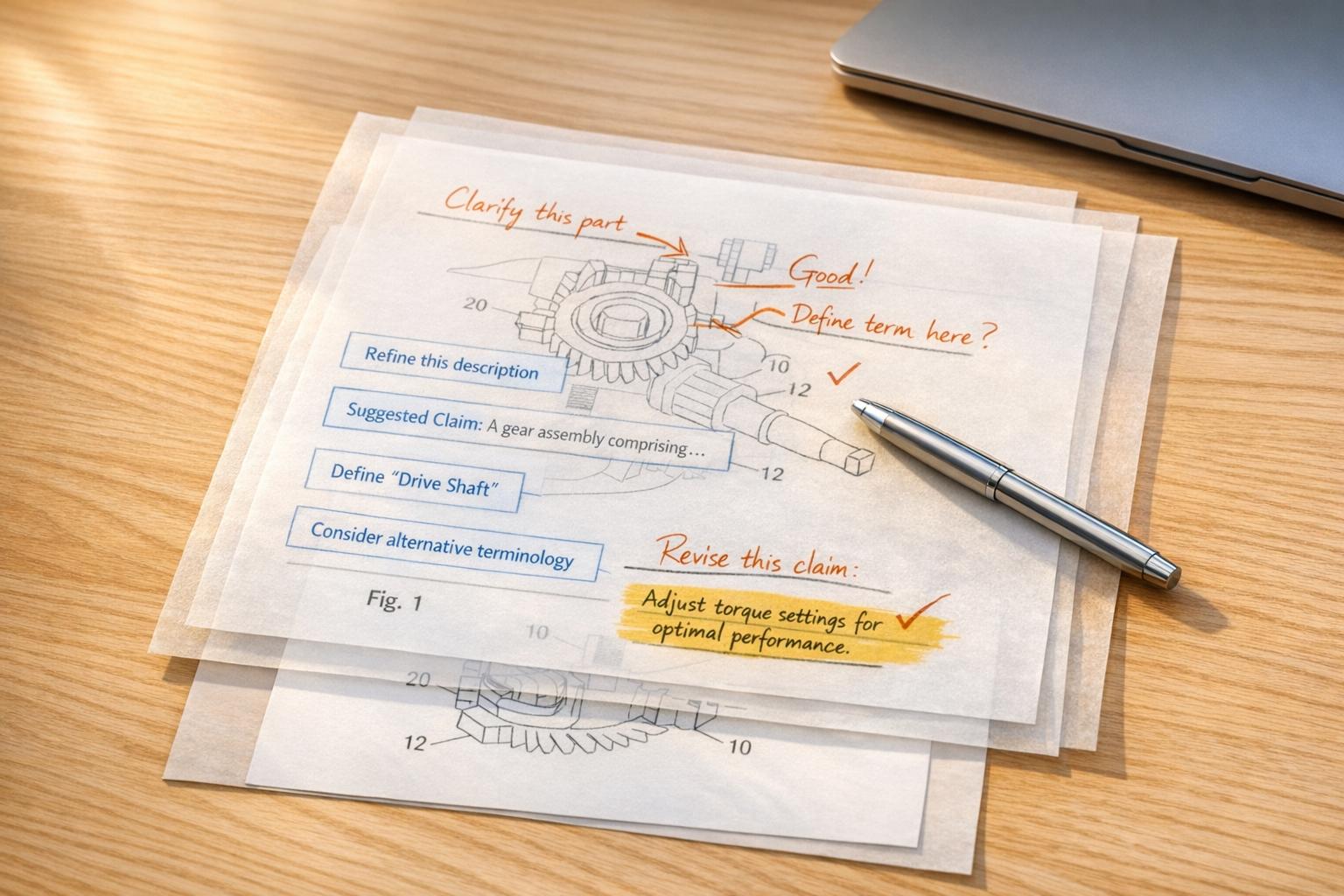
AI-assisted patent drafting is transforming how patent applications are created, offering faster timelines, reduced costs, and fewer errors compared to manual drafting. Here's what you need to know:
Time Savings: Generative AI patent drafting tools cut drafting time by 60–80%. A first draft that takes 25 hours manually can be completed in 12 hours or less using AI.
Cost Efficiency: Manual drafting costs $5,000–$40,000 per application, while AI tools start as low as $79.
Error Reduction: AI minimizes common issues like antecedent basis errors and inconsistent terminology, which are frequent in manual drafts.
Scalability: AI allows firms to handle more applications annually without adding staff, improving productivity and profitability.
Quick Comparison
Criteria | Manual Drafting | AI-Assisted Drafting |
|---|---|---|
Time for First Draft | 25 hours | 12 hours or less |
Cost Per Application | $5,000–$40,000 | $79–$299 |
Error Rate | Higher, prone to inconsistencies | Lower, with automated checks |
Annual Capacity | 10–15 applications per attorney | 13–20 applications per attorney |
Turnaround Time | 4–8 weeks | Minutes to days |
AI tools are not replacing human expertise but enhancing efficiency by automating repetitive tasks. This hybrid approach - AI for speed and humans for strategy - offers the best of both worlds, making patent drafting more accessible and effective.
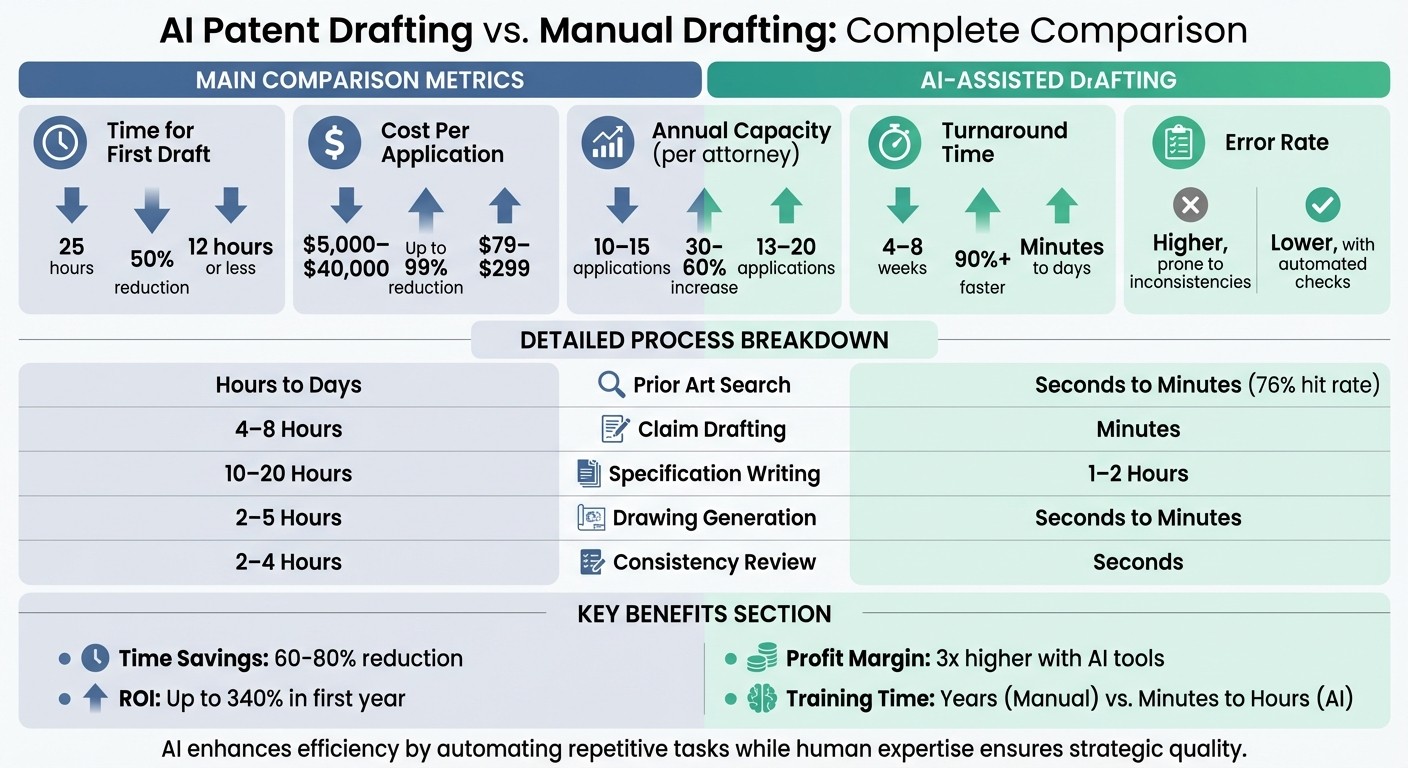
AI vs Manual Patent Drafting: Time, Cost, and Efficiency Comparison
AI-Assisted Patent Drafting Is Here (FULL DEMO)
Speed and Efficiency Comparison
Let’s dig into the specifics of how AI transforms the timelines for patent drafting. The difference between manual and AI-assisted methods is striking. For example, the average time to complete a first draft drops from 25 hours using traditional methods to just 12 hours with AI - a 50% reduction. Drafting a traditional utility patent often takes 20 to 40 hours of focused attorney work, with complex cases like software or biotech sometimes exceeding 60 hours. By contrast, some AI tools can produce a provisional application skeleton in under 10 minutes. Below, we’ll break down how AI speeds up each step compared to manual efforts.
Manual Drafting Timelines
When drafting patents manually, every stage demands significant time and effort. For instance, prior art searches can stretch from hours to days as attorneys sift through USPTO databases, scientific articles, and competitor filings. Writing claims alone can take 4 to 8 hours, followed by 10 to 20 hours for crafting the detailed specification to ensure enablement. Preparing drawings adds another 2 to 5 hours, and conducting consistency reviews - checking details like antecedent basis and reference numerals - requires an additional 2 to 4 hours. These cumulative steps explain the lengthy timelines associated with manual drafting.
AI-Powered Drafting Timelines
AI tools slash these timelines by automating repetitive and time-intensive tasks. For example, prior art searches that once took days now finish in seconds to minutes, with AI achieving a 76% hit rate on relevant references. Claim drafting, which used to require hours, is now completed in minutes, with AI generating multiple drafts for attorney review. Specification writing drops from 10–20 hours to just 1 to 2 hours, as AI expands claims into detailed descriptions automatically. Drawing creation is nearly instantaneous, and consistency checks that previously required hours of proofreading are completed in seconds.
In January 2025, PowerPatent showcased this speed advantage live at CES. Attendees watched as an application skeleton - including claims and descriptions - was generated in under 10 minutes. Attorneys then refined the draft instead of starting from scratch. Similarly, an AmLaw 100 firm reported reducing total project time from 100 hours to just 20 hours, translating to an 80% reduction in labor.
These advancements not only save time but also pave the way for greater accuracy and cost savings in patent drafting. The table below highlights the step-by-step time reductions.
Time Comparison Table
Drafting Step | Manual Timeline | AI-Assisted Timeline | Time Savings |
|---|---|---|---|
Prior Art Search | Hours to Days | Seconds to Minutes | ~75% reduction |
Claim Drafting | 4–8 Hours | Minutes | Significant reduction |
Specification Writing | 10–20 Hours | 1–2 Hours | Significant reduction |
Drawing Generation | 2–5 Hours | Seconds to Minutes | Substantial reduction |
Consistency Review | 2–4 Hours | Seconds | Minimal time required |
Total First Draft | 25 Hours | 12 Hours | 52% reduction |
Overall Completion | 4–8 Weeks | Minutes to Days | 50–80% reduction |
Accuracy and Error Reduction
Precision is just as critical as speed when it comes to patent drafting. Errors - whether it's a typo, a missing antecedent, or inconsistent terminology - can derail the entire process. These mistakes not only delay the prosecution of a patent but also weaken the strength of the claims. A single inconsistency, like switching between "control unit" and "controller", can lead to rejections or even compromise the enforceability of the patent. Alarmingly, around 90% of patent applications receive a non-final rejection from the USPTO, often due to issues like inconsistent claim scope, antecedent basis errors, or gaps in the specification.
Common Errors in Manual Drafting
Drafting patents manually is a detail-heavy process, requiring attorneys to juggle multiple elements at once. This makes it prone to errors such as antecedent basis mistakes, formatting problems, claim dependency issues, and even mislabeling of figures. These errors can result in rejections or procedural delays. For example, antecedent basis errors - like using "the" to refer to something that hasn't been introduced with "a" - are among the most frequent technical mistakes. Claim dependency mishaps, where numbering is incorrect or references to parent claims are flawed, are another common problem. Even figure labeling can go wrong; referencing "Fig. 3C" when no such figure exists causes unnecessary confusion and triggers formal correction notices. To tackle these challenges, AI tools now offer automated solutions that minimize these errors significantly.
How AI Reduces Errors
AI tools provide a systematic approach to error reduction by automating critical aspects of patent drafting. They ensure consistent terminology throughout the document, instantly flag missing antecedent bases, and synchronize figure references to avoid mismatches. For instance, AI tools can automatically enforce uniform language, eliminating inconsistencies that could weaken claims. Antecedent basis verification happens in real time, catching issues before they escalate into rejections. Platforms like Patently also synchronize part references and figure numbers across the entire draft.
Additionally, AI integrates compliance standards for major patent offices, including the USPTO, EPO, JPO, and WIPO. This means drafts are adjusted automatically to meet local legal requirements. Elizabeth M. Manno, a partner at Venable LLP specializing in IP litigation, highlights this capability:
"AI enhances the accuracy of patent drafts and prior art searches by reducing errors and ensuring accuracy".
To illustrate the effectiveness of AI in this space, Solve Intelligence conducted a performance audit in October 2024, testing their Patent Drafting Copilot against five years of EQE Paper A questions (2019–2024). The results were striking: the specialized AI tool scored an average of 80%, compared to just 38% for GPT-4o. On the 2021 EQE paper, the domain-specific AI outperformed the general-purpose model by a factor of four.
The table below shows how AI-assisted drafting dramatically reduces common errors.
Error Comparison Table
Error Type | Manual Drafting | AI-Assisted Drafting | Reduction |
|---|---|---|---|
Antecedent Basis | High risk; requires manual cross-checking | Automatically flagged | Near elimination |
Formatting Errors | Common; leads to procedural delays | 100% compliance via templates | Complete prevention |
Terminology Consistency | Frequent inconsistencies weaken claims | Strict consistency enforced | Near zero occurrence |
Claim Dependencies | Jumbled numbering causes rejections | Auto-renumbered and validated | Eliminated |
Figure References | Mismatched labels create confusion | Synchronized automatically | Eliminated |
Spelling/Grammar | Occasional human oversight | Linguistically flawless output | Near zero |
Cost and Resource Efficiency
AI-assisted patent drafting isn't just about accuracy - it's also a game-changer for cost efficiency. The financial difference between traditional manual drafting and AI-assisted methods is striking. For instance, drafting a provisional application through a small IP boutique firm typically costs between $5,000 and $10,000. At large law firms, this can skyrocket to $15,000–$40,000 or more. These fees reflect attorney hourly rates ranging from $300 to $750, with drafting times spanning 28 to 60 hours per application. By cutting costs while also improving speed and accuracy, AI-assisted drafting offers a clear advantage.
Manual Drafting Costs
Traditional drafting is a resource-heavy process. It demands an average of 28 hours of work at hourly rates of $300–$750, leading to high labor costs. The process includes multiple inventor meetings, detailed cross-checking, and repetitive formatting tasks. For firms working under fixed-fee arrangements - a preference for 71% of legal clients - this often results in a "write-off problem." Attorneys may spend more hours than budgeted, leading to lost revenue and tighter profit margins.
AI-Assisted Drafting Cost Benefits
AI-assisted drafting tools completely transform the economics of patent preparation. These platforms significantly reduce drafting time and resource needs. For example, some AI tools have reported a return on investment (ROI) of up to 340% in the first year, while cutting drafting times by an average of 70% and saving around $4,500 per patent application. In one study, an AI tool reduced the standard 28-hour drafting process to about 19.6 hours, freeing up 8.4 hours per application for more strategic work. This efficiency allows attorneys to handle 13–20 applications annually, compared to the traditional 10–15, enabling firms to lower fixed fees by roughly 20% while still boosting profit margins.
Platforms like Patently's Business+ and Law Firm+ plans automate time-consuming tasks such as drafting detailed descriptions, preparing figures, and formatting. This lets attorneys focus on higher-value activities like claim strategy and technical positioning. By addressing the "write-off problem", these tools help firms maintain profitability on fixed-fee projects while delivering faster results to clients.
Cost Comparison Table
The table below highlights the dramatic cost advantages of AI-assisted drafting, further emphasizing its efficiency.
Cost Factor | Manual Drafting | AI-Assisted Drafting | Savings |
|---|---|---|---|
Per-Application Cost | $5,000 – $40,000+ | $49 – $299 (tool cost) | Up to 99% reduction |
Attorney Time Required | 28 – 60 hours | 8 – 15 hours | 60–80% reduction |
Hourly Rate | $300 – $750 | Flat fee or subscription | Predictable pricing |
Turnaround Time | 4 – 8 weeks | Minutes to a few days | 90%+ faster |
Annual Capacity (per attorney) | 10 – 15 applications | 13 – 20 applications | 30–60% increase |
Profit Margin (fixed fees) | Low (frequent overruns) | ~3x higher | 200%+ improvement |
Flexibility and Ease of Use
Drafting patents manually is no small feat. It requires years of specialized training to master the technical expertise, legal nuances, and jurisdiction-specific rules. On average, creating a single patent application can take 10 to 40 hours of concentrated effort spread across two to four weeks. Even minor revisions can mean hours of meticulous rework.
Challenges in Manual Drafting
Manual drafting comes with its own set of hurdles. The process is rigid and unforgiving - every change demands careful attention to ensure consistency across claims, specifications, and drawings. This rigidity makes the process not only time-consuming but also prone to errors. It's worth noting that 80–90% of first-time patent applications are rejected by the USPTO, often due to drafting mistakes or unclear descriptions.
AI User Experience and Flexibility
AI tools are changing the game by automating tedious tasks and simplifying the patent drafting process. For instance, Patently’s AI-powered drafting system automatically updates revisions throughout the entire document, saving countless hours of manual cross-checking. With AI, users can create a first draft in as little as an hour. These tools also adapt seamlessly to different jurisdictional requirements, automatically adjusting formatting and terminology for various patent offices with minimal user input.
Reports show that generative AI tools can cut drafting time by 20–40%, with some advanced platforms achieving up to 80% time savings. Instead of spending years mastering the intricacies of drafting from scratch, junior professionals are now being trained to refine and review AI-generated drafts, ensuring they still develop essential skills. This shift makes revisions faster and integrates smoothly into efforts to speed up the patent drafting workflow.
Flexibility Comparison Table
The table below highlights the key differences in flexibility and ease of use between manual and AI-assisted drafting:
Factor | Manual Drafting | AI-Assisted Drafting |
|---|---|---|
Training Time | Years of legal and technical training required | Minutes to hours with user-friendly interfaces |
Revision Speed | Slow, requiring manual cross-referencing | Fast, with automatic updates across the document |
Jurisdictional Updates | Requires manual research and rewriting | Automated adjustments tailored to patent offices |
Error Detection | Relies on manual proofreading, prone to inconsistencies | Real-time automated checks for formatting and logic |
Handling Changes | Rigid and time-intensive | Flexible, with instant updates across the application |
Conclusion: Choosing the Right Patent Drafting Method
Key Findings from the Comparison
AI-assisted drafting has shown to be a game-changer compared to traditional manual methods. Manual drafting often demands significant time investment, while AI tools can reduce drafting time by an impressive 60–80%. On the cost front, AI-powered solutions range from $79 to $1,000 per application, a stark contrast to the $5,000 to over $40,000 typically charged for manual services. Beyond saving time and money, AI also improves consistency and minimizes errors. For instance, in testing, a specialized AI tool achieved an 80% score on marking criteria, compared to only 38% for a general-purpose AI. Additionally, AI-assisted applications have seen a 23% drop in USPTO office actions compared to manually drafted ones.
When AI Outperforms Manual Drafting
The benefits of AI drafting tools are especially evident under tight deadlines or when managing a high volume of filings. Unlike manual processes that can take weeks, AI can produce detailed first drafts in just minutes. For firms operating under fixed-fee structures - a preference for 71% of legal clients - AI tools are crucial for maintaining profitability. As a Chief IP Counsel from a leading biotech company observed:
"Right off the bat, we're saving at least 10 to 15 hours by generating high quality claim sets, and that translates directly into financial savings".
Final Recommendations
To fully leverage the advantages of AI, firms should consider adopting a hybrid approach that combines AI tools with human oversight. A practical way to begin is by running a 30-day pilot in specific technology areas to measure the impact on efficiency and application hours. Platforms like Patently offer AI-powered drafting tools that integrate features like semantic search and project management, ensuring both quality and productivity. With 85% of AmLaw 100 firms already using some form of AI assistance and patent practices reporting an average ROI of 340% in the first year, the real question isn't whether to adopt AI but how quickly you can integrate it into your workflow to maintain a competitive edge.
FAQs
Will the USPTO accept patents drafted with AI?
The United States Patent and Trademark Office (USPTO) does accept patents that involve AI-generated content, but there's a key condition: the inventor must be a natural person. While AI can assist in drafting or developing a patent application, the actual inventorship cannot be attributed to an AI system.
Additionally, applicants must adhere to existing rules regarding disclosure and accuracy. The USPTO has provided guidance to ensure that AI tools are used responsibly throughout the patent process, emphasizing compliance with these established standards.
How much attorney review is still needed with AI drafting?
AI drafting tools simplify the legal drafting process by handling initial tasks with precision and consistency. This reduces the time attorneys spend on extensive reviews, allowing them to concentrate on fine-tuning and strategic decision-making. The result is a more efficient workflow for creating legal documents.
What invention details should I provide an AI tool for accurate drafting?
To create an accurate and well-structured patent draft, it's essential to provide detailed and precise information about your invention. This includes:
Technical Disclosures: Share the technical details that explain how your invention works, including any processes, systems, or components involved.
Key Inventive Concepts: Highlight the unique aspects or breakthroughs that set your invention apart from existing solutions.
Specific Claims or Embodiments: Clearly outline the intended claims or variations of your invention, focusing on what you want to protect legally.
By offering this level of clarity, the AI can better interpret your invention and craft a patent draft that aligns with your goals.