AI in Patent Reviews: Research Insights 2026
Intellectual Property Management
Feb 13, 2026
AI transformed patent reviews by 2026: wider adoption, faster semantic prior-art search, improved claim mapping, automated workflows, and human oversight.
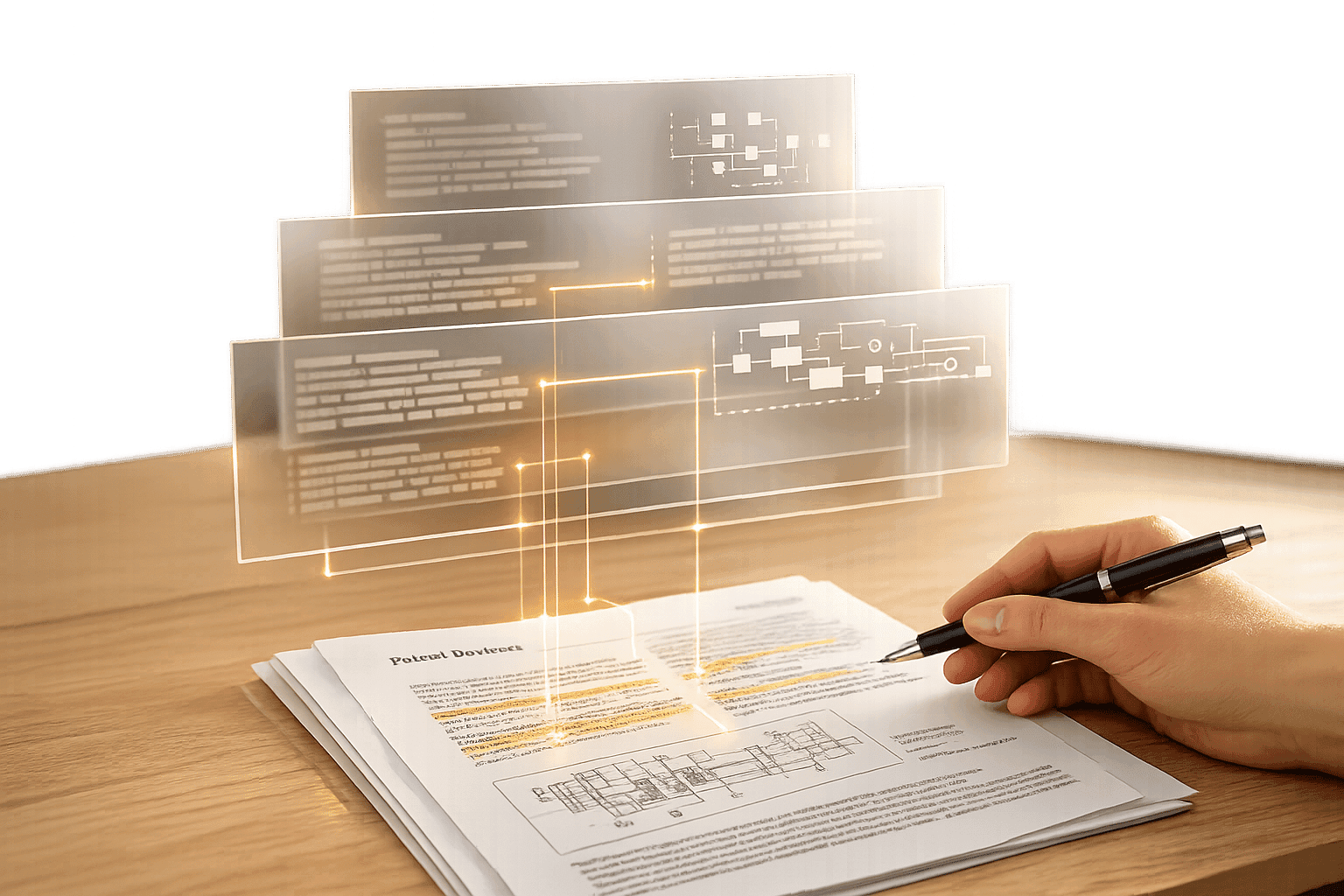
AI is transforming patent reviews, saving time, improving accuracy, and reshaping workflows. Between 2023 and 2025, AI adoption in intellectual property (IP) surged from 57% to 85%, driven by tools that streamline invention analysis, prior art searches, and claim mapping. Key advancements include:
Efficiency Gains: AI frameworks like IPAS‑CARNA improved recall by 14.8% and boosted novelty ranking by 18.2%.
Enhanced Claim Mapping: Tools like PatentMind achieved a 0.938 correlation with expert evaluations, offering deeper semantic understanding.
Automation in Workflows: AI now handles repetitive tasks, but human oversight remains crucial for legal validation.
AI-Assisted Patentability: Systems provide confidence scoring and rank prior art for better prioritization.
Platforms like Patently integrate these technologies into everyday tools, cutting review cycles and improving patent quality. By 2026, leveraging AI will be a baseline requirement for staying competitive in IP management.
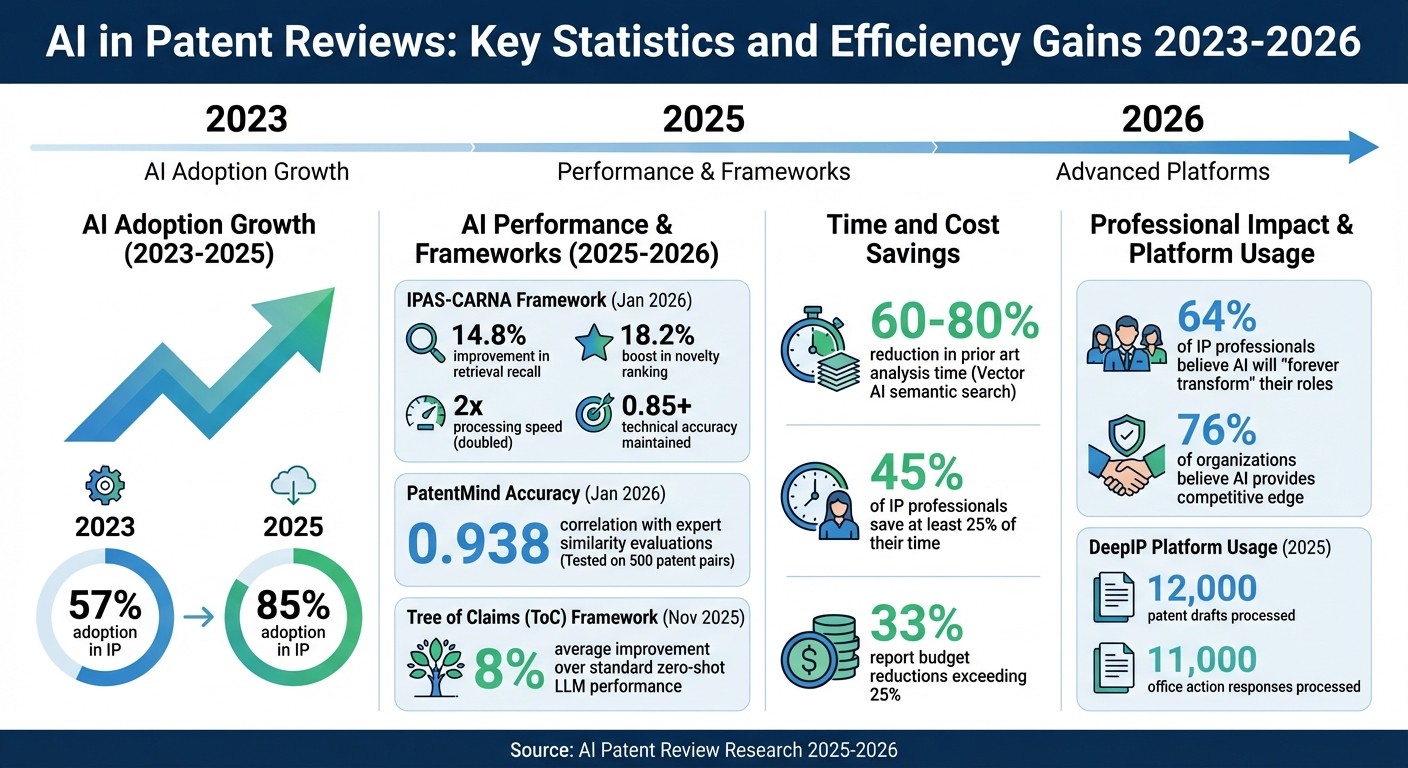
AI in Patent Reviews: Key Statistics and Efficiency Gains 2023-2026
Key Research Findings on AI in Patent Reviews (2025-2026)
Time Savings and Efficiency Gains
AI is transforming the efficiency of patent review processes. In January 2026, researchers Xudong Han and Xiaoyi Qu introduced the IPAS‑CARNA framework, which showcased a 14.8% improvement in retrieval recall and an 18.2% boost in novelty ranking compared to traditional methods. This framework's mechanism-aware optimization not only doubled processing speed but also maintained technical accuracy above 0.85.
By moving from keyword-based searches to semantic analysis, AI has significantly reduced manual iterations. Instead of relying on traditional methods, AI now analyzes complete invention disclosures and draft claim sets, creating consistent search strategies across different terminologies.
"The most meaningful gains in speed, accuracy, and decision quality increasingly come earlier in the workflow - at the level of patent search and prior art discovery." – DeepIP
These advancements in efficiency are also improving the accuracy of claim mapping.
Better Accuracy in Claim Mapping
AI-driven claim mapping has shifted from simple keyword matching to a deeper semantic understanding. In January 2026, researchers Yongmin Yoo, Qiongkai Xu, and Longbing Cao introduced PatentMind, a framework that uses a Multi-Aspect Reasoning Graph (MARG). When tested against a human-annotated benchmark of 500 patent pairs, PatentMind achieved a 0.938 correlation with expert similarity evaluations, thanks to its ability to calculate dimension-specific scores for technical features and claim scopes.
Another major development came in November 2025 with the Tree of Claims (ToC) framework, introduced by Shuyang Yu, Jianan Liang, and Hui Hu. This system combines Monte Carlo Tree Search with a multi-agent setup, where an "EditorAgent" proposes edits and an "ExaminerAgent" provides structured critiques. This approach enhanced novelty and scope optimization by an average of 8% over standard zero-shot LLM performance.
Automation in Team‑Based Workflows
AI has taken over repetitive tasks like claim mapping and generating response templates, but human oversight remains critical for legal and technical validation. Research using the PANORAMA dataset, which includes 8,143 U.S. patent records, highlights that while LLMs excel at retrieving prior art, they still need human involvement for complex novelty and non-obviousness evaluations.
One persistent issue is the "black box" problem - AI systems that cannot explain their reasoning pose risks in legal decision-making. François-Xavier Leduc, CEO and Co-Founder of DeepIP, emphasizes this concern:
"If an AI system cannot explain how it arrived at an output, it introduces unacceptable risk into legal decision‑making."
To address this, modern AI-enabled patent platforms now integrate AI as a decision-support tool, working alongside human expertise rather than replacing it.
New Trends in AI-Driven Patent Review Tools
AI-Assisted Patentability Assessments
AI tools are taking patentability assessments to a new level. As of 2026, these systems now provide continuous confidence scoring, helping patent teams prioritize their workload more effectively. They also rank prior art based on its potential impact on patentability, making the review process more strategic and focused.
One standout development is the rise of agentic search systems. These systems go beyond simple document retrieval by autonomously planning multi-step searches and delivering structured legal intelligence. Through iterative reasoning, they analyze full invention disclosures and generate actionable insights, transforming how patent teams approach their work .
"AI does not simply make patent analysis faster. It changes what enters the analysis altogether." – DeepIP
Another breakthrough is automated invention capture, where AI integrates directly with R&D tools like lab reports and design logs. This integration allows AI to identify patentable concepts in real time, streamlining the invention process and making it easier to capture innovative ideas as they emerge.
Team Collaboration Features and Real-Time Feedback
AI platforms are now seamlessly embedding into everyday productivity tools like Microsoft Word. This integration allows patent attorneys to draft claims, specifications, and office responses directly within familiar software. It supports a hybrid workflow where in-house teams can provide pre-structured drafts to external counsel, cutting down on review cycles.
To illustrate the impact, the DeepIP platform processed 12,000 patent drafts and 11,000 office action responses in 2025 alone, significantly increasing support for intellectual property professionals. Tom Tassignon, Head of IP at Philips, emphasized this shift:
"We think these tools are becoming an indispensable part of the patent attorney's toolkit. They allow us to be much more efficient and also deliver higher-quality work - across drafting, novelty analysis, intelligence, and prosecution."
Another game-changing feature is the introduction of critique agents, or LLM-as-a-Judge frameworks. These specialized AI tools evaluate outputs for accuracy and provide iterative feedback, ensuring that AI-generated content meets rigorous legal standards before it even reaches human review. This level of quality control complements advanced search capabilities, creating a more refined and reliable patent review process.
Semantic Search and Global Prior Art Mapping
AI-driven search methods are evolving to ensure more comprehensive prior art coverage. The industry standard for 2026 is hybrid search, which combines semantic (Vector) search for broad recall with Boolean logic for precise results. This approach bridges vocabulary gaps and reportedly surfaces up to 99% of relevant prior art.
To further enhance coverage, element-wise claim matching has become a critical tool. By breaking down claims into discrete technical features, AI ensures that no essential element is missed. This method also enables cross-domain discovery, uncovering prior art from unrelated fields that use similar concepts or solutions . For patent teams conducting Freedom-to-Operate or novelty searches, this capability adds an extra layer of reliability, minimizing the risk of overlooking critical prior art.
Generative AI in Patent Drafting and Prosecution | Justia Webinars
How Patent Teams Can Use Patently
Patent teams have a powerful ally in Patently, a platform that leverages AI to simplify and improve every step of the patent review process.
AI-Driven Collaboration Tools
Patently's project management tools are designed to help in-house teams produce high-quality first drafts using R&D data, significantly cutting down review times. With features like hierarchical project categorization and access control, the platform ensures drafting workflows and terminology are consistent.
This tool allows patent professionals to collaborate seamlessly on tasks like invention capture, prior art analysis, and patent drafting, all while maintaining strict access controls. By automating invention discovery from R&D data, Patently reduces the reliance on manual submissions.
Beyond its project management capabilities, Patently also offers advanced search tools to make patent analysis faster and more efficient.
Vector AI Semantic Search
Patently’s Vector AI semantic search slashes prior art analysis time by 60–80% compared to traditional Boolean search methods. Using natural language processing, it matches concepts, identifies relevant patents, and bridges gaps caused by differences in jurisdictional terminology.
The platform’s ability to explore multiple technical domains simultaneously is especially useful. Research shows that cross-domain discovery is critical for finding analogous solutions outside an inventor’s immediate expertise. By starting with an invention disclosure rather than rigid Boolean queries, the semantic search provides explainable relevance signals that are crucial for legal defense.
SEP Analytics Tools
Patently also offers SEP analytics tailored for 4G/5G technologies, automating essentiality screening for ICT standards. This is invaluable for licensing strategies and litigation planning. The platform’s quick assessments are equally useful for M&A diligence, as they evaluate standard essentiality across large patent portfolios. This reflects the growing reliance on AI tools to manage patent quality and mitigate legal risks.
Conclusion and Key Takeaways
The Future of AI in Patent Reviews
Between 2025 and 2026, research shows AI has become a cornerstone of patent operations. Its adoption across the intellectual property (IP) landscape surged from 57% to 85% during this period. AI systems have advanced far beyond basic assistance, evolving into tools capable of autonomous reasoning, planning, and decision-making. These tools now handle tasks like monitoring dockets, identifying risks in real time, and executing complex search strategies - all without constant human oversight.
This shift has reshaped the way IP professionals work. A striking 64% of them believe AI will "forever transform" their roles. Processes that were once manual are now automated and continuous. AI can automatically capture inventions by analyzing R&D documentation, conduct prior art searches using semantic understanding rather than rigid keywords, and even generate first drafts of patent applications that teams can refine strategically.
"By 2026, the competitive advantage will not come from simply using AI, but from using AI that meets enterprise standards for trust, transparency, and strategic value." – François-Xavier Leduc, CEO and Co-Founder, DeepIP
These developments highlight why AI is no longer optional for patent teams - it’s essential.
Why Patent Teams Should Adopt AI Tools
AI's transformative potential in patent reviews makes it a strategic necessity for patent teams. The benefits are clear: 45% of IP professionals report saving at least 25% of their time, while 33% note budget reductions exceeding 25%. Furthermore, 76% of organizations believe adopting AI provides a competitive edge.
Using platforms like Patently, patent teams gain access to powerful tools such as advanced semantic search, which identifies relevant prior art that keyword searches often miss. These platforms also automate invention discovery by analyzing R&D data and offer comprehensive Standard Essential Patent (SEP) analytics to support licensing and litigation strategies.
The real question isn't whether to adopt AI but how quickly your team can integrate it into daily workflows to maintain a competitive edge.
FAQs
What parts of patent review should AI handle vs. humans?
AI shines in areas like prior art search, patent classification, and document retrieval - tasks that demand processing massive amounts of data. It’s incredibly effective at analyzing large datasets and handling repetitive processes with speed and precision. That said, humans play a crucial role in more nuanced aspects, such as evaluating novelty and non-obviousness, interpreting reasoning, and making the final calls on patentability. By blending AI’s efficiency with human judgment, this hybrid approach ensures the best balance of accuracy and expertise.
How can teams trust AI results if they’re a “black box”?
Teams can strengthen trust in AI results by prioritizing clarity and thorough validation. This involves making AI decision-making processes more transparent, utilizing tools designed to explain how AI systems work, and establishing clear performance benchmarks to measure reliability. Alongside these efforts, implementing solid audit frameworks, comparing outputs across different models, and maintaining human oversight can tackle uncertainties. Even when AI systems function as "black boxes", these steps can go a long way in building confidence in their outcomes.
What’s the fastest way to add AI to our patent workflow with Patently?
Patently offers AI-assisted tools designed to make patent drafting, semantic search, and project management easier and faster. These tools simplify the process of creating patents, improve prior art searches, and enhance team collaboration. The result? A quicker, more efficient way to adopt AI in your workflow.
Want to dive in? Start by requesting a demo or trial. The platform is built with patent professionals in mind, so you can reduce setup time and focus on getting results.