5 Trends Shaping Patent Data Visualization
Intellectual Property Management
Feb 12, 2026
AI-driven semantic search, interactive citation maps, natural-language queries, real-time dashboards, and predictive analytics turn patent data into strategic foresight.

Patent data visualization is transforming how professionals analyze and use patent information. With millions of applications filed annually, making sense of this data requires advanced patent tools. Here are the five trends redefining the field:
AI-Powered Semantic Search: AI tools now understand concepts, not just keywords, making searches faster and more accurate. Features like clustering and semantic mapping reduce manual work by up to 80%.
Interactive Citation Mapping: Dynamic maps allow real-time exploration of patent relationships, helping users identify trends, gaps, and competitor activities with ease.
Natural Language Interfaces: Users can describe inventions in plain English to generate visualizations, cutting the need for complex search strings.
Real-Time Dashboards: Continuous updates and interactive tools keep teams informed about competitor filings and market changes instantly.
Predictive Analytics: AI tools forecast trends, highlight emerging technologies, and anticipate competitor moves, aiding in strategic decision-making.
These trends are not just improving efficiency - they're changing how businesses approach innovation and competition. AI-driven tools are helping professionals focus on strategy rather than manual tasks, ensuring faster, data-driven decisions.
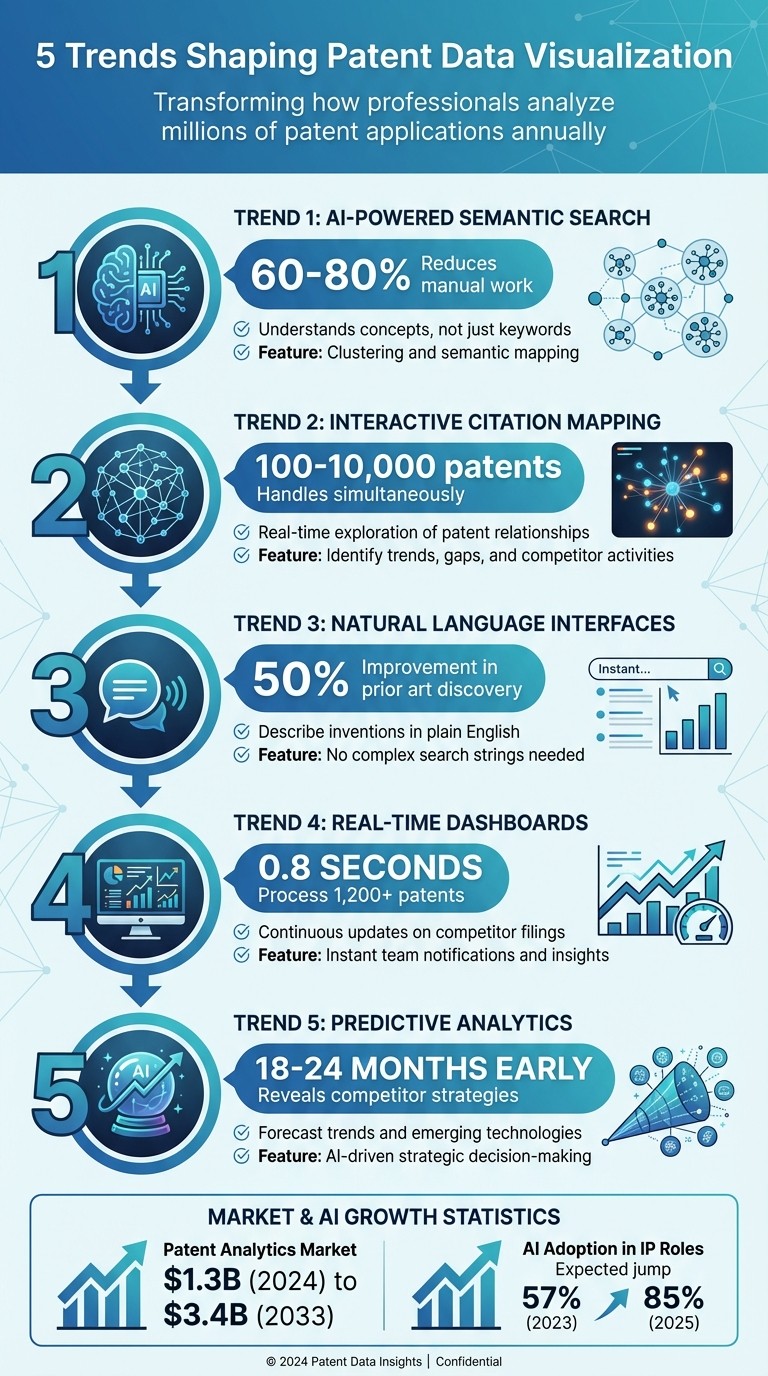
5 Key Trends Transforming Patent Data Visualization in 2024
Using Patent Analytics Dashboards for IP Strategy, Competitor Surveillance, and Portfolio Management
1. AI-Powered Semantic Search and Clustering
Traditional keyword searches often fall short when it comes to capturing variations in terminology. For instance, one inventor might use "battery electrode", while another opts for "electrochemical cell terminal." These differences can lead to missed connections when relying solely on keywords.
Integration of AI and Machine Learning
Semantic search takes a different approach by focusing on understanding concepts rather than just words. Using natural language processing (NLP), it transforms patent text into compact numerical representations, known as vector embeddings. These embeddings help identify similarities and group related ideas in a "semantic space." As DrugPatentWatch puts it:
"AI-powered semantic search does not just find keywords; it understands concepts, enabling searches of unprecedented accuracy, speed, and comprehensiveness."
Algorithms like K-means and hierarchical agglomerative clustering (HAC) take this a step further by creating "innovation landscapes." These landscapes are built by combining textual similarities, citation links, and CPC code descriptions. Advanced systems even integrate multiple data sources into "multifeature networks." The benefits? R&D teams can reduce manual cross-referencing efforts by 60–80% and cut solution scouting time by over tenfold.
User Interactivity and Customization
Forget complex Boolean search strings with endless AND/OR/NOT combinations. Modern systems allow users to input a detailed technical description or invention disclosure in plain language. The result? An interactive landscape that lets you zoom into specific technology areas, highlight key sections, and refresh visualizations to uncover "white spaces" - areas where competitors haven’t filed patents yet.
Platforms like Patently are leveraging Vector AI semantic search to revolutionize how professionals discover concepts. This technology even bridges language gaps by mapping concepts into a universal space, making cross-language prior art searches seamless. Such interactive tools are transforming patent visualization, making the process more intuitive and efficient.
Support for Patent-Specific Workflows
These advanced systems don’t just stop at visualization. They also apply techniques like cosine similarity (≈0.95) and IPC code overlap to eliminate duplicate results and identify prior art with precision. A striking statistic highlights the impact of AI: 26.5% of all patent clusters now include at least one AI-related patent. By automating bulk data processing, these tools free up professionals to focus on strategy and innovation.
2. Interactive Citation Network Mapping
Interactive citation mapping is revolutionizing how we interpret patent citation networks, turning complex webs of connections into actionable insights. These networks illustrate how patents are linked through references - whether looking backward to prior art or forward to newer filings. While traditional static charts often obscured important patterns, interactive maps bring these relationships to life. They allow users to explore, zoom, and filter in real time, making it easier to uncover hidden connections and trends within patent data.
User Interactivity and Customization
Interactive citation maps give users a hands-on way to navigate through vast patent datasets. With a single click, users can zoom from a broad overview down to specific patent details. Hovering over a node provides instant access to key metadata, such as the abstract, assignee, and filing date. Features like brushing and linking make it easy to select a citation cluster and immediately see related dimensions, including IPC classes or applicant rankings. These tools also differentiate between examiner-cited and applicant-cited patents, offering valuable insight into a patent's origins and strategic purpose.
Given the sheer volume of global patent filings, this level of interactivity is indispensable. For example, a study analyzing 2,460 patents related to inductive sensors (filed between 1994 and 2014) highlighted how interactive tools can efficiently manage large datasets. Some platforms even handle datasets ranging from 100 to 10,000 patents at once. Users can further refine their analysis by highlighting specific sections to regenerate visual landscapes, helping to pinpoint areas with low patent density - often referred to as "white spaces". These tools seamlessly integrate into analytical workflows, offering a powerful foundation for advanced patent strategies.
Support for Patent-Specific Workflows
Interactive citation maps go beyond data exploration - they directly support critical patent workflows. For instance, they are invaluable for tasks like Freedom to Operate (FTO) analysis and novelty assessments. Clicking on a node can instantly pull up the original patent document, specific paragraphs, or even claim details. This capability bridges the gap between high-level strategic insights and the granular details needed for legal analysis. As Joan Codina-Filbà, a senior researcher, explains:
Patent information is increasingly important for decision makers. Their demand for exploratory trend and competitor analysis poses new challenges with respect to the processing and visualization of patent data.
These tools also help identify patent thickets - dense clusters of overlapping intellectual property rights that can shed light on competitor behavior, such as cross-licensing agreements or litigation. Researcher Adam Bartkowski notes:
The position of applicants within citation networks seems to be useful in explaining behaviour of the applicants in the marketplace, such as cooperation or patent infringement trials.
3. Natural Language-Driven Visualization Generation
Imagine describing an invention in plain English and instantly receiving detailed patent visualizations. This approach is reshaping how professionals interact with patent data. Instead of relying on complex Boolean searches, users can now type queries like "patents on lithium-ion battery thermal management" and quickly access visual landscapes. This shift to natural language makes patent data analysis more accessible and efficient, building on earlier advancements in AI and interactive mapping.
Integration of AI and Machine Learning
Platforms powered by Large Language Models (LLMs) and Generative AI go beyond simple keyword matching to interpret the deeper semantic meaning of patent claims. Graph-based AI maps the relationships between technical concepts, offering a more connected view of data. As Clarivate explains:
AI isn't here to reinvent classification - it's here to help it evolve.
These AI-driven tools can improve the discovery of relevant prior art by up to 50% compared to traditional keyword searches. This ensures critical references aren't overlooked due to variations in terminology.
User Interactivity and Customization
Natural language interfaces allow users to describe inventions and instantly generate tailored visualizations, such as 3D landscapes or citation maps. AI "co-pilots" assist users in refining their search strategies, acting more like conversational partners than static tools. Users can also create custom taxonomies in plain English, aligning patent data with specific R&D or business objectives, with AI automatically categorizing thousands of patents accordingly.
The growing demand for these tools is evident in the patent analytics market, which is projected to grow from $1.3 billion in 2024 to around $3.4 billion by 2033. AI adoption in intellectual property (IP) roles is soaring, expected to jump from 57% in 2023 to 85% by 2025. Many in R&D-related roles see AI as a "Socratic tool to accelerate insight". Features like Explainable AI (XAI) are crucial, as they clarify the reasoning behind AI-driven connections, ensuring legal defensibility.
Real-Time Data Processing Capabilities
Real-time systems, using webhooks and APIs, push updates straight into interactive dashboards, cutting manual scouting time by up to 75%. For instance, when a competitor files a patent or litigation status changes, visualizations update automatically, ensuring decisions are based on the latest intelligence. This is particularly valuable for Standard-Essential Patent (SEP) analysis and FRAND negotiations, where timely updates are critical.
Organizations leveraging these tools make patent decisions 65% faster. As IP8 LLC puts it:
The future of patent analytics will be about anticipating what comes next... shifting from descriptive analytics to predictive intelligence.
Support for Patent-Specific Workflows
Natural language tools are designed to streamline essential patent workflows, from automated prior art searches to Freedom-to-Operate (FTO) analyses and one-click claim chart generation. These tools can also identify "white space" opportunities by integrating non-patent literature and market data with patent filings. Platforms like Patently combine semantic search with AI-assisted drafting, allowing professionals to move seamlessly from analysis to document creation.
Integration is key. Modern platforms offer API access to embed patent visualizations into existing IP management systems, ensuring insights flow directly into daily operations. To evaluate these tools, test them with real invention disclosures and known prior art to gauge their natural language processing accuracy. The goal is not just faster searches but a complete transformation in how IP data is analyzed and utilized.
4. Real-Time Collaborative Dashboards
Real-time dashboards have reshaped how patent teams work together, turning static reports into dynamic, interactive tools. These dashboards are more than just data viewers - they’re "living tools" that continuously update, providing instant insights into competitor activity and technology trends. For example, when a competitor files a new patent or a key patent changes ownership, the entire team is notified immediately. This eliminates the need for manual exports and delays tied to traditional reporting methods.
User Interactivity and Customization
Modern dashboards are designed for flexibility and deep exploration. They allow users to filter data by factors like technology domain, geography, assignee, and jurisdiction. Features such as "brushing and linking" make it possible to click on a trend line and instantly update related visualizations, like applicant rankings or IPC distributions. Users can also highlight specific clusters to create fresh visualizations, enabling endless opportunities to dive deeper into data patterns. Importantly, every insight generated is fully traceable, ensuring transparency and accountability.
Real-Time Data Processing Capabilities
Speed is a game-changer in today’s fast-paced environment. AI-powered platforms can process data from over 1,200 patent documents in just 0.8 seconds. This rapid processing eliminates the tedious work of cleaning data and exporting spreadsheets, as AI pipelines handle normalization and categorization seamlessly. As noted by Signicent:
Dashboards can be updated in real-time, giving your leadership a living tool for continuous monitoring rather than a one-time snapshot.
This level of automation ensures teams can act immediately, fostering faster decision-making across departments.
Support for Patent-Specific Workflows
By integrating earlier analyses into unified workspaces, these tools encourage real-time collaboration across functions. Search, analysis, drafting, and comparison are all consolidated into a single platform, making insights easily shareable and traceable. Teams can distribute AI-generated landscapes across R&D, legal, and business units, streamlining communication and coordination. Platforms like Patently take this a step further, combining collaboration tools with advanced semantic search and project management features. This seamless integration allows teams to efficiently move from analysis to actionable strategies. With over 60% of businesses using patent analytics for competitive intelligence, this market is expected to grow to $15.69 billion by 2035.
5. Predictive Analytics and Trend Forecasting
Predictive analytics is reshaping patent visualization, shifting it from a backward-looking process to a forward-focused strategic tool. Modern platforms now anticipate competitor strategies, highlight emerging technology clusters, and forecast market changes. This evolution from descriptive to predictive intelligence equips organizations with a clear edge in planning R&D investments and patent filing strategies. At the heart of this transformation are AI techniques that not only analyze historical data but also project future trends.
Integration of AI and Machine Learning
Machine learning models are taking patent analysis to new levels. They can now predict the likelihood of a patent being granted, estimate its economic potential, and even forecast litigation outcomes by analyzing factors like judges, jurisdictions, and involved parties. AI goes a step further by converting unstructured patent text into high-dimensional vectors, enabling visualization tools to cluster patents based on predicted trends instead of just historical similarities.
Consider this: between 2014 and 2023, the number of patent families in Generative AI skyrocketed by over 800%, climbing from 733 to more than 14,000. AI-driven tools have also proven their efficiency, cutting prior-art search time by 60% to 80% and reducing patent maintenance costs by up to 30% through portfolio optimization. Reflecting this momentum, the global patent analytics market is expected to grow from $1.3 billion in 2024 to approximately $3.4 billion by 2033.
Support for Patent-Specific Workflows
Predictive analytics has become an integral part of patent workflows, thanks to real-time updates and user-friendly interfaces. These tools help uncover "white spaces" - less crowded technological areas - by visualizing filing velocities and identifying competitive gaps. This insight allows R&D teams to focus on areas with lower competition and higher growth potential. Using AI-driven network analysis and community detection techniques, companies can spot emerging innovation clusters and track how technologies evolve, moving from isolated developments to integrated frameworks. As IP8 aptly puts it:
The future of patent analytics will be about anticipating what comes next... These frontiers signal a shift from descriptive analytics to predictive intelligence.
Platforms like Patently combine predictive analytics with semantic search and project management tools, enabling teams to transition smoothly from insights to action. Since patents often act as early indicators, real-time analysis can reveal competitor strategies 18–24 months before their products hit the market. This foresight gives companies the chance to design around potential infringement risks or secure licensing agreements well in advance, turning predictive insights into actionable business strategies.
Conclusion
The five trends discussed - AI-powered semantic search, interactive citation mapping, natural language interfaces, real-time dashboards, and predictive analytics - are reshaping how patent professionals approach their work. Patent intelligence has evolved from being a narrowly focused legal function to becoming a proactive business tool. The move from simple keyword searches to AI-driven semantic understanding bridges the "semantic gap", allowing professionals to search based on concepts rather than exact word matches. These advancements are paired with significant market growth, as the patent analytics sector is expected to expand from $1.3 billion in 2024 to about $3.4 billion by 2033.
The role of patent professionals is also transforming. As highlighted by DrugPatentWatch:
AI will manage the scale and speed of data, while humans provide the indispensable strategic oversight, ethical judgment, and nuanced interpretation.
This shift allows professionals to move away from manual data handling toward more strategic tasks like prompt engineering and critical analysis. The result? They can focus on making informed decisions that drive business success. These new visualization tools enhance the predictive and interactive features already in play, creating a cohesive ecosystem for patent intelligence.
For businesses aiming to stay ahead, the takeaway is straightforward: these tools reveal patterns that were previously hidden, enable predictions that seemed out of reach, and open up new possibilities for collaboration. They are ready to be implemented now - embrace them to maintain a competitive edge.
FAQs
How does semantic search find patents beyond keywords?
Semantic search takes things a step further than basic keyword matching. By leveraging AI techniques like natural language processing (NLP) and vector embeddings, it focuses on understanding the deeper meaning and context behind both search queries and patent documents. This means it can pick up on related ideas, synonyms, and contextual connections, even when different terms are used. The result? A more precise and comprehensive search experience that uncovers patents traditional keyword searches might overlook.
What can citation maps reveal about competitors and “white space”?
Citation maps offer a clear view of the competitive landscape by pinpointing areas where innovation is heavily focused and identifying potential “white spaces” - untapped opportunities for growth. They also reveal how competitors are linked through patent citations, shedding light on industry trends and connections.
How do predictive analytics forecast tech and filing trends from patent data?
Predictive analytics leverages AI-powered techniques like machine learning and multimodal data analysis to uncover patterns within patent data. This includes analyzing text, images, and diagrams to reveal hidden insights. These tools enable organizations to visualize trends, group similar patents into clusters, and even forecast upcoming technologies. By examining patent growth and shifts in innovation, businesses can stay ahead of industry changes and make smarter strategic choices. This approach turns traditional patent analysis into a forward-thinking tool for monitoring technological progress.