Semantic Clustering for Patent Labels with AI
Intellectual Property Management
Feb 11, 2026
AI groups patents by concept, replacing brittle keyword searches and making labeling and landscaping faster, more accurate, and scalable with expert oversight.
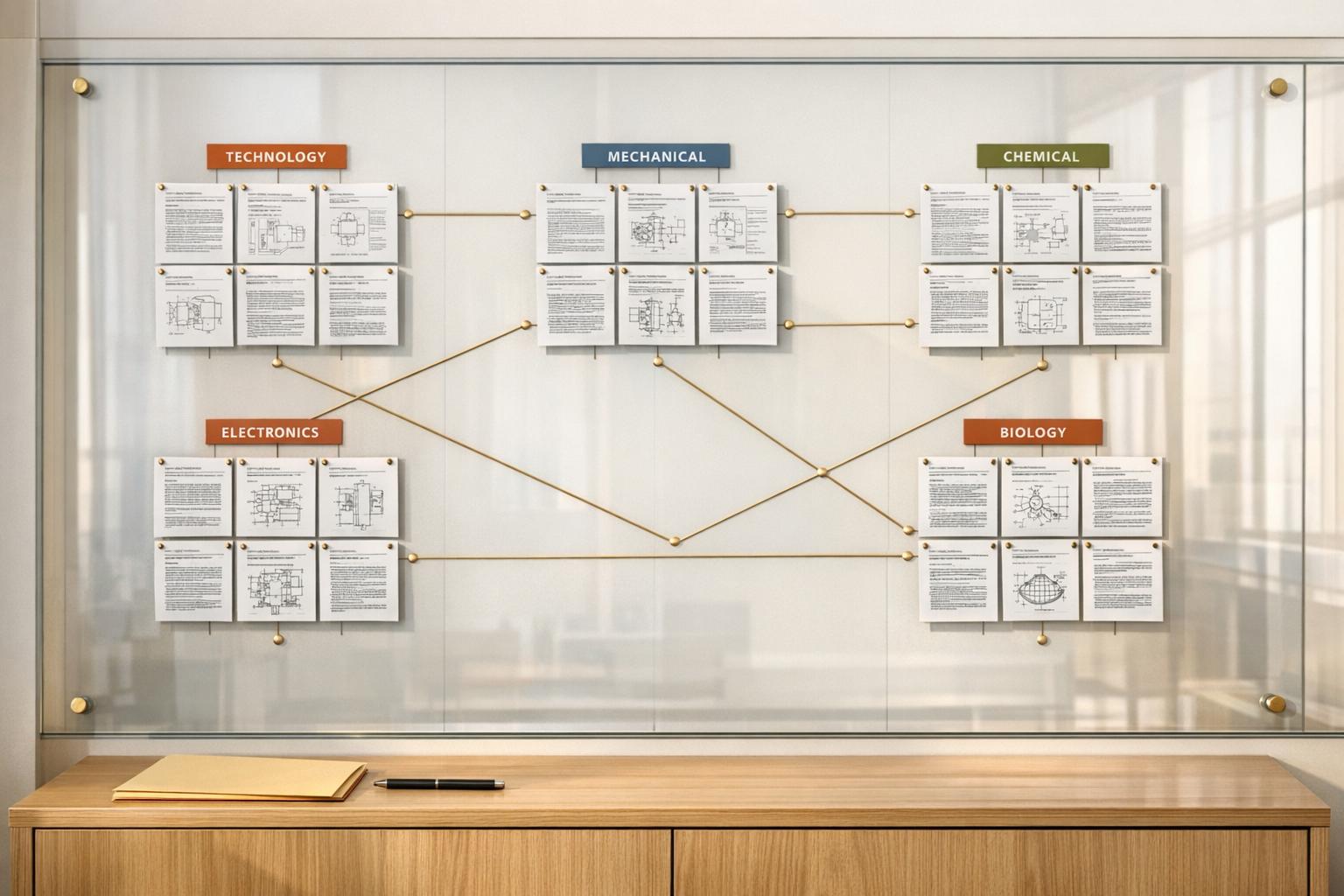
Semantic clustering is changing how patents are analyzed. Instead of relying on outdated keyword searches, this AI-driven method groups patents by their core ideas, even when different terms are used. This approach is a cornerstone of the top patent tools currently used by IP professionals. Here's what you need to know:
What it solves: Traditional keyword-based methods miss connections between patents using varied language. Semantic clustering identifies similarities based on meaning.
How it works: AI models like PatentSBERTa process patent text into numerical vectors, enabling clustering by conceptual similarity. Claims sections often yield the best results.
Performance: PatentSBERTa achieved a 66% F1 score for classification and 91% accuracy in clustering tasks - outperforming older models like TF-IDF.
Applications: Automates tasks like patent landscaping and classification, saving time and improving precision.
Challenges: Handling millions of patents, legal jargon, and vague descriptions requires combining AI with expert input.
AI is making patent analysis faster and more precise by focusing on concepts rather than words.
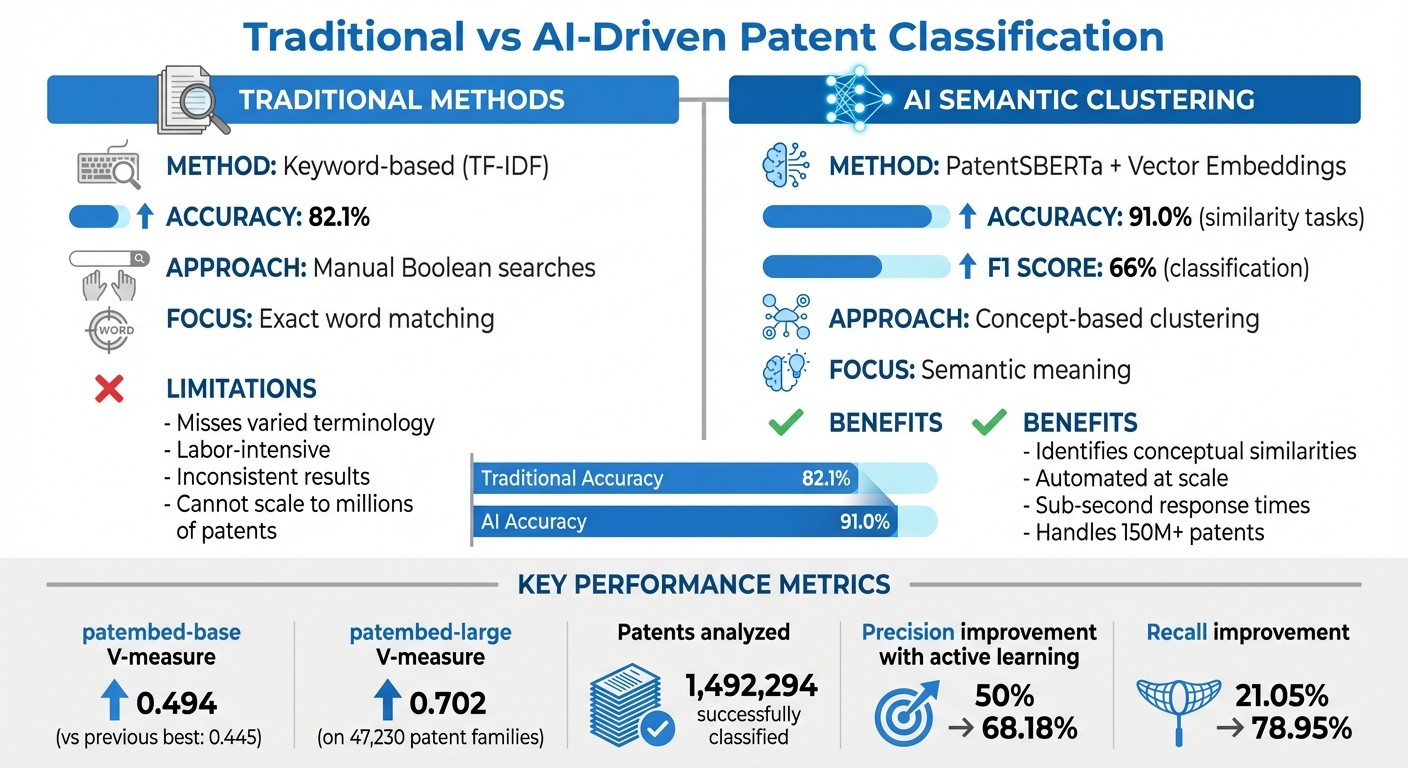
AI vs Traditional Patent Classification Methods Performance Comparison
AI Methods for Semantic Clustering
Vector Embeddings and Natural Language Processing
Semantic clustering starts with transforming patent text into numerical vectors that computers can process. These vectors, or embeddings, place each patent in a high-dimensional space where distances between points reflect how conceptually similar the patents are. However, general NLP models need adjustments to handle the technical and legal complexities of patents. These complexities are also being addressed by generative AI patent drafting tools that streamline the creation of high-quality applications. That’s where PatentSBERTa comes in - a fine-tuned version of SBERT specifically trained on patent claims. Using this model along with a KNN approach, researchers successfully predicted CPC classes for 1,492,294 patents, achieving an F1 score exceeding 66%.
The section of a patent analyzed also plays a critical role. Claims, for instance, often produce more accurate embeddings than titles or abstracts because they define the invention's technical boundaries. Hybrid models take this further by combining textual embeddings with metadata, such as CPC labels, to improve clustering accuracy. Some advanced techniques even use phrase graphs to connect patents with their citations, blending localized text analysis with a broader network context.
With these embeddings in place, clustering algorithms can group patents based on their conceptual similarities.
Clustering Algorithms for Patent Data
Once patents are represented as vectors, clustering algorithms can group them into meaningful clusters. While traditional methods like K-Means and Hierarchical Clustering remain useful, newer approaches - such as Deep Embedding Clustering (DEC) and KNN-based systems - are better equipped to handle the complexities of patent data. Patent text presents unique challenges, including specialized technical language and deliberately vague descriptions, which can lead to out-of-vocabulary issues.
Modern systems tackle these challenges by using dimensionality reduction techniques like t-SNE or PCA to compress sparse data into simpler forms. Deep learning models, particularly Transformer-based ones like BERT, XLNet, and RoBERTa, are especially effective. They automatically extract higher-level features from text and capture the long-range dependencies often found in lengthy patent documents.
These clustering techniques create a foundation for refining results using established classification codes.
Using IPC and CPC Codes
Text-based clustering becomes even more precise when paired with IPC and CPC codes. These codes act as a structural framework, helping validate models, define seed sets, and refine clusters. In semi-supervised patent landscaping, algorithms use these codes to expand from a small set of seed documents to a larger pool by identifying overrepresented technological categories.
For example, the patembed-large model achieved a V-measure of 0.702 when clustering 47,230 IPC-coded patent families, while the patembed-base model reached a V-measure of 0.494 on the MTEB BigPatentClustering.v2 benchmark - outperforming the previous best score of 0.445. However, these classification codes have limitations. As noted by Bergeaud Antonin and Verluise Cyril:
"Standard classifications by IP offices are constructed with technical attributes in mind and frequently deviate from an economist's interpretation of a technology. Designed primarily for engineers, these classifications emphasize techniques over functional applications".
AI-driven semantic clustering helps address these gaps by treating these codes as starting points rather than definitive labels. This allows the system to bridge functional similarities that technical classifications might overlook. In 2022, Subhash Pujari and colleagues showed that combining full patent text with CPC-based embeddings produced the best outcomes for real-world patent landscaping tasks.
Active Learning and Human-AI Collaboration
Improving semantic clustering often requires a mix of active learning, expert feedback, and iterative refinements to address AI misclassifications and clarify tricky technical language.
Iterative Refinement Workflows
Active learning boosts AI clustering by integrating human feedback to zero in on the most informative examples. Instead of relying on massive pre-labeled datasets, this approach targets patents the system struggles with - usually those near the decision boundary - and asks experts to step in for labeling. This method, known as uncertainty sampling, sharpens model performance over time.
Take the example from February 2025: researchers at the United States Patent and Trademark Office, including Nicholas A. Pairolero and Andrew A. Toole, applied this method to the Artificial Intelligence Patent Dataset (AIPD) 2023 update. By retraining the model after every 10 annotations near the 50% decision threshold, they saw precision jump from 50% to 68.18%, while recall soared from 21.05% to 78.95%. This shows how regular retraining with carefully selected data outperforms relying on a single, large dataset.
Another example comes from July 2024, when Tisa Islam Erana and Mark A. Finlayson at Florida International University introduced "Patentify", an annotation tool. Remarkably, it achieved a 0.75 F1 score using just 24 human-labeled examples. These cases highlight how targeted, iterative feedback can significantly enhance AI's clustering accuracy.
Incorporating expert input into these workflows takes things further, addressing subtle complexities that AI alone might miss.
Adding Domain Expertise to Clusters
Human expertise is essential for refining patent clustering, especially given the deliberate vagueness and jargon often found in patent texts. As Arousha Haghighian Roudsari and colleagues from PatentNet explain:
"The deliberate usage of vague and new terms in patent documents are intended to protect and keep as broad as possible rights..."
Experts help by reviewing AI-generated clusters and using techniques like constrained clustering. For example, they might apply "must-link" rules to group related patents or "cannot-link" rules to separate unrelated ones. This process allows for renaming, merging, or splitting clusters to better align with the nuanced realities of technology.
Consider the International Patent Classification (IPC) system, which includes around 67,000 labels at the sub-group level. While comprehensive, these rigid classifications often fail to capture how economists or business analysts view technology applications. Human oversight bridges this gap, ensuring that the clusters reflect practical, real-world insights rather than just strict technical categories.
Applications and Benefits
Using advanced semantic clustering and active learning techniques, these tools are reshaping how patents are managed. Instead of relying on keywords, they focus on understanding concepts, making patent analysis more efficient and scalable. This shift is crucial given the sheer volume of patents. For example, the USPTO issued its ten-millionth patent in 2018 and crossed the eleven-million mark just three years later. Annual patent grants have also surged from 177,312 in 2002 to 361,435 in 2022, making traditional manual methods increasingly impractical. Automated solutions are no longer optional - they're essential.
Patent Landscaping and Trend Analysis
Patent landscaping is all about identifying patents within a specific technology area. It’s a key step for understanding competition, innovation trends, and market opportunities. Historically, this process relied on Boolean searches and manual reviews, which often proved costly and inconsistent. As Abood and Feltenberger aptly pointed out:
"Building patent landscapes is often seen as more of an art than a science... making reproducing and updating landscapes difficult while methodologies may be inconsistent or difficult to explain."
Semantic clustering offers a better way. By starting with a seed set - a small sample of relevant patents - AI models can identify thousands of related documents automatically. This approach captures subtle technical details that keyword searches often miss. The result? Faster and more consistent landscapes that can be updated effortlessly as new patents are filed.
Automated Patent Labeling
Classifying patents manually is another time-consuming and error-prone task, requiring deep technical expertise. Automated systems using neural landscaping have proven to be highly accurate, even with minimal human intervention. Hybrid models that combine text embeddings with metadata further enhance classification accuracy. By focusing on challenging cases - those near decision boundaries - these systems minimize manual work while maintaining precision.
Tisa Islam Erana and Mark A. Finlayson highlighted the growing demand for automation in this area:
"Traditionally, constructing patent landscapes is intensely laborious and expensive, and the rapid expansion of patenting activity in recent decades has driven an increasing need for efficient and effective automated patent landscaping approaches."
This automation allows organizations to scale their operations without a corresponding rise in costs.
Patently's Semantic Clustering Features

Patently takes these advancements a step further by embedding semantic clustering throughout its platform, delivering real-world benefits for patent professionals. Its Vector AI semantic search uses deep neural embeddings to find patents based on meaning, not just keywords, capturing technical similarities that traditional methods overlook.
The AI drafting assistant, Onardo, applies semantic understanding to suggest precise language and identify related patents during claim drafting. For SEP (standard-essential patents) analytics, semantic clustering uncovers relationships among patents in 4G and 5G technologies, mapping out licensing landscapes and technical interdependencies.
All these tools are seamlessly integrated into Patently's project management platform, enabling teams to organize findings, track citations, and collaborate on strategies. By automating what was once a manual, labor-intensive process, Patently empowers professionals to focus on higher-level tasks. These capabilities pave the way for tackling the remaining challenges in AI-driven patent clustering.
Challenges and Future Developments
Semantic clustering for patent labeling is riddled with obstacles. Multi-class classifiers, for example, falter when tasked with managing the enormous number of labels found in systems like the IPC or CPC. The USPTO-2M dataset, which contains 2 million records, illustrates the sheer scale of this challenge. As Dan Li and colleagues noted:
"Classification-based models face challenges in scaling to large numbers of labels, struggle with generalizing to new labels, and fail to effectively utilize the rich information and multiple views of patents and labels".
Another hurdle lies in the nature of patent documents themselves. These texts are filled with dense legal and technical jargon, making it tough for standard semantic similarity methods to perform effectively. Zhuoyi Peng and Yi Yang highlighted this issue:
"As patent documents employ legal and highly technical language, existing semantic textual similarity methods that use localized contextual information do not perform satisfactorily in inferring patent phrase similarity".
To complicate matters further, many systems fail to account for essential structural details, such as citation relationships and the logical flow of patent claims - elements that are crucial for accurate categorization. These linguistic and structural complexities make it even harder to scale AI models to handle the vast and intricate taxonomies of patents.
Scalability Issues
AI models face significant hurdles when attempting to adapt to new and emerging technology areas with novel labels. In May 2024, researchers at LREC-COLING introduced a multi-view ranking method that aggregates four distinct ranking models. This approach, tested on datasets like USPTO-2M and CLEF-IP-2011, demonstrated a marked improvement over existing baselines in handling large-scale label sets. However, even with these advancements, maintaining accuracy while scaling to millions of patents remains a daunting task.
In addition to these technical challenges, the need for human oversight adds another layer of complexity.
Automation vs. Human Oversight
Fully automated systems often stumble when dealing with borderline cases, leading to misclassifications. On the other hand, manually reviewing the sheer volume of patents is simply not feasible. A balanced approach - combining automation with targeted human oversight - has shown promise. By focusing human effort on the most uncertain cases, systems can significantly boost accuracy while keeping manual intervention to a minimum. This selective strategy highlights how expert input can complement automation to improve classification performance.
Future AI Improvements for Patent Clustering
Overcoming these challenges requires stepping beyond traditional text-based methods. Future AI systems are likely to integrate advanced techniques, such as citation and co-reference graphs, to refine label hierarchies. For instance, the CSPC-LA model, introduced in November 2025, demonstrated the potential of structural graph learning. Tested on the latest USPTO datasets, this approach outperformed conventional text-only methods. As Mengting Gui and colleagues emphasized:
"Existing methods mostly focus on general texts like titles and abstracts, thus ignoring the key technical content claims and the corresponding citation relationships".
Looking ahead, advancements could include the use of global contextual information through phrase graphs, self-supervised learning tailored to niche technical fields, and enhanced multilingual capabilities. These innovations aim to achieve the kind of nuanced and efficient patent clustering that mirrors the understanding of human experts.
Conclusion
AI-driven semantic clustering has transformed the way patent professionals handle labeling and classification. Traditional CPC labels often scatter related technologies across multiple classes, focusing primarily on technical attributes rather than broader functional applications. In contrast, AI groups patents based on high-level goals and tasks, offering a more intuitive and practical view of the patent landscape.
The results speak for themselves: Feature Vector Space Models (FVSM) achieved an impressive 91.0% accuracy on patent similarity tasks, significantly outperforming the 82.1% accuracy of traditional TF-IDF methods. Additionally, the "patembed-base" model set a new benchmark with a V-measure of 0.494 on the BigPatentClustering.v2 dataset, surpassing the previous record of 0.445. These advancements drastically cut down the manual workload for IP professionals, enabling them to navigate a global database of over 150 million patents with sub-second response times - something manual curation simply cannot match.
But it’s not just about speed. AI-driven clustering uncovers connections that traditional classifications often miss. Semantic classes, especially when overlapping clusters are allowed, better reflect citation patterns than traditional technological classes. This enhanced perspective helps professionals identify emerging trends, discover untapped opportunities, and perform more precise Freedom to Operate analyses.
These advancements lay the groundwork for integrated platforms designed to streamline patent workflows. Tools like Patently are leading the charge, incorporating advanced semantic search powered by Vector AI and fostering collaborative workflows that blend automation with human expertise. By using domain-adapted models and hybrid classification techniques, these platforms provide the precision that IP professionals demand while significantly reducing the time spent on routine tasks.
Looking ahead, the future of patent management will rely on effective human-AI collaboration. Machines will handle the scale and speed of data processing, while experts bring the strategic insight and domain knowledge needed to ensure accuracy and maintain legal defensibility. This partnership between humans and AI not only enhances efficiency but also ensures the balance of automation and expert oversight that is essential in the complex world of intellectual property.
FAQs
How do I choose which patent sections to embed (claims vs. abstract)?
When deciding whether to embed claims or abstracts, it all boils down to your goals for semantic clustering. Abstracts give you a concise, high-level overview, which works well for broader categorization or tasks like prior art searches. On the other hand, claims dive into the detailed legal and technical specifics, making them perfect for precise, in-depth analysis. For tasks that demand both a wide context and technical depth, combining the two can provide a more well-rounded perspective.
Which clustering method works best at million-patent scale?
Recent studies indicate that knowledge graph-based clustering can efficiently process data on a scale of millions of patents. However, the research does not provide detailed performance comparisons between this method and other clustering approaches.
How much expert review is needed to make clusters defensible?
The level of expert review needed for reliable semantic clusters varies depending on the situation. Typically, blending automated techniques with human validation improves both accuracy and consistency. Adding a layer of expert oversight helps ensure the clusters meet their intended goals and maintain reliability.