Lifecycle Analysis for Sustainable Patents
Sustainable Innovation
Feb 10, 2026
Use patent data and AI to run prospective life cycle assessments, predict environmental impacts of emerging technologies, and inform sustainable design.
Patents can help identify environmental challenges early. By using lifecycle analysis (LCA) methods, companies can evaluate the environmental impact of new technologies from their inception to disposal. This process, guided by ISO standards, leverages patent data to predict resource use, emissions, and sustainability outcomes. Here's what you need to know:
Lifecycle Analysis (LCA): A method to assess the environmental impact of a product from raw materials to disposal.
Patent-Based LCA: Uses patent data to model future environmental impacts of emerging technologies, even at early stages.
Key Patent Data: Includes technical specs, geographic trends, citations, and maintenance fees to assess innovation potential.
AI Tools: Automate patent searches, analyze citations, and improve the accuracy of environmental modeling.
Why it matters: Patent-based LCA helps businesses refine designs early, reducing costs and environmental harm. Top patent tools and AI streamline the process, making it faster and more precise. However, challenges like incomplete patent data and strategic filings remain. Future research should focus on integrating emissions data and broader sustainability metrics.
Environmental Sustainability & Data: Life Cycle Assessments
Patent-Based Prospective LCA Explained
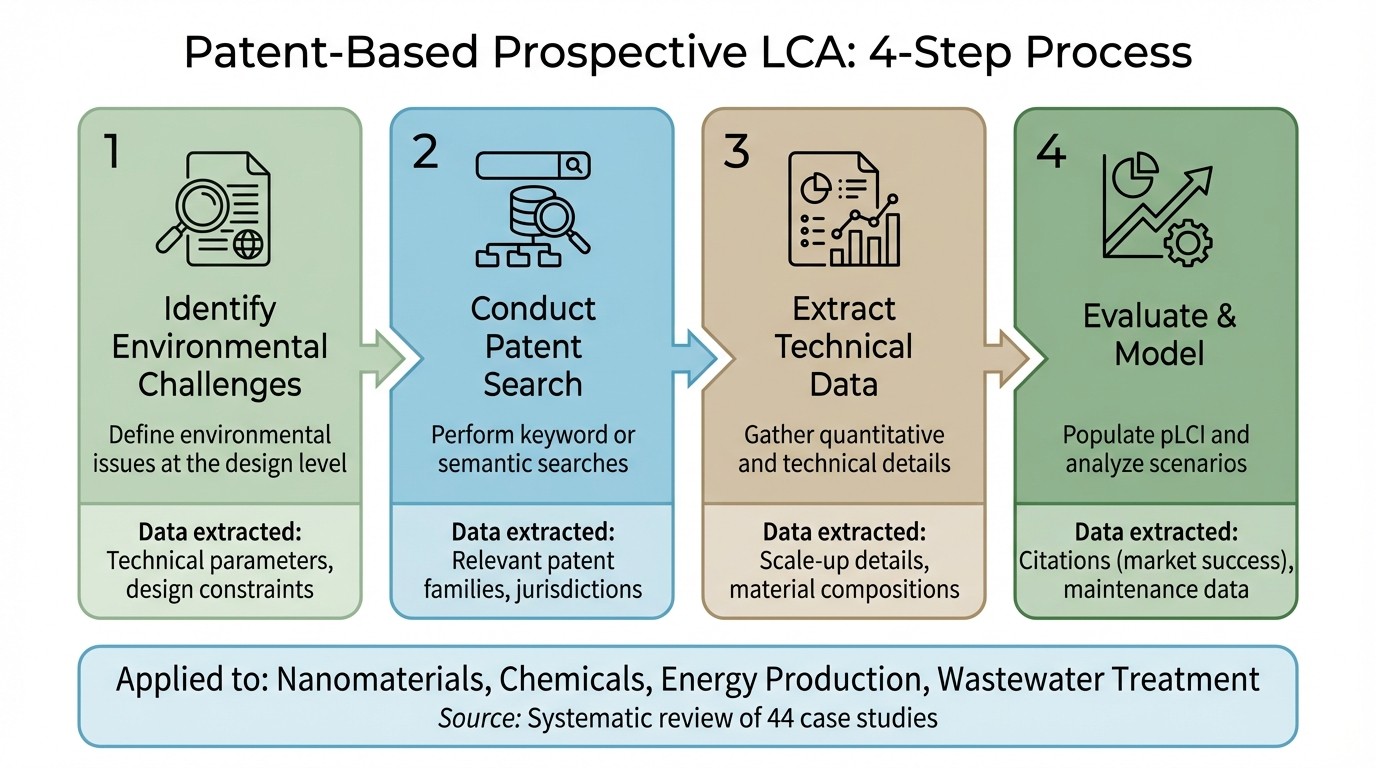
4-Step Patent-Based Prospective LCA Process for Sustainable Technology Assessment
Patent-based prospective Life Cycle Assessment (LCA) focuses on analyzing emerging technologies during their early development stages, modeling them as if they were already in industrial production. This forward-looking method helps pinpoint environmental challenges before they become embedded in the technology's design.
"An LCA is prospective when the (emerging) technology studied is in an early phase of development (e.g., small-scale production), but the technology is modeled at a future, more-developed phase (e.g., large-scale production)."
Rickard Arvidsson
Patents play a key role in this type of LCA. They offer technical details and design specifications that are often unavailable elsewhere. When experimental data is limited or experts are hard to consult, patents become the primary resource for building the "foreground system" - the specific new technology being evaluated. A systematic review of 44 case studies showed that prospective LCAs are commonly applied to fields like nanomaterials, chemicals, energy production, and wastewater treatment.
Steps in Patent-Based Prospective LCA
This approach follows a structured process to extract environmental insights directly from patent documentation.
The first step is identifying environmental challenges tied to specific design features and parameters. This detailed examination enables precise improvements rather than broad, generalized changes.
Next is the patent search phase, where researchers use keywords or semantic tools to locate relevant patent families. They analyze factors like geographical jurisdictions, publication trends, and patent maintenance costs to narrow down the scope and identify the most promising technologies.
The third step involves data extraction. Researchers pull quantitative details, such as material compositions and scale-up parameters, to build a prospective Life Cycle Inventory (pLCI). Finally, they evaluate and model the technology using predictive scenarios to account for uncertainties in its future development.
Step | Action Required | Data Extracted from Patents |
|---|---|---|
Problem Identification | Define environmental issues at the design level | Technical parameters, design constraints |
Patent Search | Perform keyword or semantic searches | Relevant patent families, jurisdictions |
Data Extraction | Gather technical and quantitative data | Scale-up details, material compositions |
Evaluation | Populate the pLCI and analyze scenarios | Citations (for market success), maintenance data |
This method not only highlights technical challenges but also offers insights into potential environmental benefits.
Benefits of Using Patents for LCA
Patents provide a unique advantage by offering early access to technical data about emerging technologies. Unlike academic journals, which often lag behind, patents reveal design details early, allowing companies to make adjustments while changes are still manageable and cost-effective.
"In patents, solutions at the level of detail of design features and technical parameters can actually be found and evaluated at this level through prospective LCA."
Christian Spreafico, University of Bergamo
Additionally, patents help ensure compliance with ISO 14040 and ISO 14044 standards. They also include bibliometric indicators, like citation counts and maintenance fees, which can predict which technologies are more likely to succeed in the market. This combination of technical depth and market foresight makes patents an invaluable resource for assessing the environmental impact of new technologies.
Patent Data That Supports Lifecycle Analysis
Patents are a treasure trove of information for conducting lifecycle assessments (LCA), especially when used to predict the environmental impact of emerging technologies. They provide data points that help define the scope of assessments, anticipate the success of technologies, and refine environmental models. For example, geographic jurisdiction data can guide the selection of region-specific life cycle inventory (LCI) datasets that align with local energy grids or manufacturing practices. Christian Spreafico from the University of Bergamo highlights this versatility: "The analyses of patent geographical jurisdiction, publication trend, maintenance costs, citations, and infringement can be used to define geographical and temporal scope and to select technology alternatives". Let’s break down these data dimensions and their role in LCA.
Geographic and Jurisdictional Trends
Where patents are filed can reveal innovation hubs and regional sustainability priorities. Over the last two decades, all World Intellectual Property Organization (WIPO) technology sectors have experienced double-digit growth in patents tied to the United Nations Sustainable Development Goals (SDGs). The Chemistry sector stands out, with 46% of its patents addressing SDGs, particularly those focused on reducing greenhouse gases. Similarly, over one-third of patents in Mechanical Engineering and Instruments are linked to SDGs. Certain SDGs, like SDG 6 (Clean Water) and SDG 11 (Sustainable Cities), align with Environmental Technology and Civil Engineering patents, respectively. This geographic data helps LCA practitioners focus on the regions where specific environmental challenges are being addressed, tailoring their assessments to the markets where these technologies are likely to be implemented.
Citation and Maintenance Data
Patent citations and maintenance fees offer insights into a technology's relevance and longevity. Forward citations - when newer patents reference older ones - indicate that a patent has foundational importance and is likely to influence future innovations. High citation counts suggest broader industry adoption, which is critical for predicting a technology's long-term environmental impact. Maintenance fees, on the other hand, reflect the patent holder's confidence in the technology's commercial potential. As Lubica Hikkerova from IPAG Business School explains, "Patent renewal is critical since it reinforces information reported to investors about utility and quality of inventions". Technologies with consistent renewals are more likely to scale commercially, making them ideal candidates for LCA modeling. However, some patents, known as "sleeping patents", are maintained solely to block competitors. This can skew assessments if the technology is wrongly assumed to be actively contributing to emissions reductions.
Technology Scope and Function Predictions
Patent claims contain critical details about material compositions, energy requirements, and scale-up potential - information often absent in academic studies. Spreafico notes that "Function(s), quantitative data, and information about scale-up and technological trends can be extracted from patents and used to predict function(s) of the new technology, fill the prospective life cycle inventory (pLCI), and choose existing LCI datasets". Additionally, tracking patent publication trends over time can reveal whether a technology is in its infancy, reaching maturity, or declining. This temporal data is invaluable for determining whether a technology is ready for large-scale environmental modeling or still in the experimental phase. Together, these patent insights provide a comprehensive foundation for assessing the environmental impact of new technologies.
Patent Data Type | LCA Application | Benefit for Sustainability Assessment |
|---|---|---|
Geographical Jurisdiction | Spatial Scope Definition | Identifies market-specific environmental impacts |
Maintenance Costs | Temporal Scope & Selection | Indicates technology longevity and commercial value |
Citations/Infringement | Technology Relevance | Measures market success and knowledge diffusion |
Claims & Descriptions | Inventory (pLCI) Development | Provides technical parameters for resource modeling |
Publication Trends | Technological Forecasting | Identifies emerging green technology shifts |
This table highlights how different types of patent data contribute to more precise and effective LCAs, ultimately supporting sustainable innovation efforts.
Using AI-Powered Tools for Patent Lifecycle Analysis
Analyzing the lifecycle of patents has always been a labor-intensive process, demanding manual searches and detailed data extraction. But AI-powered platforms are reshaping this landscape by automating tasks like categorization, clustering, and competitive intelligence. These tools not only speed up workflows but also improve precision, revealing connections that traditional keyword searches often overlook. For professionals assessing patents in sustainability, this means quicker identification of relevant green technologies and more dependable environmental impact predictions.
AI-driven tools go beyond automation by introducing advanced search and analysis capabilities that transform how patents are examined.
AI-Assisted Semantic Search
One of the most exciting shifts in lifecycle analysis is the move from keyword-based searches to semantic search. Unlike traditional methods that rely on Boolean queries, modern AI tools - like Patently's Vector AI - allow users to search using natural language descriptions or even excerpts from research papers. This approach is especially useful for capturing a wide range of sustainability-related terms.
For example, in April 2025, Lumus Ltd., a company specializing in augmented reality optics, adopted LexisNexis TechDiscovery. This tool enabled its team of 63 scientists and engineers to conduct prior art research quickly without needing specialized IP training.
"One of the biggest challenges IP departments face is getting the R&D team to engage in technology exploration. R&D engineers tend to focus on internal IP and developing it further",
Dr. Michael Adel, Vice President of Intellectual Property at Lumus.
Thanks to semantic search, Lumus reduced their average search time to just 2 minutes and 27 seconds. This efficiency allowed their R&D teams to identify gaps in the patent landscape, making their innovation process far more effective.
But the benefits of AI don't stop at search capabilities. Advanced tools also enhance how we interpret a patent's influence through citation analysis.
Patent Citation Browsing and Analytics
Citation analysis has evolved far beyond simply counting how many times a patent is cited. With natural language processing, AI tools can now extract detailed insights from Office Actions and applicant responses, clarifying how a cited document was actually used. This deeper understanding helps assess a patent's technological impact more accurately.
For lifecycle analysis, forward citations are particularly important as they indicate a patent's foundational value and broader industry adoption. In fact, just one additional citation is linked to a 3% increase in market value. For sustainability-focused patents, the numbers are even more striking - AI-related climate patents see a 30% to 100% increase in forward citations compared to non-AI climate patents. Citation network analysis also uncovers how innovations spread across industries, showing how advancements in one sector can drive environmental solutions in another.
Patently's Forward and Backward citation browser simplifies this process, enabling users to trace how knowledge from climate-related patents influences the broader innovation ecosystem.
Collaboration and Data Integration
Lifecycle analysis doesn’t end with search and citation analytics - it requires seamless collaboration across teams. AI-powered platforms excel here, offering integrated project management and data synchronization tools. Knowledge Graph (KG) frameworks, for instance, can combine diverse data sources - like patent claims, domain expertise, and manufacturing data - to model a product's entire lifecycle.
"By integrating KGs with AI, we can perform real-time LCAs that are more adaptable... AI can identify patterns and suggest optimizations that might not be apparent using traditional analysis methods",
Researchers at MDPI Applied Sciences.
These frameworks can handle enormous datasets, with some systems managing over 40 million entities and 100 million relationships. Tools like Patently enhance collaboration by providing hierarchical project categorization and access controls, allowing teams to organize sustainability efforts by specific technology sectors or geographic markets. When parameters like material selection or design specs change, AI tools automatically update environmental impact assessments. This ensures that lifecycle models remain accurate and up-to-date as technologies evolve.
Challenges in Patent-Based Lifecycle Analysis
Patent-based lifecycle analysis holds potential, but it comes with several hurdles that can complicate accuracy and reliability. Understanding these challenges is key for professionals aiming to conduct effective sustainability assessments.
Data Quality and Completeness Issues
Patent documents weren’t created with lifecycle analysis in mind, which leads to some tough data challenges. Companies often leave out or obscure technical details in their patent filings to safeguard trade secrets and keep competitors at bay. This makes it tricky to extract the precise technical specs needed for lifecycle inventory (LCI) calculations.
Another issue? Patent data often stem from early-stage prototypes with low Technology Readiness Levels (TRLs). These prototypes might never make it to commercial production. And even if they do, the data from a lab prototype rarely reflects what happens at an industrial scale. Things like energy use, material efficiency, and emissions can shift dramatically in mature, mass-produced systems.
On top of that, inconsistent naming conventions - such as variations in inventor names or changes in corporate structures - create headaches for data integration. These inconsistencies can lead to errors when merging patent data with lifecycle assessment (LCA) databases. To tackle this, experts should use systematic data extraction methods that align with ISO 14040 and ISO 14044 standards. Cross-referencing patent data with scientific research can also help. These quality issues are just the starting point for the challenges in deriving environmental insights from patents.
Difficulties in Predicting Environmental Impacts
The lack of environmental performance metrics in patents adds another layer of complexity. Most patents don’t include the critical data needed for comprehensive Life Cycle Impact Assessments (LCIA). Christian Spreafico, a researcher at the University of Bergamo, highlights this gap:
"Patents are not very helpful to quantify emissions."
Patents focus on technical innovation and legal protection, not environmental details. Information like carbon footprints, water usage, or waste generation is often missing.
There’s also a timing issue. A patent filed today might describe a technology that won’t hit the market for another 10 to 15 years. By then, the surrounding economic and industrial systems - like energy grids, manufacturing processes, or transportation infrastructure - could look very different. This makes it difficult to predict the future environmental impact of a technology. Analysts should use prospective life cycle inventory (pLCI) databases and run sensitivity analyses to understand how changes in key parameters could affect outcomes.
Strategic Patenting and Emissions Data Gaps
Strategic behavior by companies further complicates matters. Some firms file "blocking" or "sleeping" patents not to develop new technologies, but to hinder competitors. These patents can create a false sense of technological maturity, suggesting progress where none actually exists.
Bibliometric indicators like citation counts can also be misleading. Patents from high-profile companies often gather more citations, regardless of their actual technological or environmental value. This can cause analysts to overestimate the potential of certain technologies while overlooking promising innovations from lesser-known entities.
Here’s a quick overview of the challenges and potential solutions:
Challenge Category | Specific Issue | Proposed Mitigation Strategy |
|---|---|---|
Data Quality | Distorted details and legal jargon | Systematic data extraction and expert reviews |
Technical Maturity | Low TRL of prototypes | Upscaling methods and TRL assessments |
Strategic Behavior | Blocking and sleeping patents | Multi-indicator bibliometric analysis |
Environmental Metrics | Lack of emissions data | Use of pLCI databases and integrated IAM scenarios |
Interoperability | Format conversion errors | Unified data systems for consistency |
To address strategic patenting issues, analysts should focus on patents that have passed legal examinations and are actively maintained through fee payments. Relying on multiple indicators, rather than just citation counts, can provide a more balanced view of a technology’s sustainability potential.
Conclusion and Future Directions
Key Takeaways
Patent-based lifecycle analysis is changing how we evaluate emerging technologies, focusing on their impact long before they hit the market. By using patents as core data sources for lifecycle assessments, professionals can assess environmental impacts during the early stages of development - when there’s still time to tweak designs and address environmental challenges effectively. Since data collection often represents a major cost in lifecycle assessments, making adjustments early on can save both time and resources.
AI tools like Patently are transforming this process. With features like semantic search and citation analytics, these platforms help simplify the extraction of technical and functional insights from dense patent documents. They also help filter out less relevant patents, such as strategic blocking ones. Christian Spreafico from the University of Bergamo highlights this potential:
"The analyses of patent geographical jurisdiction, publication trend, maintenance costs, citations, and infringement can be used to define geographical and temporal scope and to select technology alternatives"
.
Areas for Future Research
While these advancements are promising, there’s still work to be done. One major gap is the lack of direct emissions data in patents. Future research needs to address this shortfall. Additionally, incorporating broader sustainability methodologies - like Social Life Cycle Assessment (S-LCA) and Life Cycle Costing (LCC) - into patent analysis tools is another area that requires attention.
The connection between patents and the UN Sustainable Development Goals (SDGs) also holds great potential. As WIPO points out:
"The intersection of patents and the SDGs offers a unique lens and help track innovation aligned with the SDGs across diverse technology landscapes"
. A recent example from the Karlsruhe Institute of Technology shows how Knowledge Graph frameworks, combined with synthetic data from Large Language Models, can tackle data shortages during early-stage design. These developments hint at a future where patent analytics and lifecycle assessments are seamlessly integrated, supporting sustainable innovation and aligning with global objectives. By advancing these areas, researchers can establish patent analytics as a key tool for sustainable progress.
FAQs
How do you turn patent text into LCA-ready inventory data?
Turning patent text into lifecycle assessment (LCA)-ready inventory data means pulling out the technical and functional details hidden within patents. This involves pinpointing key functions, technical specifications, and design aspects that are crucial for new technologies. By studying trends in publications, citation patterns, and technical specifics, this information can be transformed into measurable inventory inputs. These inputs are essential for eco-design and sustainability evaluations, ensuring they align with ISO standards.
How can you identify blocking or “sleeping” patents in LCA work?
Identifying dormant or "sleeping" patents during lifecycle analysis (LCA) means finding patents that aren't actively used but could still hold untapped value. To spot these, you can look at citation patterns, publication trends, and maintenance status. For example, patents with minimal citations, expired renewals, or extended periods of inactivity might signal dormancy. Using tools like patent landscape analysis and monitoring technological trends can help highlight these strategically idle patents, which might influence innovation or open up licensing opportunities.
What data should you add when patents don’t report emissions?
When patents lack emissions data, you can look to other types of information to gauge their environmental impacts. Some helpful data points include the geographical jurisdiction of the patent, publication trends over time, maintenance costs, citation records, and even details about infringements. Additionally, extracting insights like function descriptions, scale-up details, and technological advancements from patents can provide valuable clues. These elements can help predict functions and contribute to building prospective life cycle inventories (pLCI). Together, they serve as stand-ins for emissions data, enabling more thorough sustainability assessments.