AI Patent Forecasting for Competitive Advantage
Intellectual Property Management
Dec 19, 2025
AI models predict patent trends across pharma, telecom, automotive, and semiconductors to guide filings, licensing, and portfolio strategy, with key limitations.

AI patent forecasting is transforming how companies manage intellectual property (IP). By analyzing vast datasets like patent filings, scientific papers, and litigation records, AI tools help predict trends, identify market gaps, and optimize patent strategies across industries. From pharmaceuticals to semiconductors, these models enable faster decisions, reduce risks, and improve filing success rates. Here's what you need to know:
Pharmaceuticals/Biotech: Predicts patent timelines, innovation gaps, and market trends in areas like gene therapy and mRNA vaccines.
Telecom (5G/6G): Tracks Standard Essential Patents (SEPs), forecasts licensing opportunities, and aligns filings with global standards.
Automotive/Mobility: Maps EV and autonomous tech innovations, highlights "white space" opportunities, and reduces infringement risks.
Electronics/Semiconductors: Guides R&D investments, predicts technology lifecycles, and optimizes portfolios for licensing.
While these tools save time and improve accuracy, limitations include incomplete data, biases, and challenges in adapting to legal changes. Companies should pair AI insights with expert analysis for the best outcomes.
1. Pharmaceutical and Biotech Models
Data Characteristics
Pharmaceutical and biotech models draw from a mix of patent data sources, including USPTO, EPO, and WIPO, alongside clinical trial registries like ClinicalTrials.gov, regulatory approvals from agencies like the FDA and EMA, scientific publications, and litigation records.
These models encode small molecules using SMILES strings and graph neural networks, while biologics are represented through DNA, RNA, or protein embeddings. Specialized language models capture intricate details such as mechanisms of action, indications, and formulations. Tools like Patently use this data to identify structurally similar prior art.
With this diverse dataset as a foundation, the models predict key outcomes for patents and market trends.
Model Focus and Predictions
The models analyze factors like examiner history, prior art density, and claim language patterns to predict patent grant timelines and market exclusivity periods, including Patent Term Extensions. They also flag potential disputes, such as IPRs and Paragraph IV filings, and identify emerging areas of innovation, such as mRNA vaccine platforms and gene therapy vectors. Additionally, they map under-patented "white spaces" in disease areas.
These predictions are essential for shaping strategies throughout the drug development process.
Strategic Use Cases
Pharmaceutical companies in the U.S. rely on these models at every stage of a drug's lifecycle. During the discovery phase, the models help identify underserved targets and highlight crowded areas, refining R&D and in-licensing strategies. In development, they align patent filing strategies with clinical trial milestones and estimate grant timelines. At launch, forecasts that factor in patent expirations and regulatory considerations support decisions on pricing, lifecycle management, and formulations. Post-launch, these insights guide patent maintenance decisions and inform strategies for settlements.
Competitive Impact
Biotech startups use AI-driven tools to explore patent landscapes for technologies like CRISPR and cell therapy manufacturing. These tools identify high-value, low-density claim areas and pinpoint the best filing windows under U.S. and PCT frameworks. Meanwhile, large pharmaceutical companies leverage forecasting to focus on strong patents, eliminate weaker ones, and evaluate the future IP potential of acquisitions. This ensures they can respond effectively to competitors' actions.
2. Telecom and 5G/6G Models
Data Characteristics
Telecom patent forecasting models pull data from a broad spectrum of sources to reflect the global reach of wireless standards. These models incorporate patent filings from major offices like the USPTO, EPO, CNIPA, JPO, and KIPO, ensuring a comprehensive analysis. Beyond traditional patent repositories, they also include documents from standards organizations such as 3GPP, IEEE, and ITU, capturing early innovation signals crucial to the telecom industry.
A key focus is on Standard Essential Patents (SEPs), which are critical for technologies like 4G, 5G, and the emerging 6G standards. These models don’t just rely on declarations but also use essentiality metrics to determine whether a patent is genuinely necessary for standard compliance. Tools like Patently’s SEP analytics dive into details like ownership, geographical reach, and the specific parts of the technology stack covered by a portfolio. The data includes both structured bibliographic records and unstructured text from claims and specifications, enabling advanced semantic clustering. This approach highlights technical trends in areas such as massive MIMO, network slicing, and non-terrestrial networks, forming the foundation for predicting future innovations.
Model Focus and Predictions
These models are designed to forecast trends in patent filings, particularly in areas like beamforming and AI-driven RAN optimization, while estimating SEP density by company and technology domain. By combining patent clusters with insights from standards bodies and research papers, they predict growth in ultra-reliable low-latency communications (URLLC) and identify which companies might dominate essential patent portfolios as 5G-Advanced and 6G standards take shape.
Geographic strategies also play a significant role. The models predict where key players are likely to expand patent coverage - whether in the U.S., Europe, India, or Brazil - to align with operator deployments and shifting regulatory landscapes. They also assess grant probabilities, opposition risks, and litigation potential by analyzing examiner histories and past telecom disputes. For firms focused on licensing, these models evaluate the revenue potential of emerging patent families in high-value areas like modem chipsets, baseband processors, and RAN software.
Strategic Use Cases
The insights derived from these forecasts are invaluable for operators and vendors alike. Mobile network operators use them to perform freedom-to-operate scans for new architectures such as Open RAN, private 5G, and fixed-wireless access. This helps flag high-risk SEP zones and identify potential licensors before committing to significant investments. Operators can also time their network upgrades by correlating patent trends with 3GPP releases and vendor roadmaps.
For equipment vendors and chipset manufacturers, AI-powered models guide research and development efforts toward features that are standards-relevant but under-patented, increasing the likelihood of securing influential SEPs. These tools also assist in shaping licensing and cross-licensing strategies ahead of major standard releases by forecasting competitors’ SEP developments. Vendors can make informed decisions about which patent families to file, maintain, or abandon in different regions, optimizing their spending on patent prosecution relative to expected licensing returns. Platforms like Patently, which combine advanced semantic search with SEP analytics and project management, streamline these workflows, keeping teams aligned in a rapidly evolving telecom IP landscape.
Competitive Impact
Early trend detection can offer telecom firms a substantial edge over competitors. Companies using AI-based tools to map the patent landscape have identified opportunities in areas like Open RAN and cloud-native core functions, allowing them to build portfolios that not only support new service offerings but also strengthen their partnerships with operators. Accurately forecasting SEP shares and licensing dependencies enhances the position of U.S. firms in FRAND and cross-licensing negotiations, providing clear technical and strategic insights. Additionally, these models enable firms to simulate the effects of portfolio adjustments - like dropping weaker patents or accelerating strong continuations - on licensing dynamics, helping them strategically time assertions as 5G and 6G technologies continue to evolve.
3. Automotive and Mobility Models
Data Characteristics
Automotive models are reshaping competitive strategies by leveraging early detection, much like advancements seen in pharmaceuticals and telecom industries. These models analyze both structured and unstructured patent data from sources like USPTO, EPO, and JPO. Structured data includes patent claims related to critical areas such as electric vehicles (EVs), autonomous driving systems, battery technology, and advanced driver-assistance systems (ADAS). Meanwhile, unstructured data covers technical descriptions, market reports, and litigation histories, which can uncover potential risks of patent infringement. For instance, AI tools can identify surges in EV battery innovations by detecting filing patterns.
A significant focus of mobility models lies in analyzing Standard Essential Patents (SEPs) tied to 4G and 5G connectivity. With modern vehicles increasingly dependent on vehicle-to-everything (V2X) communication, detailed SEP analytics have become indispensable. These models provide insights into ownership shares, geographical coverage, and the technical scope of connected technologies, all of which are critical for navigating vehicle connectivity standards. By combining these diverse data sources, automotive models lay the groundwork for anticipating future technology trends.
Model Focus and Predictions
These models excel at predicting technology advancements in areas like autonomous vehicle sensors, software-defined vehicles, and solid-state batteries. By analyzing filing patterns and R&D signals, they can estimate approval timelines for patents, leveraging examiner histories for greater accuracy. For example, AI tools have improved the accuracy of predicting patent approval timelines by 40%, factoring in the technical complexity of filings.
In addition, these models identify "white space" opportunities - areas with little to no patent activity - allowing companies to secure patents ahead of competitors. They also track developments in key areas like ADAS, connected vehicle cybersecurity, and hydrogen fuel cell technology. For EV charging technology, these tools gauge market saturation and revenue potential for emerging patent families, giving firms a sharper edge in their strategic planning. Notably, automotive patent filings have grown by approximately 15% annually, further emphasizing the need for precise forecasting tools.
Strategic Use Cases
Automotive companies are using these models to gain a competitive edge by mapping out the market landscape more efficiently. By uncovering 20–30% more white space opportunities than traditional manual methods, firms can focus on underserved areas like EV charging infrastructure or higher levels of vehicle autonomy. Tools like Patently's semantic search and SEP analytics streamline patent mapping against technical documentation, helping companies avoid costly design changes caused by infringement risks. These models also support freedom-to-operate scans, which are crucial in crowded patent landscapes.
For connected vehicle development, AI models enhance rate negotiations by offering detailed evaluations of 4G and 5G standards. Additionally, tracking jurisdictional trends helps vendors optimize their filing strategies. Filing in regions with stronger IP protections, for example, can reduce rejection risks by 25%. This level of precision allows companies to make informed decisions while minimizing risks and costs.
Competitive Impact
The ability to detect trends early provides a significant advantage in the fast-paced automotive industry. AI tools reduce the time required for landscape reviews from weeks to mere hours, enabling companies to quickly adjust their R&D priorities or pursue licensing opportunities. This agility has helped firms like Waymo secure first-mover advantages by adopting proactive global filing strategies, solidifying their competitive standing as the market evolves. In a sector where timing is everything, rapid trend detection through AI strengthens strategic positioning and ensures companies stay ahead in a constantly shifting landscape.
4. Electronics and Semiconductor Models
Data Characteristics
Electronics and semiconductor forecasting models rely on extensive patent datasets from key sources like USPTO, EPO, JPO, KIPO, and CNIPA. These datasets include application dates, assignees, IPC/CPC classifications, and claim breadth, alongside unstructured text from abstracts and technical descriptions. What makes this sector unique is the demand for precise semantic analysis of highly technical language. This includes details about process nodes (e.g., 7 nm, 5 nm, 3 nm), packaging types (2.5D, 3D, chiplets), and functional areas such as AI accelerators and power management circuits.
Another critical layer involves standards-essential patents (SEPs) for memory interfaces, display protocols, and connectivity standards. Tools like Patently’s semantic search, powered by Vector AI, and SEP analytics provide high-quality text embeddings and standards-related data, enabling better signal detection in this crowded and competitive space. Beyond patents, these models also incorporate data from non-patent sources like standards contributions, fab capacity announcements, product teardowns, and litigation records. This broad scope helps capture competitive dynamics, as even minor shifts in technology trends can lead to multi-billion-dollar capital expenditure (capex) decisions in the U.S. These models are fine-tuned to detect early weak signals in patent filing behavior, often before trends become widely apparent.
Model Focus and Predictions
With their extensive data coverage, these models transform technical details into actionable forecasts. Semiconductor forecasting tools analyze filing patterns and pace to predict technology lifecycles and R&D momentum. By clustering claims and abstracts semantically, they spotlight emerging technology areas, such as specialized AI accelerators or domain-specific system-on-chips.
The models also provide freedom-to-operate risk forecasts, particularly in dense fields like memory interfaces and power electronics. Using overlap analysis and historical litigation data, they identify potential legal risks and highlight areas prone to disputes. Additionally, they estimate the likelihood of patent enforcement or monetization, factoring in assignee behavior and the type of technology involved. For companies working in standards-based technologies, these insights help prioritize patenting strategies, identify opportunities for partnerships or licensing, and flag technical areas that could lead to costly disputes.
Strategic Use Cases
These predictive capabilities play a critical role in shaping strategic decisions. U.S. chipmakers and electronics companies use these models to guide capex and process node planning, which often involve investments worth tens of billions of dollars per fabrication site. By forecasting filing density and gauging technology maturity at each process node, firms can better time their long-term equipment and facility investments.
Another important application is design-around strategies. By predicting which third-party patents are likely to be asserted, these models help companies prioritize early licensing deals or alternative designs to minimize litigation risks in U.S. courts.
Portfolio optimization is also a key focus. AI tools classify patents based on their predicted commercial or licensing value, helping companies decide which assets to maintain, discard, or expand upon. For standards positioning, forecasting which interconnect or memory standards will attract heavy patent activity allows firms to focus their contributions and filings on areas tied to future royalty opportunities. Patently integrates these use cases by combining semantic search, SEP analytics, and project management tools tailored to U.S. standards compliance.
Competitive Impact
The ability to quickly identify early signals and respond at scale is transforming competitive dynamics in the semiconductor industry. Instead of relying on periodic manual landscape analyses, AI delivers near-real-time insights into competitors’ filings, standards activities, and litigation strategies. This speed gives companies the advantage of preempting rivals in both patent filings and commercialization efforts. It also levels the playing field, enabling smaller U.S. device makers to access insights that were once the domain of large, well-funded in-house teams. In a fast-moving industry, rapid and data-driven decision-making is essential for maintaining a competitive edge.
Using AI to Transform and Unlock Your IP Landscape 1
Advantages and Limitations
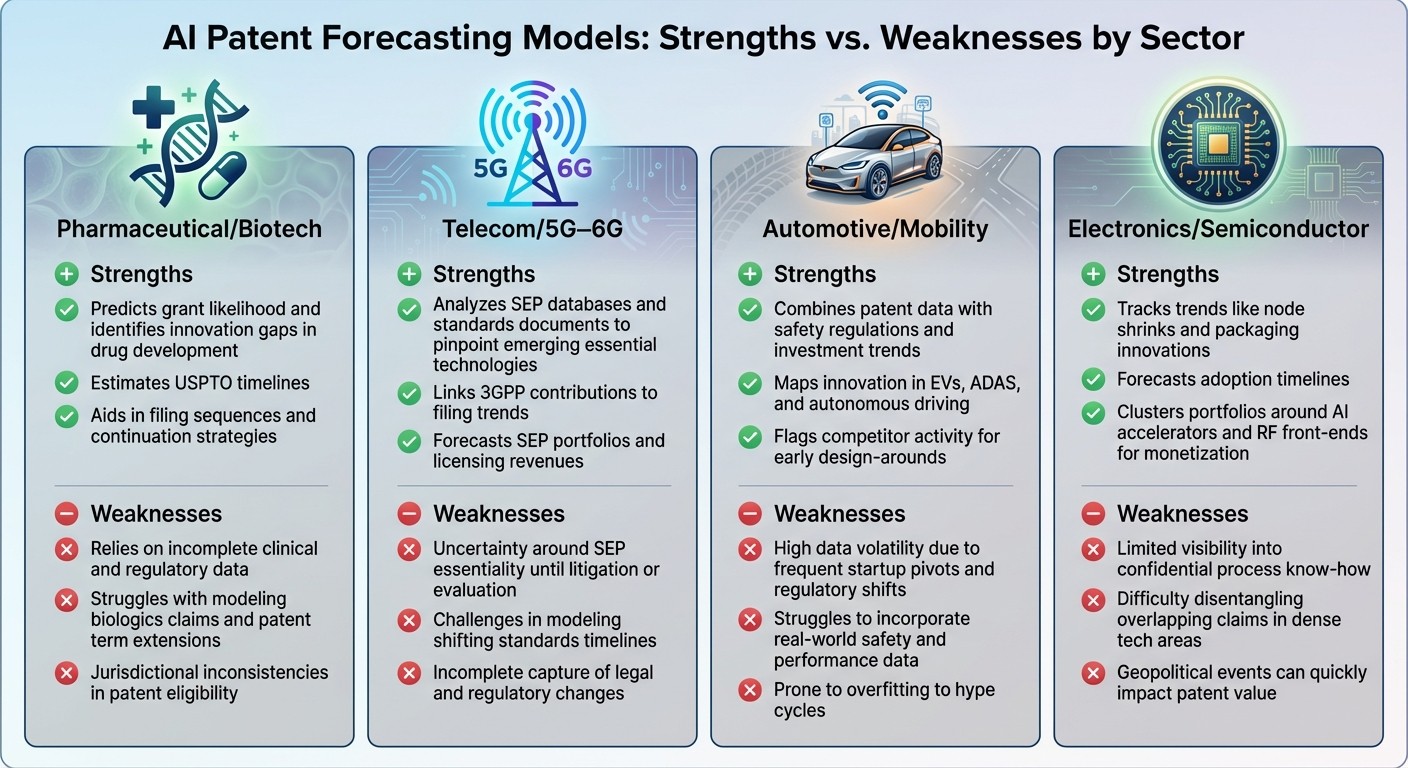
AI Patent Forecasting Models: Strengths and Weaknesses by Industry Sector
Expanding on the earlier forecasts, these models offer clear benefits but also come with some notable challenges. Sector-specific AI patent forecasting tools can save a tremendous amount of time and money by processing millions of patents and documents - something that would be nearly impossible to achieve manually. By automating this heavy lifting, legal teams can shift their focus to more strategic tasks while still handling data efficiently. These models also improve strategic awareness, offering insights into competitor activities, emerging technology trends, and untapped opportunities. This helps organizations file patents earlier, time their product launches better, and make smarter decisions regarding licensing and mergers or acquisitions. For U.S.-based intellectual property (IP) and research and development (R&D) teams, the benefits include reduced legal costs, higher success rates for patent grants, and better returns on patent portfolios through targeted monetization.
That said, these models aren’t without their limitations. Issues like incomplete or delayed data - such as missing non-English documents or inconsistencies in legal status - can introduce bias into forecasts. Historical biases may also creep in, often favoring established players or technologies while underestimating newer, disruptive entrants. Legal and regulatory changes, such as shifts in U.S. patent eligibility rules or increased scrutiny of standard-essential patents (SEPs), are difficult to fully incorporate into these models. Additionally, there’s the risk of overfitting to past patterns, which can lead to overconfidence and inaccurate predictions when markets or technologies evolve rapidly. The table below highlights the strengths and challenges of these models across different sectors.
Model Type | Strengths | Weaknesses |
|---|---|---|
Pharmaceutical/Biotech | Predicts grant likelihood and identifies innovation gaps in drug development; estimates USPTO timelines; aids in filing sequences and continuation strategies | Relies on incomplete clinical and regulatory data; struggles with modeling biologics claims and patent term extensions; jurisdictional inconsistencies in patent eligibility |
Telecom/5G–6G | Analyzes SEP databases and standards documents to pinpoint emerging essential technologies; links 3GPP contributions to filing trends, forecasting SEP portfolios and licensing revenues | Uncertainty around SEP essentiality until litigation or evaluation; challenges in modeling shifting standards timelines; incomplete capture of legal and regulatory changes |
Automotive/Mobility | Combines patent data with safety regulations and investment trends to map innovation in EVs, ADAS, and autonomous driving; flags competitor activity for early design-arounds | High data volatility due to frequent startup pivots and regulatory shifts; struggles to incorporate real-world safety and performance data; prone to overfitting to hype cycles |
Electronics/Semiconductor | Tracks trends like node shrinks and packaging innovations; forecasts adoption timelines; clusters portfolios around AI accelerators and RF front-ends for monetization | Limited visibility into confidential process know-how; difficulty disentangling overlapping claims in dense tech areas; geopolitical events can quickly impact patent value |
The best approach is to treat AI-generated forecasts as tools for decision support, not as replacements for thorough analysis. IP teams should always validate these insights with subject-matter experts and external counsel, especially in high-stakes scenarios. Platforms like Patently, which combine semantic search powered by Vector AI with SEP analytics and project management tools, enable U.S. teams to integrate these capabilities into regular workflows. These include quarterly landscape reviews, pre-filing novelty checks, and competitor monitoring. Human oversight remains critical, ensuring that these tools are used effectively alongside expert judgment. This approach aligns well with the broader strategic insights discussed earlier.
Conclusion
AI patent forecasting is proving to be a game-changer for U.S. businesses navigating fast-evolving sectors. These models can process vast amounts of data - patents, scientific papers, and legal documents - within seconds, offering unmatched insights. Whether in pharmaceuticals, telecommunications, automotive, or semiconductors, AI-driven forecasting is reshaping how companies handle patent filings, maintain portfolios, and identify monetization opportunities.
The advantages are clear: quicker landscape analysis, earlier detection of competitors, more precise freedom-to-operate evaluations, and better licensing revenue. Companies that integrate these tools into their IP reviews and pre-filing processes can shorten patent application timelines, improve grant rates, and reduce infringement risks. However, the most effective strategies combine AI-powered analysis with expert oversight, especially for high-stakes filings and litigation.
To make the most of these tools, businesses should consider launching sector-specific pilot programs. This could include integrating AI for real-time competitor tracking, training IP and R&D teams on predictive analytics, and focusing resources on high-value filings. The return on investment can be measured through reduced search times, improved grant success, and increased revenue from licensing.
Platforms like Patently exemplify how AI can streamline this process. By combining AI-assisted patent drafting, Vector AI-powered semantic search, SEP analytics, and collaborative project management, Patently helps businesses accelerate patent forecasting. When treated as a decision-support tool, AI transforms patent data into a strategic asset, driving innovation, reducing risks, and unlocking market opportunities.
FAQs
How can AI-driven patent forecasting give businesses a competitive edge?
AI-powered patent forecasting enables businesses to spot upcoming trends and innovation opportunities well in advance. By diving into sector-specific data, companies can make informed decisions about their R&D investments, refine strategies to safeguard critical intellectual property, and stay prepared for technological changes ahead of their rivals.
This method doesn't just simplify patent processes - it also helps businesses enter markets more quickly and build stronger IP portfolios, giving them a competitive edge in their industries.
What challenges do businesses face when using AI for patent forecasting?
AI tools in patent forecasting aren't without their hurdles. For starters, their effectiveness is tightly linked to the quality and completeness of the data they process. If the data is flawed or incomplete, the insights generated may not be as dependable as you'd hope.
Another tricky aspect is that AI models often struggle to grasp the intricate legal and technological nuances that play a big role in patent forecasting. This lack of contextual understanding can sometimes limit their accuracy.
There are also challenges tied to the ever-changing patent landscape. Keeping up with constant shifts and updates can be tough for AI systems. On top of that, biases within AI models can skew results, creating an additional layer of complexity.
Transparency and interpretability are other sticking points. If businesses can't fully understand how an AI system arrives at its conclusions, it can be hard to trust the results. Lastly, staying compliant with legal and regulatory standards adds another layer of responsibility for companies leveraging AI in this space.
How can businesses combine AI patent forecasting with expert insights for better results?
Businesses can achieve stronger outcomes by blending AI-powered patent forecasting with the expertise of human professionals. While AI tools excel at rapidly analyzing vast datasets, spotting trends, and identifying potential opportunities, human experts bring essential context, seasoned judgment, and practical experience to validate and fine-tune these findings.
This partnership leads to more precise predictions, aids in anticipating shifts in the market, and supports smarter intellectual property strategies. By combining cutting-edge technology with deep industry knowledge, companies can maintain a competitive edge and make more informed decisions.