AI in Patent Search: Balancing Efficiency and Ethics
Intellectual Property Management
Apr 17, 2026
How AI speeds patent searches and the ethical limits—hallucinations, bias, and why human review and transparency remain essential.

AI is reshaping how patent searches are conducted, making them faster and more precise. Traditional searches could take weeks and cost thousands, but The top patent tools now use AI to analyze millions of records in minutes. These systems use advanced techniques like semantic understanding and vector-based models to identify relevant prior art, even across languages and varied terminology.
However, this speed comes with challenges. AI-generated content has led to an overwhelming amount of prior art, raising questions about reliability, ethical oversight, and transparency. Issues like "AI hallucinations" (fabricating results) and inconsistent findings across platforms highlight the need for human expertise to verify AI outputs.
Key points:
Efficiency: AI tools drastically reduce search time and improve accuracy by understanding concepts, not just keywords.
Ethical Concerns: Transparency, algorithmic bias, and accountability remain critical issues.
Collaboration: Tools now include features like shared ratings, search journals, and automated alerts to support teamwork.
Regulatory Compliance: AI helps meet legal obligations but still requires human oversight for nuanced interpretation.
While AI enhances the patent search process, it’s not a replacement for expert judgment. Combining AI’s speed with careful human review ensures trustworthy and reliable outcomes.
1. Patently
Efficiency
Patently takes a unique approach to patent searches by leveraging Vector AI technology. This advanced system converts patent text into high-dimensional vectors using transformer-based models. Instead of relying solely on exact keyword matches, it digs deeper to understand the conceptual meaning and legal context of claims. This means it can uncover relevant prior art even when different terminology is used.
The platform's capabilities are impressive. It searches through 82 million patent families (representing 135 million individual patents) and 250 million non-patent literature publications. Users can describe their inventions in plain language - like "In-ear headphones with noise isolating tips" - without needing to create complicated Boolean search strings. The AI then identifies technical features and functions from the description, applying algorithms such as Cosine Similarity and K-Nearest Neighbors (KNN) to measure the "mathematical proximity" between the query and millions of documents.
Patently also offers automated evidence mapping, which assigns relevance scores and highlights specific parts of prior art documents that align with an invention's claims. Its multilingual capabilities are another standout feature, allowing it to match conceptually similar patents across different languages. For example, it can connect the German term "Bremssystem" with the English "brake system" - no manual translation required.
Features for Collaboration
Patently goes beyond just improving search accuracy; it also makes teamwork easier. Patent work often involves coordinating across teams with different expertise levels, and Patently's collaboration tools are designed to address this challenge. Teams can use shared rating systems - like five-star ratings, numeric scores, risk indicators, or traffic light signals - to collectively evaluate patent relevance.
The platform includes a search journal feature that records dates, tools, queries, and relevance notes, creating a detailed audit trail. This is especially useful for partners or investors who need verification of the search process. Additionally, automated alerts notify team members when new filings match an invention profile, keeping everyone updated. Findings can also be exported to Word or Excel for documentation purposes.
One of the most user-friendly aspects is the natural language interface, which allows team members - whether engineers or attorneys - to contribute to the search process without needing to learn complex Boolean syntax. This lowers the barrier for collaboration and ensures that everyone can participate effectively.
2. Other AI Patent Search Tools
Efficiency
AI patent search tools have taken a leap forward by incorporating semantic understanding instead of relying solely on keyword matching. With advancements in natural language processing, these tools can now evaluate conceptual similarities, making it easier to identify relevant prior art across various technical fields and jurisdictions.
Modern systems often cater to invention-focused workflows, enabling users to input invention disclosures or draft claims directly. The AI then generates search representations automatically. Some platforms even employ "agentic" search, where the AI refines its strategies as new information becomes available. As DeepIP explains:
Agentic search does not replace core patent search principles - it amplifies them.
A 2026 comparative test of seven AI patent tools revealed that nearly 90% of references identified were unique to a single system. Out of 225 reference appearances, only 20 were identified by more than one tool, and just three references appeared in results from three different platforms. This lack of overlap means that professionals using different systems might reach entirely different conclusions about the same invention, which complicates the process of forming consistent legal arguments.
While these tools offer notable efficiency improvements, they also bring ethical concerns into sharper focus.
Ethical Considerations
One of the primary ethical issues involves AI hallucination - where the system generates summaries for patents that don't exist or that are weakly supported. To combat this, many workflows have adopted an "evidence-first" approach. This requires AI systems to present valid patent identifiers and source records before offering interpretations. By combining advanced retrieval methods, such as vectorization and graph-based databases, with human oversight, these tools aim to ensure accuracy and reliability.
The USPTO has taken steps to address these concerns through initiatives like the ASAP! pilot program, which ran from October 2025 to April 2026. The program aimed to process at least 1,600 applications and introduced Automated Search Results Notices (ASRNs). These notices provide up to 10 ranked references, helping applicants fulfill their duty of candor under 37 C.F.R. § 1.56. According to Jamie Holcombe, Chief Information Officer at the USPTO, the internal SimSearch tool now accounts for approximately 30% of references in some technology groups. The petition fees for the pilot were set at $450 for large entities, $180 for small entities, and $90 for micro entities.
To address these ethical challenges, AI tools increasingly emphasize transparency and expert oversight.
Features for Collaboration
Modern AI patent tools are designed with collaboration in mind, ensuring that human experts remain central to the process. Platforms like NLPatent and Patlytics allow legal professionals to validate and refine the AI's initial findings. Paul Lee, Co-founder of Patlytics, which has raised approximately $21 million, highlights this emphasis:
Services and workflow is where the value accrues.
Features such as structured claim mapping, complete with detailed explanations, help experts verify, challenge, and adjust AI-generated conclusions. These tools also maintain an auditable trail, showing why specific patents were included or excluded. This transforms raw data into actionable insights. On the other hand, reliance on opaque "black-box" algorithms - where similarity scores and rankings lack transparency - can hinder effective collaboration. As Charles Eldering, author of Light Drafts, points out:
The real question is not whether AI can search patents, but whether it can make different people see the same prior art when faced with the same claim.
Regulatory Compliance
To support ethical practices and collaboration, AI tools also focus on meeting regulatory requirements. They assist users in fulfilling U.S. obligations, such as the duty of candor under 37 C.F.R. § 1.56 and the Information Disclosure Statement (IDS) rules under §§ 1.97 and 1.98. The USPTO's ASAP! program plays a role here by generating ASRNs that flag material prior art early in the examination process. While these notices don't require a formal response, they help streamline compliance.
Certain systems also document the search history directly in the file wrapper, ensuring a transparent and auditable record of the AI's role. The USPTO explains:
When a search is performed using Similarity Search, it will be reflected in the search history recorded in the file wrapper.
This transparency is vital for maintaining legal certainty. As A. Aledo Lopez, Chief Operating Officer at the European Patent Office, emphasizes:
AI suggestions may guide the process, but it is always the examiner who decides which documents are relevant and how they are to be cited.
Exploring AI in the patent profession
Pros and Cons
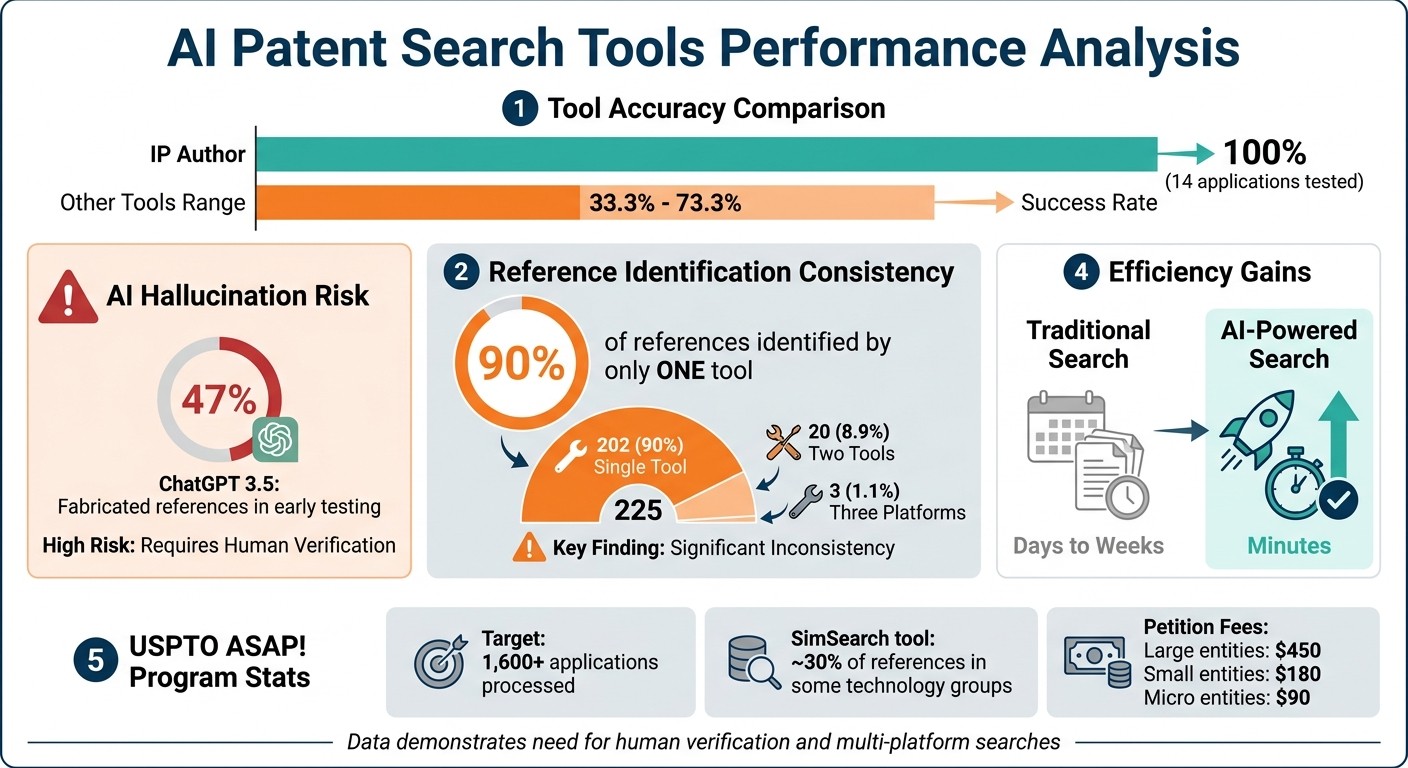
AI Patent Search Tools: Accuracy Comparison and Performance Metrics
AI patent search tools have transformed the process, cutting search times from days or weeks to just minutes. However, they come with a notable drawback: inconsistency. A study revealed that 90% of references were identified by only one tool. This inconsistency can cause major issues for legal strategies, as professionals using different platforms might arrive at completely different conclusions about the same invention.
When it comes to accuracy, the results vary widely. For instance, IP Author demonstrated a perfect 100% success rate across 14 applications, while other tools ranged between 33.3% and 73.3%. Early testing also highlighted problems like "hallucinations" in AI systems. ChatGPT 3.5, for example, fabricated references in 47% of cases. These issues underline why human verification remains critical, even though AI can handle much of the initial heavy lifting. This is especially true when using tools to draft patent applications with AI to ensure technical accuracy. The accuracy gap between platforms only reinforces this need.
Another concern tied to accuracy is ethical transparency. Tools that provide clear, explainable relevance signals help strengthen legal defenses. On the other hand, systems that rely on opaque "black-box" ratings - offering only similarity scores without explanations - can erode trust. Some tools are moving toward evidence-first workflows, where AI presents actual patent identifiers before offering interpretations. While this is a step in the right direction, it’s not yet a universal standard.
Speed and accuracy aside, regulatory compliance adds another layer of complexity. AI excels at global pattern recognition, but nuanced claim interpretation and adherence to specific jurisdictional standards still require human oversight.
As Charles Eldering aptly puts it:
The real question is not whether AI can search patents, but whether it can make different people see the same prior art when faced with the same claim.
Until AI tools achieve greater consistency, they should be seen as powerful assistants rather than standalone decision-makers. Their speed is a game-changer, but professionals must balance this advantage with careful strategic interpretation and thorough verification.
Conclusion
AI-powered patent search tools can significantly speed up the search process, but their use requires careful oversight to ensure accuracy, ethical standards, and transparency.
While AI can broaden the scope of searches and uncover results quickly, the role of human expertise remains irreplaceable. AI may assist in discovery, but professionals must validate every finding. As PowerPatent aptly put it:
Accountability cannot be outsourced. AI does not carry a law license.
This highlights the importance of adopting workflows where AI handles the initial information gathering, while experts meticulously review the findings to ensure accuracy. For instance, relying solely on AI-generated summaries isn’t enough - manually reviewing the claims sections of top-ranked patents is essential to catch any limitations or nuances that an algorithm might overlook. Transparency in AI processes is also a must, ensuring that users can trust the results.
To reinforce this transparency, choose tools that offer clear explanations for their relevance rankings rather than relying on vague similarity scores. Keep a detailed search log that records the tools used, the queries entered, and the reasoning behind keeping or discarding results. Such an audit trail is invaluable for due diligence and addressing concerns about the "black box" nature of AI, which can undermine trust if left unchecked.
To minimize bias and ensure comprehensive results, consider running parallel searches across multiple platforms. Expand your research beyond patents by including sources like academic papers, conference presentations, and public code repositories to cover all possible angles.
As AI becomes a more integral part of patent searches, professionals must strike a balance between leveraging its speed and maintaining rigorous oversight. This combination is crucial for preserving the integrity of legal processes and ensuring trustworthy outcomes.
FAQs
How can I trust AI prior art results?
Relying on AI for prior art searches can be incredibly helpful, but it’s essential to understand both its advantages and its limitations. AI can make searches faster and more thorough, but it’s not perfect - it might return false positives or even generate inaccurate information (sometimes referred to as hallucinations).
To get the most out of AI tools, it’s best to follow a multi-step approach. Start by using AI to generate initial results, but don’t stop there. Pair these findings with a review by experienced professionals, and make sure to cross-reference the results with trusted, authoritative sources. Think of AI-generated outputs as a starting point, not the final word. By critically analyzing and validating the information, you can approach the results with far greater confidence.
What’s the best way to prevent AI hallucinations?
Transparent architectures, like Glass Box AI, offer one of the most effective ways to prevent AI hallucinations. These systems are designed to allow verification against source documents, ensuring the AI cannot fabricate information. This approach minimizes risks such as phantom citations or mischaracterized rejections, which can be especially problematic in areas like patent prosecution.
How do I keep an audit trail for AI searches?
To keep a reliable audit trail for AI searches, it's essential to document every step. This includes noting the query parameters, identifying the data sources used, and recording the generated results. Implementing versioned processes, such as committing to data snapshots and creating retrieval proofs, helps ensure consistency and accountability. Cryptographic techniques, like zero-knowledge proofs, can further validate outputs while safeguarding sensitive information. By combining thorough documentation with these methods, you can establish a transparent and dependable audit trail.