AI Patent Search Platforms: Key Benefits
Intellectual Property Management
Feb 16, 2026
AI patent search cuts research time, improves relevance and collaboration, and delivers analytics - yet hybrid AI/Boolean workflows and human review remain essential.

AI patent search tools are transforming how professionals handle intellectual property research. Unlike older keyword-based methods, these platforms use semantic search powered by AI technologies like NLP and machine learning. This allows them to understand the meaning behind queries rather than just matching words. Key benefits include:
Time Efficiency: Search times are reduced by up to 80%. For example, a task that previously took 100 hours can now be done in 20 hours or less.
Improved Accuracy: Semantic search uncovers results traditional methods often miss, reducing false negatives by up to 60%.
Collaboration Tools: Centralized workspaces streamline teamwork, allowing legal, R&D, and IP teams to work together seamlessly.
Advanced Analytics: Features like 3D mapping and trend analysis help users gain insights into competitive landscapes and patent activity.
Platforms like Patently exemplify these advancements with features like an AI drafting assistant, a vast patent database, and tools for managing Standard Essential Patents (SEP). However, challenges like "semantic drift" and the "black box" problem highlight the need for human oversight. By 2026, a hybrid approach - combining AI's broad search capabilities with Boolean precision - has become the standard for balancing efficiency and accuracy.
1. Patently
Patently brings together AI-powered search, drafting, and collaboration tools into one platform tailored for patent professionals. It manages an impressive database of over 82 million patent family groups and 135 million individual patents, each meticulously categorized into 226 distinct fields to ensure thorough and precise searches.
Time Savings
Patently's AI drafting assistant, Onardo, simplifies generative AI patent drafting by automatically conducting prior art searches as you write. This eliminates the need to juggle multiple tools. For example, in October 2024, Laurence Brown showcased this capability by using Patently's Vector AI to search for "In-ear headphones with noise isolating tips", applying a priority date filter before 2000. He reviewed 300 search results and located the relevant Sony patent applications in less than five minutes.
This streamlined process not only saves time but also improves the accuracy of research outcomes.
Accuracy and Relevance
Patently stands apart from traditional Boolean search methods by employing sentence-based semantic search powered by vector embeddings and natural language processing. It also introduces proprietary "Genetic families", created using custom algorithms updated monthly with data from leading patent offices. This ensures high-quality, reliable data. Additionally, the platform can identify ambiguities and flag critical issues, helping users avoid potential errors in their evaluations.
Collaboration Features
Patently strengthens teamwork by offering tools that allow inventors, IP professionals, legal teams, and executives to collaborate seamlessly. Within its unified workspace, teams can search, evaluate, and draft patents together. Features like tagging, commenting, and marking assets for assessment enhance group efficiency. Its cloud-first infrastructure ensures smooth information sharing across global teams, while visual tools make it easier to analyze priority claims and patent relationships.
Analytics and Insights
Patently also provides advanced analytics to help professionals derive strategic insights from their searches. For instance, the platform includes Patently License, a specialized tool for managing and searching Standard Essential Patents (SEP). Its analytics capabilities uncover patterns in large datasets, quickly surfacing the most relevant results.
"Patently has become an indispensable tool for us, playing a crucial role in various aspects of our Research and Innovation processes."
– Stan Zurek, Head of Research and Innovation, Megger Instruments
2. Additional Insights on AI-Driven Patent Search Benefits
top AI-driven patent search tools are reshaping the way professionals navigate intellectual property data. Moving beyond traditional keyword-based Boolean searches, these platforms utilize semantic understanding and natural language processing (NLP) to interpret the technical intent behind queries. This means patent professionals can now perform searches using plain language, making the process more intuitive and effective. Studies show that AI-powered tools can cut research time by up to 70% and reduce false negatives by as much as 60%.
Time Savings
By integrating AI directly into patent workflows, the need for switching between multiple tools is eliminated, saving valuable time. For example, some platforms can surface relevant prior art while attorneys draft patent applications, significantly boosting productivity. Features like one-click semantic mapping transform claims into structured comparison charts, and domain-specific AI can reduce tasks like Freedom-to-Operate and prior art searches from weeks to mere minutes. Additionally, AI assistants that summarize patents or explain claims in plain language help streamline the review process. These time-saving measures not only improve efficiency but also lead to more actionable insights.
Accuracy and Relevance
Modern AI platforms bring a new level of precision to patent searches. Using techniques like knowledge graph reasoning, they represent inventions as interconnected technical features rather than relying solely on text matches. This enables the discovery of prior art through technical correlations that traditional keyword searches often miss. Advanced systems even employ "agentic" methods, where AI autonomously refines search strategies across multiple steps to identify related technical concepts. Moreover, many platforms expand their scope by integrating non-patent literature from sources like IEEE journals and conference proceedings, ensuring a more comprehensive search. With access to over 170 million patent records across 100+ jurisdictions and daily updates, these tools enable real-time monitoring of global patent activity.
Collaboration Features
Recognizing the collaborative nature of patent work, AI platforms are designed to bring multiple stakeholders together. Instead of relying on fragmented email chains, some tools centralize patent data, annotations, and discussions within a shared workspace. Recent advancements have introduced features that connect IP professionals with R&D teams, allowing engineers to provide technical feedback directly within the platform. Granular permission controls let teams share projects securely, whether with specific individuals or entire departments, while managing access levels for viewing, editing, or administration. AI-assisted summaries further bridge the gap by helping non-experts quickly understand technical relevance, making patent data accessible across diverse teams.
Analytics and Insights
AI platforms do more than just search - they offer tools to extract strategic intelligence from patent data. Features like 3D mapping and heat maps make it easier to visualize complex competitive landscapes, helping stakeholders who may not be IP experts understand the bigger picture. Invention-centric search capabilities allow users to input entire invention disclosures or draft claims, with the AI generating optimized search representations automatically. These tools turn patent search into an ongoing process, complete with automated alerts for competitor filings and emerging trends. By combining efficiency, precision, collaboration, and strategic insights, AI is fundamentally transforming the patent search landscape.
Advantages and Disadvantages
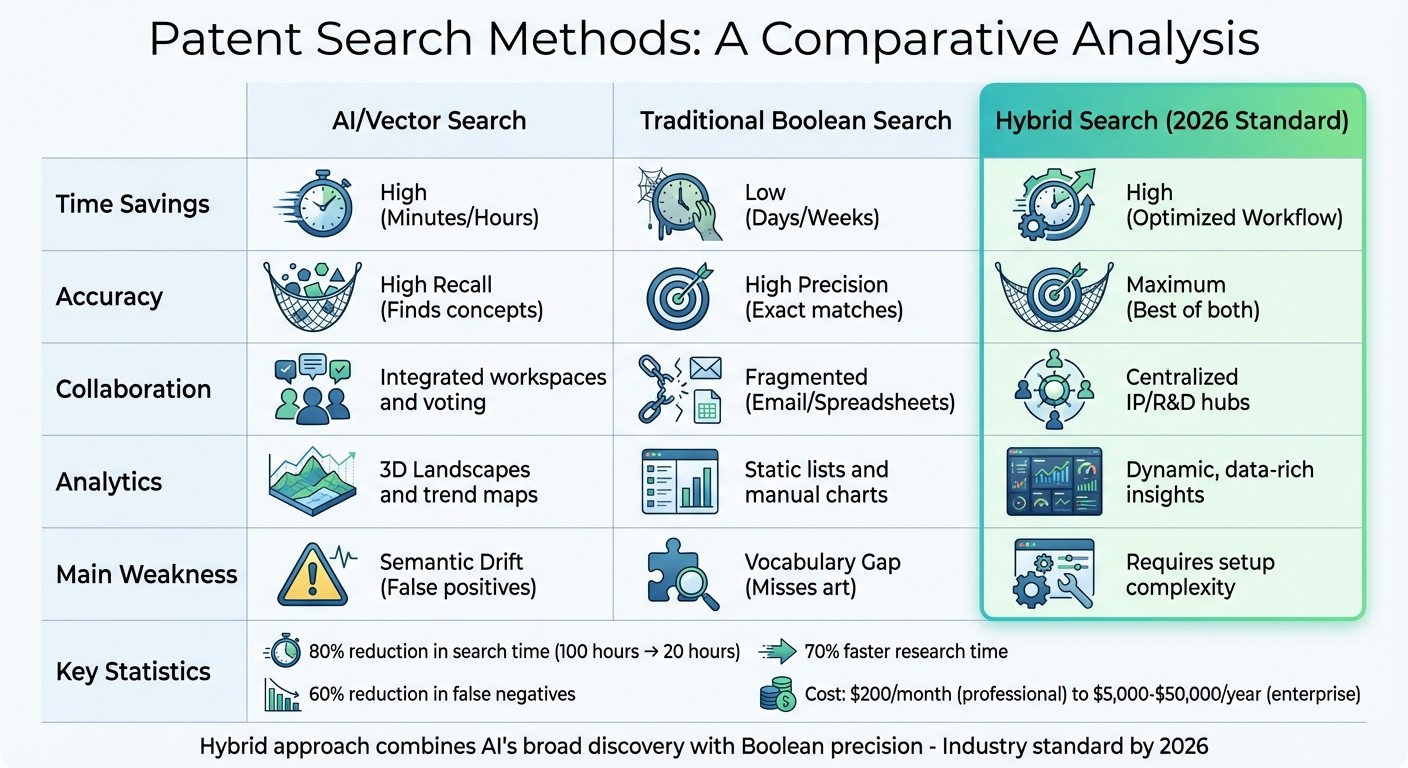
AI vs Traditional vs Hybrid Patent Search Methods Comparison
AI-driven patent search platforms offer a mix of benefits and challenges, making it essential to weigh their strengths and limitations. One of the standout advantages is the significant time savings. These tools can reduce search times from weeks to mere minutes. For instance, some organizations report cutting 100 billable hours down to just 20 - an impressive 80% reduction in effort. To put this into perspective, saving 10 hours at a rate of $300 per hour means the AI system can pay for itself after a single search.
However, these platforms are not without their challenges. A common issue is "semantic drift", where the AI may confuse functional similarities with contextual ones. For example, it might incorrectly associate medical imaging technologies with automotive sensors due to overlapping features. As Golam Rabiul Alam, PhD, from Patent AI Lab, aptly explains:
"AI is a drafting accelerator, not a legal replacement".
Another concern is the "black box" problem. Many AI systems provide similarity scores without offering clear explanations for their results, which can erode trust in high-stakes legal contexts. Additionally, while AI excels at processing vast amounts of information, it lacks the nuanced legal judgment required for decisions about patents and intellectual property or infringement, making human oversight indispensable.
To address these issues, the industry has leaned toward a hybrid workflow by 2026. This approach combines the broad recall capabilities of AI and vector search with the precision of Boolean logic. By doing so, it bridges the gap left by traditional searches and reduces the false positives often associated with pure AI systems. Hybrid search tools are relatively affordable, costing around $200 per month for professional users, while enterprise platforms can range from $5,000 to $50,000 or more annually, depending on features and user capacity.
Here’s how these different search methods stack up across key factors like time savings, accuracy, and collaboration:
Feature | AI/Vector Search | Traditional Boolean Search | Hybrid Search (2026 Standard) |
|---|---|---|---|
Time Savings | High (Minutes/Hours) | Low (Days/Weeks) | High (Optimized Workflow) |
Accuracy | High Recall (Finds concepts) | High Precision (Exact matches) | Maximum (Best of both) |
Collaboration | Integrated workspaces and voting | Fragmented (Email/Spreadsheets) | Centralized IP/R&D hubs |
Analytics | 3D Landscapes and trend maps | Static lists and manual charts | Dynamic, data-rich insights |
Main Weakness | Semantic Drift (False positives) | Vocabulary Gap (Misses art) | Requires setup complexity |
This table highlights why the hybrid model is becoming the standard. It combines the strengths of AI and Boolean methods, ensuring both broad discovery and precise filtering. For users, the takeaway is clear: pure vector searches alone are too risky for critical tasks like Freedom-to-Operate analyses. Instead, start with a natural language search to gather relevant keywords, then refine results using precise Boolean filters, such as CPC classifications, to minimize false positives.
With proper human oversight and validation protocols in place, AI-powered tools can help organizations innovate faster - by as much as 75% - while cutting costs by 25%. However, the key to success lies in balancing the efficiency of AI with the expertise of human judgment.
Conclusion
AI-powered semantic search has reshaped patent work, but choosing the right platform is essential for efficiency. By 2026, hybrid search methods - blending AI-driven conceptual discovery with Boolean precision - have become the go-to standard.
For patent attorneys involved in drafting and prosecution, tools like Patently stand out. With features like the AI assistant Onardo, these platforms integrate seamlessly into existing workflows. They provide access to a massive database of over 82 million patent families, encompassing 135 million individual patents. Patently's use of Vector AI technology simplifies complex searches by delivering contextually relevant results, freeing up professionals to focus on strategic decisions rather than tedious manual research.
Startups and academic researchers can begin exploring semantic search with free or low-cost tools, upgrading to professional platforms priced around $200 per month as their needs expand. Portfolio managers, on the other hand, benefit from tools that offer quality scoring for benchmarking, while R&D leaders need platforms that connect patent data with non-patent literature to gain a full picture of the innovation landscape.
One key point to remember: AI should never be the sole tool for high-stakes legal tasks like Freedom-to-Operate analyses. A smarter approach involves starting with AI to uncover synonyms and related terms, then refining results using Boolean filters and CPC classifications to weed out false positives. Human oversight remains critical to ensure legal relevance and accurate claim interpretation. This balanced strategy allows patent professionals to harness AI's speed and efficiency while applying their expertise to stay ahead in a competitive field.
FAQs
When should I use hybrid search instead of pure AI search?
When precision and detail matter most - like in patent landscaping, invalidity screening, or legal due diligence - hybrid search is the way to go. While pure AI search is fast and focuses on concepts, it can sometimes deliver results that are either too broad or not quite accurate. Hybrid search bridges this gap by blending AI's speed and conceptual analysis with the precision of traditional Boolean methods. This combination ensures more accurate filtering and validation, making it ideal for complex or high-stakes patent searches.
How can I reduce semantic drift in my search results?
To keep search results aligned with your original intent, focus on crafting clear, specific prompts. The more precise your wording, the better the AI can understand what you're looking for. Adding details like relevant prior examples or specific sections from those examples can make a big difference. This extra context helps the AI stick closely to your goals and delivers more accurate results.
What human review is still needed for Freedom-to-Operate searches?
AI tools can efficiently flag relevant patents and sift through vast amounts of data during Freedom-to-Operate (FTO) searches. But here’s the thing: they’re not a substitute for human expertise. Interpreting the results, understanding the legal nuances, and making informed strategic decisions require a skilled human touch.
Legal analysis, especially in complex patent landscapes, often involves layers of interpretation that AI simply can't handle. Human reviewers bring the ability to assess context, evaluate risks, and apply judgment - elements that are critical for ensuring thorough and accurate FTO assessments.