AI Patent Search Tools: Features Compared
Intellectual Property Management
May 11, 2026
Features, coverage, AI capabilities, and pricing compared across leading AI patent search platforms to help choose the right IP tool.

AI patent search tools are transforming how professionals handle patent searches, offering smarter, faster, and more accurate ways to find relevant prior art. These tools use advanced technologies like natural language processing (NLP) and semantic modeling to go beyond keyword-based searches. Here's a quick overview of the major players in this space:
Patently: Combines AI search with drafting and workflow tools. Offers flexible pricing starting at $0 for basic features.
Patsnap: Known for its vast global coverage and AI analytics. Pricing starts around $3,000 annually for solo users.
Derwent Innovation: Built on curated patent data with strong semantic search capabilities. Enterprise pricing starts at $10,000 per year.
Questel Orbit: Integrates search with portfolio management and analytics. Costs range from $15,000 to $50,000+ annually.
PatBase: Offers reliable Boolean and semantic search for mid-sized firms. Pricing is based on search volume.
NLPatent: Focused on optimizing patent language searches. Pricing tiers include Standard and Premium plans.
PatSeer: Features hybrid AI and Boolean search with strong analytics. Pricing starts at $900 per user per quarter.
These tools differ in their strengths, from advanced search capabilities to integration with broader workflows. Choosing the right one depends on your specific needs, such as budget, jurisdiction coverage, or workflow integration.
Quick Comparison
Tool | Key Features | Pricing |
|---|---|---|
Patently | AI search, drafting, global data coverage | Free to custom ($125/month/user+) |
Patsnap | Semantic search, non-patent data insights | $3,000–$50,000+ annually |
Derwent | Curated data, semantic tools | $10,000–$30,000+ annually |
Questel Orbit | IP management, deep analytics | $15,000–$50,000+ annually |
PatBase | Boolean and semantic search | Per-family pricing (varies) |
NLPatent | Patent language-focused AI tools | Standard and Premium plans |
PatSeer | Hybrid search, advanced analytics | $900+/user/quarter |
AI tools are no longer optional - they're essential for competitive patent work. Whether you're searching for prior art, managing portfolios, or analyzing trends, these platforms offer solutions tailored to modern IP challenges.
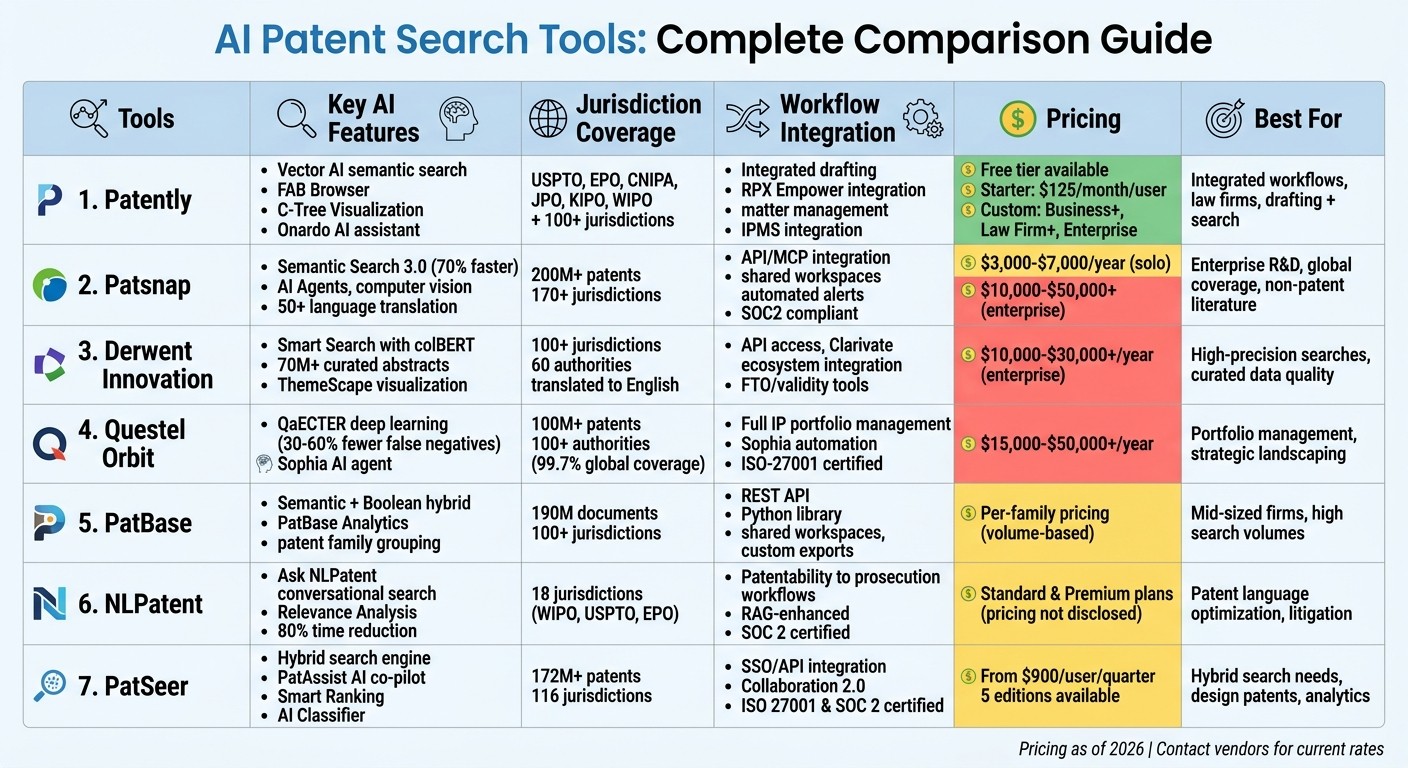
AI Patent Search Tools Comparison: Features and Pricing Guide
1. Patently
Patently brings together search, drafting, and portfolio management into one connected workspace, making it a streamlined solution for intellectual property tasks.
AI/Semantic Search Capabilities
Patently’s Vector AI interprets full sentences to deliver results that align conceptually with your search. Its patent-pending FAB Browser eliminates duplicate citations by grouping them into families, while the C‑Tree Visualization tool maps out priority claims and relationships. These can be sorted by factors like family size, active patents, citations, and filing dates. Additionally, the Onardo AI assistant can draft claims, figures, and full descriptions directly from invention disclosures, saving time and effort.
"Patently has become an indispensable tool for us, playing a crucial role in various aspects of our Research and Innovation processes." – Stan Zurek, Head of Research and Innovation at Megger Instruments.
Jurisdiction Coverage
Patently sources full-text patent data from major international offices, including the USPTO, EPO, CNIPA (China), JPO (Japan), KIPO (Korea), and WIPO (PCT). It also provides bibliographic or partial text data for over 100 additional jurisdictions such as ARIPO, Brazil, and India. The platform pulls this data directly from patent offices, using proprietary algorithms to create custom family structures and clean up results, ensuring any ambiguities are flagged. This robust data feeds seamlessly into Patently’s workflow tools, enhancing efficiency and accuracy.
Workflow Integration
The Create module allows users to draft text while generating figures directly in the browser, complete with auto-labeling and suggested flow diagrams. Patently also integrates with RPX Empower, enabling users to connect litigation and assignment data with AI-driven workflows for infringement and invalidity analysis. Dan McCurdy, CEO of RPX, highlights that RPX Empower combines top-tier technologies for streamlined IP workflows.
For law firms, Patently supports matter-centric management with features like client access portals, IPMS integration, and role-based permissions with ethical walls. Collaboration is made easy through real-time tagging, family assessments, and shared evaluations using the Rate module.
Pricing
Patently offers flexible pricing tiers to suit different needs. The Free tier ($0) supports basic searching and browsing for a single user. The Starter plan, priced at $125 per month per user, includes enhanced search capabilities, analytics, and the FAB citation browser for teams of up to 10 users. Custom-priced Business+, Law Firm+, and Enterprise tiers provide advanced features like AI drafting, fee tracking, and fully tailored solutions. There’s also a separate SEP Analytics module for Standard Essential Patent analysis, available at custom pricing.
Plan | Price | Key Features | User Limit |
|---|---|---|---|
Free | $0 | Basic filters, Onardo AI assistant, family browsing | 1 user |
Starter | $125/mo/user | Vector AI search, analytics, FAB browser, team collaboration | Up to 10 users |
Business+ | Custom | AI drafting, custom fields, fee tracking, challenge data | Unlimited users |
Law Firm+ | Custom | Matter management, client access, IPMS integration | Unlimited users |
Enterprise | Custom | Fully bespoke solutions | Unlimited users |
2. Patsnap
Patsnap is shaking up the industry as one of the top patent tools by combining diverse innovation data with advanced AI analytics, all within one platform.
AI/Semantic Search Capabilities
Patsnap's Semantic Search 3.0 uses transformer-based language models to grasp technical concepts instead of just matching keywords. This approach reportedly cuts search time by 70% compared to traditional Boolean methods. The platform also employs computer vision to analyze patent drawings and technical diagrams.
In 2026, Patsnap launched AI Agents capable of autonomously reviewing file wrappers, prosecution histories, and examiner rejections. These capabilities complement other generative AI patent drafting tools that streamline the application process. For those working in chemical and life sciences, specialized modules are available for analyzing structures and biological sequences. Additionally, its multilingual AI translation tool supports over 50 languages, ensuring technical terminology remains intact, which makes foreign patents accessible to English-speaking users.
"PatSnap's breadth of data is unrivalled, pulling patent, non-patent literature, and chemical information globally, further enabling the translation of these documents into English. This has helped me tremendously when analyzing different jurisdictions and simplified the reading of foreign language patents." – Noel Rudie, Director of Innovation, Michael Foods
Users have reported a 60–80% reduction in search time and 30–50% lower costs for maintaining patent portfolios. Patsnap's semantic search capabilities are bolstered by its extensive global data coverage.
Jurisdiction Coverage
Patsnap offers access to over 200 million patent documents from more than 170 jurisdictions worldwide, with daily updates [8,16]. Beyond patents, its database includes over 2 billion structured data points, such as scientific publications, litigation records, clinical trials, and market data. This extensive dataset helps researchers link patent activity to broader trends in R&D and competitive intelligence. These insights are seamlessly integrated into workflows, making complex data actionable.
Workflow Integration
The platform supports API and MCP integrations, allowing users to connect it with their existing systems for patent, document, and case management. Shared workspaces facilitate collaboration among attorneys, inventors, and R&D teams, enabling real-time organization, annotation, and progress tracking. Automated alerts keep professionals updated on competitor filings, legal status changes, and citation trends around the clock. Patsnap also adheres to SOC2 compliance standards and offers both cloud-based and on-premise deployment options for organizations with stringent security needs [8,17].
Pricing
Patsnap operates on an enterprise subscription model, with annual fees typically ranging from $10,000 to $30,000+ depending on the number of users and selected modules. For solo innovators, costs are estimated between $3,000 and $7,000 annually, while full-scale enterprise solutions with advanced modules can exceed $50,000 per year.
3. Derwent Innovation
Derwent Innovation is built on the Derwent World Patents Index (DWPI), a database enriched with over 70 million expertly written invention summaries. This curated resource allows for a deeper and more nuanced understanding of patent content compared to systems that rely solely on raw patent text.
AI/Semantic Search Capabilities
The platform employs specialized AI models - colBERT for search and large language models for classification - trained on DWPI data. With access to over 70 million abstracts and titles, these tools clearly highlight an invention's originality, purpose, and advantages. The Smart Search feature is particularly useful, as it automatically retrieves relevant patents based on the terms you input, cutting down on manual research time significantly.
"I've tried other AI powered patent search tools, and Derwent AI Search is hands down the best... the most relevant records are at the top of the list, which helps me save a lot of time." – Susan Johnson, Patent Agent and IP Researcher at Boston Scientific
The platform’s semantic search capabilities allow for concept-level matching, making it easier to find relevant filings even when exact keywords aren’t used.
For more specialized needs, Derwent Innovation includes tools like Derwent Sequence Search for biological sequences and Derwent Chemistry Research for curated chemical data. The database also features over 1.17 billion high-resolution patent images, and visualization tools like ThemeScape help users explore technology clusters and citation patterns across both patent and non-patent literature. These features enhance the platform’s ability to present complex data effectively.
Jurisdiction Coverage
Derwent Innovation provides access to patent data from over 100 jurisdictions, including full-text records for major authorities like the US, EPO, China, Japan, Korea, UK, Canada, Australia, and Russia. Additionally, the DWPI team translates publications from 60 authorities into English and organizes them into 322 technology classes.
Beyond patents, the platform integrates legal status details and patent litigation data from Darts-ip, covering case information from more than 140 jurisdictions. It also includes over 73 million curated non-patent literature publications sourced from more than 13,600 journals.
"You can feel the difference in the data. It's clean, it's complete, and it gives you confidence. When I'm preparing for a client meeting, I don't want to second-guess the results - and with Derwent, I don't have to." – Dr. Ilan Riess, Patent Attorney at Ehrlich Group
Workflow Integration
Derwent Innovation’s extensive data capabilities are further enhanced by its ability to integrate with IP management systems. Through APIs, the platform delivers enriched patent data in a common XML format. It also connects with Clarivate tools like Web of Science and Compendex, as well as related IP management solutions such as IPfolio, ipan Portal, and the CPA Global Workbench - all accessible through the Clarivate portal.
Designed for high-stakes legal workflows, including Freedom-to-Operate (FTO), validity, and patentability assessments, the platform offers intuitive tools for managing complex patent searches. These features cater to high-volume professional environments and are trusted by more than 40 global patent and trademark offices. However, some users have noted that it lacks direct integration with patent drafting tools. The interface is available in English, Chinese, Japanese, Korean, and Spanish.
Pricing
Derwent Innovation operates on a custom pricing model, with enterprise subscriptions typically ranging from $10,000 to $30,000 or more annually. A free trial is available upon request. The platform has received a 5/5 rating on Software Finder based on 11 user reviews. While users frequently praise its Smart Search feature and high-quality data, some have found the interface challenging for beginners and pointed out limitations, such as the inability to highlight text or view all figures without opening individual patents. These factors underline its role in simplifying complex patent processes for seasoned professionals.
4. Questel Orbit
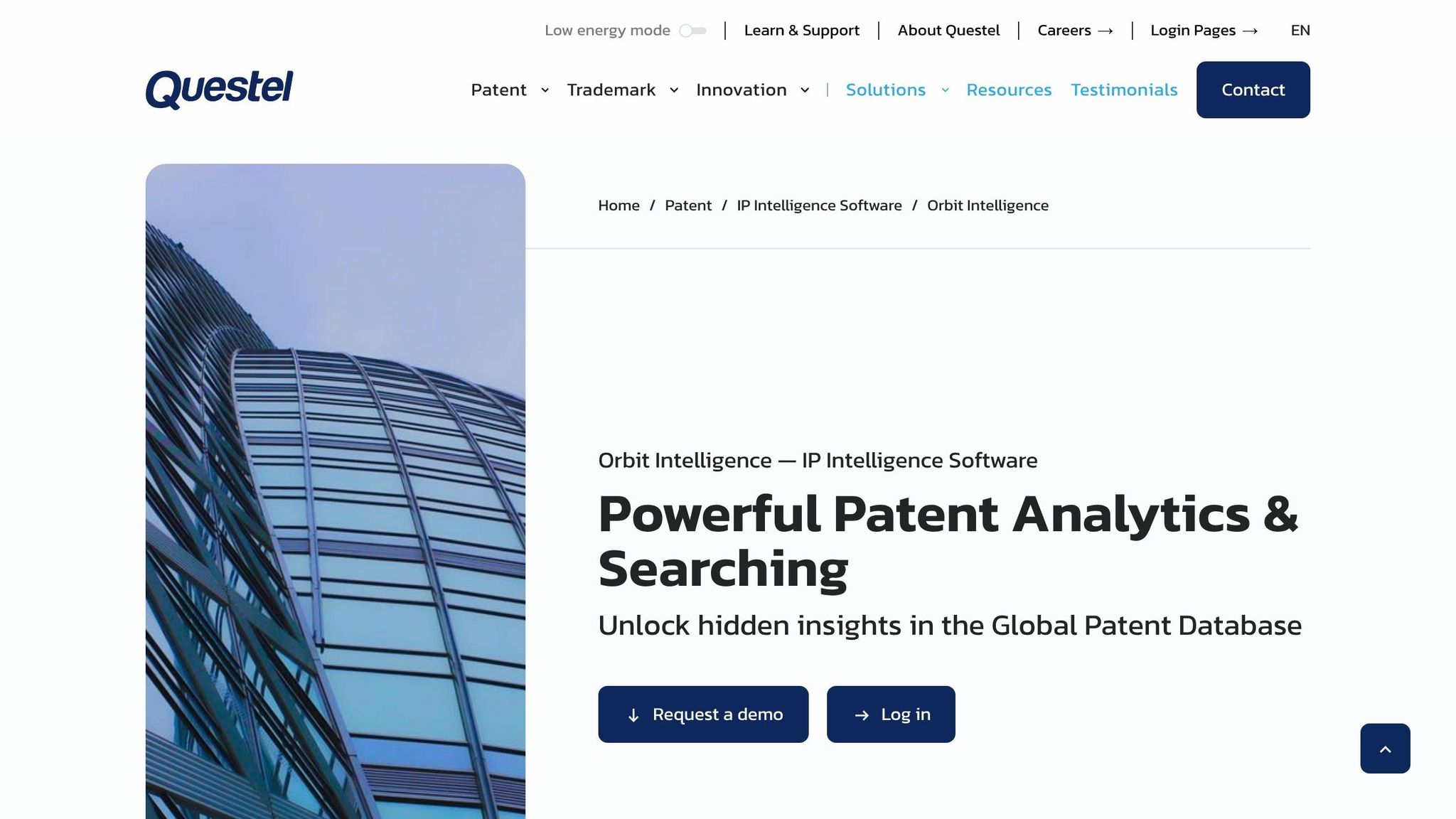
Questel Orbit stands out in the realm of AI tools designed for seamless IP workflows. By combining a massive global patent database with AI-powered search capabilities, it supports professional IP tasks with access to over 100 million patents, 17 million designs, and 150 million non-patent literature records. Impressively, it covers patent offices that account for more than 99.7% of global patent applications.
AI/Semantic Search Capabilities
The platform's QaECTER system leverages deep learning and citation-based supervision to understand conceptual meanings in searches. Internal testing shows it reduces false negatives in prior art searches by 30–60% compared to traditional keyword-only methods.
Sophia, the AI-driven search agent within Orbit Intelligence, simplifies complex search tasks. It translates natural language queries into structured Boolean searches, automatically expanding them with synonyms and classifications. Additionally, the platform uses AI-assisted patent scoring to rank search results based on relevance to user-defined claim elements, helping users focus on the most critical documents.
"QaECTER turns patent search into less searching and more finding. We built it to be the best patent search model available, putting patent experts at the center of every design choice." – Younes Djemmal, AI Engineer, Questel
Other AI features include automatic similarity searches, clustering related patent families, and semantic alerts for monitoring new filings that match specific technical concepts. The platform also integrates a translation layer, making over 97% of the collection accessible in English, either natively or through pre-translations.
Jurisdiction Coverage
Orbit Intelligence offers extensive jurisdictional coverage, including the five largest IP offices - China, the US, Japan, Korea, and Europe - which together handle 85% of global patent applications. Beyond these, it spans more than 100 patent authorities worldwide. Its multilingual translation features are particularly beneficial for accessing Asian patent documents.
The database also includes 150 million non-patent literature records, such as scientific papers and clinical trials, alongside detailed legal status tracking. Trusted by over 100,000 users globally, the platform supports live analysis of up to 2 million records, integrating these insights directly into IP workflows.
Workflow Integration
Orbit Intelligence serves as a comprehensive IP management solution, linking patent searches and analytics with portfolio management, filing, tracking, and annuity management. Sophia, the AI agent, automates tasks like crafting search queries, summarizing documents, and classifying data across various IP systems.
The platform supports collaboration through shared workspaces with audit trails, offers customizable templates for quick PowerPoint exports, and enables live, interactive data sharing via generated URLs. Users can set up automated alerts for new patents, citations, or legal status updates based on semantic triggers. For firms looking to integrate these tools into their existing systems, stable APIs are available.
While Orbit Intelligence is praised for its reliable data - especially regarding verified patent ownership and global legal statuses - the user interface can be challenging to navigate without professional training. The platform is ISO-27001 certified and provides multilingual technical support in over 10 languages.
Pricing
Orbit Intelligence follows an enterprise subscription model with annual contracts. Pricing ranges from $15,000 to over $50,000 per year, depending on the number of users and selected modules. For example, a team of five users with access to full analytics capabilities typically costs between $25,000 and $35,000 annually. Pricing is tailored to organizational needs, with optional add-ons like AI drafting and advanced analytics available.
5. PatBase
PatBase is a practical tool designed for patent professionals who need powerful search capabilities without the complexity of enterprise-level systems. With a database of over 190 million patent documents from more than 100 jurisdictions and a user base spanning over 1,000 organizations globally, PatBase combines traditional search methods with a semantic search layer. This makes it particularly appealing for mid-sized firms managing large-scale research projects.
AI/Semantic Search Capabilities
PatBase blends semantic search with traditional Boolean and classification-based query options. Users can perform conceptual searches, full-text queries, and CPC/IPC classification searches. While its semantic engine performs well, it shows moderate precision and recall in cross-domain searches. The platform’s PatBase Analytics tool transforms large datasets into visual insights, helping users with tasks like landscape mapping, trend analysis, and assignee benchmarking. These features are especially useful for invalidation studies and Freedom-to-Operate analyses. Another standout feature is its patent family grouping, which reduces redundancy by organizing related documents into searchable families. These functionalities make PatBase a strong addition to team workflows.
Jurisdiction Coverage
PatBase provides access to patent documents from more than 100 issuing authorities, covering 190 million records. Its extensive textual database makes it an excellent choice for global prior art searches and competitive intelligence efforts.
Workflow Integration
Beyond its search capabilities, PatBase integrates smoothly into IP workflows. The platform includes collaboration-friendly features like shared workspace folders, annotation tools, and comment options. It also offers a modern REST API that provides access to full-text publications, patent family details, legal statuses, and machine translations. For developers, there’s a Python client library available. Exports are highly customizable, with options like Excel, DOCX, PDF, and custom templates, making it easier to tailor client reports and incorporate results into existing processes. However, it lacks advanced claim mapping tools and comprehensive portfolio management features.
Pricing
PatBase uses a straightforward per-family pricing model with no limits on queries, offering predictable costs for users with high search volumes. This pricing structure, combined with its mix of traditional and semantic search tools, makes PatBase a practical and efficient choice for patent professionals in mid-market firms.
6. NLPatent
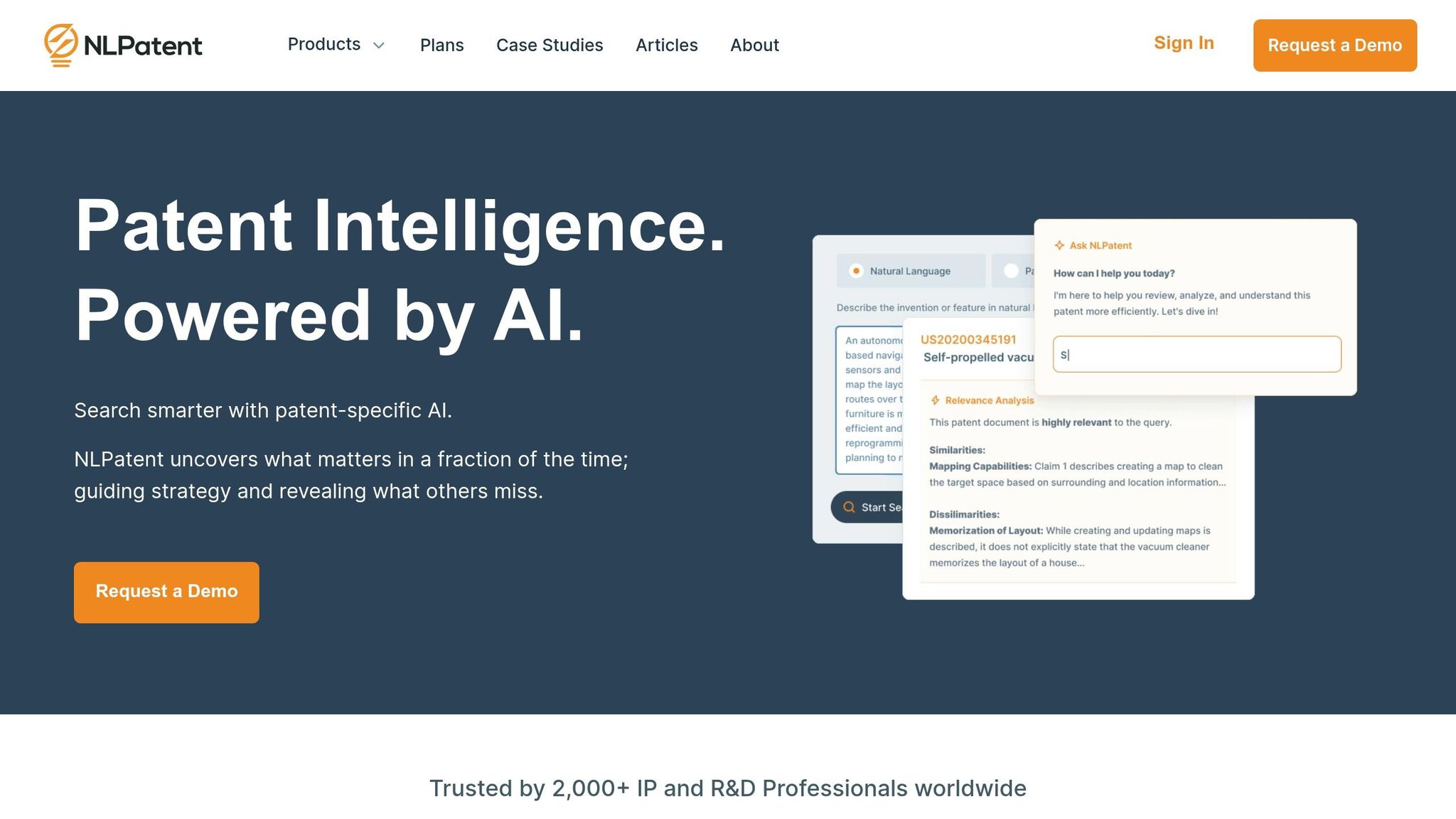
NLPatent uses specialized large language models tailored for patent language to uncover prior art that often goes unnoticed with traditional keyword searches. Over 2,000 IP and R&D professionals worldwide rely on this tool, which claims to cut patent search time by 80%. Let’s take a closer look at how its advanced features improve patent search workflows.
AI/Semantic Search Capabilities
The Ask NLPatent feature allows users to perform conversational queries, delivering patent-level summaries and contextual insights. Additionally, the Relevance Analysis tool provides real-time AI-driven explanations to help differentiate inventions from cited references.
"Not only does NLPatent replicate the strongest traditional search results, it also surfaces critical prior art that conventional methods miss. It's been a silver bullet in my litigation practice." – John Holley, Partner at Boies Schiller Flexner
For those seeking deeper analysis, the Premium plan includes access to a vast library of 160 million academic and technical documents, enhancing novelty and patentability studies. The platform also prioritizes security, maintaining SOC 2 certification and ensuring project data is isolated to prevent leaks.
Jurisdiction Coverage
NLPatent spans 18 jurisdictions, including major offices like WIPO, USPTO, and EPO. It offers weekly updates and automated monitoring of USPTO file wrappers. However, AI search and Boolean filters are currently limited to English-language specifications or machine translations.
Workflow Integration
This platform integrates seamlessly into various IP workflows, including patentability, prosecution, and due diligence. It supports tasks like Freedom to Operate (FTO), claim scoping, and invalidity analysis, making it a comprehensive tool for handling patents and intellectual property as a start-up.
"NLPatent is a core part of my drafting and pre-filing workflow. It identifies key references and streamlines claim scoping." – Bryan Meyer, Partner at Shook, Hardy & Bacon
Users can also refine searches manually by adding prior art or non-patent literature. While text prompts are capped at 600 words due to model constraints, the platform employs Retrieval Augmented Generation (RAG) to minimize inaccuracies in its AI analyses. Premium users gain access to NLPatent Visualize, an interactive tool that maps out technology clusters, trends, and competitive gaps.
Pricing
The Standard Plan includes core features like natural-language search, Ask NLPatent, relevance analysis, and patent monitoring. The Premium Plan builds on this with non-patent literature searches, interactive analytics, and expanded monitoring capabilities.
7. PatSeer
PatSeer offers a powerful combination of semantic and Boolean search capabilities, making it a go-to tool for patent professionals seeking both precision and broader conceptual insights.
This platform merges AI-driven semantic search with traditional Boolean logic through a hybrid search engine. This dual approach allows users to seamlessly toggle between detailed legal queries and wider conceptual searches - all within the same system. PatSeer's database is impressive, covering over 172 million patent records from 116 jurisdictions and 23 million design registrations.
AI/Semantic Search Capabilities
PatSeer’s PatAssist AI co-pilot is a standout feature. It helps users craft effective search strategies, expand queries, and tackle complex technical questions using advanced reasoning. For design patents, the platform employs an AI-powered image search tool that uses visual recognition to locate similar designs across more than 113 global offices.
Other notable tools include Smart Ranking and Reranking, which prioritizes results based on criteria like relevance, novelty, or technical similarity. The reranking feature even allows users to refine Boolean search results based on custom text inputs.
PatSeer’s AI Classifier takes categorization to another level by automatically or manually classifying patents and non-patent literature. Teams can build and reuse custom taxonomies, streamlining their workflows. Another handy feature, Semantic Mapping, converts patent claims into structured comparison charts, simplifying tasks like infringement analysis. According to the platform, these AI-driven tools can improve search quality by up to 70%.
Workflow Integration
PatSeer supports every stage of the innovation process, from brainstorming to monetization. Its Collaboration 2.0 tools allow users to rank, review, annotate, and share curated patent datasets while tracking progress and deadlines. Interactive dashboards and projects can even be shared with non-PatSeer users. Additionally, the platform integrates with existing patent management systems via Single Sign-On (SSO) and APIs.
"The interface feels really simple whether you’re a beginner or have years of experience under your belt. I can scan through patent literature quickly thanks to all the built-in features." – Fabian L., Patent Attorney
For a deeper analysis, the ProX edition evaluates invention families using more than 30 quality parameters. PatSeer also prioritizes user privacy with its "No AI Training" policy, ensuring that search histories and documents are not used to train AI models. The platform adheres to high security standards, holding ISO/IEC 27001:2022 and SOC 2 Type 2 certifications.
Pricing
PatSeer is available in five editions tailored to different needs:
Explorer: Focused on company-wide idea screening.
Premier: Designed for professional research and analysis.
PremierPlus: Adds advanced features like AI Search, AI Summaries, PatAssist, and Semantic Mapping.
ProX: A comprehensive IP research package that includes the AI Classifier.
Industrial Designs: Specialized for design-specific searches.
Pricing begins at $900 per user per quarter, with a two-week free trial offered. The platform boasts a 4.9/5 rating on Software Finder, based on 46 verified reviews.
Strengths and Weaknesses
This section highlights the primary strengths and drawbacks of each AI patent search tool, based on the detailed feature assessments provided earlier.
Each tool has its own set of advantages and limitations, making the choice largely dependent on your specific needs - whether that's advanced search capabilities, seamless integration into patent workflows, or strategic insights for portfolio management.
Some tools, like Derwent Innovation and PatSeer, excel in precise prior art searches with granular Boolean controls, making them ideal for complex investigations. However, they often face a "handoff problem", where search results are exported as static files, leading to a loss of context when transitioning to drafting or prosecution stages.
On the other hand, integrated platforms like Patently embed search functionality directly into drafting and project workflows. This approach ensures search intelligence is maintained throughout the entire patent lifecycle, reducing context drift and potentially saving 10–15 hours per case by streamlining the process of forming patentability opinions.
Platforms like Patsnap and Questel Orbit offer broad coverage (spanning over 180 patent offices) and deliver strategic insights. However, they come with steeper learning curves and sometimes prioritize conceptually related documents that may lack strong legal relevance.
The table below provides a concise breakdown of each tool's key strengths and weaknesses:
Tool | Key Strengths | Key Weaknesses |
|---|---|---|
Patently | Integrated drafting and search; semantic Vector AI; built-in project management | Requires onboarding for full feature utilization |
Patsnap | Exceptional global coverage; advanced semantic mapping; deep non-patent literature integration | Steeper learning curve |
Derwent Innovation | High data precision with DWPI-curated abstracts; clear "plain English" rewrites | Substantial enterprise pricing; less intuitive interface |
Questel Orbit | Comprehensive IP portfolio management; strong strategic landscaping | AI drafting is offered as an add-on and works within a proprietary platform |
PatBase | Mature Boolean capabilities; trusted by professional searchers | Limited AI-native features |
NLPatent | Optimized for patent language; 80% reduction in search time | Primarily focused on search rather than broader R&D workflows |
PatSeer | Hybrid Boolean plus AI re-ranking; ISO/SOC 2 certified; powerful analytics | Less intuitive for beginners; lacks integrated drafting |
With global patent filings expected to surpass 4 million annually, selecting a tool that balances robust search features, workflow integration, and strong security is more important than ever. The gap between teams using advanced tools and those relying on outdated systems continues to grow. Security is also a critical concern - by 2025, most AI-related breaches are predicted to stem from poor access controls. Tools like PatSeer address these risks with certifications that safeguard sensitive disclosures from being used to train public AI models.
Conclusion
From the detailed feature breakdown above, it's evident that having an AI-powered patent search tool integrated into your IP workflow is no longer optional - it's essential. Selecting the right platform depends on your specific patent lifecycle stage and your team’s priorities.
For invalidity searches and high-stakes litigation, Patently's Vector AI stands out. Its semantic search capabilities and technical depth help uncover critical prior art. The FAB Browser groups duplicate citations into families for clarity, while the C-Tree Visualization tool lays out priority claims and relationships - tools that are indispensable for crafting solid legal arguments.
For enterprise R&D teams managing patent data alongside broader innovation insights, Patently offers unified access to global databases. This includes major offices like the USPTO, EPO, CNIPA, JPO, KIPO, and WIPO, plus bibliographic data from over 100 additional jurisdictions. By integrating all this data, teams can maintain a consistent context throughout the patent process.
What sets Patently apart is its focus on workflow integration, not just search depth. As Kammie Sumpter from DeepIP puts it:
"The real differentiator is not whether a platform performs patent search. It is whether patent search becomes part of a continuous, connected system".
Patently addresses this with features like the Create module, allowing users to draft text and generate figures directly in the browser. Integration with tools like RPX Empower connects litigation and assignment data to AI-driven workflows, streamlining infringement and invalidity analyses. This eliminates the common "handoff problem", where context is lost during data exports.
Cost is another consideration. Patently offers flexible pricing tiers, starting with a Free plan for basic searches. The Starter plan, priced at $125 per month per user, includes enhanced search, analytics, and team collaboration for up to 10 users. For larger teams and advanced needs, custom-priced Business+, Law Firm+, and Enterprise plans are available.
With global patent filings on the rise, Patently's capacity to handle large volumes without compromising on data quality becomes increasingly important. When evaluating Patently, test it with your actual workflows, verify its data handling and security standards, and prioritize transparency in its AI features. By combining advanced AI search, integrated drafting, and seamless workflow management, Patently delivers a connected system tailored for today’s patent professionals.
FAQs
How is AI patent search different from keyword search?
AI patent search takes things to the next level by interpreting the meaning and context behind your queries. With tools like natural language processing and semantic analysis, it can uncover related ideas, cut down on irrelevant results, and provide more precise outcomes. On the other hand, traditional keyword searches stick to exact matches of terms or phrases, which can overlook subtle details or relevant prior art.
What should I test before adopting Patently for my team?
Before committing to Patently, it's smart to test its key features to see if they align with your team’s needs. Pay close attention to semantic search accuracy, support for patent families and citations, and how well it integrates into your existing workflows. Make sure the platform meets your security requirements and fits within your budget. Running a trial or pilot phase can help you evaluate its performance, ease of use, and the quality of customer support in a practical setting.
How do I keep search context tied to drafting and prosecution?
AI-powered patent search tools are designed to streamline workflow integration, ensuring that search insights remain relevant and accessible throughout the patent lifecycle. By linking prior art searches with drafting and prosecution tasks, these platforms help maintain context and continuity. This approach allows relevant prior art and analysis to actively inform each stage of the patent application process, improving efficiency and supporting seamless collaboration across various activities.