Custom IP Workflows for Early-Stage Startups
Intellectual Property Management
May 10, 2026
Treat IP as part of product: document early, run AI prior-art searches, and automate intake and deadlines to protect startup inventions.

Your intellectual property (IP) is a core asset that protects your innovations and strengthens your position with investors. However, for startups, traditional patents and intellectual property processes can feel slow and overwhelming. This guide breaks down a modern, streamlined approach to managing IP effectively:
Document Early: Use simple forms to capture technical ideas during development to avoid losing key details.
Understand Deadlines: File patents promptly to secure rights, especially under the U.S. "first-to-file" system. Missing deadlines can result in losing IP protection.
Leverage AI for Searches: AI tools make prior art searches faster and more affordable, helping you confirm your innovation’s originality.
Automate Workflows: Automate IP tracking, idea submissions, and deadlines to reduce manual effort and stay organized.
Centralize Collaboration: Use a shared workspace for IP projects to keep your team aligned and avoid missed steps.
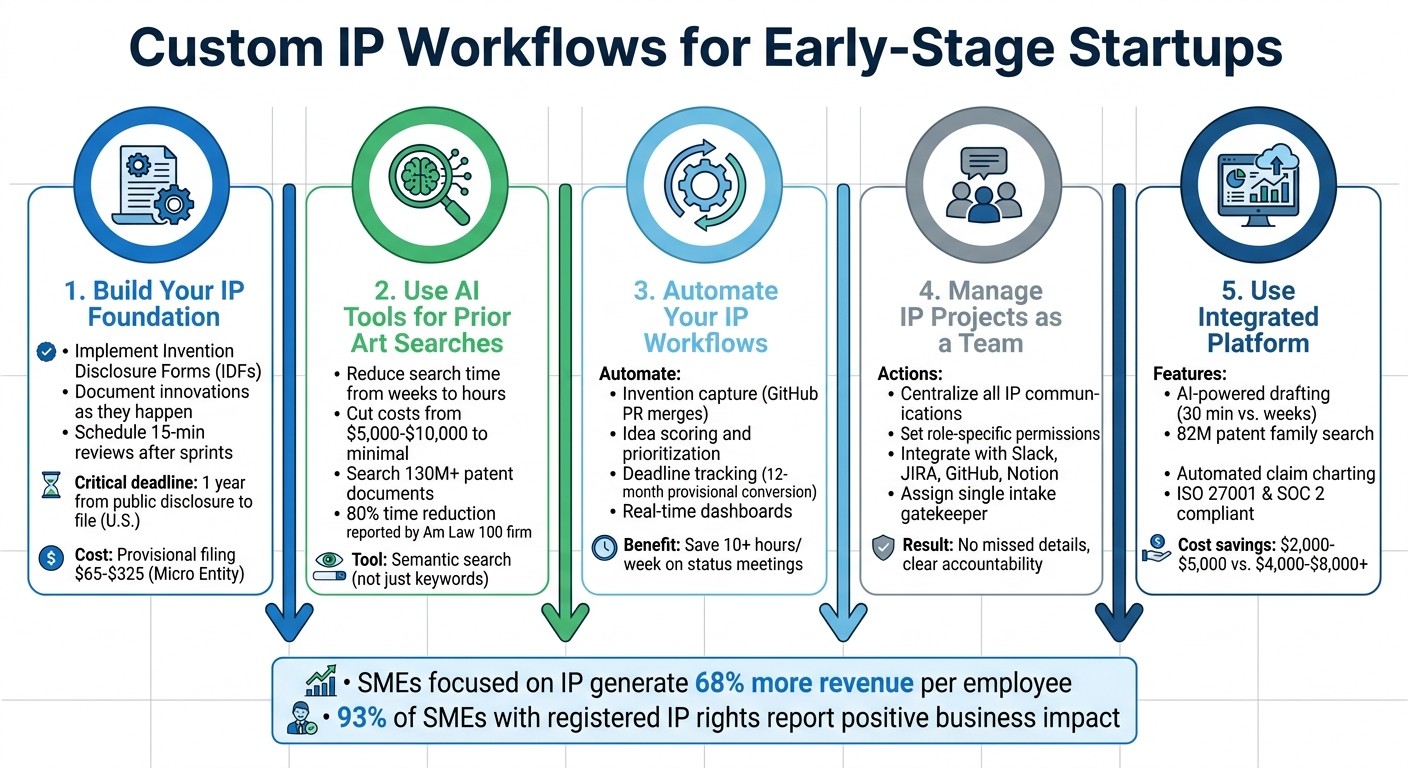
5-Step IP Workflow for Early-Stage Startups
Step 1: Build Your IP Foundation
Document Your Innovations Early
Companies often lose patents not because they lack ideas, but because they fail to document those ideas systematically. Your engineering team is likely solving tough technical challenges daily - whether it's backend improvements, new compression techniques, or unique system designs. Without a structured process to log these advancements, they can easily get buried in day-to-day communication.
To avoid this, implement an Invention Disclosure Form (IDF). This form should include a technical title, a description of the problem, details of the solution, and what makes it stand out. Simplify the process by encouraging engineers to answer questions like, "What problem did you solve?" and "How is this different from what's already out there?"
It's crucial to record these ideas as they happen. Waiting too long increases the risk of losing critical details, especially as priorities shift. Supplement these records with supporting materials like system diagrams, architecture charts, or key code snippets. To make this process part of your team's routine, schedule short reviews - perhaps 15-minute sessions after major sprints or technical milestones - to discuss and document new ideas.
Appointing someone, such as a product lead or engineering manager, to oversee the documentation process is another smart move. This ensures that valuable insights don’t just become informal knowledge that leaves the company when key team members move on.
Once you’ve established a strong documentation system, the next step is understanding the full lifecycle of intellectual property (IP) to protect your innovations from disclosure to enforcement.
Learn the IP Lifecycle Stages
Understanding the IP lifecycle is essential for securing priority dates and avoiding the loss of rights due to public disclosure. The U.S. operates under a first-to-file system, meaning the first person to file a patent application - not necessarily the original inventor - gets the rights. The lifecycle includes five key stages: Intake, Drafting, Filing, Prosecution, and Grant.
One critical deadline to keep in mind: in the U.S., you have one year from any public disclosure - whether it’s a demo, pitch, or product launch - to file a patent application. If you miss this window, you could lose your U.S. rights. Internationally, the rules are even stricter, with many jurisdictions requiring "absolute novelty", meaning any prior disclosure can void your patent rights. To avoid this, file at least a provisional application before any public presentation or investor meeting.
A provisional application is a cost-effective way to secure your priority date for 12 months while you refine your product. USPTO fees for provisional applications range from $65 to $325, and they can serve as a placeholder while you prepare a full application. Keep in mind, however, that patents come with ongoing costs: maintenance fees are due at 3.5, 7.5, and 11.5 years post-issuance, and the total cost to secure a patent can range from $15,000 to $30,000 or more, depending on its complexity.
Intellectual Property 101 for Startup Businesses
Step 2: Use AI Tools for Prior Art Searches
Once you’ve laid the groundwork for your intellectual property (IP), the next step is to confirm your innovation’s originality through prior art searches.
Before spending thousands on drafting and filing a patent, it’s crucial to check if a similar idea has already been claimed. Traditional manual searches for prior art can cost anywhere from $5,000 to $10,000 and take 2–4 weeks to complete. For early-stage startups with limited budgets and tight schedules, this process can feel like a major roadblock. Thankfully, AI-powered tools have changed the game, cutting search times from weeks to just hours and significantly lowering costs.
This is a big deal when you consider the sheer size of global patent databases, which now hold over 130 million documents. Scanning these manually is next to impossible. For example, an Am Law 100 firm reported an 80% reduction in time spent on complex patent searches - shrinking 100 billable hours to just 20 - after adopting AI tools. For startups, this means you can integrate searches throughout your product development process instead of treating them as a one-time task before filing.
How Semantic Search Works for IP
Traditional keyword searches rely on exact matches, which can miss patents that describe the same idea using different terms. For instance, searching for "data compression algorithm" might overlook patents that use phrases like "file size reduction method", even though they address the same technical issue.
Semantic search changes the game by focusing on the underlying concepts of your invention rather than just the words used. Tools like Patently's Vector AI analyze the technical details of your description to uncover patents based on functional similarities. This approach accounts for synonyms, related ideas, and even variations across languages.
With this in mind, you can optimize your search strategy by following a few key tips.
Tips for Better Search Results
The accuracy of AI search results hinges on how you describe your invention. Avoid overly legalistic language. Instead, describe your idea as you would to a technical co-founder. Break your description into three layers:
Big-picture functionality: What problem does your invention solve?
Technical approach: How does your solution work?
Alternative methods: What other approaches did you consider?
For example, instead of vaguely stating "machine learning model for fraud detection", try something like: "Detecting fraudulent transactions in real time using convolutional neural networks to analyze transaction patterns, while also exploring rule-based systems as an alternative."
Since patents often describe similar problems even if the solutions differ, it’s helpful to separate the problem from the solution in your searches. This gives you multiple angles to explore. Start with a broad search, review the results, tweak your wording, and run another search to refine your findings.
One common pitfall is relying entirely on AI-generated summaries. A Director of IP & Litigation at a leading cybersecurity company used AI tools to assess infringement risks internally, saving $20,000–$50,000 per case. However, their success came from combining AI insights with manual review. They carefully examined the claims sections of top results, knowing that legal protection hinges on the claims, not the abstract.
"If I can give the executive team an answer in a few minutes, that's priceless." - Director of IP & Litigation, Leading Cybersecurity Company
Lastly, keep a search journal. Record details like the date, tool used, and exact queries. This not only provides a due diligence record for investors but also helps you track changes in your terminology as you refine your understanding of the prior art landscape. If you discover similar patents, use AI-generated summaries to identify gaps or unclaimed areas where you can adjust your product's technical direction to strengthen its defensibility.
Step 3: Automate Your IP Workflows
Once you've completed prior art searches, it's time to ensure your intellectual property (IP) processes don't slow down product development. Relying on manual tracking for invention disclosures, filing deadlines, or review cycles can create delays that startups - especially early-stage ones - simply can't afford. The answer? Automate repetitive tasks so your team can stay focused on building.
Simplify Invention Capture
Get started by automating how you capture inventions. Instead of expecting engineers to fill out forms weeks after shipping a feature, integrate IP intake directly into the development workflow. For instance, you could set up an automatic invention capture prompt whenever a major code branch is merged in GitHub or when a release tag is created. This approach ensures that critical technical details are recorded while they're still fresh, making it easier to protect your IP before key details are forgotten.
"When disclosure becomes part of shipping, it stops feeling like extra work." - PowerPatent
To make this process seamless, replace complex legal terminology with simple, technical questions. AI-driven systems can guide engineers with prompts like, or even draft patent applications with AI, "What problem did this solve?" or "How could someone replicate this approach?". For fast-paced startups, this lighter approach ensures that inventing doesn't feel like an administrative burden.
Organize and Prioritize Ideas Automatically
Once you've automated idea capture, the next step is organizing and prioritizing the submissions. Top patent tools can score disclosures based on keywords, product relevance, and strategic importance. For example, if your goal is to outmaneuver a competitor or boost your valuation before a Series A round, you can tag disclosures accordingly and prioritize legal review for the most impactful ideas.
A layered system works best: start with simple initial descriptions, then dive deeper with follow-up questions only for strategically important ideas. Assigning a single point of accountability - like a technical lead or product manager - helps move disclosures forward without adding unnecessary meetings.
Stay on Top of Deadlines
After automating collection and review, the next challenge is tracking deadlines. Missing key filing dates, like the 12-month window to convert a provisional patent, can result in losing IP rights. Automated systems can monitor these deadlines and provide real-time updates through dashboards.
Automated alerts can flag critical dates, such as ensuring a provisional patent filed in January 2026 is converted by January 2027. This is especially important during fundraising, as investors will want to see a clean and organized record of your IP history. A centralized dashboard also gives leadership a clear view of disclosure activity and review timelines, boosting confidence during due diligence.
Task | Automation Method | Benefit |
|---|---|---|
Idea Collection | Automated prompts on PR merges or release tags | Captures details early before they fade |
Review & Triage | Keyword scoring and strategic tagging | Ensures high-value IP gets reviewed first |
Deadline Tracking | Automated monitoring of key dates | Avoids missed deadlines and loss of rights |
Documentation | Auto-linking GitHub commits or Jira tickets | Reduces manual data entry for engineers |
Reporting | Real-time dashboards | Tracks progress and builds investor confidence |
Step 4: Manage IP Projects as a Team
Once workflows are automated, the next step is ensuring smooth teamwork. Managing IP projects effectively is crucial for startups aiming to establish a fully streamlined IP workflow. These projects often involve multiple roles - engineers coming up with inventions, product managers deciding priorities, and attorneys handling filings. When discussions about IP are scattered across emails, Slack, and Google Docs, it’s easy for important details to slip through the cracks. The solution? Consolidate all IP-related work into a single shared workspace where everyone stays aligned.
Centralize Your IP Communications
Rather than juggling multiple tools for IP discussions, bring everything into one platform. This allows your team to review disclosures, provide feedback, and track filing progress in one place. A centralized system can replace time-consuming status meetings with real-time dashboards that highlight what’s in progress, what’s been filed, and what still needs attention. In fact, teams using AI-enabled patent platforms report saving over 10 hours each week by cutting out unnecessary update meetings.
Integrating IP checkpoints into your existing workflows makes collaboration feel natural. For instance, you can include IP reviews in weekly sprint retrospectives or monthly product meetings to identify patentable innovations before they’re released. This approach ensures that IP protection happens as part of your regular process, not as an extra task that slows things down. Tools like Slack, JIRA, GitHub, Notion, and Confluence can gather innovation-related insights without disrupting your team’s workflow.
By centralizing everything in one workspace, you’ll also create a structure where team roles are clearly defined, making it easier to manage permissions and access.
Set Up User Permissions
Centralized communication is just the start - defining user permissions is the next step to keep things running smoothly and securely. Assign role-specific access to protect sensitive IP information. For example, engineers can submit disclosures and view their own submissions, but they don’t need access to confidential legal communications or budget details. Product managers might need broader visibility to prioritize filings, while outside counsel should only access the projects they’re handling.
Appoint a single intake gatekeeper, such as a product lead or engineering manager, to oversee the invention submission process. This person ensures technical ideas are captured in the shared system and routed to the appropriate reviewers. Setting up clear permissions minimizes the risk of accidental leaks while keeping the workflow efficient. For instance, engineers could have "submit only" access, product managers "review and prioritize" access, and legal counsel "full edit" access for drafting applications and responding to office actions.
Step 5: How Patently Supports Startup IP Workflows

Streamlining your intellectual property (IP) workflows is crucial, and using an all-in-one platform can make a world of difference. Patently integrates AI-assisted drafting, semantic search, and collaborative project management into a single workspace. This eliminates the hassle of switching between tools for tasks like prior art searches, patent drafting, and team coordination. Let’s dive into how Patently helps startups manage their IP needs more efficiently.
Patently Features for Startups
Patently simplifies IP management with features designed to save time and reduce costs:
AI-Powered Intake Modules: These modules transform unstructured materials - like PowerPoint slides or lab notes - into structured Invention Disclosure Forms (IDFs). This reduces manual data entry and keeps your workflow smooth and efficient.
Advanced Semantic Search: Patently’s Vector AI Semantic Search scans a vast database of 82 million patent families and 250 million non-patent documents. By combining semantic and Boolean search methods, it ensures comprehensive results. For instance, searching for "Drone" will also surface patents describing "Unmanned Aerial Rotorcraft."
Rapid Patent Drafting: The Patently Create feature drafts complete patent applications in about 30 minutes. This AI-driven drafting process can cut provisional application costs to $2,000–$5,000, compared to the $4,000–$8,000+ charged by traditional firms.
Real-Time Dashboards: Say goodbye to time-consuming status meetings. Patently’s live AI dashboards provide real-time updates on every case, responsible parties, and critical deadlines.
Automated Claim Charting: For startups dealing with technical standards, Patently Mine maps patents against technical documentation in minutes instead of days [27,29].
Top-Tier Security: Protecting sensitive R&D data is a priority. Patently is ISO 27001:2022 and SOC 2 compliant. It also uses a unique "Genetic family" definition, grouping patents by invention subject matter rather than just formal priority rules. This makes it easier to track the development of your IP portfolio.
Select the Right Patently Plan
Patently offers flexible plans tailored to startups at different growth stages. Here’s a quick breakdown:
Free Plan ($0): Ideal for individual use, this plan includes basic search with filters and access to full patent details. Limited to one user.
Starter Plan ($125 per user per month): Great for small teams (up to 10 users), it adds semantic search, analytics, a FAB citation browser, and team collaboration tools.
Business+ Plan (custom pricing): Designed for scaling startups, this tier includes AI patent drafting, fee tracking, and support for unlimited users.
Law Firm+ Plan (custom pricing): Perfect for startups collaborating with outside counsel, it offers matter-centric management and client access.
Enterprise Plan (custom pricing): Fully customizable for large organizations with complex needs.
For pre-seed and seed-stage startups, the Starter plan is a practical choice. As your company grows, upgrading to Business+ ensures you’re equipped to handle portfolio expansion and international filings.
Lastly, don’t overlook cost-saving opportunities. If your startup qualifies for Micro Entity status with the USPTO, you can benefit from an 80% reduction in fees. For example, provisional filing costs drop from $320 to just $65. Matching your Patently plan to your funding stage ensures you’re investing wisely in your IP strategy.
Common IP Workflow Mistakes and Solutions
Even with well-organized workflows, mistakes in IP management can jeopardize your innovations. Startups, despite their best efforts, can stumble into errors that lead to lost patent rights, ownership disputes during fundraising, or leaving valuable ideas exposed. Let’s break down some common pitfalls and how to sidestep them.
Failing to Document Properly
A lack of proper documentation can mean missed patent opportunities. Engineers often jot down ideas in Slack messages, code commits, or verbal updates, but without structured records, vital technical details can slip through the cracks. These details are essential for building strong patent applications.
One major issue is confusing features with inventions. A feature explains what your product does - like "real-time fraud detection." An invention, on the other hand, dives into the how - the algorithm, data-routing method, or structural innovation that makes it work. Using vague terms like "automated" or "optimized" doesn’t provide patent attorneys with the technical specifics they need. As PowerPatent aptly puts it:
"Big mistakes in patents do not happen at the end. They happen at the beginning. The first call. The first form. The first set of notes from the inventor".
To address this, set up a lean intake process that simplifies how engineers share technical details. Ask straightforward questions like: What was the problem before? What did you change? How could someone replicate this approach? This eliminates jargon and ensures focus on the actual technical innovation. You can also use automated prompts tied to development milestones to capture these insights during the build process.
Missing Critical Deadlines
IP deadlines are unforgiving. Under U.S. law, you have one year from any public disclosure - like a demo, investor pitch, or product launch - to file a patent application. Internationally, the stakes are even higher. Many countries follow "absolute novelty" rules, meaning any public disclosure before filing renders the invention unpatentable.
Startups often miss these deadlines due to a lack of clear oversight. Without someone specifically responsible for moving disclosures through the process, key details can get lost in scattered tools like email or Slack. To avoid this, proactive systems and accountability are critical.
The fix: automate deadline tracking and assign ownership. Designate a product lead or engineering manager to oversee the entire IP workflow, ensuring no disclosure lingers without action. Use dashboards to get real-time updates on every invention’s status - whether it’s under review, in draft, or ready for filing. This visibility allows you to spot and address bottlenecks immediately. Treat your "Patent Ops" like DevOps - a continuous, integrated system, not a one-time legal task.
Conclusion
Creating a flexible IP workflow isn’t about achieving flawless legal processes right away. It’s about moving from reactive problem-solving to proactive IP management - integrating protection into your product development process, much like DevOps, rather than treating it as a last-minute legal hurdle. By following these steps, you can safeguard your IP while your product evolves.
The benefits of this approach are clear. Small and medium-sized enterprises (SMEs) that focus on IP generate 68% more revenue per employee compared to those that don’t. Additionally, 93% of SMEs with registered IP rights report a positive impact on their business. Leveraging AI-powered workflows makes these outcomes achievable for lean teams, reducing prior art research time from 20–40 hours to just 2–4 hours and automating administrative tasks that typically strain legal budgets.
Samim Safaei, Founder of siift.ai, emphasizes the importance of IP:
"Intellectual property is the currency of the knowledge economy. For small businesses, it is essential for sustainable growth".
The secret lies in treating IP as an ongoing business strategy rather than a one-time legal task. Scalable workflows ensure knowledge is preserved as team members change roles, demonstrate organizational maturity to investors during due diligence, and create a strong defensive barrier around the innovations that fuel your revenue. Tools like Patently bring these workflows together, offering leadership real-time insight into the IP pipeline and transforming IP from a potential bottleneck into a competitive edge.
Start small. Automate repetitive tasks. Build a system that grows with your team and compounds its value over time. By embedding IP management into your daily operations, your startup can secure a lasting competitive advantage that benefits your team, your investors, and your future innovations.
FAQs
When should we file a provisional patent vs. a non-provisional?
A provisional patent is best filed early in the development process to lock in a priority date, particularly if you're planning any public disclosures. This option gives you up to 12 months to further develop your invention or prepare a more detailed non-provisional application.
A non-provisional patent is the right choice when your invention is fully developed and ready for formal examination. If approved, it can result in an enforceable patent.
How can we avoid losing patent rights after a demo, pitch, or launch?
To safeguard your patent rights, it’s crucial to file a patent application before making any public disclosures, using, or offering to sell your invention. Filing early locks in your priority date, which is essential since patent law operates on a first-to-file basis. Waiting too long can lead to statutory bars that might void your rights entirely. Acting quickly ensures your invention is protected and preserves your chance at securing patent protection.
What’s the simplest way to capture inventions without slowing engineers down?
The easiest approach is to implement a streamlined invention intake process that fits seamlessly into your startup’s workflow. Prioritize collecting invention details as early as possible using a straightforward, user-friendly system. Pairing intuitive software with attorney reviews helps ensure ideas are recorded quickly, reducing the risk of delays or overlooked opportunities while keeping things moving efficiently.