AI in Prior Art Search: Trends for 2026
Intellectual Property Management
May 28, 2026
AI and hybrid searches speed prior art discovery, cut costs, and demand human oversight to manage errors and legal risk.

AI is reshaping how patent professionals conduct prior art searches. By 2026, tools powered by machine learning and natural language processing are delivering faster, more accurate results. These systems go beyond keyword matching to understand the concepts behind queries, addressing challenges like synonyms, paraphrasing, and multilingual content. Hybrid methods - combining AI with Boolean logic - have become the standard, offering both broad recall and precise filtering.
Key highlights:
Efficiency Gains: AI-enabled patent analysis reduces search time by up to 80%, with costs dropping to $100–$500 per search.
Market Growth: The AI patent search market is valued at $2.09 billion in 2026, with projected growth to $5.37 billion by 2035.
Adoption Trends: 88% of IP professionals now supervise AI outputs, while patent offices like USPTO are expanding AI pilot programs.
Challenges: Risks include hallucinations, language barriers, and missed references, which could lead to legal issues.
AI tools, such as those using semantic search and retrieval-augmented generation (RAG), are transforming workflows while requiring human oversight for legal reliability and precision.
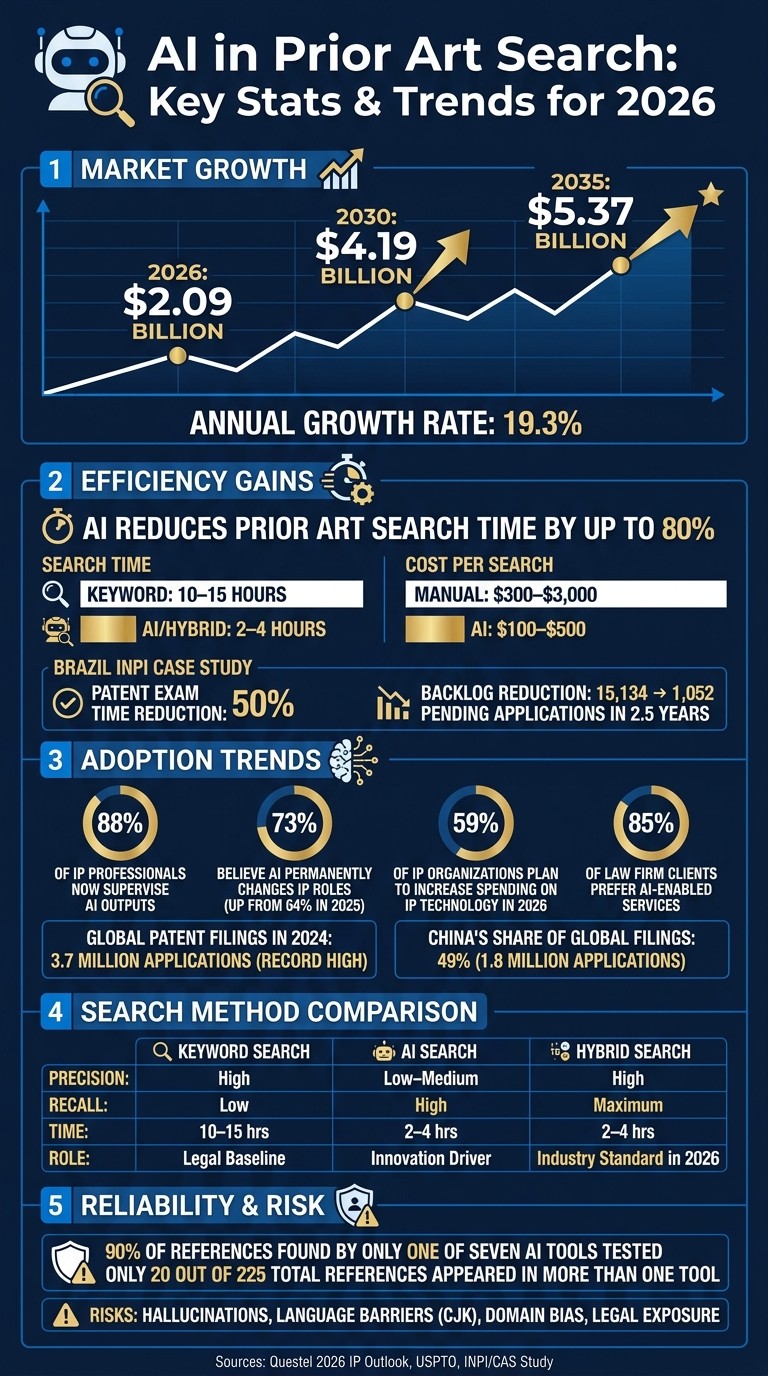
AI in Patent Prior Art Search: Key Stats & Market Trends 2026
How Is AI Improving Patent Prior Art Searches? - Trademark and Patent Law Experts
How Well Does AI Perform in Prior Art Search?
Recent data sheds light on both the strengths and limitations of AI in prior art searches.
Keyword Search vs. AI-Driven Search: A Benchmark Review
Top-tier AI-based search tools have a clear edge over traditional keyword searches when it comes to recall - finding relevant documents that keyword searches might miss. Traditional methods often fail to account for synonyms, paraphrasing, or variations across languages, potentially overlooking 20–40% of relevant prior art. AI, with its semantic search capabilities, focuses on conceptual meanings rather than exact word matches, addressing these gaps effectively.
Practical examples highlight these benefits. For instance, Brazil's National Institute of Industrial Property (INPI) partnered with CAS to implement AI-driven search tools. The results were striking: patent examination times were cut by 50%, an 80% reduction in a multi-year backlog was achieved (pending applications dropped from 15,134 to just 1,052 in 2.5 years), and costs per search fell to $100–$500, compared to the $300–$3,000 range typical of manual searches.
Known Limitations and Error Patterns
While AI offers advantages, it's not foolproof. One key issue is hallucination, where the system generates summaries of patents or claims that don't actually exist. Another challenge is precision noise - irrelevant results that increase workload and reduce trust in the tool. Language barriers also persist; for instance, in 2024, China accounted for 49% of global patent filings (1.8 million applications), yet AI models often struggle with technical content in Chinese, Japanese, and Korean. Additionally, domain bias can limit performance, as models trained on software or electrical engineering patents may falter when applied to areas like biotech or chemistry, where the language and structure of claims differ significantly.
There are also legal risks. If an AI tool misses a known reference, it could lead to allegations of inequitable conduct during litigation. As PapersFlow cautions:
"Do not confuse a search interface with a complete research process, and do not confuse fluent AI output with real evidence."
Comparison Table: Keyword, AI, and Hybrid Search Methods
Hybrid search methods have emerged as a way to combine the strengths of AI and traditional approaches. By 2026, this hybrid model - integrating AI's semantic retrieval with Boolean logic and structured classification codes - has become the industry standard. Here’s how the three approaches compare:
Criteria | Boolean/Keyword Search | AI Search | Hybrid |
|---|---|---|---|
Precision | High (exact matches) | Low–Medium (includes similar ideas) | High (AI filtered by logic) |
Recall | Low (misses synonyms/paraphrasing) | High (finds hidden concepts) | Maximum (best of both methods) |
Blind Spots | Synonyms and typos | Niche technical distinctions; CJK language gaps | Setup complexity |
Search Time | 10–15 hours | 2–4 hours | 2–4 hours |
2026 Status | Legal baseline | Innovation driver | Industry standard |
A typical hybrid workflow integrates these methods in four steps: starting with a broad AI-driven search to maximize recall, extracting new vocabulary from the results, applying Boolean and CPC filters for precision, and then involving a human expert for final review. This approach combines the speed and breadth of AI with the accuracy and judgment of human oversight. Professionals can leverage these benefits by using hybrid intelligence platforms to streamline the drafting process.
Interestingly, a study revealed that nearly 90% of references were identified by only one of seven AI tools tested. Out of 225 total references, only 20 appeared in more than one tool. Researcher Charles Eldering (Author, Light Drafts) aptly noted:
"The real question is not whether AI can search patents, but whether it can make different people see the same prior art when faced with the same claim."
This challenge of consistency underscores the importance of hybrid workflows, where AI and human expertise work together to ensure thorough and reliable prior art searches.
Market Growth and Adoption Trends in 2026
Market Size and Investment in AI Patent Search
AI-powered patent search is proving to be a growing market. By 2026, its value is projected to reach $2.09 billion, with an impressive annual growth rate of 19.3%. By 2030, the market is expected to hit $4.19 billion, driven largely by North America, while Asia-Pacific emerges as the fastest-growing region. Investor confidence reflects this momentum; in May 2026, a prominent AI patent platform secured $40 million in a Series B funding round to enhance its AI capabilities tailored for intellectual property (IP). Additionally, 59% of IP organizations plan to boost their spending on IP technology in 2026. With global patent filings reaching a record 3.7 million applications in 2024, the demand for smarter, faster search tools isn't slowing down. These trends highlight the evolving dynamics shaping the patent search landscape.
How Patent Professionals and Organizations Are Using AI
AI is reshaping how patent professionals approach their work. A striking 88% of IP professionals now spend up to half their time in supervisory roles, focusing on reviewing AI-generated results rather than building searches manually. According to the Questel 2026 IP Outlook Report, 73% of respondents believe AI will permanently change IP roles, up from 64% in 2025.
The U.S. Patent and Trademark Office (USPTO) has also embraced this shift. In April 2026, it doubled the capacity of its ASAP! pilot program, reflecting early success in using AI to streamline processes. On the corporate side, IP teams are leveraging AI for tasks like Freedom-to-Operate (FTO) or novelty searches and competitive landscape mapping. These tools have reduced prior art search times by 60% to 80%, enabling quicker product development and fewer litigation risks.
Use Case Table: AI Adoption by User Group
The table below illustrates how different user groups are integrating AI into their workflows, showcasing the benefits and tools driving adoption.
User Group | Typical Use Cases | Key AI Features Used | Reported Benefits |
|---|---|---|---|
Corporate Teams | FTO analysis, competitive intelligence, whitespace identification | Landscape mapping, semantic search, predictive analytics | 60–80% time reduction; reduced litigation risks |
Law Firms | Patentability & invalidity searches | Semantic ranking, automated summarization | Shift to supervisory roles; 85% of clients prefer AI-enabled services |
Patent Offices | Pre-examination screening, image-based design search | Automated classification, citation graph analysis, similarity search | 50% reduction in exam time; faster identification of relevant prior art |
R&D Teams | Technology scouting, concept validation | Natural language queries, trend visualization, white space analysis | Early detection of blocking patents before large investments |
Startups | Patentability checks | Natural language search | Avoids $15,000+ in filing fees for unpatentable ideas |
One of the key factors driving AI adoption is the "vocabulary gap" - the challenge of different inventors describing the same concept with varied terminology. Traditional keyword searches often fall short in addressing this issue. AI-powered semantic search bridges this gap effectively, making it an essential tool even for organizations hesitant to adopt new technologies. This practical advantage is pushing AI into the mainstream of patent workflows.
The Technology Behind AI Prior Art Search
Semantic Search and Hybrid Retrieval Methods
Patent research has seen a major shift from traditional keyword searches to semantic search, which focuses on understanding the meaning behind words. Unlike Boolean queries, semantic search translates text into numerical vectors that capture the essence of the content, bridging gaps in vocabulary.
Today, the industry standard combines semantic and Boolean methods. Semantic search casts a wide net, identifying conceptually similar documents, while Boolean logic ensures precision by narrowing down results. Research indicates this hybrid approach can uncover up to 99% of relevant prior art, while also minimizing irrelevant hits. However, pure semantic search isn't without risks. A common issue is "semantic drift," where an AI misinterprets functional similarities (like ultrasonic physics) across unrelated fields (e.g., medical vs. automotive), leading to irrelevant results. Using Boolean constraints alongside semantic methods helps address this issue.
LLMs and Retrieval-Augmented Generation (RAG)
Advancements in language models have further expanded the capabilities of patent searches. Large language models (LLMs) now go beyond simple query matching - they can generate queries, cluster results, and even summarize intricate patent claims. Retrieval-Augmented Generation (RAG) takes this a step further by grounding LLM outputs in real-time patent databases, reducing the risk of outdated or fabricated information.
Take Questel AI Lab's QaECTER as an example. This 344-million-parameter model, trained specifically on patent citation data, outperformed a much larger 8-billion-parameter general-purpose model in English RTEB tests across various domains. The takeaway? When it comes to patent retrieval, specialized training often trumps sheer model size.
Modern RAG platforms also bring interactive AI chat agents into the mix. These tools allow users to ask follow-up questions about a reference's relevance or re-rank results based on specific claim details. Some tools go even further, offering automated qualification engines that evaluate whether a document meets legal standards as prior art under frameworks like AIA or pre-AIA Section 102.
Fitting AI Tools into Professional Workflows
The integration of AI into professional workflows has been transformative. In 2026, the most practical change is the embedding of AI directly into the patent drafting process. For instance, AI tools now integrate with the Invention Disclosure Form (IDF) pipeline, enabling real-time novelty checks as claims are drafted. This proactive approach allows patent attorneys to identify potential conflicts before finalizing a draft, saving time and effort.
Patently is a standout example of this workflow-first design. Its Vector AI semantic search retrieves patents based on natural language queries, while the Forward and Backward Citation Browser helps users trace citation networks to uncover prior art that might escape traditional keyword searches. Paired with collaborative project management tools, these features allow teams to seamlessly transition from initial search to claim drafting, eliminating the inefficiencies of switching between tools.
"What stands out about agentic technology is the extent to which it has allowed penetration of a system that has so frequently seemed impenetrable." - David Hughes, Principal, Griffith Hack
The emerging workflow starts with a broad natural language query to find semantically related patents, refines the results by using Boolean filters, and concludes with human review. This layered approach - combining broad AI-driven recall with precise filtering - delivers both speed and accuracy, meeting the demands of modern patent professionals.
Legal, Ethical, and Reliability Issues to Consider
Effects on Patent Law and Litigation
AI tools have become helpful in patent assessments, but they fall short of replacing the nuanced judgment that legal professionals bring to the table. While these tools can identify conceptual similarities, they can't assess the legal importance of those findings. Determining whether a reference qualifies as prior art involves multiple factors, such as claim construction, jurisdictional standards, and procedural posture - areas that require human expertise to navigate effectively.
One critical area of concern is the duty of disclosure under 37 CFR 1.56. If an AI tool fails to identify a relevant reference, it could compromise the integrity of a patentability opinion or prosecution strategy. This makes structured disclosures and well-defined claim sets essential for achieving reliable outcomes.
"Legal relevance remains contextual, depending on claim construction, jurisdictional standards, and procedural posture. Human review is essential." - Kammie Sumpter, DeepIP
These challenges highlight the importance of transparent and auditable AI search results to ensure legal reliability.
Transparency and Auditability in AI Search Results
A major issue with AI tools in 2026 is the "black-box" problem - where results are provided without clear reasoning behind their selection. This lack of transparency creates significant risks. If the conceptual overlap between an invention and a reference is unclear, it can weaken the legal defensibility of the search strategy.
In a 2026 study comparing seven AI prior art tools, nearly 90% of references were identified by only one system. Such discrepancies undermine the reliability of results and emphasize the need for tools that go beyond simple relevance scores. Effective platforms should provide explicit conceptual mapping to clearly show the connection between the invention and the retrieved references.
"Black-box similarity scores undermine trust. Effective AI patent search tools must explain why references were retrieved, show conceptual overlap, and support defensible legal reasoning." - Kammie Sumpter, DeepIP
Patently addresses this issue with its Vector AI semantic search. It allows users to perform natural language queries while maintaining traceable citation networks through its Forward and Backward Citation Browser. This approach ensures professionals have a documented and auditable path for their searches.
Data Governance and Client Confidentiality
Transparency in search results is only part of the equation. Robust data governance is equally critical to protect client confidentiality. Entering invention details into AI tools poses risks of exposing sensitive information, which is especially concerning given that about 90% of the S&P 500's market value comes from intangible assets like intellectual property. The consequences of a data breach or accidental disclosure are enormous.
Organizations must ensure that AI vendors do not use query inputs for third-party training. Tools should operate in secure environments - preferably isolated or encrypted - and access controls must be strictly enforced to safeguard client data. For firms managing high-value portfolios, private cloud or on-premise deployments offer the best protection. Vendors with ISO 27001 certification and strong encryption practices should be prioritized during procurement.
The table below compares the risks, auditability, and benefits of different AI search methods, offering insight into how firms can balance these factors as they integrate AI into their workflows:
Search Method | Data Governance Risk | Auditability Level | Primary Benefit |
|---|---|---|---|
Keyword Search | Low (public databases) | Manual/Low | Familiarity, no data leakage |
AI-Driven (Public) | High (data ingestion) | Variable | High speed, semantic discovery |
AI-Driven (Enterprise) | Low (isolated/encrypted) | High (auto-logs) | Defensible, secure, high recall |
Hybrid Search | Low (controlled) | High (human + AI) | Best balance of speed and accuracy |
Comprehensive audit trails are also essential. These unalterable logs track every access, modification, and sharing event, supporting both accountability and compliance with U.S. bar rules on client confidentiality. As patent attorney Craige Thompson explains:
"AI tools can accelerate routine legal tasks like document review and prior art searching, but the strategic judgment that determines whether a patent will survive examination cannot be delegated to an AI system."
Conclusion: What Comes Next for AI in Prior Art Search
AI-driven prior art search has come a long way since its early days of simple keyword matching. By 2026, patent professionals have access to tools that combine semantic retrieval, retrieval-augmented generation (RAG) architectures, and cross-domain discovery - capabilities that were once just theoretical. The growing confidence in these tools is reflected in the increasing adoption by both practitioners and investors.
The next wave of AI systems is already taking shape. These agentic AI systems are set to go beyond merely returning ranked lists of documents. They will introduce capabilities like planning and refining search strategies over multiple steps, interpreting invention disclosures directly, and even flagging potential novelty concerns. As David Hughes, Principal at Griffith Hack, explains:
"Agentic searches have democratised the patent cycle by creating easier, less costly access to the information that we need."
Another major shift is the rise of continuous prior art monitoring, which transforms prior art search from a one-time task into an ongoing process. These systems deliver real-time alerts as new patent applications are published. Meanwhile, cross-domain discovery - the ability to identify analogous solutions from entirely different fields - is becoming a critical part of novelty analysis. These advancements expand the toolkit for patent professionals, but they do not replace the need for expert judgment.
Tim Bright, a patent expert, highlights this balance of innovation and caution:
"The same changes that ease prosecution today may become contested flashpoints in post-grant proceedings or district court litigation tomorrow."
For professionals deciding where to invest in AI tools, some priorities stand out: demand tools that provide explainable results, ensure verified database coverage across major patent offices like USPTO, EPO, WIPO, CNIPA, JPO, and KIPO, and meet enterprise-grade security standards such as ISO 27001 certification and SOC 2 Type II compliance.
As these cutting-edge technologies integrate into daily workflows, platforms like Patently Create are leading the charge by utilizing Vector AI semantic search to streamline processes while maintaining defensible outcomes. These advancements promise to enhance efficiency while preserving the critical role of professional expertise.
FAQs
When should I use hybrid search instead of pure AI search?
Use hybrid search when you want the expansive capabilities of AI-driven semantic search combined with the accuracy of precise filtering. While AI can identify related prior art, it may also surface irrelevant results. A hybrid strategy helps you:
Apply Boolean filters, like classification codes or date ranges, to fine-tune AI-generated results.
Maintain legal defensibility for patentability or freedom-to-operate (FTO) analyses.
Narrow your focus to particular technologies by incorporating keyword constraints.
How can I audit and defend AI search results in prosecution or litigation?
Auditing and verifying AI-driven search results requires a blend of human insight and advanced AI tools. The process involves checking outputs by linking claims to evidence, ensuring all references align with legal standards such as Section 102, and keeping thorough, audit-ready documentation. Tools like Patently play a key role here by offering features like semantic search, automated claim parsing, and data analysis. These capabilities help professionals confirm claim-to-reference connections and maintain consistency throughout the prosecution record.
What security measures protect invention data in AI tools?
Professional platforms implement strong security protocols to protect user data. These include enterprise-grade authentication methods like SAML SSO and encryption standards such as TLS 1.2+ or HTTPS for data in transit and AES-256 for data at rest. They also uphold zero-retention policies, maintain isolated search environments, and provide granular access controls alongside audit trails to monitor activity.
Moreover, these platforms align with recognized standards like ISO 27001 and offer contractual guarantees to safeguard data confidentiality and prevent sharing with third parties.